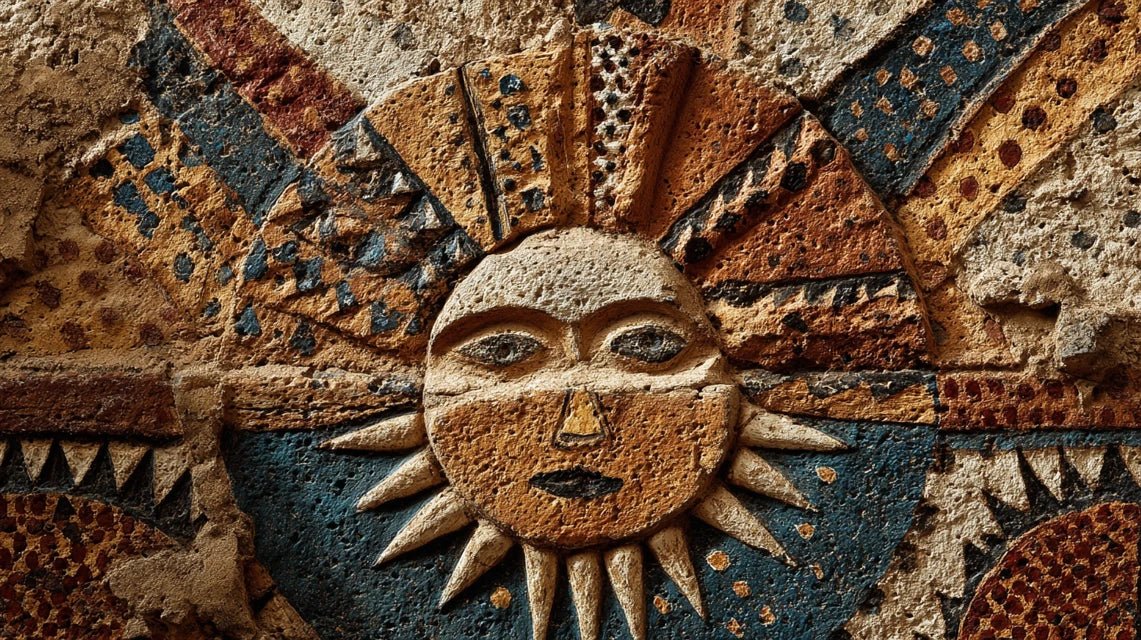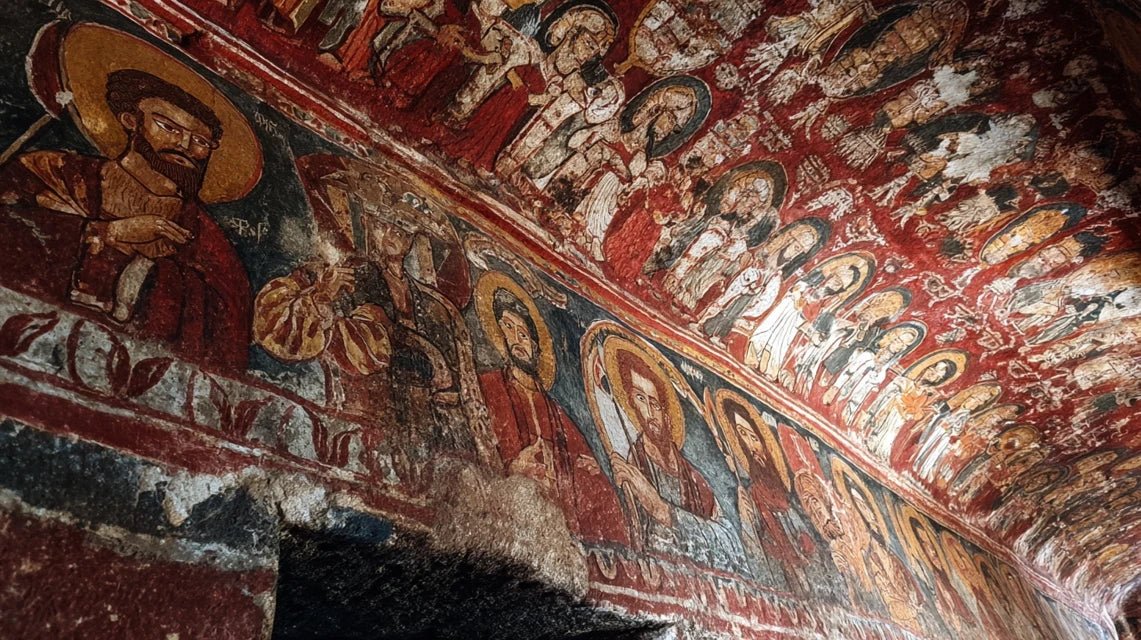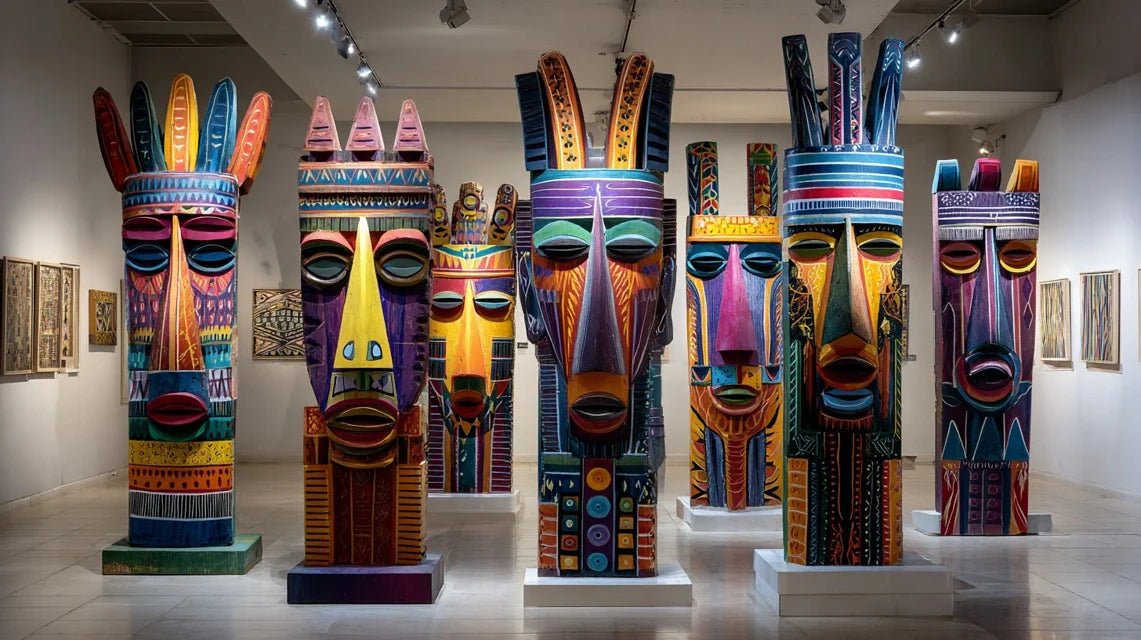
In the studio of a contemporary artist in Dakar, an immense mural takes shape before my eyes. Geometric lines blend with stylized faces, earthy colors converse with vibrant cobalt hues. What I contemplate is not simply a modern creation: it's the reincarnation of a millennial conversation between man and the sacred. The ancestral totems, these stone and wood guardians who watched over villages for generations, now whisper through contemporary African wall art, transforming our living spaces into sanctuaries of memory and identity.
Here's what this influence brings to your interior: a symbolic depth that transcends superficial decoration, an authentic connection with living traditions that enrich your daily life, and a powerful aesthetic that makes each wall a window open onto the African soul. Perhaps you are looking to give meaning to your spaces, to escape the aseptic uniformity of standardized interiors? You feel that this presence, this quiet strength is missing which transforms a house into a home inhabited by history. Rest assured: understanding how ancestral totems permeate contemporary African art will allow you to choose wall artworks that carry within them this ancestral energy, while fully integrating into your modernity.
The totemic heritage: when guardians of wood become mural pigments
The African ancestral totems were never just sculptures. In the Baoulé, Dogon or Fang cultures, these effigies embodied ancestors, protected lineages, materialized invisible forces. Each notch, each proportion, each geometric pattern carried a codified message: the long head of the Fang totem evoked accumulated wisdom, the almond-shaped eyes of the Baoulé masks opened a passage to the spiritual world.
Today, contemporary African mural artists do not copy these forms: they digest them, reinterpret them, explode them on monumental surfaces. What I observe in galleries from Lagos to Marrakech is a true alchemy. Artists extract the geometric essence of the totem — those ascending vertical lines, those ritual symmetries, those stylized faces up to abstraction — to reinvent them at the scale of the wall. The totem becomes a mural composition, keeping its protective verticality but gaining chromatic and narrative freedom.
The visual codes that cross time
In contemporary African wall art, certain totemic motifs recur as leitmotifs. The geometric scarifications of the Luba totems transform into hypnotic graphic patterns. The masks with closed eyes from Bambara traditions evolve into meditative contemporary portraits. This visual continuity is not nostalgic; it is a statement. Artists assert that ancestral totems are not relics frozen in ethnographic museums, but living languages capable of speaking to our image-saturated era.
Three artists reinventing the totemic dialogue
Ablade Glover, Ghanaian painter, integrates into his monumental wall compositions the elongated silhouettes characteristic of Ashanti totems. His characters, reduced to essential forms, dance on the canvas in vibrant color schemes that evoke African markets while retaining the solemn verticality inherent in a protective totem.
Chéri Samba, an iconic figure of contemporary Congolese art, works differently on the totemic heritage. His wall artworks integrate stylized faces directly inspired by Kongo mask-totems: bulging foreheads, kaolin eyes, stylized mouths. But he places them in satirical urban scenes, creating a fertile clash between ancestral sacredness and contemporary everyday life.
Finally, Abdoulaye Konaté in Mali has been developing textile wall installations for twenty years where Dogon totems transform into abstract compositions of dyed fabrics. His monumental works retain the sacred verticality of the ancestral totem while dressing it in bold colors and textile materials that dialogue with modern architecture.

Discover this inspiring artwork
How to integrate this power into your interior?
The influence of ancestral totems on contemporary African wall art is not reserved for galleries. It can radically transform your living space, provided you understand a few essential principles that I have observed in my consultations.
Verticality as a principle of anchoring
Totems were always vertical presences, connecting the earth to the sky. In contemporary wall art inspired by them, this verticality persists. Prioritize artworks with ascending compositions: they create a dynamic of elevation in your room, making ceilings appear higher and space more generous. A large vertical artwork inspired by Dogon totems installed in a narrow hallway transforms it into a monumental gallery.
Earth colors as an emotional foundation
Ancestral totems were often made of precious woods, patinated by time and rituals. Contemporary wall artists retain this palette: ochres, Sienna earths, deep browns, punctuated with kaolin white and sometimes touches of indigo. These tones instantly warm a contemporary interior that is too cold, bringing it the organic depth that Scandinavian mineralisms struggle to offer.
Geometric simplicity that soothes the eye
In contrast to decorative overload, African wall art influenced by totems practices a remarkable economy of means. A few lines, blocks of color, a powerful symmetry: that's enough to create a presence. In a contemporary interior saturated with objects and stimuli, a totemic wall artwork offers this anchoring visual point, this contemplative breath we desperately need.
Transform your space into a sanctuary of living memory
Discover our exclusive collection of African paintings that carry the legacy of ancestral totems into your contemporary daily life.
Beyond aesthetics: the symbolic dimension that transforms your relationship with space
What fascinates me about this influence of ancestral totems on contemporary African wall art is that it operates at several levels simultaneously. On the surface, you hang a visually powerful artwork that modernizes your interior. But in depth, you install a symbolic presence.
Totems were guardians, protectors, witnesses. Wall artworks that inherit from them retain something of this tutelary function. My clients often tell me they feel a sense of serenity since installing these pieces: as if the space was better inhabited, watched over. It's not naive mysticism, but the recognition that certain forms, certain compositions carry within them intentions that subtly affect us.
In African traditions, the ancestral totem also served as a collective memory: it embodied stories, values, and the identity of the group. Contemporary wall art inspired by these totems becomes a carrier of narrative itself. Unlike generic decor that tells nothing, these works invite conversation, questioning, and transmission. They give your interior a biographical depth: your home no longer reflects only your tastes, but also your values, your curiosity, and your openness to the world.

Discover this inspiring artwork
Mistakes to Avoid When Choosing Totem-Inspired Wall Art
Beware of simplistic reproductions that extract the motif without understanding its meaning. Authentic contemporary African wall art does not simply copy a totem form; it digests, questions, and reinvents it. Favor artists who have a visible personal approach, even when they are inspired by ancestral totems.
Also avoid thematic overload. An interior that accumulates masks, bogolan fabrics, sculptures, and totem paintings risks turning into an African hut pastiche. Elegance lies in selection: one or two strong wall pieces, inspired by totems, are enough to transform the atmosphere of an entire space. Let them breathe, surrounded by voids and neutrals.
Finally, be wary of marketing rhetoric that reduces African art to an ethnic trend. What ancestral totems and their contemporary reinterpretations carry is a worldview, a philosophy of balance between visible and invisible, between individual and community, between past and future. Choose works that respect this complexity rather than those that exoticize it.
Visualize Your Space Transformed
Imagine: you return home after a fragmented, scattered day. Your gaze rests on this large vertical wall composition, with clean lines and warm earth tones. Immediately, something refocuses. These forms inspired by ancestral totems do not shout; they do not impose themselves: they watch over, silently. Your interior is no longer just functional or pretty—it becomes inhabited by a presence that reconnects you to something larger than your daily life.
Contemporary African wall art, nourished by the legacy of totems, offers you this rare opportunity: to decorate deeply, not superficially. Start with a piece, a wall, a work. Observe how it changes not only your decor, but your relationship to space. You will discover that ancestral totems have never ceased speaking—they have simply changed support to continue guiding us.
FAQ: Your questions about the influence of totems in African wall art
Can a totem-inspired wall art be integrated into a modern minimalist interior?
Absolutely, and it's even a particularly successful combination. Contemporary African wall art inspired by ancestral totems shares with minimalism a fundamental principle: economy of means. Totems work through refinement, essential geometry, pure verticality. In a minimalist interior with neutral tones, a large wall artwork with totemic lines and earthy colors creates a warm focal point without breaking the balance. It brings that touch of humanity and symbolic depth that is sometimes lacking in overly sterile interiors. The trick is to choose graphic compositions rather than figurative ones, with restricted palettes that dialogue with your existing neutrals. Think ochre, off-white, deep black—tonalities that respect your refinement while injecting an ancestral soul. The totem, by its very nature, fits perfectly into a philosophy of less but better.
How do you know if a work is authentically inspired by totems or if it's ethnic marketing?
An essential question that I constantly encounter. Authentic contemporary African wall art, even when inspired by ancestral totems, always has a visible personal artistic signature. The artist does not simply reproduce a traditional motif: he questions it, distorts it, reinvents it, sometimes even subverts it. Look for clues of a creative approach: bold color choices that move away from the expected folklore, compositions that mix ancestral references and contemporary elements, a technique that affirms its time (acrylic, collage, mixed techniques). Find out about the artist: does he have a consistent background, training, visible evolution in his work? Authentic works often also bear thoughtful titles, accompanying texts that situate the approach. Beware of industrial reproductions with generic motifs sold as African art: they have neither the symbolic depth of an ancestral totem nor the creative intelligence of its contemporary reinterpretation.
Is it necessary to know the meaning of totemic symbols to appreciate these works?
No, and that's the whole magic of contemporary African wall art inspired by totems. These works operate on several levels simultaneously. On a purely visual level, they offer graphic strength, presence, balanced compositions that act on your perception of space without requiring intellectual decoding. This is their first function: to be powerful aesthetic objects. Then, if you want to delve deeper, the symbolic dimension enriches your experience but is not essential for immediate appreciation. Ancestral totems also speak a universal language: protective verticality, stylized face that questions, geometries that soothe the gaze. Your intuitive feeling towards these forms is already a form of understanding. That said, documenting yourself on Dogon, Baoulé or Fang traditions adds a layer of intellectual pleasure to your contemplation. But start with emotion: if a work touches you without you knowing why, it's because the totem still speaks its ancient language, the one that precedes words.