I discovered Manjak fabrics during a textile mission in West Africa, in the workshop of a weaver who was perpetuating an ancestral know-how. Her nimble hands handled the cotton threads with millennial precision, creating these hypnotic geometric patterns that tell the story of a people. These handwoven fabrics carry within them the soul of a community and the memory of a little-known territory.
Here's what Manjak fabrics bring to your interior: rare textile authenticity with unique geometric patterns, a deep cultural history passed down for centuries, and unparalleled craftsmanship from ancestral weaving techniques.
You may have seen these African textiles in decorating magazines or specialty stores, without ever knowing their true origin. Their woven cotton strips, their black and white checkerboard patterns, their intriguing graphic compositions intrigue and fascinate. But where do they come from exactly? Who makes them? And why do they bear this mysterious name?
Rest assured: I'm going to take you to the heart of Guinea-Bissau, in the villages of the Manjak people, to understand the genesis of these extraordinary fabrics. You will discover their history, their manufacturing techniques and how they can transform your space into a place full of meaning and authenticity.
The Manjak People: Guardians of an Ancestral Textile Know-How
Manjak fabrics take their name from the Manjak (or Manjaque) people, an ethnic group mainly located in northwestern Guinea-Bissau, but also present in neighboring Senegal. This agricultural and artisanal community has developed a unique textile tradition over the centuries, passed down from generation to generation as a precious cultural treasure.
The Manjak territory extends into the regions of Cacheu and Oio, rural areas where community life is organized around traditional villages. It is in these hamlets, sheltered from African metropolises, that weavers perpetuate ancestral techniques. Men cultivate local cotton, women transform the fibers and weave fabrics on horizontal looms called band looms.
This division of textile labor reflects the Manjak social organization where each member of the community contributes to the creation of these exceptional pieces. Manjak fabrics are not simply decorative textiles: they constitute identity markers worn during traditional ceremonies, weddings and initiation rituals.
The Band Weaving Technique: A Millenary Art
What fundamentally distinguishes Manjak fabrics is their unique manufacturing method. Unlike weaving on large looms, Manjak artisans use the technique of narrow band weaving. Each strip measures approximately 10 to 15 centimeters wide and can reach several meters in length.
The weaver works on a traditional horizontal loom, often installed under a tree or beneath the awning of a hut. They first create these individual strips with precise geometric patterns: checks, chevrons, broken lines, interlocking lozenges. These patterns are never arbitrary; each possesses a symbolic meaning linked to the Manjak cosmogony, community values, or historical events.
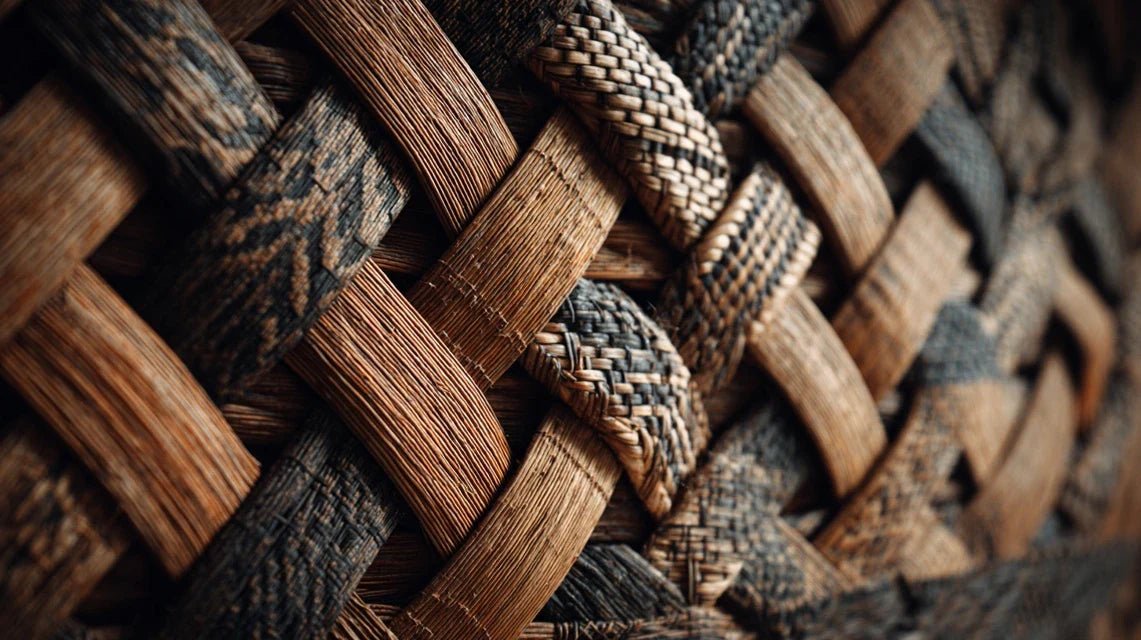
Once several bands have been woven, the crucial step of assembly arrives. The weavers meticulously sew these parallel strips together to create a wider fabric. This technique gives Manjak fabrics their characteristic appearance: a succession of vertical stripes creating a captivating visual rhythm. Variations in patterns between the bands generate a dynamic composition that evokes the codes of contemporary design while remaining deeply traditional.
The authentic colors of Manjak cotton
Traditionally, Manjak fabrics favor a restrained and powerful color palette. The natural white of the unbleached cotton contrasts with indigo-dyed threads, creating these characteristic black and white checks. Some pieces also incorporate shades of red-brown obtained by natural dyeing using local plants.
This restrained color scheme is not a limitation; it reflects the minimalist and graphic aesthetic of the Manjak people. These fabrics possess a timeless modernity that transcends eras without ever becoming outdated, a major asset for contemporary decoration.

Discover this inspiring artwork
In their original context, Manjak fabrics primarily served as ceremonial wraps and traditional clothing. Men wore them wrapped around their waist during important ceremonies, while women used them as shawls or pareos during community festivities.
These fabrics also had a social function: their quality and complexity indicated the status of the wearer. A richly decorated Manjak fabric, with elaborate patterns and perfect assembly, testified to family prestige and the artisanal mastery passed down within the clan.
Today, Manjak fabrics are experiencing a second life in the world of interior decoration. Designers and decorators around the world have discovered their exceptional aesthetic potential. Transformed into cushions, sofa throws, wall hangings or even framed as textile artworks, they bring a touch of African authenticity to contemporary interiors.
Their geometric graphic design harmonizes perfectly with the codes of Scandinavian design, ethnic-chic style, or even industrial atmospheres. This versatility makes Manjak fabrics cross-over decorative pieces that adapt to different aesthetic universes while retaining their strong identity.
The challenge of preserving a threatened heritage
Unfortunately, the Manjak textile tradition faces considerable challenges today. Rural exodus affects younger generations who prefer to migrate to cities in search of economic opportunities. Traditional weavers are aging and struggling to pass on their ancestral know-how.
Guinea-Bissau, one of the poorest countries in West Africa, does not have sufficient institutional structures to protect and enhance this intangible heritage. Authentic Manjak fabrics are becoming scarce on markets, replaced sometimes by industrial imitations that lack neither the soul nor the quality of traditional pieces.
Some NGOs and cultural associations are nevertheless working to preserve this craftsmanship. They organize training workshops, create weavers' cooperatives and develop fair trade marketing circuits. By purchasing an authentic Manjak fabric, you directly contribute to the preservation of this ancestral know-how and support the artisanal communities of Guinea-Bissau.
How to recognize an authentic Manjak fabric
Faced with the multiplication of African textiles on the market, it is essential to know how to identify genuine Manjak fabrics. Look for these distinctive characteristics: the stitched band structure visible to the touch and eye, a slightly uneven texture testifying to hand weaving, precise geometric patterns but with subtle human variations, and above all the quality of the cotton which must be dense and robust.
Authentic Manjak fabrics have a particular patina, a suppleness acquired over time. Do not hesitate to ask for the exact provenance and history of the piece: a serious seller will be able to inform you about the geographical origin and the artisans involved in its manufacture.

Discover this inspiring artwork
Integrating Manjak fabrics into your decor
Integrating a Manjak fabric into your interior goes beyond mere aesthetics. You are introducing a fragment of history, a piece of living culture that dialogues with your contemporary space.
For maximum effect, prioritize a strategic location where the fabric will be highlighted: hung on the wall as a tapestry in a minimalist living room, casually placed on a linen sofa, or transformed into a bed headboard to add character to a minimalist bedroom. The geometry of Manjak patterns creates a visual focal point that structures the space and immediately captures the eye.
These fabrics pair beautifully with raw materials: aged wood, crumpled linen, artisanal ceramics, natural rattan. Avoid cluttering the space: a single Manjak fabric is enough to transform the atmosphere of a room. Its powerful graphic design doesn't need decorative competition.
Also consider the lighting: a directional spotlight or grazing light will accentuate the texture of the weave and reveal the depth of the patterns. In the evening, under subdued lighting, Manjak fabrics acquire an almost mystical dimension, their shadows and contrasts transforming into abstract landscapes.
Extend your journey to West Africa
Discover our exclusive collection of African paintings, capturing the essence of the continent's textile and artistic traditions, to transform your interior into an authentic cultural gallery.
Manjak fabrics, witnesses of a cultural resilience
Beyond their undeniable beauty, Manjak fabrics embody the resilience of a people who have managed to preserve their cultural identity despite historical upheavals. Guinea-Bissau has experienced Portuguese colonization, independence wars, chronic political instability. Yet, in remote villages, looms continue to click with their ancestral rhythm.
Each Manjak fabric tells this story of cultural resistance. The geometric patterns are not mere decorations: they constitute a visual language transmitting the community values, founding myths and cosmology of a people. Wearing or displaying a Manjak fabric is giving voice to this silent narration.
This narrative dimension makes these textiles profoundly meaningful decorative objects. In a world saturated with anonymous industrial productions, owning an authentic Manjak fabric connects you to a human chain: the cotton grower, the spinner, the dyer, the weaver, the seller, and ultimately yourself. This emotional traceability confers on these fabrics a value that far exceeds their material dimension.
Imagine your living room transformed by the discreet yet powerful presence of a Manjak fabric. Your guests will naturally approach, touch the texture of hand-woven cotton, observe the precision of the patterns. And you will have the opportunity to share the extraordinary story of these fabrics from Guinea-Bissau, to talk about the Manjak people and their millennial textile heritage.
This moment of cultural connection, this opening to a distant but strangely familiar universe thanks to the universal language of craftsmanship, is what truly offers a Manjak fabric. More than just a decorative element, it becomes a bridge between cultures, a catalyst for conversations and a daily reminder that authentic beauty always arises from time, know-how and transmission.
Start your own African textile collection by prioritizing authenticity and traceability. Learn about the artisans, support fair trade circuits, and above all, take the time to learn the history of each piece you acquire. Manjak fabrics from Guinea-Bissau deserve to be known, celebrated and preserved for future generations.
Frequently Asked Questions about Manjak Fabrics
How to care for an authentic Manjak fabric?
Taking care of an authentic Manjak fabric requires a few simple precautions to preserve its beauty and longevity. Prefer hand washing in cold or lukewarm water with a mild natural soap, never an aggressive detergent that could alter the natural dyes. Absolutely avoid machine washing which risks damaging the seams between the woven bands. After washing, gently squeeze without twisting the fabric, then dry it flat in the shade, never in full sun which could discolor the patterns. For ironing, use a medium temperature and iron on the reverse side to protect the motifs. If your Manjak fabric is used as a wall decoration, regular dusting with a soft brush will suffice. These simple gestures will guarantee your piece optimal preservation for decades.
What is the difference between Manjak fabrics and other African textiles?
Manjak fabrics stand out from other African textiles due to several unique characteristics. Their band-weaving technique sewn together fundamentally differs from Ghanaian Kente, which also uses bands but with different patterns and structures, or Malian Bogolan, which prioritizes dyeing on cloth. The color palette of Manjak fabrics is generally more subdued, dominated by black, white, and sometimes reddish-brown, unlike the colorful Wax fabrics of Central and West Africa. Their specific geographical origin (Guinea-Bissau and border regions of Senegal) also makes them rarer than textiles produced in countries with a strong textile tradition such as Mali, Ghana or Nigeria. Finally, Manjak geometric patterns possess a symbolic coding unique to the Manjak ethnic group, reflecting their cosmogony and particular history. This combination of techniques, aesthetics and cultural meanings makes Manjak fabrics truly unique pieces in the African textile landscape.
Where can you find authentic Manjak fabrics?
Finding authentic Manjak fabrics is a real challenge due to their increasing scarcity. The best sources remain specialized shops in fair trade African crafts that work directly with weaving cooperatives in Guinea-Bissau. Some African art markets in major European cities occasionally offer authentic pieces, but always check the provenance and do not hesitate to ask for detailed information on the origin. Galleries specializing in ethnic textiles are also a reliable option, although generally more expensive. If you travel to West Africa, the artisan markets of Bissau (capital of Guinea-Bissau) or Ziguinchor (Senegal) offer opportunities for direct purchase, with the advantage of sometimes meeting the artisans themselves. Online, prioritize certified fair trade platforms that guarantee the authenticity and traceability of pieces. Be wary of abnormally low prices which often signal industrial imitations. An authentic hand-woven Manjak fabric represents dozens of hours of work and its price should reflect this artisanal reality.