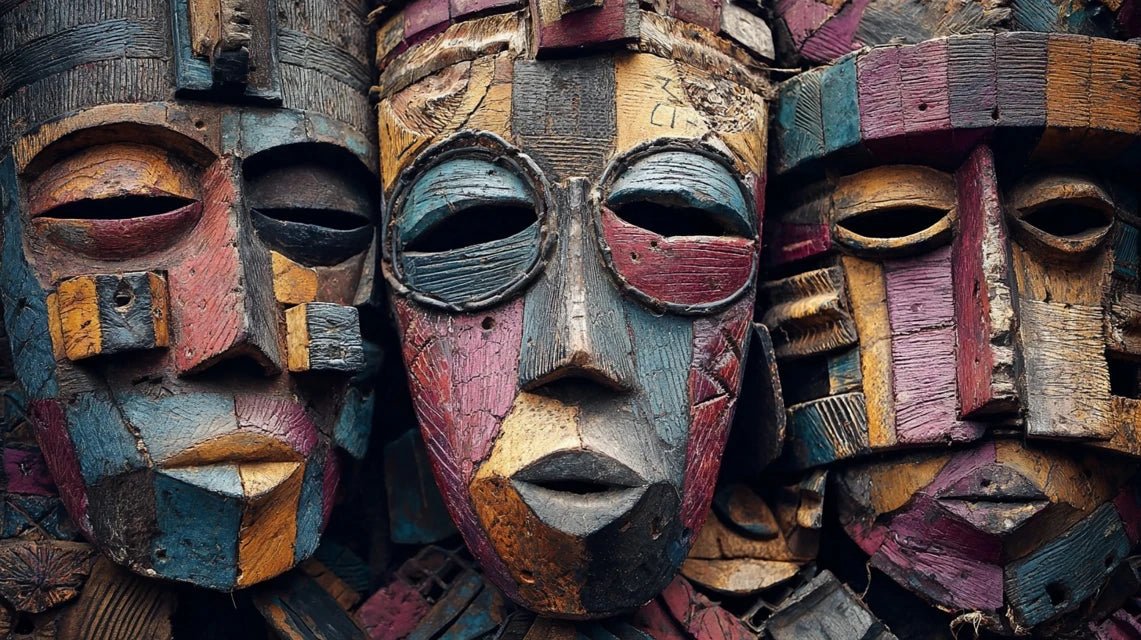
In my Brussels workshop, a couple froze in front of a framed mask. Absolute silence for two minutes. Then this question: “What is the force that looks at us?” That's exactly the effect of Kifwebe Songye masks transformed into wall art. These striated faces, hypnotic crests, tribal geometry straight from the heart of the Democratic Republic of Congo don’t decorate a wall: they possess it, transform it, charge it with an ancestral energy that instantly transforms the atmosphere of a room.
Here's what Kifwebe Songye masks bring to your interior as wall art: unparalleled visual power that immediately captures the eye, authentic cultural depth that turns your space into a true ethnographic art gallery, and that magnetic presence that makes you see nothing but them as soon as you enter the room.
You may have already felt this frustration: accumulating decorative objects without ever creating that “wow effect” you're looking for. Walls remain flat, the atmosphere lacks character, visitors pass without really noticing your effort. Rest assured: you don’t need to become an experienced collector or spend fortunes in specialized galleries. A single well-chosen Kifwebe mask can completely redefine the visual identity of your living room, office, or entrance hall. In this article, I reveal everything I've learned in fifteen years of trading tribal art in Brussels: the fascinating history of these sacred masks, their hidden symbolism, and above all how to integrate them masterfully into a contemporary decor.
The Sacred Heritage of the Kifwebe: More Than Just a Decorative Mask
Kifwebe Songye masks were not born to decorate. They were (and remain in some villages) objects of formidable ritual power, worn by members of the Bwadi Bwa Kifwebe secret societies of the Songye people, established between the Lomami and Lualaba rivers in the DRC. Each mask embodies a spirit, an invisible force that protects the village, punishes transgressors, initiates young people or heals the sick.
Recognizable among thousands, these African masks display striking visual characteristics: parallel striations covering the entire face (symbol of spiritual energy in motion), a central crest that can reach 40 centimeters high (the higher it is, the greater the power), often protuberant eyes rectangular or almond-shaped, and a rectangular mouth projected forward. Traditional colors speak for themselves: white evokes benevolent spirits and ancestors, red represents power and danger, black represents night and mystery.
What fascinates me after all these years? Each mask has a distinct personality. Male Kifwebe (Kilume) display imposing crests and vibrant colors – alternating aggressive red, white, and black. Female Kifwebe (Kikashi) have more discreet crests and a soothing dominance of white. This duality creates endless decorative possibilities depending on the energy you want to infuse.
When Ritual Art Meets Contemporary Walls
The transformation of Kifwebe masks into wall art represents a fascinating evolution from tribal art to interior decoration. In the 1920s, European collectors – including Cubists like Picasso – began exhibiting these masks as wall sculptures rather than ethnographic curiosities. They intuitively understood what we now know: a Kifwebe mounted on a white wall becomes a contemporary artwork that dialogues with both Scandinavian minimalism and bohemian exuberance.
Today, African artworks inspired by Kifwebe masks decline this powerful aesthetic in various forms: hand-painted reproductions on canvas, high-definition photographic prints of authentic masks, modern graphic interpretations that retain the visual codes (stripes, crest, geometry) while adapting them to contemporary palettes. Some designers even push the concept further by creating 3D wall installations where several masks converse in a choreographed composition.
The advantage of these wall interpretations? They make accessible an aesthetic once reserved for wealthy collectors (an authentic antique mask can easily exceed €5,000), while respecting the sacred dimension of these objects – because yes, hanging a real ritual mask in your living room raises legitimate ethical and cultural questions.
The three integration styles I consistently recommend
1. The radical statement piece : A large Kifwebe artwork (minimum 80x120cm) alone on a pristine white wall. Nothing else. This minimalist approach maximizes the visual impact and is perfect for contemporary interiors, industrial lofts or Scandinavian spaces. The contrast between the graphic complexity of the mask and the surrounding sobriety creates a captivating visual tension.
2. The tribal gallery : A composition of three to five Kifwebe masks of varying sizes, arranged in an asymmetrical constellation. This museum-like approach works beautifully in large living rooms, stairwells or hallways. The trick? Vary the expressions (male/female, colored/monochrome) while maintaining chromatic consistency.
3. The mastered eclectic mix : A Kifwebe artwork integrated into a wall of heterogeneous frames – black and white photographs, botanical engravings, gilded mirrors. This bohemian-chic approach requires a keen eye but offers a unique personality. The golden rule: the Songye mask must remain the dominant focal point, with other elements orbiting around like satellites.

Discover this inspiring artwork
How to choose your Kifwebe wall art without making a mistake
After advising hundreds of clients, I have identified the essential questions to ask yourself before investing in an African Kifwebe painting.
Which room will it be placed in? The masculine energy of red and black Kifwebes is perfect for offices, libraries or workspaces – it stimulates concentration and exudes a natural authority. White Kifwebes with soft lines find their place in bedrooms, zen living rooms or meditation spaces. For entrances and reception areas, opt for spectacular polychrome versions that create an immediate impact.
What level of authenticity are you looking for? Photographic reproductions of authentic masks offer total historical fidelity but can seem static. Contemporary paintings inspired by Kifwebes allow for chromatic variations adapted to your decorative palette (imagine a Kifwebe in blue-grey tones for a coastal chic interior). Modern wall sculptures made from resin or recycled wood add a tactile dimension and fascinating plays of light and shadow.
What size for what impact? My rule of thumb: your Kifwebe painting should cover between 40% and 60% of the width of the furniture below it (sofa, console, chest of drawers). Too small, it disappears; too large, it overwhelms. For a bare wall without furniture, aim for a minimum width of 80cm to create a real presence. Cathedral spaces with walls 4-5 meters high can accommodate absolutely spectacular giant murals.
Mistakes that kill the Kifwebe effect
First fatal mistake: indistinct tribal accumulation. Mixing a Kifwebe with a Baoulé mask, a Maasai statuette and a kente cloth creates visual confusion. Each tradition deserves its space. If you like African art, create themed areas rather than a generic patchwork.
Second classic trap: neglected lighting. A Kifwebe mask without dedicated lighting loses 70% of its impact. The striations and the crest create absolutely magical sculpted shadows under a spotlight angled at 30° from above. Invest in an LED adjustable projector rail – the difference is striking.
Third mistake I constantly see: conflicting color palettes. A red and black Kifwebe will clash with a blush pink sofa and floral cushions. Respect the mask's dominant hue: white = light and airy palette, red = earthy and warm tones, black = graphic monochrome or industrial decor.
Creating a dialogue between Songye tradition and contemporary design
What makes Kifwebe Songye masks so relevant in today's decoration? Their radical geometry strangely anticipates the aesthetics of contemporary design. These parallel streaks evoke minimalist graphic design, this imperfect symmetry recalls Japanese wabi-sabi aesthetics, this frontal presence echoes pop art. A Kifwebe never clashes with the modern – it enriches it, complicates it, gives it historical depth.
I've seen Kifwebe artworks radically transform interiors: this Paris industrial loft with raw concrete walls that gained human warmth thanks to a large white Kifwebe; this Scandinavian family home where three small black masks created a striking contrast against the omnipresent blond wood; this Brussels law firm where a monumental red Kifwebe behind the desk immediately asserts authority and international stature.
The secret? Treat the Kifwebe as the architectural hero of your room, not as just another accessory. Build your palette around it. Choose furniture that complements it without competing with it. Create lines of sight that naturally lead to it. Imagine it as the sun in a decorative solar system: everything revolves in its orbit.
Material associations that magnify the tribal effect
Some materials create a natural synergy with the Kifwebe aesthetic. Rattan and bamboo resonate with the traditional origins of the masks (sculpted from lightweight wood). Raw linen and jute recall the natural fibers of the ritual costumes that accompanied masked dancers. Matte black metal (steel, wrought iron) dialogues superbly with dark Kifwebes creating a graphic continuity.
When it comes to textiles, prioritize simple geometric patterns – stripes, chevrons, checks – that echo the characteristic streaks without stupidly duplicating them. A Malian mudcloth cushion (with white linear motifs on a black background) beautifully complements a Kifwebe artwork without creating redundancy, because the graphic logics differ sufficiently.
And plants? Absolutely essential. A large Strelitzia (bird of paradise) or a Monstera deliciosa next to a Kifwebe creates a visual bridge with the tropical African origin. Lush vegetation also softens the mask's strict geometry, creating a perfect yin-yang balance.

Discover this inspiring artwork
Caring for and preserving your Kifwebe wall art
Kifwebe-inspired African paintings require little maintenance, but a few precautions guarantee their longevity. Avoid direct sunlight which fades natural pigments or prints – positioning perpendicular to windows is ideal. Excessive humidity (bathrooms, kitchens) can damage canvases and distort wooden structures.
For dusting, a soft duster is sufficient for flat surfaces. If you have a wall sculpture with pronounced reliefs, a soft-bristled brush reaches the recesses without damaging the patina. Never use harsh chemicals – a slightly damp microfiber cloth (pure water) for any stains.
The real threat? Familiarity breeds contempt. After six months, our brains stop really seeing familiar objects. My gallery owner's trick: move your Kifwebe mask every four months. Change its lighting. Modify the surrounding objects. These micro-revolutions maintain that fresh look, that initial astonishment which justifies the investment in wall art.
Ready to transform your wall into a powerful cultural statement?
Discover our exclusive collection of African paintings that capture the visual strength of Kifwebe Songye masks in formats adapted to your contemporary interior.
Visualize your decorative transformation
Close your eyes for a moment. Imagine that moment when you return home after a demanding day. You open the door. And there, that powerful gaze, those hypnotic streaks, that ancestral presence welcomes you. Your interior no longer looks like anyone else's. Your guests stop dead in their tracks, ask questions, inquire about the story behind this fascinating face. You don't live in a furnished apartment – you inhabit a space full of meaning, history, energy.
Kifwebe Songye masks in wall art don't decorate: they transform, elevate, enrich. They create that cultural anchor missing from so many contemporary interiors, that narrative depth that standardized decoration can never offer. They prove to everyone – and especially to yourself – that you have an informed, curious, respectful view of cultures around the world.
Start small if you're hesitant: a Kifwebe artwork of medium size in the entrance hall. Observe how it changes the atmosphere, captures attention, sparks conversations. Once this magic is proven, you will understand why so many decorators consider African tribal art as the ultimate transformative element. The real question is no longer whether you should integrate a Kifwebe into your home, but how long you will wait before doing so.
Frequently asked questions about Kifwebe masks in decoration
Does a Kifwebe mask suit a minimalist modern interior?
Absolutely, and that's where it shines the most! Kifwebe Songye masks possess a radical geometry and visual simplicity that perfectly dialogues with contemporary minimalism. Their linear aesthetic (those famous parallel grooves) echoes Scandinavian design, industrial style and even Japonism. The key? Respect the principle “one wall, one strong artwork” rather than accumulating. A large Kifwebe artwork on an immaculate white wall, framed by emptiness, creates a visual impact comparable to the most sophisticated contemporary artworks. I have seen interior architects integrate Kifwebe into ultra-modern projects with stunning success – the contrast between the ancestral object and the futuristic space precisely creates that creative tension sought by experienced decorators. Don't be afraid: a well-chosen Kifwebe doesn’t add folklore, it adds cultural depth and undeniable sophistication.
What color wall best highlights a Kifwebe mask?
White remains unbeatable to maximize the visual impact of a Kifwebe mask, especially traditional polychrome versions (red, white, black). The contrast is immediate and dramatic. But don't limit yourself! Anthracite gray or deep navy blue walls create a sophisticated art gallery atmosphere that particularly enhances white or light-dominant Kifwebe – the chiaroscuro effect is absolutely magical. Earthy tones (ochre, terracotta, warm brown) establish a chromatic continuity with African natural pigments and suit red Kifwebe beautifully. The mistake to avoid? Patterned walls (graphic wallpaper, acidic bright colors) that create an exhausting visual competition. My infallible test: photograph your Kifwebe artwork against different walls in your home with your smartphone. The right association immediately catches the eye – the mask literally « pops » off the screen. Trust your visceral instinct rather than theoretical rules.
Can Kifwebe masks be mixed with other styles of African art?
Yes, but with discernment and a clear intention. Kifwebe Songye masks have such a strong visual identity that they must remain dominant in any composition. You can create a coherent tribal gallery wall by combining a large central Kifwebe with complementary African works: mudcloth textiles with simple geometric patterns, black and white photographs of African scenes, small Benin bronze sculptures. The golden rule? Maintain consistency either chromatic (black and white dominant for example), thematic (ritual art only), or geographic (African Central arts exclusively). Absolutely avoid the « ethnic bazaar » where a Kifwebe is mixed with a Baoulé mask, a Maasai shield, and a giraffe painting – this touristy accumulation devalues each piece. Informed collectors create thematic constellations where each work breathes, dialoguing with the others without overlapping. If you are just starting out, begin with a single Kifwebe mask masterpiece. Gradually add other elements only if they enrich the visual narrative rather than dilute it.