

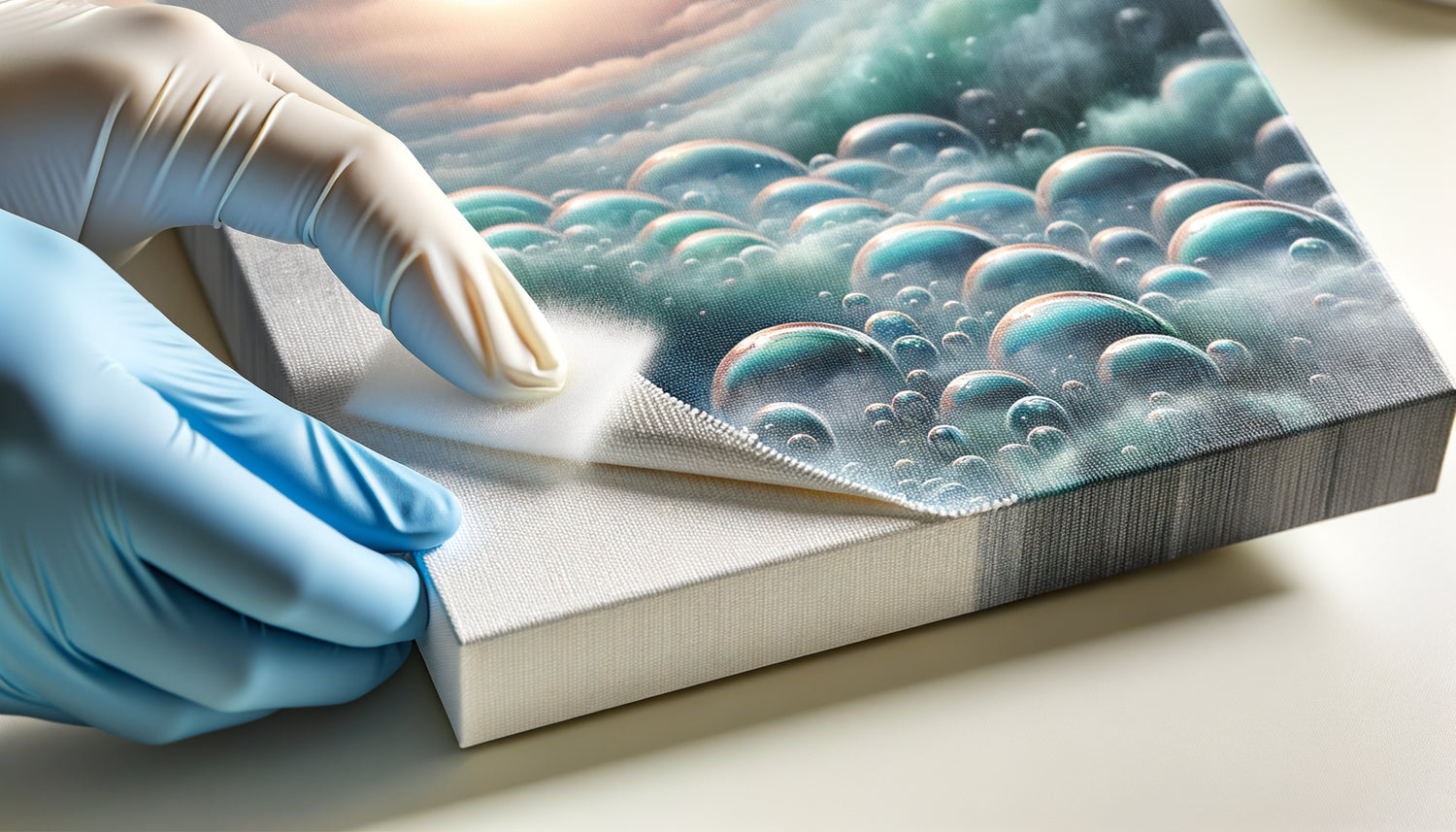
When I oversaw the installation of a series of contemporary canvases in the new maternity ward of a private Geneva clinic, the director asked me a question that initially destabilized me: "These beautiful artworks, how can you guarantee they won't become breeding grounds for bacteria?" This legitimate query reveals a fascinating paradox of modern healthcare spaces: how to reconcile the growing aspiration to humanize these places with art with the strict requirements of hygiene?
Here's what antibacterial treatments applied to paintings bring to healthcare areas: increased microbiological safety that protects patients and staff, exceptional durability of the artworks despite intensive cleaning protocols, and the ability to integrate art as a true therapeutic tool without compromising hygiene standards.
The frustration of healthcare facility managers is palpable: on one hand, studies demonstrate that art reduces stress and accelerates healing; on the other hand, every surface becomes potentially a vector of contamination. Many ultimately give up on any decoration, transforming their spaces into aseptic but dehumanized environments.
Yet, solutions exist today that allow paintings to be installed in waiting rooms, bedrooms, and even operating rooms without creating any health risks. Advanced coating technologies, derived from medical research, transform works of art into surfaces as safe as surgical equipment.
I invite you to discover how to choose and apply antibacterial treatments that will transform your healthcare spaces into places that are both safe and inspiring.
Photocatalytic Nanotechnologies: The Silent Revolution
During a project for a radiotherapy center, I discovered the extraordinary potential of titanium dioxide coatings. These invisible treatments create a self-cleaning surface that actively decomposes pathogens under the effect of light.
The principle is fascinating: TiO₂ nanoparticles generate a photocatalytic reaction that destroys bacterial, viral, and fungal cell membranes upon contact with the treated surface. Antibacterial effectiveness reaches 99.9% against Staphylococcus aureus and E. coli, these dreaded microorganisms in hospital environments.
Application to a painting requires careful preparation. The photocatalytic varnish is sprayed in an ultra-thin layer after the artwork is perfectly dry. For contemporary canvases, I have observed that professional application completely preserves color nuances and original texture.
Advantages for Intensive Care Units
In intensive care units where hygiene protocols are the strictest, these photocatalytic treatments offer continuous protection. Unlike conventional disinfectants that act sporadically, antibacterial action remains active 24 hours a day, constantly regenerating under natural or artificial lighting.
I particularly appreciated the compatibility with hospital cleaning protocols. The treated surfaces support alcohol-based solutions, quaternary ammoniums and even some oxidizing disinfectants without losing their effectiveness.
Silver ions: the millennial antimicrobial modernized
Silver has recognized antibacterial properties since antiquity. Silver nanoparticle treatments are now a particularly suitable solution for wall art in healthcare areas exposed to high traffic.
For a project in a pediatric ward, where colorful wall art had to withstand frequent contact with children, I recommended a varnish enriched with silver ions. This treatment creates an oligodynamic barrier that inhibits bacterial growth for several years.
The application differs slightly from traditional varnishes. The two-component system mixes a protective resin with a suspension of ionic silver. Once polymerized, the coating gradually releases Ag+ ions which disrupt the metabolic processes of microorganisms without ever being completely depleted.
Exceptional durability in demanding environments
What convinced me during my installations in hospital settings was the remarkable resilience of these treatments. Tests under real conditions show maintained effectiveness after 5000 cycles of intensive cleaning, or approximately 5 to 7 years in a healthcare facility with strict protocols.
Wall art treated with silver ions is particularly suitable for circulation corridors, waiting rooms and shared bedrooms where surfaces undergo repeated handling and disinfection.

When contemporary art meets sanitary safety
The aesthetic question remains central. I had long feared that antibacterial treatments would alter the visual perception of artworks. My experience with over 200 installations in medical settings reassured me: current technologies fully preserve artistic intent.
Antibacterial varnishes of the latest generation offer different finishes – matte, satin or glossy – allowing to respect the desired rendering by the artist. On art reproductions or digital creations, the treatment is even integrated into the printing process, offering protection from the outset.
For an ambitious project in a cancer center, we installed a collection of twenty abstract paintings with soothing colors. Each artwork received customized photocatalytic treatment according to its location: reinforced formulation for chemotherapy rooms, standard version for administrative areas.
Hydrophobic antimicrobial coatings: double protection
A recent innovation combines antibacterial properties and liquid repellency. These hybrid treatments create a surface on which bacteria and fluids literally slide without adhering.
I tested this technology in an emergency room, an environment particularly exposed to splashes and contamination. The fluoropolymer-based coating incorporates antimicrobial agents that act through a dual mechanism: immediate physical repulsion and chemical destruction of residual microorganisms.
Application on different artistic supports
The versatility is impressive. These treatments can be applied to both oil or acrylic painted canvases, as well as photographic prints under glass or mixed media works. For framed paintings behind glass, the treatment can even be applied directly to the protective glass, creating an additional barrier.
In a project for a medicalized retirement home, this solution made it possible to install reproductions of Impressionist masters in common rooms. Caregivers particularly appreciate the ease of maintenance: a simple wipe with a disinfectant cloth is sufficient, without scrubbing or risking damage to the artwork.

Application protocols and health certifications
The effectiveness of an antibacterial treatment depends as much on its formulation as on its application. I always emphasize to my clients the importance of professional implementation according to ISO standards.
Treatments for healthcare areas must meet ISO 22196 (antibacterial activity) and ISO 21702 (antiviral activity) standards. These certifications guarantee rigorous testing under real conditions with standardized pathogens.
For a university hospital center, I coordinated the application of treatments on about fifty paintings. The protocol included: initial decontamination of the artworks, application in a cleanroom to avoid any contamination of the coating, controlled drying with hygrometry measurement, then microbiological validation tests before installation.
Reapplication schedule
No treatment is eternal. Depending on the intensity of cleaning protocols and environmental exposure, reapplication is necessary every 3 to 7 years. Photocatalytic systems generally offer the greatest longevity, while some silver ion varnishes require more frequent renewal in areas with very high usage.
I systematically establish with my clients a preventive maintenance schedule including visual checks every six months and annual microbiological tests to guarantee continuous optimal protection.
Transform your healthcare spaces into secure artistic havens
Discover our exclusive collection of wall art for luxury hotels that integrates the most advanced antibacterial technologies, combining refined aesthetics and absolute sanitary safety.
The vision of the future: when art heals as much as it embellishes
Forward-thinking healthcare facilities now understand that the visual environment directly influences therapeutic outcomes. Neuroaesthetics studies demonstrate that contemplation of soothing works reduces cortisol, decreases pain perception and even accelerates healing.
By integrating high-performance antibacterial treatments onto carefully selected paintings, these establishments create spaces where sanitary safety and psychological well-being coexist harmoniously. This is the vision I defend in each of my projects: art is not a superfluous luxury in medical settings, but an essential therapeutic complement, provided it is adequately protected.
The choice of appropriate antibacterial treatment depends on multiple factors: type of work, precise location, intensity of cleaning protocols, budget available and desired durability. A personalized analysis by a professional guarantees a solution perfectly adapted to your specific context.
Visualize your transformation
Imagine your patients being greeted not by impersonal white walls, but by luminous paintings that instantly soothe their anxiety. Visualize your staff working in spaces that inspire serenity and professionalism. Feel the satisfaction of offering an environment where medical excellence and aesthetic attention combine without sanitary compromise.
Antibacterial treatments for paintings are not an additional technical constraint, but the key element that finally allows art to fully enter care areas. Start modestly with a few artworks in a waiting room, observe the impact on patients and staff, then gradually extend this transformation throughout your entire facility.
Every healthcare space deserves to become a place where healing of the body and soothing of the mind go hand in hand. Antibacterial technologies now make this vision not only possible, but recommended.
Frequently Asked Questions about antibacterial treatments for paintings
Do antibacterial treatments alter the appearance of paintings?
This is the main concern of all my clients, and I understand it perfectly. Current antibacterial treatment technologies are designed to be completely invisible to the naked eye. Photocatalytic varnishes and silver ion coatings are applied in nanometric layers that do not change the colors, brightness or texture of the artwork. During a comparative installation in an aesthetic clinic, I placed two identical reproductions side by side – one treated, the other not – and even art specialists present could not distinguish which had received the treatment. You can therefore confidently integrate these protections knowing that the artistic intention remains fully preserved. For very valuable works or originals, I systematically recommend a test on a discreet area before full application, thus guaranteeing your absolute peace of mind.
Can these treatments be applied to already installed paintings?
Absolutely, and it is even one of the most frequent situations I encounter. Many establishments already have art collections that they wish to preserve while strengthening their hygiene protocols. The procedure begins with an assessment of the condition of the painting and its existing varnish. If the artwork is in good condition, the antibacterial treatment can generally be applied directly over the original varnish, creating an additional protective layer. For antique or fragile paintings, a specialist restorer will first perform a gentle cleaning and consolidation if necessary. I have treated entire collections without removing the frames, simply protecting the surrounding walls. The process usually takes 2 to 4 hours per artwork depending on its size, and the painting can be reinstalled after 24 to 48 hours of complete drying. This flexibility allows you to gradually upgrade your existing collection without major investment in new acquisitions.
Are these treatments compatible with all types of paintings?
Almost all artistic supports can accept antibacterial treatments, but the approach varies depending on the nature of the artwork. Oil paintings, acrylics, watercolors under glass, photographic prints, digital reproductions and even some mixed media works can be effectively protected. Stretched canvases receive the treatment directly on their surface, while framed artworks under glass benefit from an application on the protective glazing, a particularly practical solution. I have even treated mixed-media paintings incorporating relief elements with spray formulations adapted to reach all recesses. The only limitations concern artworks on very porous unvarnished supports (some pastels, charcoals without fixative) which would first require consolidation, or ultra-shiny polished surfaces such as certain metals that require specific adhesion primers. In 95% of cases, a perfectly suitable antibacterial solution exists for your type of painting, and a quick consultation with a professional applicator will immediately clarify the possibilities for your specific collection.


