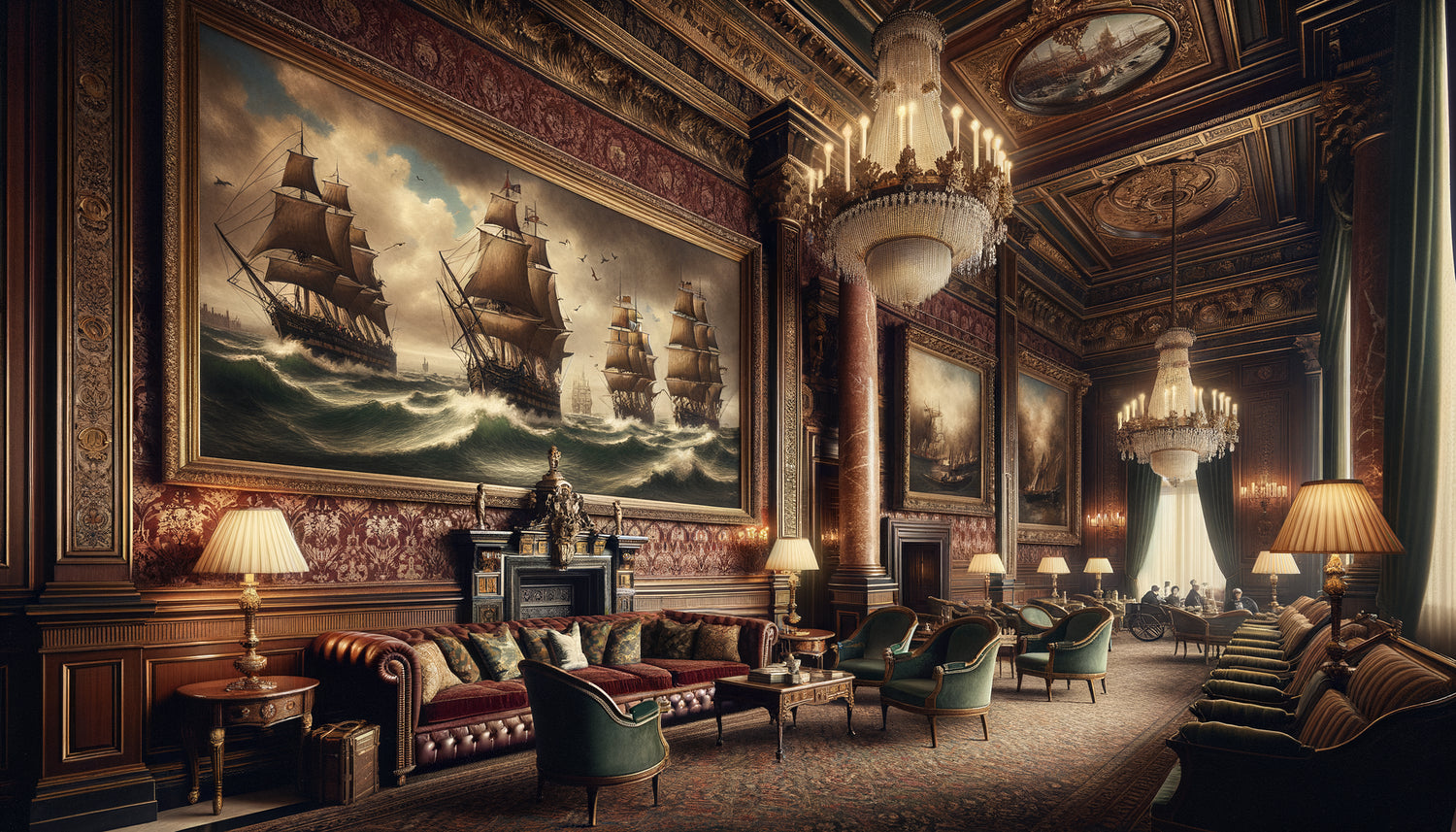
Step into a grand London hotel built during the Victorian era, and you will be greeted by tumultuous waves, majestic ships cleaving through foam, stormy skies above endless marine horizons. Rarely an alpine lake, almost never a Norman meadow. This omnipresence of seascapes in Victorian establishments is not chance, but the codified expression of an age that saw in the ocean far more than a simple decorative motif.
Here's what this preference reveals: an affirmation of British imperial power, a visual language understood by an international clientele, and a psychological appeasement strategy adapted to 19th-century travelers. Three dimensions that transformed each hotel corridor into a patriotic gallery and each room into a reassuring sanctuary.
Today, when furnishing a high-end establishment, we desperately seek this soul, this narrative coherence that Victorian hoteliers instinctively mastered. We accumulate disparate works, follow trends, but forget that a painting is never neutral. It tells a story, projects values, shapes the emotional experience of the place.
Rest assured: understanding Victorian aesthetic choices gives access to timeless principles of hotel decoration. Codes that still work today, transferable to our time, to create spaces that indelibly mark people's minds.
I invite you to dive into the fascinating world of these London hotels, decipher their decorative choices, and discover how this Victorian wisdom can radically transform the atmosphere of your own spaces.
The Empire hung on walls: when the sea becomes a political statement
In the years 1850-1900, London is the beating heart of the largest maritime empire the world has ever known. One in four Britons lives outside the islands, and the Royal Navy reigns over all oceans. For Victorian hoteliers, hanging seascapes in their establishments was not simply an aesthetic choice, but a declaration of national identity.
The Langham Hotel, opened in 1865 on Portland Place, had lined its lounges with naval scenes depicting British three-masted ships dominating foreign fleets. Each canvas whispered the same subliminal message: you are at the center of the civilized world. Continental landscapes – these French meadows, these Alpine mountains – belonged to 'others', to rival powers or secondary nations.
This decorative strategy worked particularly well with the colonial clientele. An administrator returning from India, a Ceylan planter, a Cape officer found in these seascapes confirmation of their belonging to a superior civilization. The painted waves referred back to the journeys accomplished, the distances crossed, and the technological mastery that allowed London to connect to the fringes of the empire.
Victorian London hotels intuitively understood that their decor had to reflect British power. A Tuscan landscape or the Pyrenees would have betrayed this mission. The sea, however, remained quintessentially British, a conceptual territory as much as a geographical one, a space of domination and collective pride.
The universal language of tides: why seascapes appeal to all travelers
But the political dimension alone does not explain the ubiquity of seascapes. Victorian hoteliers had discovered a fundamental psychological truth: the ocean is one of the few visual motifs universally understood.
A continental landscape always carries a specific cultural charge. A French countryside scene immediately evokes France, a view of the Dolomites refers to Italy. For a traveler American, Russian or Ottoman disembarking at the Savoy or the Claridge's, these precise geographical references created a distance, even a subtle form of exclusion.
Seascapes, on the other hand, transcended borders. Whether coming from Boston, Saint Petersburg or Constantinople, everyone had crossed the ocean to reach London. These canvases of storms, bustling ports, sailboats at sunset triggered immediate recognition, a personal memory. The painting became a mirror of lived experience.
Victorian establishments also exploited the emotional neutrality of the sea. A mountain landscape can oppress, an urban scene can tire, a forest can darken. The marine horizon, on the other hand, offers this rare combination of openness and structure, infinity and defined frame. It expands mental space without destabilizing it.
This decorative intelligence was particularly evident in the choice of tones. The deep blues, silver grays, golden ochres of Victorian seascapes created a soothing color palette, compatible with the dark wood paneling and thick carpets characteristic of the era. A continental landscape, with its intense greens or earthy browns, would have created visual dissonances.

Domesticated storms: the therapeutic function of the Victorian seascape
Traveling in the 19th century was a physical and psychological ordeal. Sea crossings lasted weeks, often under difficult conditions. Arriving in London, after days of rolling and seasickness, marked the end of an ordeal. London hotels knew this perfectly.
Curiously, these establishments decorated their spaces with the same seascapes that could have revived unpleasant memories. But they performed a subtle transformation: the paintings almost always depicted seas viewed from dry land, or ships returned to port, or storms contemplated from a securing lighthouse.
This staging allowed the traveler to symbolically relive their journey, but in a posture of regained control. The sea became a spectacle, no longer a threat. The painted waves offered the visual excitement of the ocean without its real dangers. It was an early form of what we would call today a safe immersive experience.
The Grand Hotel in Trafalgar Square even installed an immense seascape showing the eponymous battle in its hall, visible from the entrance. The message was clear: you have conquered the ocean as Nelson conquered enemy fleets. You have arrived, you are safe, you have accomplished something.
Continental landscapes could not offer this cathartic narrative. A view of the Alps would simply decorate the wall. A Victorian seascape, on the other hand, validated the traveler's journey, transforming their stay into a logical continuation of their personal epic.
The hierarchy of spaces: seascapes strategically distributed
A careful examination of inventories from the period reveals that Victorian hotels did not place their seascapes randomly. A true visual choreography guided customers from the public to the private, from the impressive to the intimate.
In halls and common lounges dominated heroic large seascapes: naval battles, spectacular storms, departures of merchant fleets. These monumental canvases affirmed the prestige of the establishment and created a first impression of grandeur. They addressed the social dimension of travel, that of status and representation.
The corridors welcomed transitional seascapes: bustling ports, fishing scenes, rocky coasts at dusk. The dramatic intensity gradually diminished. The traveler mentally left the public space to make their way to their private refuge.
In the rooms, finally, the seascapes became contemplative: solitary sailboats at sunset, peaceful coves, serene horizons. The sea appeared as an invitation to rest and reverie, no longer as a demonstration of power. This emotional gradation subtly orchestrated the experience of the stay.
Continental landscapes, by their very diversity, did not allow for this consistent progression. How could one create a visual hierarchy with scenes of countryside, mountains and forests juxtaposed? Victorian seascapes offered an infinity of variations on a single theme, allowing for this narrative sophistication.

Beyond Aesthetics: Marine Art as an Economic Investment
The financial dimension also largely explains this preference. The Victorian art market produced marine paintings in industrial quantities. Entire workshops, particularly in the Southwark and Chelsea districts, specialized in these canvases intended for commercial establishments.
A hotelier could order fifty stylistically consistent marine paintings at a cost far lower than that of a collection of varied landscapes signed by different artists. This relative standardization also facilitated replacements: a damaged canvas could be easily replaced without breaking the overall harmony.
Marine paintings also benefited from better value stability. A continental landscape depended on the reputation of a region, changing tourist trends. A marine painting remained timeless, its value anchored in the permanence of British maritime dominance.
Some astute establishments even bought their marine paintings directly at customs auctions, where goods belonging to deceased colonial officers ended up. These opportunistic acquisitions sometimes made it possible to obtain remarkable quality works at a modest price, reinforcing the profitability of the thematic choice.
The Victorian Legacy in Contemporary Hotel Decoration
This Victorian decorative wisdom strangely resonates with today's challenges facing luxury hospitality. How to create a strong visual identity? How to speak to an international clientele? How to transform space into a memorable experience?
Contemporary high-end hotels that succeed in this alchemy often apply, consciously or unconsciously, Victorian principles. They choose a consistent visual language that tells a clear story, creating an emotional progression for the audience towards intimacy.
Marine paintings remain surprisingly relevant. In a hyperconnected world, they paradoxically evoke escape, authentic travel, disconnection. Coastal establishments have understood this, but even urban hotels are rediscovering this theme to offer visual breathing space, a mental window to elsewhere.
Victorian London hotels teach us above all that decoration is never neutral. Each painting is a statement of intent, each chromatic choice influences the state of mind of the occupants. Their preference for marine paintings was not a passing fashion, but a global customer experience strategy, thought out with a sophistication we are only just rediscovering.
Infuse timeless Victorian nautical elegance into your spaces
Discover our exclusive collection of art for luxury hotels that combines the classic heritage of nautical themes with contemporary aesthetic demands.
Transposing the Victorian lesson to your project
What can be concretely retained from this Victorian preference when composing your own spaces? Three fundamental principles emerge, perfectly applicable today.
First, thematic coherence. Victorian hotels did not mix nautical scenes, hunting scenes and still lifes. They chose a narrative thread and ran it consistently. This discipline creates an immediately recognizable visual signature, which transforms a simple establishment into an identifiable destination.
Next, universal emotionality. Prioritize motifs that speak to diverse sensibilities, that trigger personal resonances without excluding. The horizon, space, light, movement: these fundamental human dimensions cross cultures and eras.
Finally, . Think of your decoration as an emotional journey, from the spectacular public to the soothing private. Each area deserves its specific visual register, contributing to a global orchestrated experience.
Victorian nautical themes also remind us that a painting is never just a decorative element, but a storytelling tool, an atmosphere generator, an emotion catalyst. Choosing your works means choosing the story your space tells.
Conclusion: The inner sea of grand hotels
Today, when you enter a great hotel that immediately captivates you, that makes you feel exactly in the right place, ask yourself: what visual coherence creates this magic? What pictorial language speaks to me without me realizing it? What emotional progression have I traversed since the lobby?
The next time you choose a work for your establishment, your office or your interior, think of Victorian hoteliers. Ask yourself not 'is it pretty?' but 'what story does it tell? Who does it speak to? What emotion does it generate?'
The Victorian sea was never anything more than a painted sea. It was a promise, a validation, a shared pride. Your walls can also tell such stories.
FAQ: Understanding nautical themes in Victorian hotels
Were Victorian marines all original artworks or did reproductions exist?
The reality was more nuanced than one might imagine. London's grand hotels like The Langham or The Savoy indeed invested in original works by recognized artists – painters such as Clarkson Stanfield or Edward William Cooke regularly signed hotel commissions. But the majority of establishments, even prestigious ones, strategically mixed a few original masterpieces in public spaces with more standardized workshop productions in guest rooms. This hybrid approach allowed for maintaining visual consistency while controlling costs. Specialized Victorian workshops produced marine paintings of remarkable quality, often difficult to distinguish from originals for the untrained eye. What mattered was not absolute authenticity but the overall effect and the impression of refinement conveyed.
Why did this trend for marines decline after the Victorian era?
The decline of marine paintings' prevalence in hotel decor corresponds to several converging developments. Firstly, World War I profoundly transformed perceptions of British naval power and, by extension, its visual celebration. The interwar period saw the emergence of modernism, which rejected historical and patriotic references in favor of abstraction and functionality. Secondly, the development of commercial aviation in the 1930s-1950s radically changed the travel experience: one no longer crossed the Atlantic by boat for weeks but by plane in a few hours. The cathartic dimension of marine painting – symbolically reliving the maritime ordeal from safety – lost its relevance. Finally, decolonization and the end of the British Empire made it problematic to display triumphalist naval dominance. Hotels gradually diversified their artistic choices, reflecting a more international clientele and varied cultural sensibilities.
Can this Victorian decorative strategy inspire contemporary boutique hotels?
Absolutely, and that's precisely what the most innovative establishments are doing today. The Victorian lesson isn't 'hang marines,' but 'create a strong narrative consistency.' Boutique hotels that leave a mark apply exactly the same principles: they choose a clear thematic universe (urban art, Scandinavian design, industrial heritage, tropical botany...), decline it consistently in all spaces, and thus create a distinctive immersive experience. This approach perfectly meets current expectations of authenticity and uniqueness. Rather than following generic trends, these establishments tell a unique story, just as Victorian hotels told the story of the British maritime empire. The difference lies in the narrative content, not in the method. A contemporary boutique hotel in Marseille could legitimately adopt a Mediterranean marine theme, adapting it to its local culture and clientele, creating a signature as strong as that of London establishments from the 19th century.