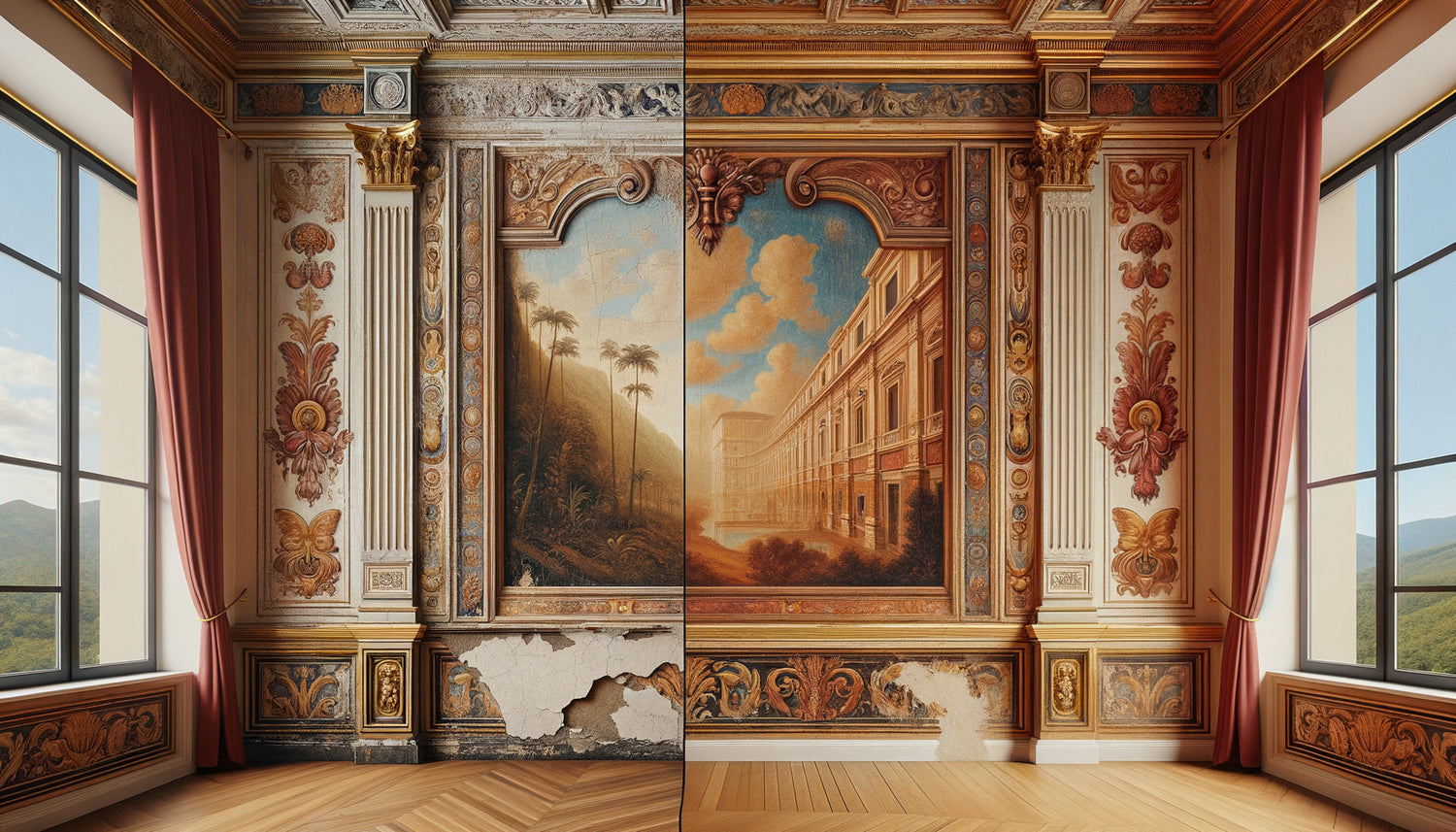
Last summer, I had the chance to witness the rediscovery of an 18th-century fresco in a Nice palace. Beneath three layers of modern paint lay an intact Italian trompe-l'oeil. This revelation reminded me how these wall artworks tell the silent history of exceptional places.
Here’s what recognizing an original fresco brings: a deep understanding of the heritage surrounding you, the ability to appreciate the authentic value of a historic place, and a trained eye to distinguish period craftsmanship from contemporary interventions.
Faced with these walls adorned with mythological scenes or floral motifs, we are often helpless. How do you differentiate the brushstroke of a 17th-century master from a 20th-century restoration? This frustration transforms our stays in these exceptional establishments into missed opportunities.
However, a few accessible clues allow us to read these walls like an open book. You don't need to be an art history expert: attentive observation and a few reading keys are enough to unravel these mysteries.
I invite you on a journey into the secrets of historic mural frescoes, these precious testimonies that give soul to prestigious hotels listed as historic monuments.
The material clues that never deceive
The first thing I always examine in a fresco is its surface texture. An original wall painting has characteristic micro-cracks, a fine and coherent network resulting from the natural aging of pigments and plaster. These cracks form organic patterns, almost predictable.
Modern repaints, even artificially aged, betray a suspicious uniformity. The surface remains too smooth, too perfect. When observing a fresco in a historic listed hotel, approach discreetly: grazing light reveals these differences in relief.
The support is another valuable indicator. Authentic frescoes are made on lime plaster applied in several layers, with pigments incorporated while the surface is still wet. This ancestral technique creates a fusion between color and support. A repaint, on the other hand, simply rests on the surface, like a layer added a posteriori.
The color palette as a temporal signature
The pigments available according to the eras tell a precise story. A 17th-century fresco cannot contain certain synthetic blues that appeared in the 19th century. Ochres, earths, and natural ultramarine dominate ancient compositions, with that characteristic depth that mineral pigments impart.
I have learned to recognize this particular saturation of original colors: never garish, always harmonious, even when the shades have faded. Modern restorations often err on the side of excessive brightness, seeking to restore a brilliance that may never have existed with such intensity.
The artistic style reveals its era
Each artistic period has its immutable visual codes. A Renaissance fresco presents proportions, perspectives and draperies that are unlike a Baroque or Neoclassical composition. Artists of the time perfectly mastered the aesthetic conventions of their time.
In private mansions transformed into palaces, I often observe stylistic inconsistencies that betray repainting. A decor supposedly Louis XV with Art Deco elements? A mythological scene whose characters have suspicious anatomies for the supposed era? These anachronisms are obvious once you know them.
The composition technique also differs. Old masters worked in compartments, with cartouches, medallions and painted architectural frames. Their compositions respect rules of symmetry and balance inherited from centuries-old traditions. A modern repainting, even well-intentioned, often reveals an imperfect understanding of these visual grammars.
Details that speak to connoisseurs
Look at the faces in an original fresco: they possess this nuanced expressiveness, this psychology that only an artist confronted with their model can grasp. Repaints tend towards generalization, copy of a copy which loses subtlety.
The draperies, the folds of clothing, constitute an infallible test. An old painter knew the real behavior of fabric, its way of falling, of creasing. This direct observation is reflected in the rendering. A restoration is inspired by images, references, but rarely by live study.

Architectural integration as proof of authenticity
An authentic historical fresco dialogues with the architecture that welcomes it. It was designed for this specific space, taking into account natural light, openings and volumes. In a historic listed hotel, this original harmony remains perceptible.
The painted elements sometimes extend under the woodwork, behind the cornices, revealing their seniority. A repainting stops at the visible limits, scrupulously respecting current boundaries. This difference in integration constitutes a major index when examining a mural painting.
I also observe the connections with other decors. An antique fresco fits into a coherent decorative program: motifs respond from one room to another, colors dialogue with stuccos, parquet floors, ceilings. A single repainting breaks this silent conversation between elements.
Archive documents, indispensable accomplices
Historically classified historic residences generally possess valuable archives: inventories, descriptions, sometimes old photographs. These documents allow us to compare the current state with testimonies from the past.
Death inventories and sale descriptions often mention painted decorations with surprising precision. Comparing these texts with what remains reveals transformations, disappearances, additions. This documentary approach wonderfully complements direct observation.
Old photographs, even in black and white, provide crucial information about compositions, the state of preservation at different times, areas that have undergone interventions. In some palaces, I was able to identify restorations dating back to the 1920s which were passed off as works from the 18th century.
Modern restoration campaigns
Since the 1990s, restoration techniques have considerably evolved. Contemporary interventions generally leave documented traces: reports, before-and-after photographs, maps of retouched areas. These archives constitute a valuable memory for distinguishing the original from the restored.
Current restorers apply a principle of reversibility and readability: their interventions must be distinguishable from the original upon close observation. This professional ethic paradoxically helps to identify what truly belongs to the ancient heritage.

Examination in natural light, an unsuspected revealer
Changing natural light reveals the secrets of a fresco. Throughout the day, shadows reveal reliefs invisible under electric lighting. These variations highlight reworked areas, overloads, fillings.
A technique I particularly like: observing a wall painting from different angles. The grazing morning or evening light brings out pentimenti, compositional changes, traces of tools characteristic of each era.
The ultraviolet fluorescences used by conservators reveal differences invisible to the naked eye. Even without this specialized equipment, a simple patient observation under various lighting conditions provides valuable information about the authenticity of a decor.
Create your own artistic heritage
Discover our exclusive collection of wall art for luxury hotels that bring nobility and character to your exceptional spaces, in accordance with artistic traditions.
Become a reader of the walls around us
This ability to distinguish an original fresco from a repaint radically transforms the experience of staying in a historic hotel. The walls are no longer simple decorative surfaces: they become pages of history, tangible testimonies of the passage of time.
Imagine your next stay in one of these exceptional establishments. You look up at a ceiling adorned with putti and garlands of flowers. Now you know how to observe cracks, analyze the palette, decode the style. You perceive this silent conversation between the original work and the hands that have preserved it.
Start with a simple exercise: during your next visit to a historic listed hotel, take ten minutes to carefully observe a fresco. Mentally note the details that attract your attention. This practice sharpens the eye and gradually reveals the subtleties that distinguish the authentic from the reconstituted.
These wall paintings constitute the soul of heritage places. Knowing how to read them is accessing a hidden dimension of true luxury: that of preserved and transmitted history. Your gaze then becomes that of an accomplice, capable of appreciating not only visible beauty but also the temporal depth of the spaces that welcome you.
Frequently asked questions about historic frescoes
Can you touch a fresco to verify its authenticity?
Absolutely not, and this is a fundamental rule in historic listed hotels. Touching, even gently, deposits oils and acids from the skin that gradually alter the pigments. Moreover, these works are legally protected. Visual observation, even close-up, is quite sufficient to detect clues of authenticity. Use natural changing light and observe details from different angles. If you are truly passionate about analyzing a particular fresco, approach the concierge who may be able to arrange a guided tour with a specialist guide. This respectful approach preserves heritage while satisfying your legitimate curiosity.
Are all repaints necessarily problematic?
No, and this is an essential nuance to understand. Repaints and restorations are often indispensable acts of preservation. Without intervention, many frescoes would have disappeared. The problem arises when a repaint abusively presents itself as an original, intact work. Honest, documented restorations carried out according to the rules of contemporary art possess their own heritage value. They bear witness to the history of conservation, the tastes and techniques of different eras. In a quality historic hotel, managers clearly distinguish between original areas and modern interventions in their communications with informed visitors. This transparency even adds richness to the reading of the place, showing the successive layers of attention paid to the heritage.
How can you learn more about reading ancient frescoes?
Several complementary approaches are available to develop your eye. Start by regularly visiting museums offering collections of murals with detailed explanatory labels. Decorative arts museums often host accessible conferences on these topics. Heritage Days offer an exceptional opportunity to access private houses usually closed, often with experts present to comment. Several heritage preservation associations offer short training courses for enlightened amateurs. Reading illustrated books on the history of pictorial techniques also refines your understanding. Finally, don't hesitate to talk to the managers of historic hotels you frequent: many are passionate and delighted to share their knowledge with curious and respectful visitors.