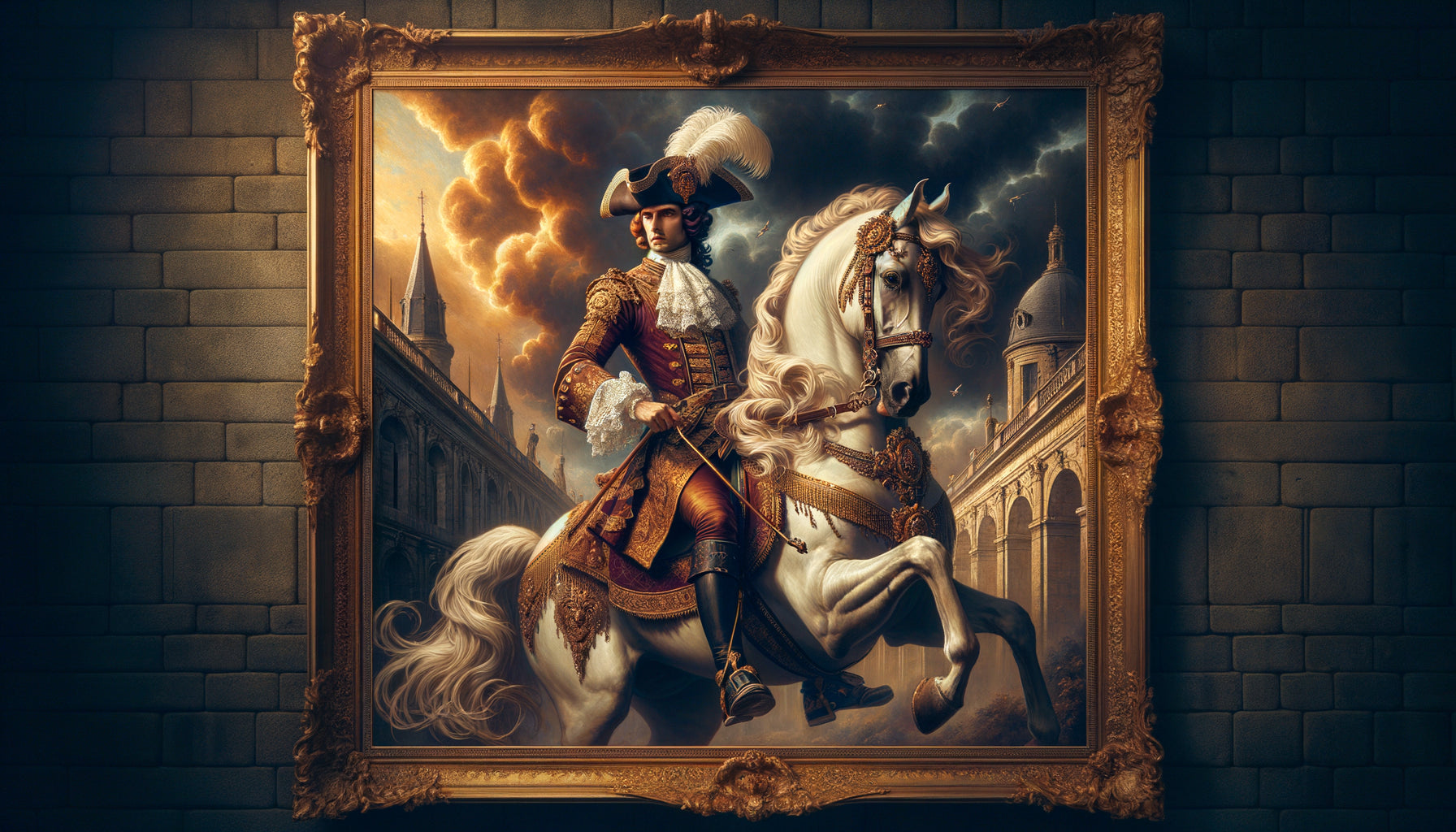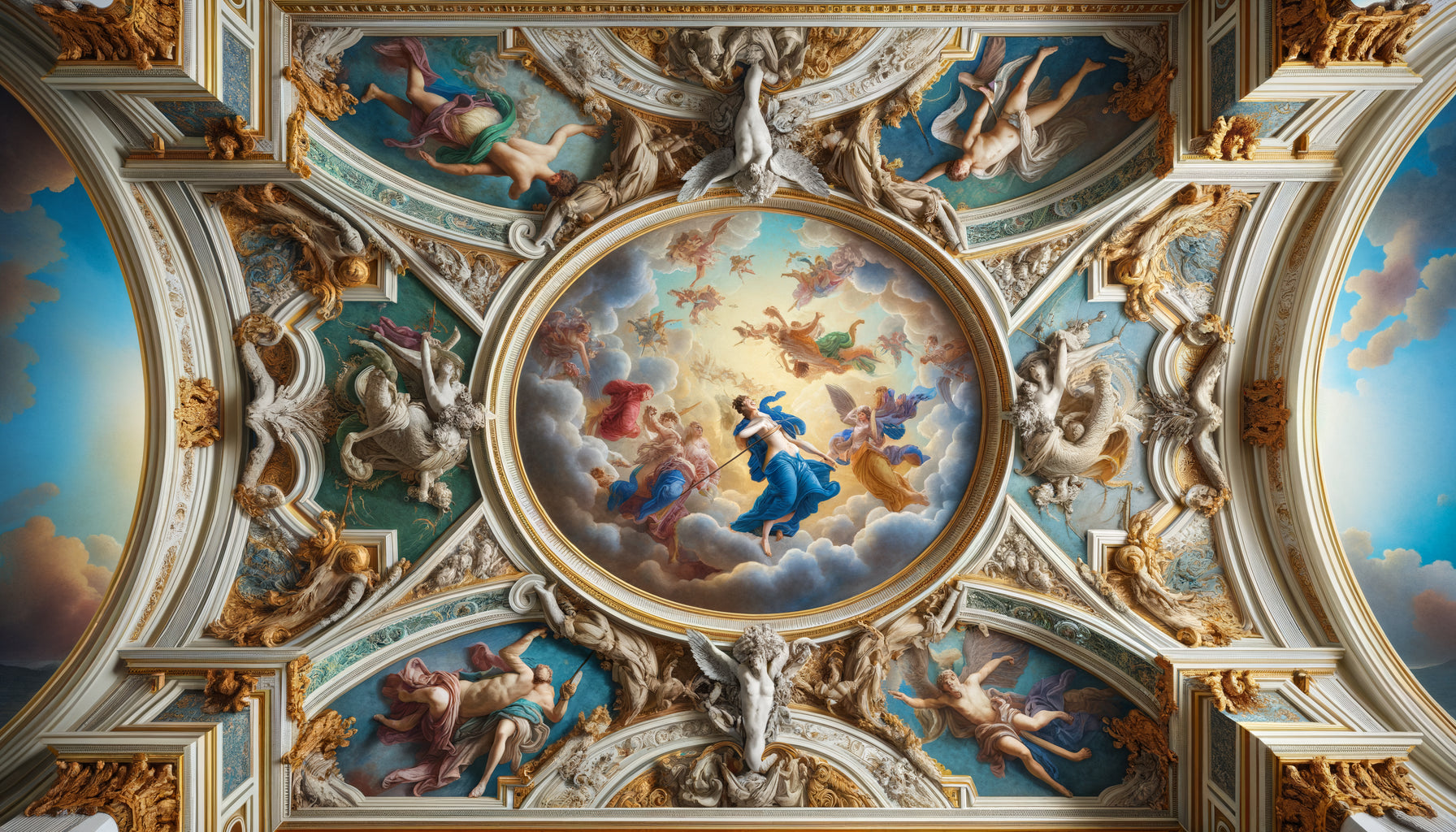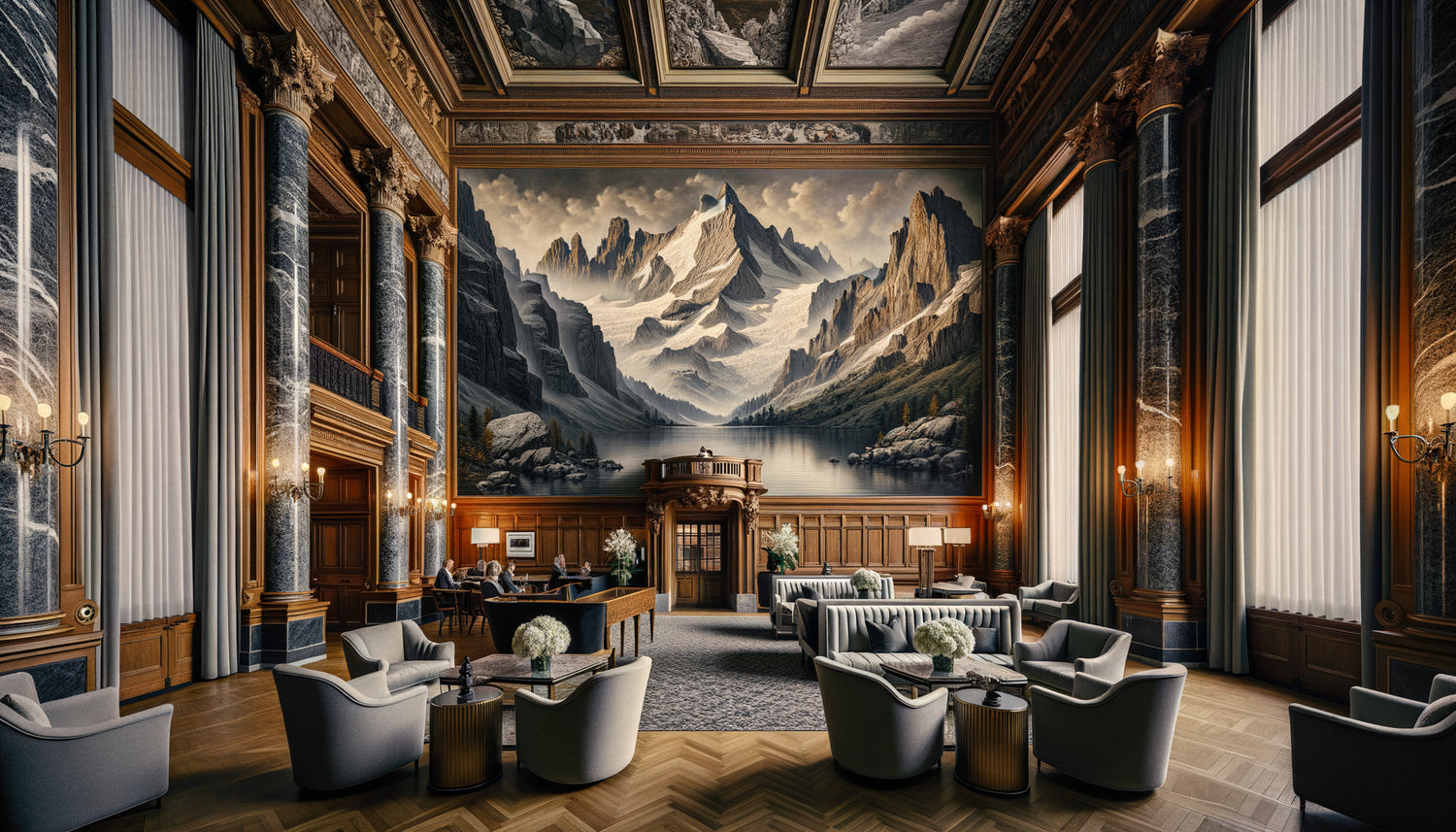
Stepping through the door of a faded palace hall, I felt that particular alchemy: the walls were telling the story of the mountain. Not in a naive or touristy way, but with an almost ceremonial sophistication. Monumental frescoes dialogued with centuries-old woodwork, contemporary paintings reinterpreted peaks in mineral abstractions. This moment crystallized fifteen years spent examining the private collections of alpine establishments: yes, a distinct visual language exists, born between tradition and modernity.
Here's what the Alpine wall style of Swiss palaces brings: a territorial identity that transcends decoration, a historical continuity that values authenticity, and a timeless elegance that elevates the customer experience. These aesthetic codes, forged since the golden age of alpine tourism in the 19th century, create an immediately recognizable atmosphere, blending cultural heritage and contemporary refinement.
Many hotels struggle to move beyond mountain clichés: repetitive edelweiss, naively painted chalets, frozen reproductions of generic landscapes. The result lacks soul, transforming spaces into faded postcards rather than living memory places. This superficiality undermines the very identity of luxury alpine hotels, which deserve a visual signature worthy of their history.
The good news? Swiss institutions have developed a subtle and consistent visual grammar, passed down through generations of artistic directors, regional artists, and passionate curators. This tradition is neither rigid nor outdated: it breathes, evolves, integrates contemporary voices while honoring its mountain DNA. Understanding these codes allows us to grasp how wall art shapes the sensory experience of alpine luxury.
The legacy of Alpine fresco artists: when walls tell the saga
In the halls of historic palaces like the Badrutt's Palace or the Suvretta House, monumental frescoes bear witness to a specifically Alpine pictorial tradition. These compositions, often made between 1890 and 1930, depict epic scenes: first ascents, idealized pastoral life, dramatic panoramas where light pierces the clouds.
What distinguishes these works from simple tourist decorations is their narrative ambition and quality of execution. Artists like Giovanni Giacometti or Cuno Amiet brought a post-impressionist sensibility to alpine subjects, creating compositions where the mountain becomes chromatic abstraction rather than photographic reproduction. Mineral palettes – slate gray, off-white, deep ochres, glacier blues – establish an immediately recognizable color signature.
This pictorial approach still influences today's artistic commissions of Swiss establishments. Panoramic formats, assumed monumentality, and poetic rather than documentary treatment of the landscape are stylistic constants. Alpine wall art favors suggestion over description, atmosphere over illustration.
The geometry of peaks: alpine abstractions and modernity
Starting in the 1950s, Swiss grand hotels embraced a tempered modernity, integrating abstract works while maintaining territorial roots. This evolution marks a turning point: alpine style in wall art ceases to be figurative and becomes conceptual, exploring the geometric structures of the mountain, its vertical rhythms, its contrasts of light.
Artists like Max Bill or Hans Emmenegger create compositions where edges, rock strata, crystallizations become formal language. These mineral abstractions now adorn the contemporary spaces of renovated establishments: sleek lobbies, lounge rooms, circulation galleries. The mountain expresses itself through line, plane, and texture, rather than literal representation.
Materials as an extension of the landscape
Alpine wall style also integrates a distinctive material dimension. Swiss grand hotels favor supports that dialogue with the environment: locally carved or pyrographed wood, sculpted slate, compositions in natural stone, textiles woven representing topographic motifs. This tactile approach transforms wall art into a multisensory experience, where texture counts as much as image.
Contemporary installations play on this hybridization: solid wood panels embedded with translucent resin evoking glacial crevasses, reconstituted stone wall compositions imitating geological formations, monumental tapestries translating contour lines into abstract rhythms. This alpine materiality creates continuity between architecture, decoration and territory.

Altitude photography as a visual signature
Since the 2000s, large format photography has become the preferred medium in alpine establishments. But not just any photography: artistic commissions from Swiss palaces favor contemplative, almost mystical approaches to the mountain. The photographs of Robert Bösch or Ludovic Coutière – monumental black and white prints, minimalist framing on glacial details, vertiginous perspectives – transform public spaces into meditative galleries.
This art photography radically distinguishes itself from promotional images. It explores the spiritual dimension of the alpine experience: solitude of summits at dawn, silence of snowfields, abstractions formed by fog. Large formats (often 2 to 4 meters wide) create an immersion that suspends time, inviting contemplation rather than simple wonder.
Hotels like the Tschuggen Grand Hotel or the Carlton St. Moritz showcase these photographic works as aesthetic manifestos, asserting a vision of alpine luxury where expressive sobriety takes precedence over ostentation. The contemporary alpine wall style thus cultivates a form of ascetic elegance, in resonance with the mineral rigor of the landscape.
When tradition meets innovation: artistic collaborations
The most visionary Swiss establishments develop artist residency programs, inviting creators to reinterpret the alpine imaginary. These collaborations produce hybrid wall installations, blending ancestral techniques and contemporary mediums. We find digital frescoes projected onto stone, evolving light compositions simulating climatic variations, participatory works integrating elements collected during hikes.
This living approach to alpine visual heritage avoids museumification. The style is no longer fixed in nostalgic Belle Époque but becomes a territory of experimentation. Young Swiss artists – such as Not Vital or Ugo Rondinone – offer offbeat readings, sometimes ironic, always respectful of the territorial identity. Their wall interventions dialogue with historical works without imitating them, creating a stimulating temporal polyphony.
Custom commissions: investing in identity
Unlike standardized chains, Swiss luxury hotels consider wall art as a heritage investment. The budgets allocated to artistic commissions (often 3 to 7% of the renovation cost) testify to this conviction: wall works do not decorate, they constitute the very identity of the establishment. This philosophy explains why some paintings or frescoes become iconic, photographed, commented on, and expected by regulars.
The artistic directors of alpine palaces work on long cycles – five to ten years – guaranteeing consistency and maturity of the visual project. They consult art historians, regional curators, local artists to build iconographic programs that tell a story, celebrate a heritage, and project a vision. This curatorial requirement radically distinguishes the Swiss approach from ephemeral or opportunistic decorations.

Recognizing the codes: anatomy of alpine wall style
What are the visual invariants that immediately signal belonging to the alpine style of Swiss grand hotels? First, a restricted color palette: dominant grays, whites, deep browns, with accents of glacier blue or mineral rust. Then, formats often horizontal and panoramic, echoing the amplitude of mountain views. And finally, a preference for balanced compositions, never aggressive, prioritizing harmony over disruption.
The treatment of the subject itself obeys tacit conventions: the mountain is never conquering but contemplative, never sporty but spiritual, never touristy but poetic. Human scenes, when they appear, show silhouettes integrated into the landscape, never dominant. This visual humility reflects an alpine philosophy where man makes himself discreet in the face of natural majesty.
Finally, alpine wall works prioritize permanence over fashion. Aesthetic choices aim for timelessness, avoiding dated effects or ephemeral trends. This search for longevity explains why century-old frescoes coexist harmoniously with contemporary installations: they share a common formal ethic, a quest for essence rather than appearance.
Infuse alpine elegance into your own spaces
Discover our exclusive collection of luxury hotel wall art that captures the essence of mountain refinement and transforms your walls into true aesthetic manifestos.
From inspiration to appropriation: bringing alpine style to life
Understanding the alpine wall style of Swiss grand hotels is accessing a sophisticated visual grammar, the result of decades of exchanges between artists, architects and passionate hoteliers. This aesthetic does not belong only to historic palaces: it can inspire any project where one seeks to celebrate territorial authenticity, elegant sobriety, contemplative connection with nature.
Whether you are arranging a private chalet, an altitude restaurant, a wellness space or simply your urban interior in search of mineral tranquility, the codes of alpine style in wall art offer a reliable aesthetic compass. Prioritize works where the mountain becomes luminous abstraction, where natural materials dialogue with the image, where the color palette remains subdued and earthy.
Look for artists who understand the difference between tourist illustration and poetic evocation. Invest in generous formats that create immersion rather than simple decoration. Compose in layers of time, perhaps combining an antique engraving, a contemporary photograph, a mineral texture. This mastered polyphony characterizes the most beautiful alpine interiors.
Alpine wall art ultimately invites you to a form of decorative wisdom: the one that recognizes that true visual richness is born from creative constraint, territorial anchoring, and fidelity to a deep cultural identity. Swiss grand hotels have understood this for over a century: their walls do not follow trends, they embody a living heritage.
Frequently Asked Questions about the Alpine Wall Style
Can the Swiss hotel alpine style be translated into a contemporary interior?
Absolutely, and it is even recommended if you are looking to create a soothing and timeless atmosphere. The secret lies in adaptation rather than literal copying. Select works that capture the mineral essence rather than tourist imagery: large-format black and white photographs of rock formations, geometric abstractions evoking mountain strata, textured compositions blending raw wood and stone. Favor generous formats (at least 100x150 cm) to create the characteristic contemplative impact of alpine hotel spaces. Combine these wall pieces with natural materials – patinated wood, thick linen, woven wool – to reinforce sensory coherence. The common mistake is to multiply small mountain images: it is better to have a single monumental work than a decorative accumulation.
Which contemporary artists perpetuate the alpine wall style?
Several Swiss and European creators are currently renewing this visual language. In photography, explorers like Robert Bösch or Matthieu Ricard (for his Himalayan shots with an alpine sensibility) offer monumental contemplative visions. In abstract painting, artists such as Katharina Grosse or Helmut Federle develop compositions where geological structures become chromatic architecture. The mixed installations of Not Vital combine sculpture, photography and raw materials to create sophisticated territorial evocations. To identify these creators, consult the catalogs of galleries specializing in Swiss contemporary art (Hauser & Wirth, Galerie Karsten Greve) or visit the public spaces of recently renovated hotels that often communicate about their artistic collaborations. Alpine art biennials – notably the one in St. Moritz – are also excellent observatories of current trends.
How to avoid clichés while remaining faithful to the alpine identity?
The key lies in the conceptual approach rather than the illustrative one. Instead of literally representing chalets and snowy peaks, focus on the sensory qualities of the alpine experience: silence (translated by clean, minimalist compositions), verticality (elongated formats, ascending lines), the particular light at altitude (contrasting games, bright whites), mineral textures (raw surfaces, layered materials). Favor works that suggest rather than describe: an abstraction in glacial tones evokes the mountain more powerfully than a banal photographic reproduction. Systematically ask yourself: could this piece be featured in the lobby of a five-star palace hotel, or does it look like souvenir shop decor? This quality requirement naturally leads to sophisticated choices. Finally, don't hesitate to incorporate contemporary works that have no explicit thematic connection with the mountain but share its color palette and sober elegance: this indirect approach often creates the most successful atmospheres.