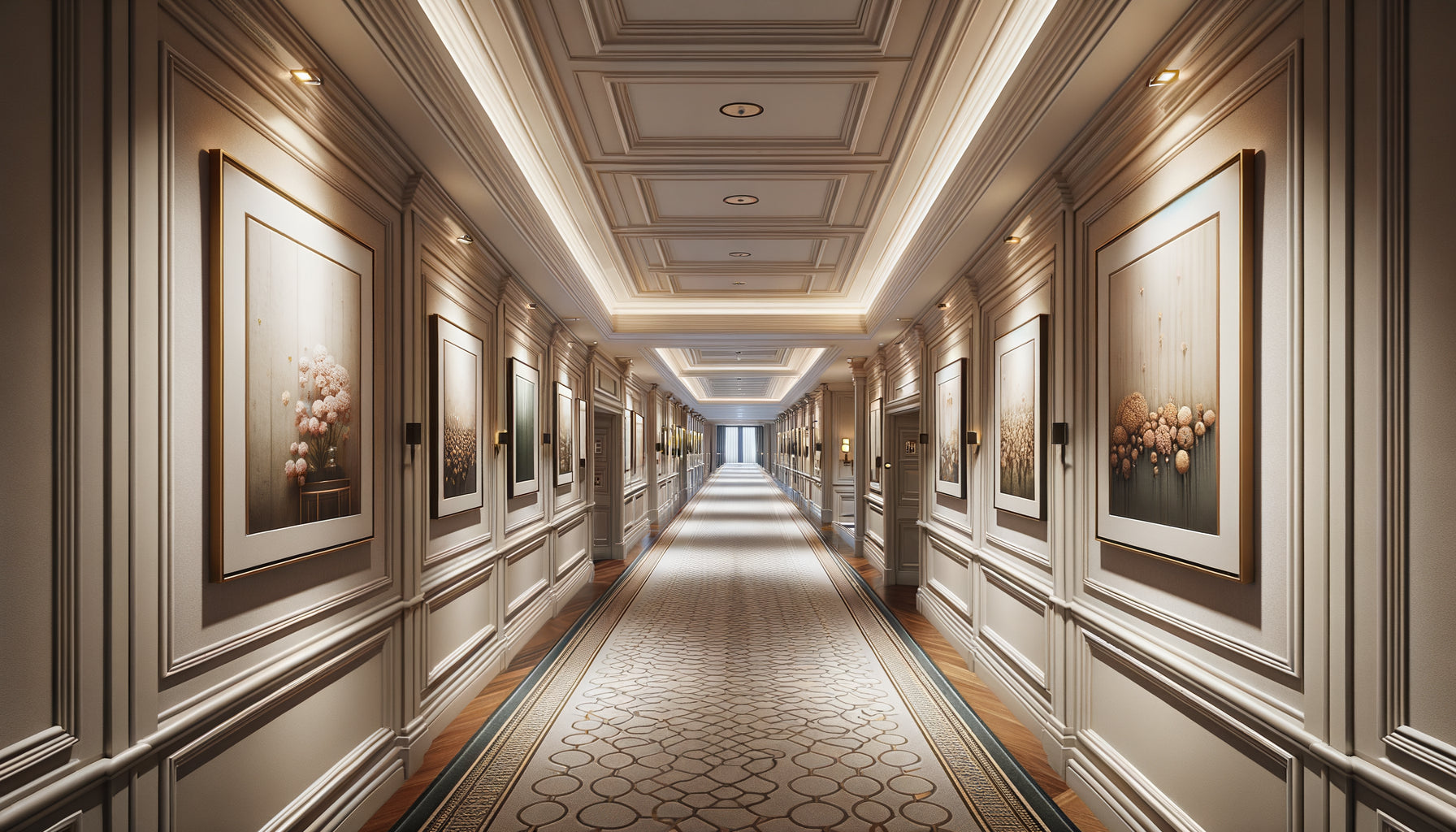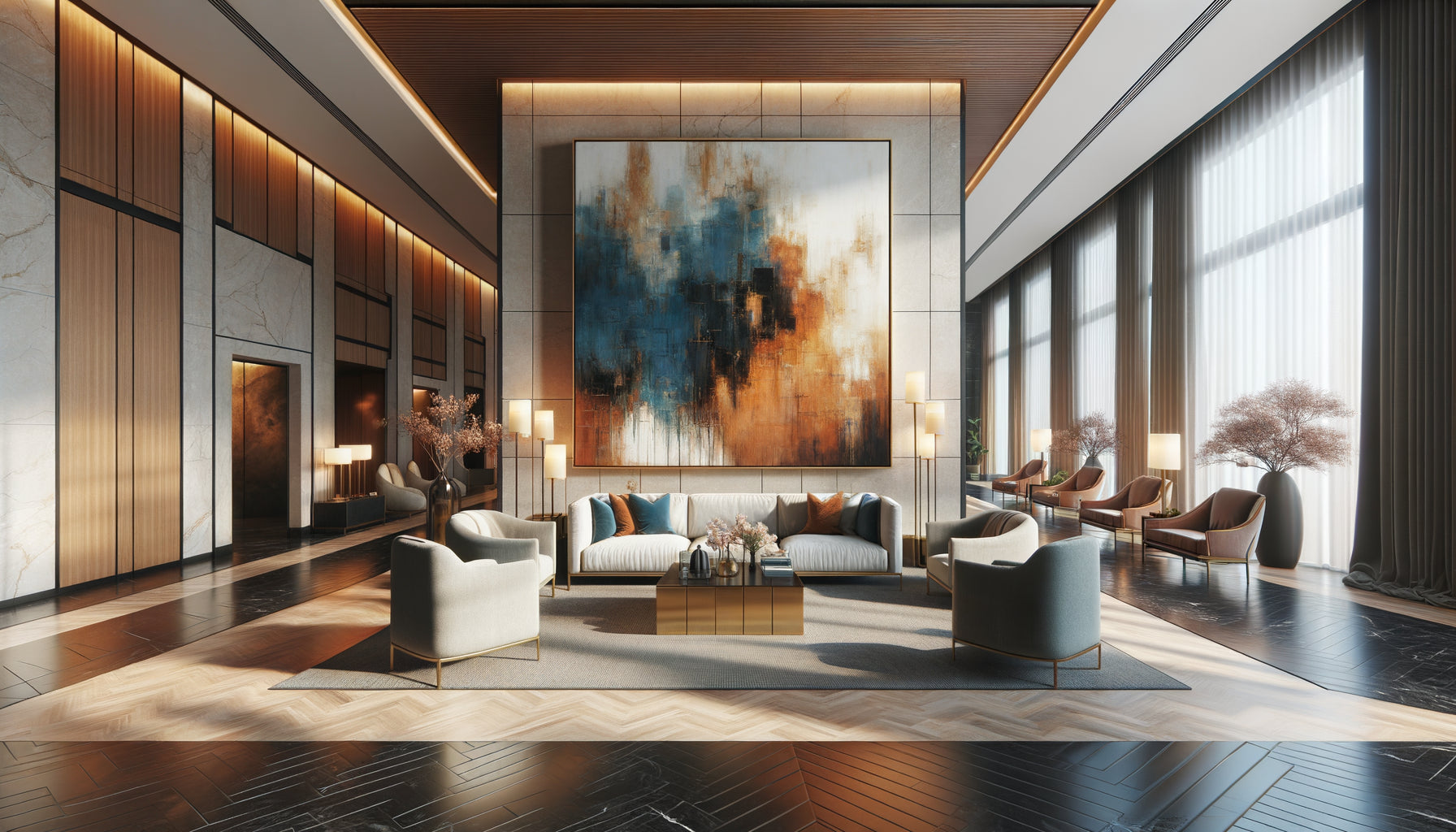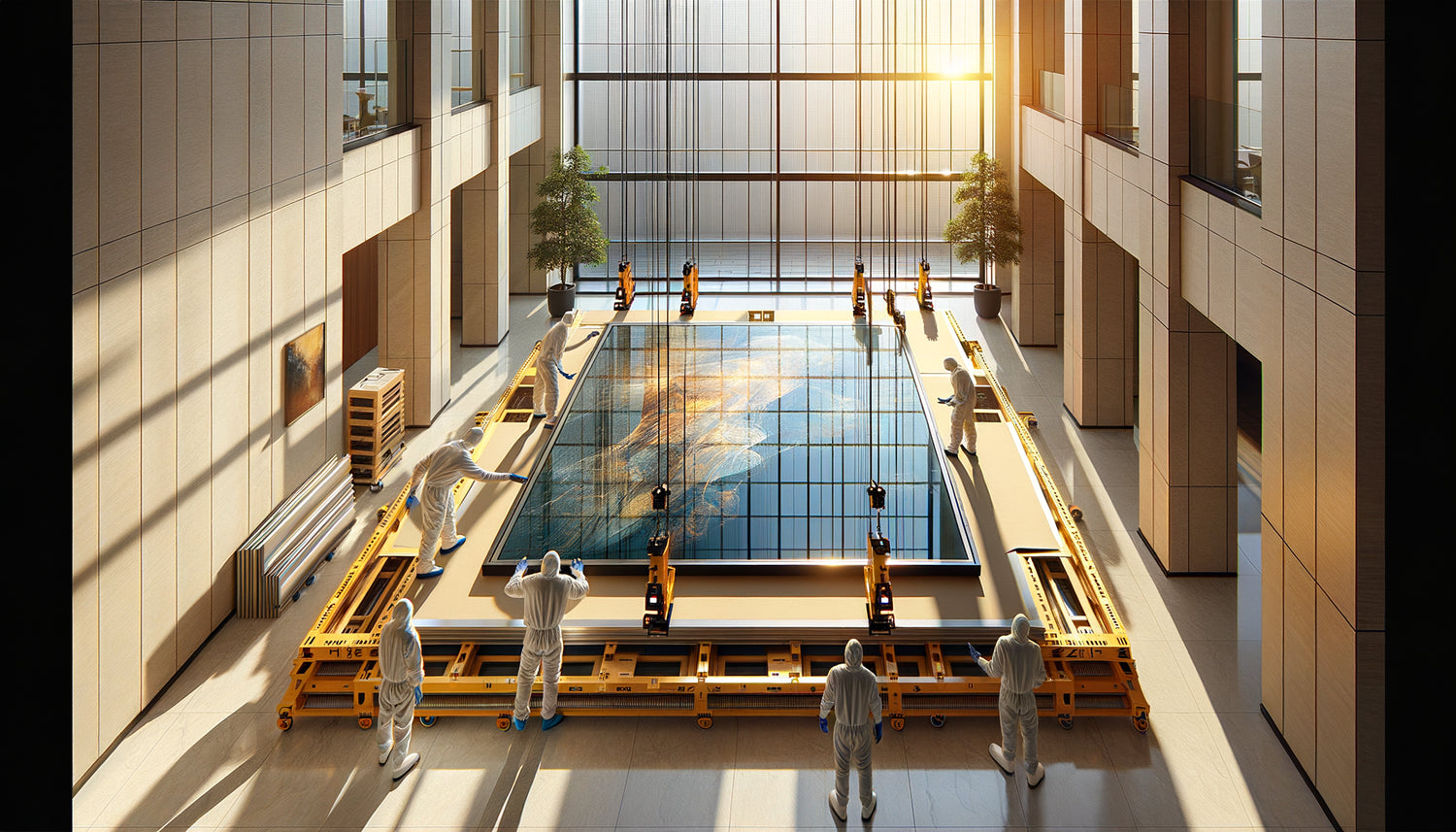
This morning again, crossing the threshold of a renovated grand hotel, I observed this troubling phenomenon: a magnificent abstract work literally devoured by sunlight. The colors once vibrant, now faded, told the story of a poor finishing choice. In lobbies bathed in natural light, the dialogue between the artwork and its environment is not only about aesthetics – it's about durability, resistance, and technical intelligence.
Here's what good finishes for wall artworks in bright lobbies bring: optimal protection against UV discoloration, enhancement of colors without dazzling glare, and a longevity that transforms artistic investment into lasting heritage. Too often, we select an artwork for its visual impact, neglecting the daily reality of these passageway spaces where the sun reigns supreme for several hours each day. The result? A magnificent installation in September that loses its luster by the following spring.
Rest assured: with the right finishes and a clear understanding of lighting issues, your wall artworks can stand the test of time without losing their splendor. I'm going to reveal the solutions I've tested on dozens of hotel projects, those that actually protect your artistic investments while enhancing their presence in these first impression spaces.
UV-resistant varnish: your first line of invisible defense
During a project for a Mediterranean boutique hotel, we installed a series of contemporary artworks facing a south-facing skylight. Six months later, only those protected by a professional anti-UV varnish retained their original color intensity. This experience definitively convinced me: in a lobby exposed to natural light, protective varnish is not an option, it's a necessity.
Varnishes with integrated UV filters create an invisible barrier that blocks up to 95% of harmful ultraviolet rays. For wall artworks in acrylic or oil, prioritize specific formulations that preserve the depth of pigments without altering their rendering. The matte finish absorbs stray reflections – ideal for lobbies with large bay windows where glare is a problem. Conversely, a satin finish offers an elegant compromise: enough protection, with that slight luster that animates the artwork depending on the viewing angle.
Professional application makes all the difference. I've seen too many artworks damaged by varnishes applied in layers that are too thick or under unsuitable humidity conditions. For a lobby, require at least three thin coats of conservation-grade varnish, with complete drying between each application. This rigor guarantees homogeneous protection that will age harmoniously with the artwork.
Anti-reflective glass and museum grade plexiglass: the elegant armor
In high-end reception areas, physical protection also becomes a hallmark of quality. I have definitely adopted anti-glare glass after observing its effectiveness on a large-format photographic installation in a corporate lobby. Despite eight hours of direct sunlight daily, the prints retained their contrast and sharpness without any annoying white haze.
UV treated anti-glare glass combines two crucial benefits for lobby wall artworks: it eliminates up to 99% of distracting reflections while filtering destructive ultraviolet rays. Visitors appreciate this perfect visual clarity, this impression of proximity to the artwork despite the physical protection. For works of high value or limited editions, this is the standard to aim for.
Museum grade acrylic : lightweight and remarkably effective
For large-format installations where weight becomes a limiting factor, museum grade acrylic represents a sophisticated alternative. This high-tech material, originally developed for cultural institutions, offers UV protection comparable to glass while dividing the weight by two. I equipped a Parisian hotel lobby with artworks measuring 2 meters by 3: installation was easier, security enhanced, and protection optimal.
Next-generation scratch-resistant treated acrylic has evolved considerably. The cheap plastic look is gone: premium versions display crystalline transparency that rivals mineral glass. For a lobby where hundreds of people circulate daily with luggage and strollers, this impact resistance becomes a significant factor for durability.

Matte versus glossy finishes : the art of light dosage
Each lobby has its unique luminous personality. I have learned to observe the space at different times before recommending a finish. An east-facing lobby is flooded with soft morning light, while a west exposure creates dramatic backlighting in the late afternoon. These variations radically influence the choice of finish for your wall artworks.
Matte finishes absorb light rather than reflect it. In a very bright lobby with large windows, they offer constant readability without glare. Matte-finish artworks create a calming, almost contemplative presence that contrasts pleasantly with the bustle of a passageway. I particularly recommend them for black and white photographs or abstract paintings with blocks of color.
Conversely, a glossy or varnished finish amplifies depth and color saturation. On a figurative work or a detailed landscape, this luster creates a showcase effect that captures the eye and invites prolonged observation. However, be careful: in a lobby with skylights or a glass roof, reflections can become overwhelming. The solution? Position these artworks on walls perpendicular to direct natural light sources.
Resistant inks and pigments: investing in durable materials
The finish only does half the job. I realized this reality during a disastrous project where, despite excellent UV varnish, prints on standard paper faded within a year. The intrinsic quality of pigments and supports determines the longevity of any installation in a bright lobby.
For printed works, require archival pigment inks (and not dye inks). These professional inks, used by museums for their reproductions, resist 75 to 200 years according to manufacturers – compared to 5 to 25 years for consumer inks. On museum-quality paper or premium cotton canvas, these prints last through the decades without noticeable loss of color quality, even when exposed to daily natural light.
Original paintings deserve the same vigilance. Professional-grade pigments, although more expensive, offer incomparably superior lightfastness. A conscientious artist will use pigments rated LF (lightfastness) 7 or 8 on the light resistance scale. This information, often mentioned on the certificate of authenticity, becomes crucial for a work intended for a sun-drenched lobby.

Aluminium Dibond and rigid supports: the structure that protects
The support of the wall art directly influences its resistance to the stresses of a lobby. Variable humidity according to the seasons, micro-vibrations related to constant traffic, temperature variations near glazing: all these mechanical stresses require a stable and durable support.
Aluminum Dibond has become my preferred support for demanding lobbies. This sandwich of polyethylene between two sheets of aluminum combines lightness, perfect rigidity and total impermeability. Works mounted on Dibond retain their flatness for years, without warping or deformation. For a large-format print displayed near a bay window, this dimensional stability becomes a guarantee of visual longevity.
The lightbox: when the finish becomes light itself
An avant-garde solution is gaining ground in contemporary lobbies: the backlit lightbox. Rather than being subjected to natural light, the work itself becomes a source of light. I installed this solution in an urban hotel lobby with limited windows: the effect is striking, creating a constant luminous focal point regardless of external conditions. Printing on special translucent film, protected between two plates of plexiglass, benefits from optimal protection against oxidation and UV rays.
Enhance your lobby with works designed to last
Discover our exclusive collection of luxury hotel wall art that incorporates the most advanced professional finishes to resist natural light while enhancing your reception areas.
Maintenance of finishes: preserving investment over time
A suitable finish does not exempt from regular maintenance. In a lobby, dust, fingerprints and urban atmospheric pollution gradually accumulate on the protective surfaces. I have established a simple protocol for my hotel clients: a gentle monthly cleaning with a microfiber cloth slightly damp, without aggressive chemical products.
For works under glass or plexiglass, a special antistatic spray prevents electrostatic dust accumulation. This small attention, repeated regularly, preserves visual clarity and extends the life of anti-reflective treatments. Every two years, a professional inspection allows to check the condition of the sealing joints and UV protection, particularly for works in situations of intense exposure.
Never forget that rotating artworks is also a form of protection. In establishments where I work regularly, we plan seasonal rotations: the most sensitive works leave high-exposure summer locations for more sheltered areas. This museum strategy, adapted to the hotel context, multiplies the overall longevity of the art collection.
Imagine your lobby transformed by these enlightened choices
Visualize your reception space in five years: your wall artworks, protected by the finishes you carefully selected today, retain their original luster. Visitors continue to stop, captivated by these artistic presences that defy time and light. This vision is not utopian – it simply results from informed technical choices and a fine understanding of the specific constraints of bright lobbies.
Start with a lighting audit of your space: note areas of direct sunlight, critical hours, problematic reflections. This mapping will guide your finishing decisions for each wall artwork, creating a harmonious balance between maximum protection and visual impact. The initial investment in professional finishes is largely offset by avoiding premature replacements and preserving the aesthetic coherence of your lobby over the long term.
Natural light should no longer be perceived as a threat to your wall artworks, but as an opportunity to reveal their beauty in their best light – literally. With adapted finishes, you transform this constraint into an asset, creating luminous dialogues that evolve throughout the hours while guaranteeing the permanence of your artistic heritage.
Frequently Asked Questions about Lobby Wall Artwork Finishes
What is the cost difference between standard glass and UV anti-reflective glass?
UV treated anti-reflective glass costs approximately 2.5 to 3 times more than standard glass, but this difference represents a strategic investment rather than a simple expense. For an 80x120 cm artwork, expect between 180 and 250 euros for museum grade glass versus 60 to 80 euros for classic glass. This difference of 120 to 170 euros avoids the complete replacement of the artwork in 3 to 5 years (often exceeding 1000 euros), not counting the aesthetic value of perfect visibility without distracting reflections. In a lobby where the artwork constitutes a central element of the visual identity, this initial additional cost is quickly offset while preserving your artistic investment.
Can UV varnish be applied to a work that has been hanging for several months?
Technically yes, but with important precautions. If the wall artwork has not yet undergone visible discoloration, applying a protective UV varnish remains beneficial to stop degradation. However, the operation requires removal from the wall, gentle cleaning of the surface, and ideally application in a climate-controlled workshop to guarantee optimal drying. For acrylic or oil artworks, ensure that the paint is completely dry (minimum 6 months after creation). If signs of discoloration are already visible, the varnish will stop the progression but will not restore lost colors. In a lobby exposed to strong natural light, it is better to anticipate and protect from installation rather than correct afterwards.
Do matte finishes make colors less vibrant than glossy finishes?
This is a misconception that deserves nuance. Matte finishes do absorb more light, which can slightly reduce the perceived intensity of colors compared to a glossy finish that amplifies them. However, in a lobby bathed in abundant natural light, this difference becomes minimal or even imperceptible. In reality, matte finishes often offer better readability of subtle nuances and fine details, precisely because they eliminate distracting reflections that mask certain areas of the artwork. For wall art with already saturated or contrasting colors, the matte finish perfectly preserves their visual impact while ensuring optimal viewing comfort at all times. The choice depends less on the vibrancy of the colors than on the desired atmosphere: contemplative and soothing (matte) or spectacular and deep (glossy).