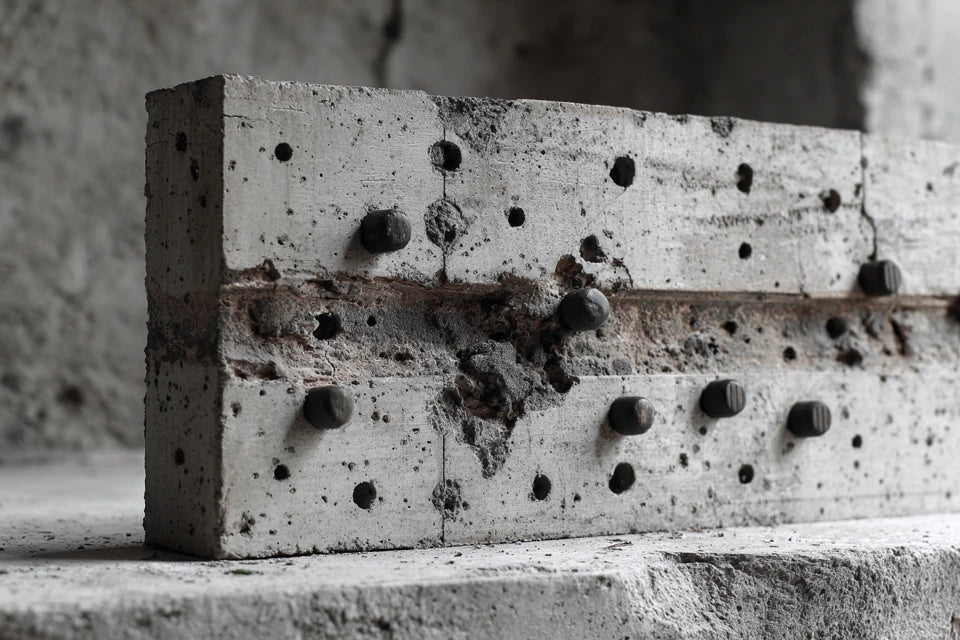
You've just acquired the perfect artwork for your living room. You can already imagine the striking effect it will create on that wall. But here's the thing: your drill fails, the bit breaks, concrete chips fly everywhere, and your wall now looks like a battlefield.
The acrid smell of concrete dust fills the room, your neighbors are already knocking at your door because of the noise, and this reinforced concrete wall seems to mock you with its unwavering resistance.
You may have tried with your standard drill, experimented with different bits, even borrowed one from your neighbor "who drills everything." Result? The same failure and now misplaced holes that disfigure your wall.
Rest assured: it's not your technique that's at fault. The truth is that 90% of homeowners try to drill concrete with totally unsuitable equipment, without knowing the real rules of this capricious material.
In the next few minutes, you'll discover how to drill concrete like a professional to safely hang your artwork, without stress or damage, and create the wall decoration you dream of!
Why your concrete wall could ruin your decor project in seconds?
A failed concrete hanging is like building a house of cards on shifting sand. Even today, hundreds of homeowners are horrified to discover their artwork on the floor, the frame broken, the wall holed. Because unlike plasterboard or wood, concrete doesn't forgive approximations: now or never is when you must master its secrets.
🏠 True story from a customer: "Marine had ordered a magnificent 80x60cm abstract painting for her modern living room. First drilling attempt: the bit breaks clean. Second try: a hole off-center that forces her to move all of her layout. In the end, three weeks of stress for a simple hanging that should have taken 20 minutes with the right method."
💬 Conversation with a decor expert
The golden rule of concrete drilling: Like cooking a delicate dish, preparation is 80% of the success. A perfect concrete drill hole is decided before even turning on the drill, and once mastered, it will take you less time than making a coffee!
What really happens when you try to drill concrete
You find yourself in one of these situations: your drill is overheating and smells burnt, the bit becomes red and twists, or worse, you hear that metallic screech announcing imminent breakage.
What's actually happening is that concrete is an ultra-dense composite material with aggregates that create micro-shocks with each rotation. Your standard drill simply doesn't have the force needed to "break" the material instead of "scraping" it.
It’s like trying to crack a nut with a plastic hammer: the more you insist, the more you exhaust yourself without result.
The real reason: your drill isn't made for that
Contrary to what one might think, it’s not power that counts first, but the percussion system. A standard drill rotates, whereas concrete requires repeated impacts of several thousand blows per minute.
That's the difference between stroking a door and knocking on it: only hammering breaks through reinforced concrete.
As a result, you waste time, damage your equipment, and your decor project takes weeks behind schedule instead of being finished in an afternoon.
🔍 30-second revealing test: Take your current drill and press the bit against your wall without drilling. If you don't feel any particular vibration when you pull the trigger, it doesn’t have a percussion function!
The fatal mistake: confusing speed and efficiency
Most people think that you need to go fast to get through concrete, like forcing your way. In reality, it's exactly the opposite: concrete is drilled slowly, with patience and method.
Imagine crumbling a very hard biscuit: small repeated blows are infinitely more effective than a large violent blow that only moves it.
This haste explains why your holes go off-center, why your anchors don't hold, and why your final attachment lacks solidity.
The invisible trap: the composition of modern concrete
Today’s concretes are no longer what they were 30 years ago. They contain synthetic fibers, hardening additives and sometimes even micro-beads that completely change their structure.
You can recognize this type of “modern” concrete by its lighter color, very smooth surface, and especially the fact that your bit barely leaves a white mark on it.
That's why "grandfather’s tricks" don't work anymore and you need to adapt your approach to these high-performance new materials.
🎯 The 4 signals of “difficult” concrete:
- Your bit heats up in less than 10 seconds: The concrete contains very hard aggregates that create extreme friction
- Sparks appear during drilling: You are probably touching metallic fibers or nearby reinforcing bars
- The dust is very fine and white: Sign of a high-strength concrete with modern admixtures
- The hole refills with dust: The percussion is insufficient, the debris are not evacuated correctly
The trigger factor: striking power
What really makes the difference is the impact force per mm². Like an ice pick that concentrates all its force on a tiny point, your drill bit must literally "explode" the concrete crystals grain by grain. You can check if your equipment has this power by observing whether the dust comes out of the hole continuously during drilling, which is a sign that the material is really broken and evacuated.
The universal rule of concrete: If your drill does not make more noise than a kitchen mixer, it is not powerful enough for concrete. A real percussion drill sounds like a miniature jackhammer!
| ❌ Common belief | ✅ Technical reality | 💡 Simple explanation | 🎯 Practical benefit |
|---|---|---|---|
| The more I force it, the faster it goes | Patience and regularity are paramount | Concrete "fatigues" under repeated impacts | Drill bits that last, perfect holes |
| A powerful drill is enough | Only percussion breaks concrete | Like a hammer vs. continuous pressure | 5x faster drilling |
| All concrete drill bits are the same | Geometry changes everything | Each attack shape has its specialty | Professional finish guaranteed |
| Noise is inevitably disturbing | 2-3 minutes max per hole | Efficiency drastically reduces the duration | Neighborly relations preserved |
The professional method in 3 steps for a perfect hanging
Don't worry: drilling concrete to hang a picture follows a logic as simple as cooking. Preparation, execution, verification - just like succeeding at baking a cake, each step has its importance and its moment. The result? A hanging so solid and so clean that even your guests will notice the difference!
🎯 Overview in 3 steps: First we "read" your wall to avoid surprises, then we drill with the precision of a watchmaker, finally we fix for the long term. At each step, you will feel a growing satisfaction until you admire your work perfectly highlighted!
Step 1: Preparation and reconnaissance of the terrain
Starting with this step is ensuring that all lights are green before starting. Like an architect studies the soil before building, we will "diagnose" your wall to avoid any surprises. This phase will already bring you a total peace of mind before even taking out the drill!
🔧 Your basic arsenal (all found in hardware stores)
- Metal and cable detector: A small rectangular box with an LCD screen that "scans" the wall. Essential to avoid pipes and reinforcing bars. Look for models with both audible and visual signals (expect to spend €30-50, avoid entry-level models at €15 which detect electrical cables poorly) Laser level: These small red devices that project a perfectly straight line onto your wall. Revolutionary for aligning multiple pictures without complicated calculations. The quality criterion: the line must remain stable even at 3 meters (direct impact on the final beauty of your arrangement) Magnetic tape measure: More practical than a classic tape measure as it "hooks" onto metal surfaces. Look for the model with one-handed ribbon locking - you'll understand why when you're alone facing the wall!Now, let's move on to the "detective" phase:
🕵️ Investigation of the wall (5 minutes that avoid hours of hassle)
Scan the drilling area: Pass your detector in a cross pattern over an area of 50cm around each planned fixing point. The principle: reinforcing bars often follow horizontal lines 20-30cm from the floor and ceiling, while pipes run vertically. Move slowly, the device needs 2-3 seconds per zone to analyze.
⏱️ Time: 2 minutes per point | ✅ Successful when: Constant green signal, no alert beep | ⚠️ Attention: A weak signal may indicate a deep reinforcing bar - move 10cm and rescan
Test the hardness of the concrete: Tap different areas with the handle of your screwdriver. A clear, metallic sound indicates very hard concrete, a more muffled sound reveals standard concrete. This "sound signature" will tell you what type of drill bit to use and what rotation speed to use.
⏱️ Time: 1 minute | ✅ Successful when: You identify a homogeneous sound | ⚠️ Attention: Very different sounds over 50cm may indicate an expansion joint to avoid
Mark the drilling points: Use your laser level to draw a reference line, then mark each future hole with a small pencil point. The pro rule: always mark BEFORE definitively measuring, because the laser will sometimes reveal imperfections invisible to the naked eye.
⏱️ Time: 2 minutes | ✅ Successful when: Points aligned to the millimeter | ⚠️ Attention: Inaccurate marking = picture off-center impossible to correct after drilling
✅ Stage validation: Your wall is "mapped", the points are marked precisely, no pipes detected within a 10cm radius. If you have any doubts somewhere, now is the time to resolve them - it will be too late afterwards! Encouragement: you've just done most of the mental work!
OUR RECOMMENDED PRODUCTS
Step 2: Precision Drilling (the moment of truth!)
That's it, you are taking action! This step is more rewarding as you finally see concrete results materialize. This is where your preparation pays off: each gesture becomes fluid, each hole forms effortlessly. The snowball effect begins: the more you drill with method, the more your confidence grows!
🔨 Specialized equipment (rental possible if occasional purchase)
- Rotary hammer with percussion function: Resembles a robust drill but with a characteristic "machine gun" sound. The essential function: simultaneous "percussion + rotation" mode. Rental 1 day = €25-35, purchase count on €80-150 for an effective model. Quality sign: minimum weight of 2kg (the heavier it is, the more powerful it is)
- Carbide tipped concrete drill bits: Recognizable by their very hard metallic gray tip and their special "wings". Unlike wood drill bits, they have an aggressive geometry with "teeth" that break up the material. Standard size: 6mm or 8mm depending on your wall plugs. Approximate price: €8-15 per bit (but it lasts for years)
- Vacuum cleaner or blower: To evacuate dust in real time and keep a clean hole. Concrete dust that remains in the hole prevents the wall plug from tightening properly. A workshop vacuum is ideal, otherwise a simple bulb syringe will do!
⚡ Professional drilling technique
Position and prime the hole: Place the bit exactly on your mark, rotary hammer off. Give a small tap with a hammer on the back of the bit to create a "prime" of 2mm. This micro-notch prevents the bit from "slipping" at startup and guarantees a perfectly positioned hole.
⏱️ Time: 30 seconds per hole | ✅ Successful when: Small visible mark, bit stable on it | ⚠️ Attention: Never start at full power without priming - the bit will "shoot off" to the side
Drill in sequences of 10 seconds: Start in percussion + rotation mode at moderate speed. Drill for 10 seconds, stop, blow away the dust, start again. This method prevents overheating and allows the bit to "bite" effectively into the fresh material each sequence.
⏱️ Time: 2-4 minutes depending on concrete hardness | ✅ Successful when: Fine dust comes out regularly | ⚠️ Attention: If the dust becomes black or it smells burnt, stop immediately = bit too worn or speed too high
Check the depth: Mark the desired depth on your bit with a piece of colored adhesive tape. Standard for paintings: depth = length of wall plug + 5mm safety margin. Check regularly by removing the bit - concrete sometimes "eats" more or less depending on its composition.
⏱️ Time: Check every 30 seconds | ✅ Successful when: Depth reached, smooth walls | ⚠️ Caution: A hole that is too deep weakens the fixing, too short prevents the wall plug from expanding properly
🎯 Validation step 2: Your holes are clean, at the right depth, perfectly positioned. Final tip: Blow energetically into each hole to remove any residual dust - it is this cleanliness that will guarantee optimal wall plug fixing! You're almost there!
Step 3: Definitive Fixing and Finishing
You are now reaching the master level ! This final step transforms your technical work into a true decorative success. This is the difference between "it's hung" and "it's beautifully showcased". Visualize already the final result: this painting perfectly horizontal, this fixing invisible and solid, this pride of having done it yourself!
🎨 Finishing Materials
- Special concrete expansion wall plugs: "molly" or "flanged" models with a minimum 4-point expansion. The difference from standard wall plugs: they grip over the entire length of the hole, not just at the bottom. Recommended size: 8x60mm for paintings up to 5kg, 10x80mm beyond Countersunk screws: Choose screws whose head "disappears" into the flange of the wall plug. Length = wall plug depth + thickness of the hanging system + 5mm. A screw that is too short does not tighten anything, too long it hits at the bottom and prevents tightening Hook or hanging system: Prefer adjustable hooks that allow you to correct small alignment defects. "Tilting" models are perfect for paintings with a taut cable, fixed "J" models for works with rigid eyelets
🏆 Definitive Installation
Inserting wall plugs: Push each wall plug by hand until the flange is flush with the wall. If it resists, the hole is too small - re-drill slightly. If it sinks in too easily, the hole is too large - use a larger size wall plug. The perfect wall plug "forces" slightly over the last 2 millimeters.
⏱️ Time: 1 minute per wall plug | ✅ Successful when: Flange perfectly aligned with the wall | ⚠️ Caution: A wall plug that "turns" in its hole will never hold - start again with a larger size
Fixing hooks: Screw progressively while checking horizontality at the level. Tighten firmly but not excessively - you must feel the wall plug "swell" and lock in the concrete. The correct tightening: impossible to turn the hook by hand, but no suspicious cracking.
⏱️ Time: 2 minutes per fixing point | ✅ Successful when: Hook stable, perfect alignment | ⚠️ Caution: Overtightening can cause the wall plug to explode or crack the concrete around
Load test and adjustments: First, hang an object of equivalent weight (pile of books, bag...) for 5 minutes. Check that no hook moves. Then install your artwork and use the level for final micro-adjustments. Pro tip: adjustable hooks allow you to compensate for up to 5mm of misalignment without re-drilling!
⏱️ Time: 10 minutes test + adjustments | ✅ Success when: Artwork perfectly horizontal and stable | ⚠️ Attention: An artwork that is not perfectly level catches the eye and spoils the visual effect - take the time to adjust
🌟 Final quality check: Your artwork is hung, horizontal, stable even when you push it slightly. The fixings are invisible, the wall is clean. Congratulations: you have just completed a professional-level hanging! Step back and admire: this artwork now reveals all its beauty!
Universal progression rule: You are ready for the next step when you can reproduce the gesture with your eyes closed. Keep in mind that today's patience will save you hours on your future projects - you are developing real expertise!