


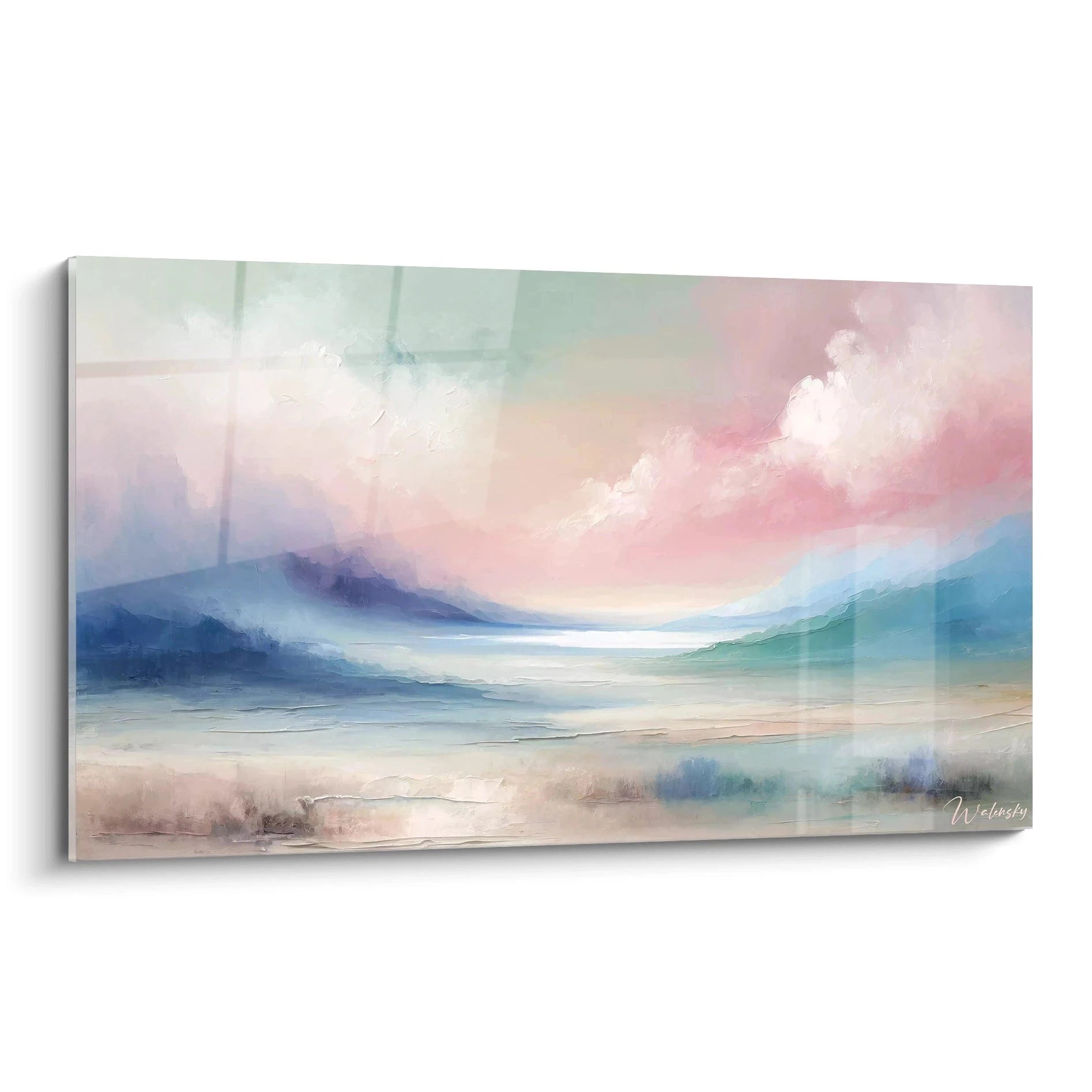

How to balance a painting that always leans to one side?
October 11, 2025 · 17 min read · by Walensky
You've just hung your new favorite artwork on the wall with so much enthusiasm, and then... disaster! It stubbornly leans to the right, as if wanting to escape from your living room. You straighten it once, twice, ten times...
And yet, a few hours later, here it is again, back in its crooked position, defying all laws of physics and your patience. This feeling of imperfection jumps out at you every time you pass the wall, turning your decor pleasure into a real daily obsession.
You've already tried the level, tightened the screws, changed the hooks... Nothing works! And the worst part is that your guests immediately notice it, discreetly pointing at this anomaly that spoils the harmony of your room.
Rassurez-vous : this problem has nothing to do with your DIY skills! The real reason lies in invisible technical details that the vast majority of people completely ignore. It's exactly like trying to make a bicycle stand without understanding balance.
In 8 minutes, you will master the 3 professional hanging secrets that guarantee a perfectly stable painting, and you will finally be able to enjoy your decor without this permanent frustration!
Why does a leaning painting instantly ruin the atmosphere of a room?
A crooked painting acts like a grain of sand in a Swiss watch mechanism. Our brain, programmed to detect imbalances, immediately focuses on this imperfection and cannot detach itself. It's like having a thorn in your foot: impossible to ignore! If you wait any longer, your gaze will constantly be drawn to this defect, and you will end up associating this beautiful painting with a feeling of chaos rather than the serenity you are seeking.
🏠 Customer testimonial: "I had hung my favorite abstract canvas in the entrance. For months, it leaned slightly, and I told myself 'I'll get used to it'. Result: my guests systematically asked me if I had foundation problems in the house!"
Conversation with a decor expert
The golden rule of perfect hanging: A well-balanced painting becomes invisible... in the right sense! Your gaze focuses on the artwork itself, not its position. The result? Instant harmonious atmosphere that enhances your interior.

But why does your painting refuse to stay straight?
Your painting keeps tilting, you straighten it mechanically every morning while drinking your coffee, and you start to suspect your wall is crooked. You may have even invested in a more precise level, convinced that the problem lies with your installation...
In reality, the problem doesn't come from you or your wall, but from a set of invisible forces acting on your painting. It's like trying to balance a mobile without understanding the balance points: even with the best intentions, it's doomed to fail.
Imagine your painting as a tightrope walker on his wire: he needs several perfectly calculated support points to maintain his balance. Without this understanding, you are fighting physics itself.
Weight distribution: the secret no one tells you
Contrary to what one might think, the weight of a painting is not distributed evenly. The frame, the canvas, the glass (if any) create different density zones that constantly pull to one side. It's exactly like a poorly balanced suitcase that always tips over on the same side.
Here's a telling analogy: try carrying a shopping bag with a bottle of water on one side and chips on the other. Even if the two items seem to "weigh the same", the bag will naturally tilt towards the denser bottle.
This weight inequality explains why your painting always returns to the same crooked position, creating that permanent frustration that makes you doubt your abilities. Once you master this principle, hanging becomes as easy as putting on your shoes.
🧪 Instant test: Hold your painting out in front of you by the center. Observe which side it naturally tilts towards. That heavier side will always be the one that "wins" once hung on the wall!
Micro-vibrations: the silent enemy
Here's something even some professionals don't know: your house is constantly moving. Not visibly, but footsteps in the stairwell, door closures, even trucks passing outside create micro-vibrations that gradually destabilize a poorly secured painting.
It's like a house of cards that seems stable, but collapses with a single breath. Your painting, subjected to these permanent micro-movements, eventually "slides" to its position of least resistance.
Result: you feel like your painting moves on its own, which explains this frustrating feeling of having to readjust again and again. The solution is not to tighten it more, but to use an anchoring technique that absorbs these movements.
The single hanging point syndrome
Here's the mistake most people make: hanging a painting on a single point. Even with the best hook in the world, it's like trying to balance on one leg: possible, but inherently unstable.
Observe a professional at work: he always uses multiple anchor points that "talk" to each other to maintain balance. It's the difference between a one-legged stool (which tips over) and a four-legged chair (stable by nature).
This revelation explains why your attempts to tighten it don't do anything: you are reinforcing an unstable system instead of creating a true balance system. Once you switch to multi-points, it's like discovering the wheel after having pushed loads with your arms.
🚩 The 3 telltale signs:
- The painting always returns to the same angle: Sign of an uncompensated weight imbalance, like a rigged scale
- It tilts more after people pass through the room: Reveals a fixation sensitive to vibrations, like an unstable house of cards
- The inclination worsens over time: Indicate a mounting system that "fatigues" under the weight, like a rope that stretches
The domino effect of invisible deformations
Here's the factor that no one suspects: your mounting system deforms millimeter by millimeter under constant weight. It's like an elastic band that gradually retains its new shape after being stretched. This invisible deformation creates a new equilibrium point... off-center! The longer you wait, the more this "new normal" sets in, making readjustment increasingly difficult.
The universal law of stable mounting: A well-balanced painting does not fight physics, it uses it. Check it by lifting it slightly: if it returns naturally to the horizontal, your system is perfect.
| ❌ What we believe | ✅ The reality | 💡 Why | 🎯 The benefit |
|---|---|---|---|
| The more you tighten, the better it holds | Balance is more important than force | Physics always seeks natural balance | Durable stability without effort |
| One large hook is always enough | The distribution of points counts more | Like the wheels of a car: balance is better than size | Invisible and elegant mounting |
| The bubble level solves everything | Internal imbalances must be compensated | The weight is never perfectly centered in a painting | Stability that lasts over time |
| If it's tilted, the wall is crooked | It's often a problem of fixing | Micro-movements reveal the weaknesses of the system | Confidence regained in your skills |
The 3-pillar method for perfect mounting
Now that you understand why your painting is acting rebellious, let's move on to the solution! This method follows the logic of an architect: first the solid foundations, then the structure, and finally the finishing touches. In a maximum of 30 minutes, you will obtain a result that rivals professional galleries, and above all... that lasts!
🎯 Overview of your success: Step 1 - Diagnosis and preparation (like a doctor who examines before operating), Step 2 - Installation of the multi-point system (creating your stability network), Step 3 - Fine adjustments and locking (the master's final touch). At each step, you will feel the difference!
Step 1: The precise diagnosis (the key to everything)
This step may seem basic, but it is the one that determines the success of everything else! Like an architect who studies the terrain before building, you will identify the forces at play to master them. The advantage? No more approximations that lead to disappointments!
Your professional diagnostic tools
- A spirit level of at least 30 cm: Opt for a model with graduation (avoid mini novelty levels). It reveals imbalances invisible to the naked eye. Find it in any good hardware store. Quality criterion: the bubble must return exactly to the center when you tilt the level.
- A metal measuring tape: Metal retains its shape unlike plastic which sags. It ensures perfectly reproducible measurements. Test its accuracy: bend it and unfold it, the measurement must remain identical.
- A 2H pencil: Harder than a standard pencil, it marks finely and erases easily. This millimeter precision makes all the difference between an amateur and a professional hanging.
Now, let's get to work!
Step-by-step execution
Find the real center of gravity: Place your painting face down against a bed or sofa, slide your index finger under the frame as you move towards the center until you find the perfect balance point. Mark this point discreetly. Why? Because this point is never exactly at the geometric center!
⏱️ Time: 2 minutes | ✅ Successful when: The painting balances on your finger | ⚠️ Attention: Don't rely on the center of the frame, the internal distribution may be asymmetrical
Measure critical distances: From the center of gravity to the edges, then from that center to the existing mounting points. Note everything! These measurements reveal why your painting is tilting and in what direction to compensate.
⏱️ Time: 3 minutes | ✅ Successful when: You have 4 precise measurements noted | ⚠️ Attention: A 2mm error can ruin the entire balance
Test the wall's stability: Press firmly 50cm from your future mounting point. A wall that "sounds hollow" or moves slightly will require special wall plugs. This test avoids unpleasant surprises after installation!
⏱️ Time: 1 minute | ✅ Successful when: You know the nature of your support | ⚠️ Attention: An unstable wall sabotages the best mounting system
✅ Validation step 1: You know the true center of gravity, the exact measurements, and the nature of your wall. If something seems unclear, repeat this part: 5 more minutes now will save you 2 hours of hassle later!
Step 2: Installing the multi-point system
Now comes the magic part! You are going to create a stability network that will transform your recalcitrant painting into a model of wisdom. This step marks the transition from chronic instability to total serenity. The effect is so spectacular that you will wonder why you waited so long!
Your stability arsenal
- 2 to 4 hooks of identical quality: Choose models made of steel with anti-corrosion coating. They better withstand micro-movements than plastic hooks. Where? Hardware stores or specialty sites. Quality test: the hook should not bend under your manual pressure.
- Plastic-coated wiring: More flexible than wire, it absorbs vibrations and distributes tensions better. The standard gauge (1.5mm) is suitable for most paintings. Its flexibility naturally compensates for micro-displacements.
- Wall plugs suitable for your wall: Molly for hollow walls, fischer for concrete, screw + classic wall plug for solid wall. An unsuitable wall plug is like building on sand: everything collapses sooner or later.
Installing the stability network
Position the anchor points: Transfer two points located at equal distance from the calculated center of gravity, spaced 15 to 25cm depending on the width of the painting, onto the wall. This distance creates a "triangle of forces" that naturally cancels out imbalances.
⏱️ Time: 5 minutes | ✅ Success when: Your marks are perfectly symmetrical and level | ⚠️ Warning: A 3mm gap between the two points will create a permanent imbalance
Install the hooks with the clockmaker's technique: Drill with a drill bit slightly smaller than your wall plugs, insert the wall plugs straight, screw in the hooks counting the turns so that they are identically positioned. This precision avoids asymmetrical tensions.
⏱️ Time: 8 minutes | ✅ Success when: The two hooks point in the same direction with the same inclination | ⚠️ Warning: A crooked hook pulls harder than the other
Create the distribution system: Fix the cable with a slight curve between the two hooks (not taut like a guitar string!). This curve absorbs vibrations and distributes the weight naturally. Hang your artwork in the center of this curve.
⏱️ Time: 3 minutes | ✅ Success when: The artwork stabilizes immediately without oscillation | ⚠️ Warning: A wire that is too tight transmits all vibrations to the artwork
Step 3: The master's adjustments
You're almost there! This final step transforms a good hanging into a masterpiece of stability. It's the difference between a musician who knows how to play and a virtuoso who makes souls vibrate. Your artwork will not only stay straight, but will sublimate your decoration!
Millimetric refinement
Adjustment by micro-movements: Move the hanging point slightly on the wire (not the wire itself!) in small movements of 5mm. Observe the artwork's reaction. This technique compensates for internal imbalances without reinstalling.
⏱️ Time: 5 minutes | ✅ Success when: The artwork remains perfectly horizontal even after a slight shake | ⚠️ Warning: Patience! Large movements break the balance you have just created
The final validation test: Gently lift the artwork 2cm and release. It should return exactly to its initial position, without oscillation. This test reveals whether your system is perfectly balanced or if it "cheats" by relying on external forces.
⏱️ Time: 1 minute | ✅ Success when: Immediate return to horizontal without swaying | ⚠️ Warning: If the artwork oscillates or stabilizes elsewhere, re-adjust the previous adjustment
The criterion for absolute perfection: Your system is perfect when you can vacuum nearby, slam a door, or make the floor tremble without the artwork moving a millimeter. At that level, you master the art of professional hanging!
Congratulations! You have just discovered the hanging secrets of art galleries. But wait, there are still a few pro tips that will make you a true expert. These subtleties make the difference between a good handyman and a master of hanging!
🎓 Expert level - The invisible damper technique: Slip small felt washers between the frame and the wall at the lower corners. They absorb micro-vibrations and prevent marks on the wall. This museum curator's trick keeps your artwork stable even in the most "lively" homes!
"But my wall is plasterboard, will it hold?"
"I'm afraid my plasterboard wall won't support this system with several hooks..."
Excellent question! Actually, it’s the opposite: the multi-point system distributes the weight better than a single large nail that concentrates all the load on one point. It’s like distributing the weight of a shelf over several brackets rather than just one. With the right Molly anchors and this technique, even a drywall wall can support paintings up to 15kg without any problems. The trick? Space your attachment points to hit several studs if possible.
🔍 Confidence test: First, install the system with a less valuable object (like a small mirror) to validate its solidity. Once you’re confident, apply the method to your valuable painting!
The 5 pitfalls that ruin even the best installation
Warning! Even when following the method perfectly, some sneaky errors can compromise your result. I’m revealing these pitfalls to avoid the frustration of seeing your beautiful work ruined by a "detail" that isn't one.
- 🚫 Using hooks of different sizes: It’s tempting to use what you have on hand, but different hooks create uneven tension points. Result: your painting tilts towards the weakest hook! Invest in identical hooks, it’s the guarantee of perfect balance.
- 🚫 Installing hooks "by eye": A height difference of just 2mm between two hooks is enough to create a permanent imbalance. Even professionals systematically use a level! Never trust your eye, even an excellent one.
- 🚫 Tensing the wire like a guitar string: A wire that is too tight transmits all vibrations and prevents the painting from self-stabilizing. The right technique? A slight curve that acts as a natural damper.
- 🚫 Neglecting the "break-in" period: Any attachment system needs 48 hours to fully stabilize. During this period, slight adjustments may be necessary. That’s normal, not a failure!
- 🚫 Hanging a heavy painting directly: Always start by testing your system with a lighter object. This reveals any potential weaknesses without risking damage to your valuable painting. Caution is intelligence!
🛡️ Your safety checklist: Before declaring victory, check: both hooks are at the same level (±1mm), the wire forms a natural curve, the painting returns to horizontal after a slight shake, no attachment point moves when you pull on it. If all these points are green, your installation is indestructible!

Your expert questions decrypted
For your first painting: allow 45 minutes of concentration. But the good news? From the second, you’ll be at 20 minutes, and by the fifth, it’s automatic! The time investment is quickly worth it. Tip: start with a medium-sized painting in a low-traffic room to get the hang of it without stress.
Between 8 and 25€ depending on the size of your painting and the type of wall. It’s cheaper than a dinner at a restaurant! In this budget: quality hooks (5-12€), suitable anchors (2-8€), wiring (1-3€), small hardware (2€). Prioritize quality: 3€ hooks that fail cost more than a 15€ system that lasts 20 years.
Absolutely! Concrete, brick, drywall, stone... the principle remains the same, only the anchors change. Solid wall = Fischer or Rawl anchors, hollow wall = Molly anchors, old wall = chemical anchors. Your hardware store salesperson will guide you perfectly with these precise names.
Not only can you, you MUST! The larger and heavier a painting is, the more essential this method becomes. For artworks over 80cm or 10kg, simply add a third hanging point in the center. The principle remains the same: distribute intelligently rather than blindly concentrate.
No need to panic! In 95% of cases, it's enough to adjust the position of the painting on the wire by a few millimeters. If the problem persists, check that your two hooks are perfectly level. A small level, and that's it! Rome wasn't built in a day, perfection sometimes takes 2-3 micro-adjustments.
Your transformation: from daily annoyance to decorative pride
In a few weeks, when your friends admire the perfect horizontality of your paintings and ask you your secret, you will smile discreetly. No more reflexive straightening when passing by! Your gaze now rests on the artwork itself, not on its position. This visual serenity literally transforms the atmosphere of your interior.
But beyond the aesthetic aspect, you have acquired a valuable technical skill that you will use for all your future hangings. Mirrors, photo frames, decorative shelves... This logic of balance and distribution applies everywhere! Your confidence in DIY has just taken a spectacular leap.
The best part? You only need your hands and 45 minutes to get started. No complex learning, no expensive specialized tools. Just a logical method that you will master for life. So, which painting will you free from its curse of imbalance first?
🚀 Your mission, should you choose to accept it: Transform your daily frustration into decorative pride! In one hour, your painting will be the perfect example of what a successful hanging is. Your guests will notice... for the right reasons this time!
Also read: 🔧 Read more articles on hanging techniques
Explore our collections


