In 1301, a luminous trail crossed the European sky and shook the collective imagination. Medieval chroniclers noted with fascination the passage of Halley's comet, visible for weeks. A few years later, in the Scrovegni Chapel in Padua, Giotto di Bondone immortalized this celestial spectacle by radically transforming Christian iconography: for the first time in art history, the star of Bethlehem took the form of a blazing comet. This pictorial revolution reveals to us much more than a simple astronomical observation. It testifies to a major shift: the transition from medieval symbolism to the observation of reality, the birth of a new way of seeing and representing the world. Here's what this fresco brings us: an understanding of a fundamental artistic turning point, an illustration of a nascent scientific curiosity, and the perfect example of how lived experience transforms creation. You may have always wondered why some works seem to speak directly to our time, why they resonate with a disturbing modernity. Let me tell you the extraordinary story of this comet that changed art forever, and how Giotto dared to paint what he had seen rather than what was expected of him.
The sky of 1301: when Halley illuminates medieval Europe
Imagine the fear and wonder of the inhabitants of Florence, Padua or Venice in this year 1301. In the night sky appears a spectacular luminous trail, stretching across several degrees of the celestial vault. Halley's comet, during one of its most remarkable passages, offers a spectacle that no one has ever seen in their lifetime. Comets, at that time, inspire as much terror as fascination. They are considered divine omens, heavenly messages announcing major upheavals, royal births or imminent catastrophes.
Giotto, then at the height of his art and working on the cycle of frescoes in the Scrovegni Chapel, cannot remain indifferent to this phenomenon. Unlike his contemporaries who see only a mystical sign in it, the Florentine artist observes with the eye of an early scientist. He notes the characteristic shape: a bright nucleus extended by a luminous tail, totally different from traditional representations of the star of Bethlehem in the form of a symmetrical-branched star.
The visual memory of an observant genius
What distinguishes Giotto from the artists of his time is his extraordinary ability to memorize and reproduce what he observes. Halley's comet remains visible for several weeks, giving him ample time to study its structure, its variations in brightness, the graceful curve of its trail. This careful observation is part of his overall approach: Giotto is the first Western painter systematically seeking to represent three-dimensional reality, authentic human emotions, details of the natural world.
The Adoration of the Magi: an iconographic revolution
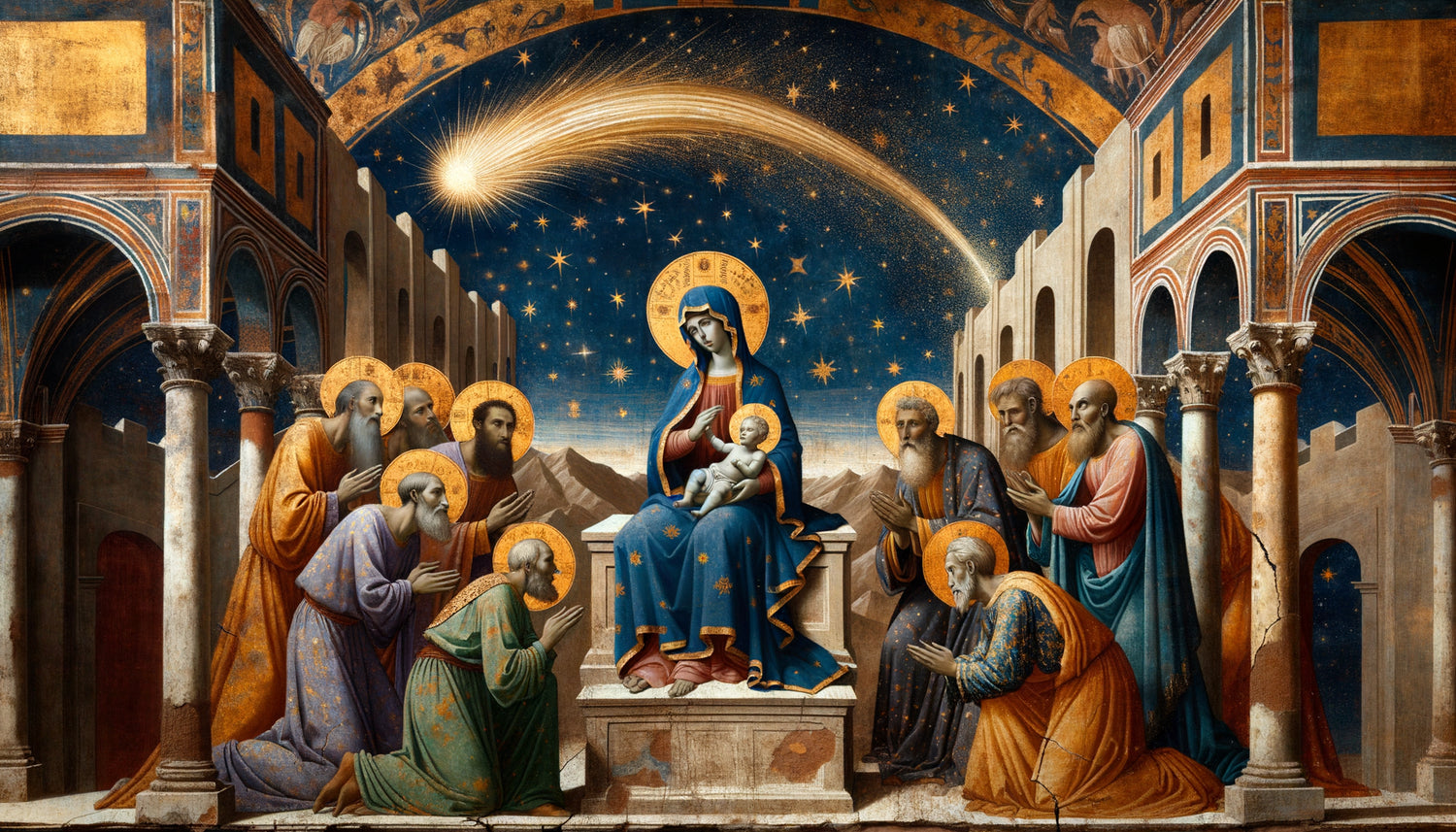
In the fresco of The Adoration of the Magi, painted around 1305, Giotto accomplished a revolutionary artistic gesture. Where all painters before him depicted the Star of Bethlehem as a conventional star with eight or sixteen branches, sometimes gilded with gold leaf, always geometric and symbolic, he chose to paint a comet with astonishing precision. The bright, compact and luminous core extends into a long golden trail that seems to traverse the vault of the chapel's sky.
This representation marks the collision between two worlds: that of rigid medieval symbolism and that of the nascent Renaissance’s naturalistic observation. Giotto does not merely mechanically reproduce what he saw in the sky; he establishes a bold connection between a contemporary astronomical phenomenon and a biblical event located thirteen centuries earlier. This approach is evidence of a brilliant intuition: if God placed an extraordinary star to signal the birth of Christ, why wouldn’t that star resemble the most spectacular celestial manifestations we can observe?
A composition that guides the gaze
In the fresco of Padua, the comet is not a mere decorative detail. It constitutes the focal point of the composition, literally directing the gazes of the Magi towards the Infant Jesus. Giotto uses the natural trajectory of the cometary trail to create a visual guideline, a luminous path that connects the sky to the earth, the divine to the human. This functional use of the comet demonstrates that his choice was not only scientific or anecdotal, but deeply considered from a narrative and spiritual point of view.

When scientific observation meets medieval faith
Giotto’s choice to represent the Star of Bethlehem as a comet raises a fascinating question: how to reconcile empirical observation with religious tradition? At the beginning of the 14th century, the Catholic Church dominates all aspects of intellectual and artistic life. Yet, Giotto dares to propose an interpretation that radically departs from the established iconography.
This boldness is set within a broader context of intellectual renewal. Medieval Europe begins to rediscover Aristotelian texts, the observation of nature gradually gains legitimacy, and thinkers like Roger Bacon advocate for an experimental approach to knowledge. Giotto, although illiterate according to some sources, fully participates in this movement through his artistic practice. By choosing to paint what he actually saw rather than what tradition prescribed, he affirms the validity of sensory experience as a source of truth.
A renewed visual theology
Paradoxically, Giotto's realism reinforces rather than weakens the spiritual dimension of the scene. By making the comet tangible, almost palpable in its golden luminosity, the artist suggests that divine miracles are part of the real world. The star of Bethlehem is no longer an abstract symbol floating in an undefined sacred space, but an authentic celestial phenomenon that could have been observed and admired by human witnesses. This approach humanizes the biblical narrative, making it accessible and credible for the faithful who contemplate the fresco.
The legacy of an intuition: from Giotto to modern astronomers
History does not stop at the walls of the Scrovegni Chapel. Six centuries later, in 1910, French astronomer Camille Flammarion established an explicit link between the comet painted by Giotto and Halley's Comet, suggesting that the artist had been directly inspired by the observation of 1301. This hypothesis, widely accepted today, has transformed the fresco into a historical document of inestimable value, visual testimony to an astronomical phenomenon over seven centuries old.
Even more fascinating, some researchers have speculated on the possibility that the historical star of Bethlehem was actually a comet, perhaps an earlier passage of Halley around 12 BC, or another bright comet, or even an exceptional planetary conjunction. Giotto unknowingly offered an interpretation that anticipates modern astronomical hypotheses about the real nature of the celestial phenomenon mentioned in the Gospel according to Matthew by several centuries.
A cosmic recognition
The influence of this representation even crosses the borders of art to reach official astronomy. In 1986, during the last passage of Halley's Comet, the European Space Agency names its exploration probe “Giotto” as a direct tribute to the painter who, almost seven centuries earlier, was the first to faithfully represent a comet in the history of Western art. This recognition testifies to the universality and lasting nature of his observation.

What this comet teaches us about creativity
Beyond the historical and astronomical anecdote, Giotto's comet offers a timeless lesson on the nature of artistic creation. It reminds us that the greatest innovations often arise from the confrontation between tradition and direct observation, between what we are told to see and what we actually see. Giotto could have, like all his predecessors, mechanically reproduced the established iconography of the star of Bethlehem. Instead, he chose to trust his experience, to prioritize the authenticity of his vision over the safety of convention.
This boldness resonates particularly today, at a time when we are constantly solicited by models, trends, and pre-established aesthetic standards. The comet of Padua invites us to cultivate our own gaze, to dare the singularity of our perspective, to transform our personal observations into unique creative expressions. It teaches us that true innovation does not come from gratuitous rupture, but from deep attention paid to reality.
Let the cosmos inspire your interior
Discover our exclusive collection of space artworks that capture the celestial magic in your daily life, to transform every glance into a stellar journey.
Contemplate your own star
When you observe the night sky, remember this Florentine painter who, more than seven centuries ago, looked up at a luminous trail and understood that he was witnessing something extraordinary. Giotto had neither telescope nor astronomy treatise, only his eyes, his memory, and his creative courage. His comet of Padua remains one of the most moving testimonies to humanity's ability to transform observation into art, science into poetry, the fleeting into the eternal. It reminds us that the most inspiring moments are often those when we dare to see the world as it is, not as we are told it should be. So look up, observe, memorize, and let your own experience of the world transform your way of representing and inhabiting it.
Frequently asked questions
Did Giotto really observe Halley's Comet before painting his fresco?
Yes, according to historical research, Giotto was active in Italy during the particularly spectacular passage of Halley's Comet in 1301. The fresco of the Adoration of the Magi in the Scrovegni Chapel in Padua was created between 1303 and 1305, just a few years after this observation. The accuracy with which he depicts the characteristic morphology of a comet – bright nucleus and long tail – strongly suggests that he drew direct inspiration from this exceptional celestial phenomenon. This hypothesis, formulated by astronomer Camille Flammarion at the beginning of the 20th century, is now widely accepted by art historians and astronomers. Giotto's representation thus marks a major turning point: for the first time in Western art, an artist abandons traditional symbolic representation to prioritize scientific observation of reality.
Was the historical Star of Bethlehem really a comet?
This question has fascinated astronomers and historians for centuries. Several scientific hypotheses have been put forward to explain the celestial phenomenon mentioned in the Gospel according to Matthew. The cometary theory is one of the most compelling: some researchers have calculated that a bright comet could have been visible between 5 and 12 BC, a period compatible with the historical dating of Christ's birth. Other scientists favor the hypothesis of an exceptional planetary conjunction between Jupiter and Saturn, or that of a supernova. What is remarkable is that Giotto, by his artistic intuition, proposed an interpretation that anticipates these scientific questions by several centuries. By choosing to represent the Star of Bethlehem as a comet, he suggests that divine manifestations can take the form of real and observable astronomical phenomena, reconciling faith and reason in a visionary way.
Can this fresco be seen today in Padua?
Absolutely, and it's an experience not to be missed if you visit Northern Italy! The Scrovegni Chapel in Padua is remarkably well-preserved and accessible to the public. Listed as a UNESCO World Heritage site, it houses one of the most important cycles of frescoes in Western art history. To protect these invaluable works from degradation due to humidity and carbon dioxide, visits are strictly regulated: limited groups, mandatory reservation, and prior passage through a decontamination room. But these constraints are well worth it. Standing face to face with this comet painted over seven centuries ago, in the dim light of the chapel, is an extraordinary moment of emotion. You will see how Giotto not only revolutionized the representation of space and human emotions, but also how he dared to inscribe within a sacred narrative his own observation of the cosmos, thus creating a sublime bridge between earth and sky, between art and science.