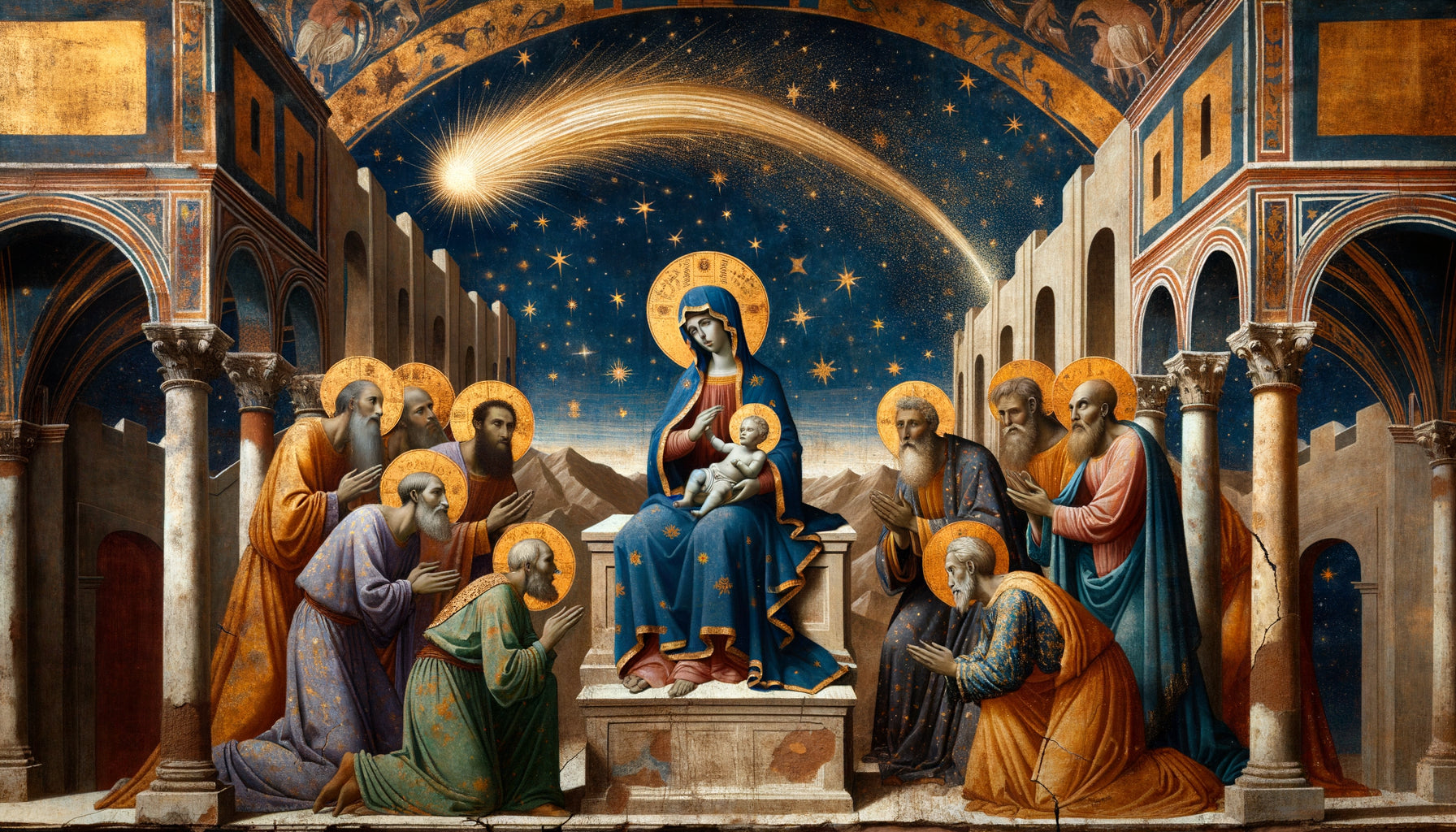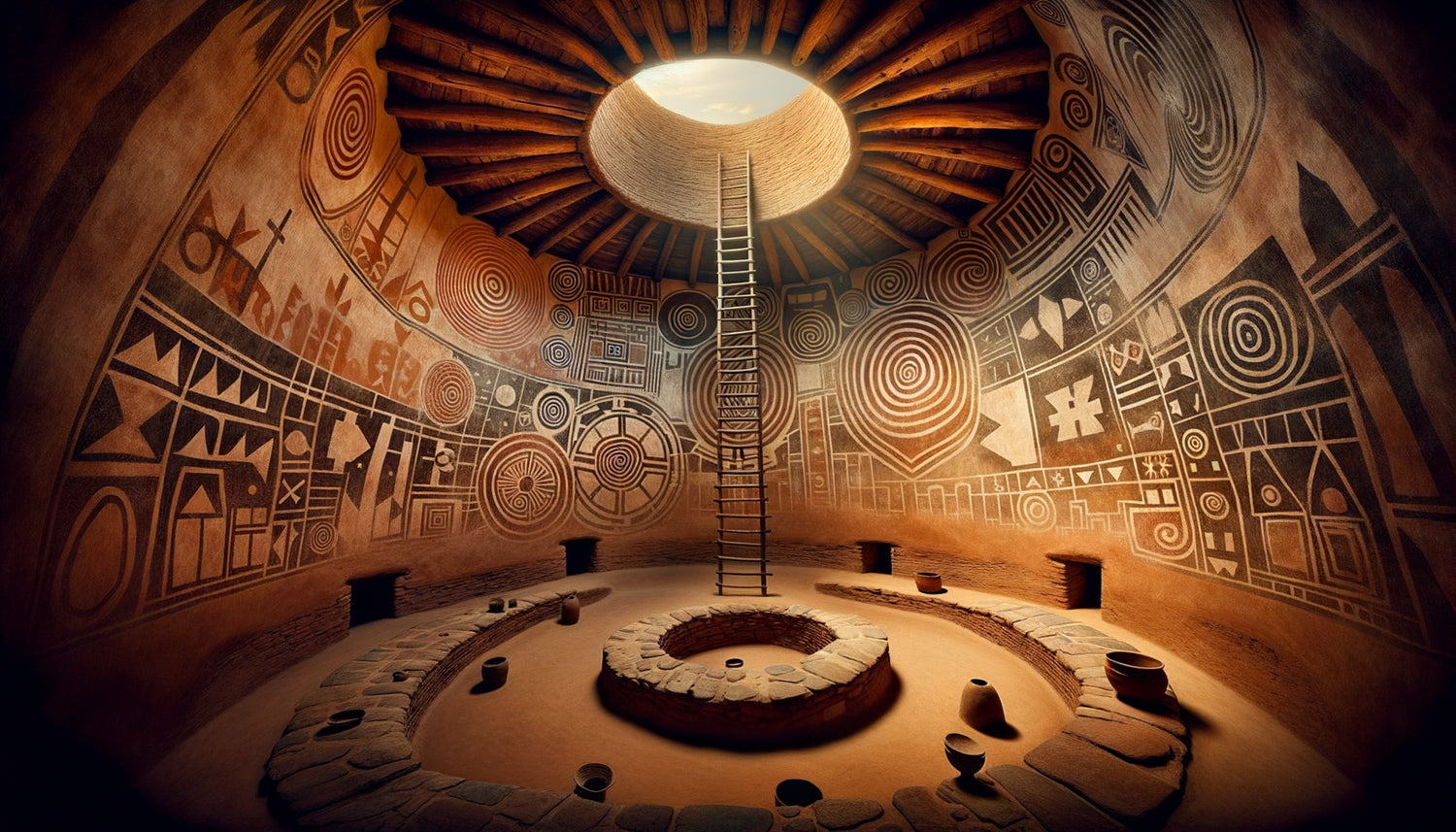
Imagine descending a wooden ladder into a circular underground chamber, barely illuminated by a central fire. Your eyes gradually adjust to the dimness, and suddenly you see them: monumental frescoes depicting winged serpents, stars, cosmic spirals painted directly onto the adobe walls. You have entered a kiva pueblo, this sacred sanctuary where art becomes a bridge between worlds.
Here's what the cosmological paintings of the kivas brought to the Pueblos: they created a space for spiritual transformation where the visible and invisible met, they taught the laws of the universe to successive generations through a universal symbolic language, and they allowed communities to renew their relationship with the cosmos during ceremonies essential to maintaining the balance of the world.
We live today in spaces disconnected from the sacred, functional interiors but often lacking deep meaning. How did our ancestors manage to create places charged with such spiritual power? How did wall art transform a simple underground chamber into a cosmic portal?
Rest assured: understanding the ritual function of these ancient paintings requires no training in archaeology. Simply look at these spaces with your heart and grasp how each visual element participated in a transformative collective experience. This article reveals the secrets of these painted sanctuaries and how they redefined the very notion of sacred space.
The kiva: much more than a ceremonial chamber
The kiva pueblo was not simply an underground meeting place. This circular, semi-buried architecture symbolically reproduced the womb of Mother Earth. By descending into the kiva, participants undertook an initiatory journey, leaving the ordinary world to enter a sacred space-time.
The very structure of the kiva embodied a vertical cosmology: the sipapu, a small hole dug in the floor, represented the original point of emergence through which ancestors came from the lower worlds. The central hearth symbolized the vibrant heart of life. The upper opening allowed smoke to rise to the celestial realms, creating a vertical axis connecting the three levels of the pueblo universe.
It is within this highly symbolic architectural context that the cosmological paintings took on their full meaning. They were not mere decorations but constitutive elements of the spiritual machine that was the kiva.
When walls become portals: the transformative function of frescoes
The ritual paintings of the kiva pueblos primarily served to create a visual environment conducive to consciousness transformation. Imagine yourself sitting in the dimness, your gaze captivated by monumental feathered serpents undulating on curved walls, hypnotic geometric patterns representing rain-bearing clouds, ancestral figures guarding the four cardinal directions.
These murals served as supports for collective meditation. During multi-day ceremonies, participants would gaze at these images until they came to life in their minds, facilitating visions and spiritual journeys. Cosmological paintings became gateways to other dimensions of reality.
The color palette itself carried a precise ritual intentionality: white clay evoked clouds and the purity necessary for prayer, red ochre recalled the nurturing earth and vital blood, charcoal black symbolized the mystery of the underworld, while turquoise, a precious pigment, represented the sacred sky and water essential for survival in these arid regions.
The language of cosmic symbols
Each symbol painted in a kiva possessed multiple ritual functions. The feathered serpent, present in countless kivas, was not just an artistic representation: it embodied the vital force circulating between heaven and earth, water snaking through rivers, lightning zigzagging from clouds. Contemplating this symbol during rain ceremonies was to invoke these forces, drawing them towards the community.
The ubiquitous spirals in Pueblo cosmological paintings simultaneously represented the cycle of seasons, the movement of the sun, the migration of souls, and the energy circulating through the cosmos. These repetitive patterns created a visual rhythm that facilitated entry into an altered state of consciousness, essential to ceremonial practices.

The silent teaching: transmitting cosmology through image
One of the essential functions of kiva ritual paintings was pedagogical. In a culture where oral transmission prevailed, these murals served as wall books teaching young initiates the structure of the universe, founding myths, and the spiritual responsibilities of each member of the community.
The four cardinal directions, often represented by totemic animals or specific colors, taught the spatial organization of the Pueblo cosmos. Each direction possessed its qualities, its guardian spirits, its associated seasons. A young boy participating in his first initiation ceremony learned at a glance this sacred geography simply by observing the walls of the kiva.
Agricultural cycles, vital to these societies, were encoded in the cosmological compositions. Overlapping horizontal bands sometimes represented the different layers of the world, the stages of growth of sacred corn, or the steps of the annual solar journey. These paintings functioned as spiritual calendars, reminding communities of the appropriate time for each ceremony.
Collective memory embodied
The kiva pueblo paintings also preserved the mythological memory of the community. Some frescoes narrated the emergence of the first humans from the underworld, while others depicted cultural heroes who brought corn, fire, or social laws. These visual narratives kept alive the collective identity and sense of belonging to an ancestral lineage.
Unlike works intended to last forever, many of these paintings were periodically covered and repainted, sometimes creating up to forty superimposed layers in some kivas. This renewal ritual reflected the cyclical conception of time: each generation renewed the symbols, maintaining their living power.
Renewing cosmic order: direct ceremonial function
At the heart of their use, the kiva cosmological paintings directly served ceremonies aimed at maintaining balance between the forces of the universe. In Pueblo thought, the world was not a stable given but a fragile equilibrium requiring constant ritual maintenance.
During rain ceremonies, essential in the arid climate of the southwestern United States, participants danced and sang facing paintings depicting clouds, lightning, and water serpents. The frescoes amplified the ritual intention, concentrated collective energy, and served as a focal point for prayers addressed to the spirits of water.
Male initiation ceremonies, often lasting several days in the kiva, used the ritual paintings as progressive revelations. Throughout the initiation, young boys learned to decode the layers of meaning of each symbol, gradually accessing the mysteries reserved for adult men.
The kiva as a microcosm
The cosmological paintings transformed the kiva into a true microcosm, a miniature replica of the entire universe. The four walls corresponded to the four sacred directions. The ceiling sometimes represented the celestial vault with its constellations. The floor embodied the nourishing earth. By entering this totally painted and symbolically charged space, participants literally entered inside the cosmos.
This design allowed ceremonies performed in the kiva to have a universal reach. A ritual accomplished in this microcosm affected the entire macrocosm. The paintings were interfaces enabling this magical connection between the small underground space and the immensity of the universe.

The living heritage: contemporary kivas and their inspiration
Communities pueblos still use kivas for their traditional ceremonies. Although photographs of these sacred spaces remain forbidden out of respect for their sanctity, we know that the tradition of ritual paintings continues in some active kivas.
This millennial continuity is a testament to the lasting power of these painted spaces. The ritual functions of cosmological paintings were not mere cultural practices abandoned to modernization: they responded to deep spiritual needs that contemporary Pueblos still feel.
For us, this tradition offers a fascinating inspiration. It reminds us that our living spaces can be much more than functional: they can be imbued with intention, bearers of symbols that connect us to something greater. Wall art, far from being purely decorative, can transform our relationship with our daily environment.
Transform your interior into a cosmic inspiration space
Discover our exclusive collection of space paintings that captures the majesty of the cosmos and creates in your home a focal point for contemplation and wonder.
Creating sacredness: lessons for our contemporary spaces
What can we learn from pueblo cosmological paintings for our modern interiors? First, that wall art can do more than embellish: it can define the intention of a space. A meditation room, a creative studio, even a living room can benefit from wall artworks chosen for their personal symbolic resonance.
Next, the symbolic coherence of kivas teaches us the power of a holistic vision. Rather than accumulating disparate decorative elements, imagine a space where each visual element contributes to a unified atmosphere, a coherent narrative. This approach transforms a room into a true immersive environment.
Finally, the cyclical dimension of Pueblo paintings, regularly renewed, invites us to consider our spaces as living and evolving. Changing a wall mural according to the seasons, rearranging a space regularly to reflect personal growth: these are practices that keep our living spaces dynamic and meaningful.
Pueblo kivas and their cosmological paintings remind us that inhabiting is not only occupying a space, but creating a world. A world where the visible and the invisible dialogue, where art becomes spiritual language, where walls tell our place in the universe.
Frequently asked questions about Pueblo kiva cosmological paintings
Can you visit kivas with their original paintings?
Most kivas still used for traditional ceremonies are strictly forbidden to non-initiates, and photographing them would be a serious breach of respect. However, several archaeological sites in the southwestern United States feature ancient kivas accessible to the public. The Mesa Verde National Park in Colorado offers guided tours of historic kivas, some of which retain traces of murals. The Bandelier site in New Mexico also features restored kivas. These remains, even partial ones, allow you to grasp the unique atmosphere of these sacred spaces. To understand the complete ritual function of cosmological paintings without violating the sanctity of living practices, prioritize museums such as the Museum of Indian Arts and Culture in Santa Fe, which presents educational reproductions and explanations contextualized by members of the Pueblo communities themselves.
Did different Pueblo communities use the same symbols in their kiva paintings?
Although sharing a common cosmology, each pueblo developed its own symbolic language with fascinating regional variations. The Hopis of Arizona favored certain motifs related to their specific totem clans, while the pueblos of the Rio Grande valley incorporated symbols reflecting their particular environment. However, constants run through all traditions: the serpent as an aquatic and celestial symbol, the four sacred directions, cloud and lightning patterns essential in these arid regions. This diversity within unity testifies to the cultural richness of the pueblo. Each kiva was unique, its paintings reflecting the history, geography, and specific spiritual visions of its community. This personalization made each sacred space deeply rooted in its local context while participating in a shared cosmological vision.
How were the paintings technically made in the kivas?
Pueblo ritual artists crafted their pigments from locally sourced natural materials: white clays and red ochres, charcoal for blacks, ground minerals to obtain yellows and sometimes precious turquoise. These pigments were mixed with water and often an organic binder such as plant sap. Application was directly onto adobe walls, sometimes previously smoothed with a plaster. Artists used brushes made with vegetable fibers, feathers or their own fingers for the flat areas. The painting process itself was ritualized: prayers accompanied each step, and only certain individuals possessing the appropriate sacred knowledge could create these frescoes. This ritual dimension of the creative process was as important as the final result. The paintings were not individually signed but considered collective works inspired by ancestral spirits, executed by human hands in service of the entire community.