One morning in 1906, in her Stockholm studio, Hilma af Klint traces perfect circles on a large canvas. She doesn't paint what she sees, she paints what she feels: the vibrations of the invisible, the hidden dimensions of the universe. Her celestial spheres do not represent astronomical planets, but spiritual portals to a cosmic understanding of existence. Today, these mysterious forms fascinate both art collectors and seekers of meaning.
Here's what the esoteric significance of Hilma af Klint’s celestial spheres reveals to us: a spiritual map of human evolution, a visual language for translating the invisible, and a unifying vision of the cosmos and consciousness. Three keys to understanding why these abstract paintings, created nearly fifty years before their recognition, are transforming our relationship with spiritual art.
You may admire the aesthetics of her concentric circles, her luminous spirals, but you wonder what they really mean. How do you decipher these symbols? Why those specific colors? What intention guided her hand? This visionary artist deserves more than a superficial contemplation. She invites us on an initiatory journey.
Good news: understanding the esoteric symbolism of Hilma af Klint does not require training in Theosophy. It is enough to follow the thread of her spiritual influences, decode her systems of correspondence, and let resonate within oneself this truth that she formulated: geometric forms are the language of the soul.
I propose that we explore together the hidden dimensions of her celestial spheres, these pictorial universes where science, spirituality and beauty are one.
Spheres as a mandala of spiritual evolution
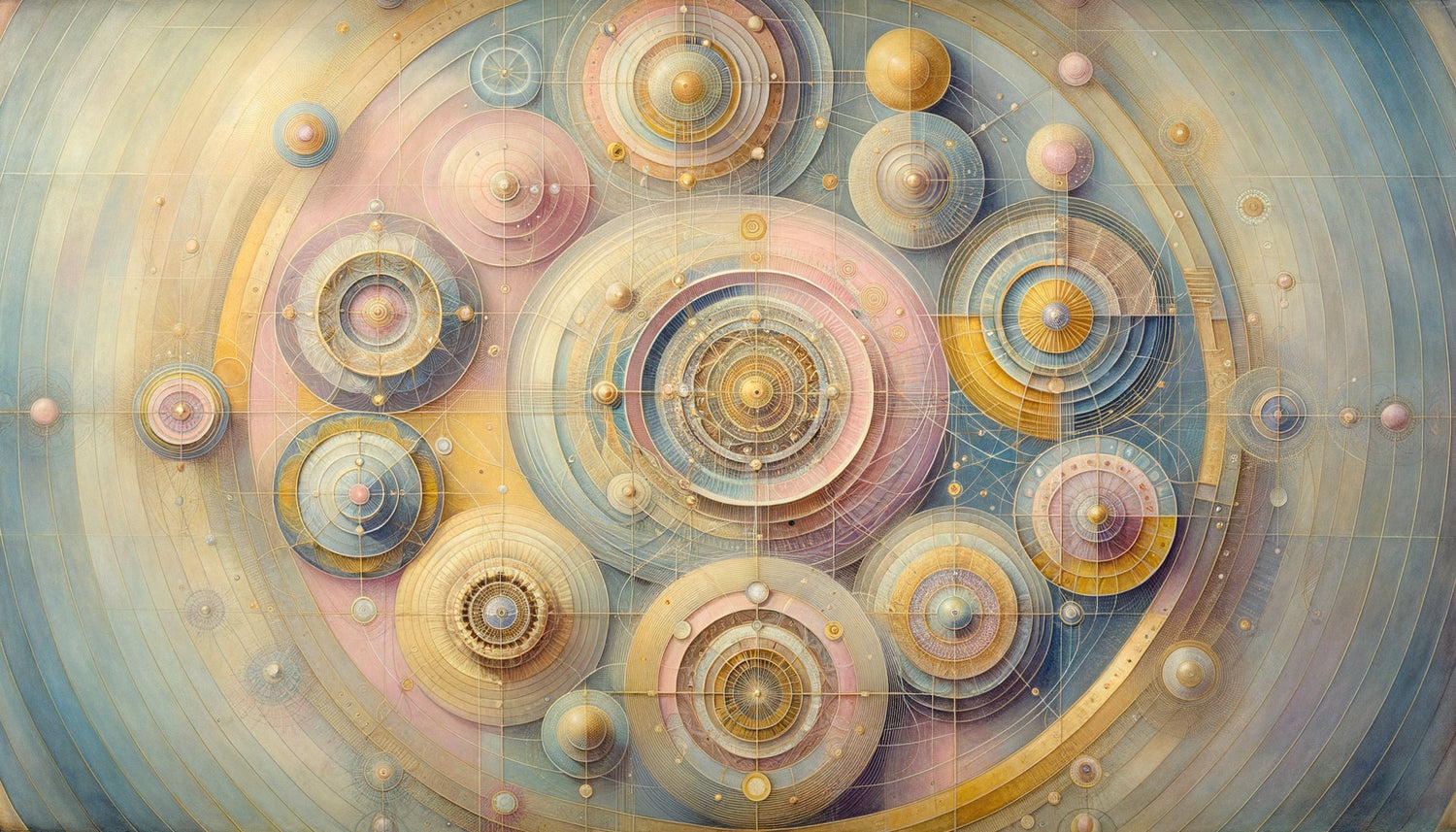
In the paintings of the series The Ten Largest (1907) and The Paintings for the Temple (1906-1915), the celestial spheres appear as organic structures in perpetual transformation. For Hilma af Klint, these circles are not static: they represent the stages of spiritual evolution, from raw matter to enlightenment.
Influenced by Helena Blavatsky’s Theosophy and Rudolf Steiner’s Anthroposophy, the Swedish artist conceived the universe as a series of interlocking dimensional planes. Each sphere corresponded to a level of consciousness: the physical plane, the astral plane, the mental plane, the spiritual plane. The concentric circles she painted symbolized this progression, this ascending movement towards cosmic unity.
Colors play a fundamental role in this esoteric cartography. Blue represented femininity, spirituality, the interior; yellow embodied masculinity, materiality, the exterior. When these hues met within the same sphere, it meant the union of opposites, the resolution of dualities. Pink evoked universal love, green expanding life.
In Group IV, The Ten Largest, No. 7, Adulthood, an immense rosy sphere floats at the center of the composition, surrounded by stylized plant forms. This celestial sphere symbolizes spiritual maturity, the moment when the human soul reaches its full earthly expression before continuing its ascent to higher dimensions.
The secret language of cosmic correspondences
Hilma af Klint never painted randomly. Each sphere, each spiral, each intersection obeyed a meticulous system of correspondences, inherited from Western and Eastern esoteric traditions. She studied Rosicrucian tables of correspondence, alchemical diagrams, Buddhist mandalas.
Her celestial spheres functioned as initiatory diagrams. They mapped the invisible relationships between macrocosm and microcosm: the external universe reflecting inner consciousness. A large sphere could represent the entire cosmos, while a smaller nested sphere symbolized the atom, the cell, or the individual.
In the Primordial Chaos series, the spheres multiply, overlap, creating luminous intersection zones. These meeting points represent moments of synchronicity, those instants when the veil between dimensions tears, when the human soul can directly perceive spiritual truths.
Spirals as vectors of ascent
Often, her celestial spheres are arranged in spirals, a form found everywhere in nature: nautilus shell, galaxy, DNA. For Hilma af Klint, the spiral represented evolutionary movement itself, that cyclical but always ascending process that characterizes all life forms.
The spiral allows you to return to the same point, but at a higher level of understanding. It is the perfect symbol of spiritual initiation: one goes through the same trials, the same questions, but with an expanded consciousness. The spheres arranged in spirals in her compositions indicate this initiatory path, this progressive ascent towards enlightenment.

When meditation meets sacred geometry
What few people know is that Hilma af Klint created her paintings in a deep meditative state, often trance-like. A member of the spiritual group De Fem (The Five), she regularly practiced collective meditation sessions, automatic writing, and communication with what she called the High Masters.
The celestial spheres were therefore not intellectual constructions but mediumnistic visions transcribed onto canvas. She claimed that these forms were "dictated" to her by spiritual entities, guides who transmitted cosmic knowledge for future generations.
This mediumnistic dimension explains the almost mathematical precision of her compositions. The proportions, the ratios between the spheres, and the intersection angles respect the principles of sacred geometry: the golden ratio, harmonic proportions, divisions based on Pythagorean ratios.
In The Swan (1915), a monumental series composed of 24 paintings, the celestial spheres evolve from painting to painting, telling a story of spiritual transformation. We see the progression from black (ignorance) to white (knowledge), with spheres that gradually light up, multiply, and merge.
Contemporary legacy: when circles speak to our time
Today, Hilma af Klint's celestial spheres resonate particularly with our contemporary quest for meaning. At a time when science and spirituality are dialoguing again, when quantum physics meets mystical intuitions, her paintings appear prophetic.
Circles, these universal forms found from Tibetan mandalas to crop circles, symbolize completeness, unity, infinity. In a fragmented world, they remind us that everything is interconnected, that each part contains the whole, that the individual participates in the cosmos.
Collectors and lovers of spiritual art are rediscovering this esoteric dimension today. Having a reproduction of a celestial sphere by Hilma af Klint in your home is not only possessing an aesthetically powerful work of art, but installing a meditative tool, a focal point for contemplation, a window to other dimensions of consciousness.
Art of the future created in the past
Hilma af Klint stipulated in her will that her works should not be shown until twenty years after her death, by which time humanity would be ready to understand them. She died in 1944, but her paintings remained invisible until the 1980s. When they were finally exhibited, the shock was immense: this woman had created spiritual abstraction before Kandinsky, before Mondrian, before Malevich.
Her celestial spheres anticipated the astronomical visions of the Hubble telescope, representations of DNA, contemporary data visualizations. As if she had captured, through mediumnistic intuition, the forms that science would discover a century later.

How to Contemplate the Celestial Spheres Today
When faced with a celestial sphere by Hilma af Klint, adopt the posture of the contemplative rather than the analyst. Let your gaze get lost in the concentric circles, follow the spirals, observe how the colors interact. Do not immediately seek to understand intellectually.
Ask yourself these meditative questions: which sphere spontaneously attracts my gaze? Which color resonates within me? If I were to enter this painting, where would I begin my journey?
The celestial spheres function as meditation supports. Fix your gaze on the center of a sphere for a few minutes, breathing calmly. Observe the thoughts that emerge, bodily sensations, mental images. Hilma af Klint would have approved of this approach: for her, art was not meant to be simply looked at, but to be lived.
Transform Your Space into a Temple of Cosmic Contemplation
Discover our exclusive collection of space art that captures the same fascination with celestial mysteries and the invisible dimensions of the universe.
Integrating Cosmic Vision into Your Daily Life
You don't need to be a theosophist or medium to benefit from the power of celestial spheres. These archetypal forms speak directly to our unconscious, activate deep resonances, open inner spaces.
Imagine your living room transformed by the presence of a large reproduction of Altarpiece, with its golden spheres floating in a deep blue space. Every morning, while drinking your coffee, your gaze rests on these perfect forms. They remind you that you are part of something larger, that your individual existence is inscribed in a cosmic dance.
This is the subtle transformation that Hilma af Klint proposed: not a decoration, but an elevation of the gaze, a daily invitation to remember the spiritual dimensions of existence.
The celestial spheres continue to turn, in her paintings as in the universe. They remind us that we are both observers and participants in this great mystery. As the artist wrote in her journal: « The circles are eternal, and we are the circles. »
Frequently Asked Questions About Hilma af Klint’s Celestial Spheres
Do You Need to Know Theosophy to Appreciate Hilma af Klint’s Paintings?
Absolutely not. Even though theosophy inspired her work, Hilma af Klint’s celestial spheres speak a universal language. Circles, spirals, vibrant colors touch something instinctive in us, beyond any esoteric knowledge. Simply let yourself be carried away by the shapes and hues. You will naturally feel their contemplative power, this ability to soothe the mind and open inner spaces. Intellectualization comes after sensory experience. Start by contemplating; meaning will gradually reveal itself. That’s exactly what the artist wanted: for her works to act as catalysts for transformation, accessible to all who agree to slow down and truly look.
Why Did Hilma af Klint Hide Her Works for So Long?
Hilma af Klint knew that her time wasn’t ready for her radical vision. Female artist in a world of art dominated by men, creator of abstraction before the movement was recognized, carrier of a spiritual message at a materialistic age, she accumulated all the handicaps to be understood. She therefore asked that her paintings remain invisible for twenty years after her death, hoping that future generations would develop the necessary sensitivity. This decision is a testament to an extraordinary confidence in the future of humanity. She did not seek immediate glory, but the transmission of knowledge destined for spiritual seekers to come. And she was right: today, her celestial spheres speak directly to our era seeking meaning and cosmic reconnection.
How to Use Reproductions of Her Works as Meditative Tools?
Install a reproduction facing your meditation space or in a place where you spend quiet time. Start with just a few minutes of silent contemplation each day. Fix the center of a celestial sphere, let your vision relax slightly, as if looking through the canvas rather than at the surface. Observe how the colors seem to vibrate, how the shapes create subtle movements. You can also mentally trace the path of the spirals, follow the flow of one color to another. This regular practice develops your contemplative ability, soothes the chattering mind, opens a door to expanded states of consciousness. Hilma af Klint’s celestial spheres then become what they have always been: portals to the invisible, maps for navigating the spiritual dimensions of existence.