Milan, 1912. In Boccioni’s smoky workshop, a revolutionary canvas takes shape: a fragmented body, multiplied, vibrating in space as if time itself exploded onto the surface. This is not a traditional portrait. It's a bold attempt to capture the invisible: the fourth dimension, that mathematical concept which obsessed Italian futurists and overturned their vision of art.
Here’s what this revolutionary quest brings to our interiors today: unprecedented visual energy that transforms a static wall into a dynamic portal, spatial depth that defies traditional perception, and timeless modernity that dialogues perfectly with refined contemporary spaces.
You may be looking at your walls searching for this intensity, this vibration which is sorely lacking in conventional reproductions. Classic still lifes leave you indifferent, soothing landscapes do not match the energy of your urban space. You aspire to something more vibrant, bolder, but without descending into decorative chaos.
Rest assured: understanding how futurists revolutionized the representation of space requires no training in art history. Their genius lies precisely in their ability to make the invisible visible, to translate abstract concepts into visually striking compositions. And this energy still works remarkably well in our contemporary interiors.
Let's discover together how these pioneers attempted the impossible: to paint time, space and speed simultaneously.
The revolution of a manifesto: when art declares war on static time
On February 20, 1909, Marinetti publishes an incendiary text on the front page of the Figaro that changes everything: the Manifesto of Futurism. His message? Destroy museums, celebrate speed, glorify the machine and, above all, represent movement as the very essence of modern life.
For Italian futurists, academic art committed a crime: it froze life. Umberto Boccioni, Giacomo Balla, Gino Severini and their colleagues wanted to capture what the eye cannot grasp: the simultaneity of experiences, those moments when past, present and future coexist in our perception.
Their obsession with the fourth dimension did not come out of nowhere. Mathematical works on non-Euclidean geometries fascinated the era. If space possessed three dimensions, wasn't time that fourth dimension which painting must finally conquer? For them, every object in motion carried within it all its past and future positions. A dog running does not have four legs, but twenty, forty, an infinite multiplication of limbs capturing its complete trajectory.
The lines-forces: the invisible anatomy of the universe
The great technical discovery of futurists to represent cosmic simultaneity? The lines-forces. Imagine energetic rays invisible which emanate from each object, which connect it to its environment, which prolong its movement in space.
In Dynamism of a Dog on a Leash (1912), Giacomo Balla multiplies the paws, tail and leash of the dachshund into a cascade of shapes that traverse the canvas. This is not simply a superposition of images as in a multiple exposure photograph. It's an organic fusion where each position interpenetrates, creating a visual continuum.
These lines of force materialize the idea that nothing exists in isolation. A face is not separated from the atmosphere surrounding it. A figure walking merges with the street, the sidewalk, the vibrations of the city. The fourth dimension becomes this spatiotemporal interconnection where boundaries between subject and environment collapse.
For our contemporary interiors, this approach offers a fascinating alternative to static compositions. A work inspired by lines of force creates a perpetual visual movement, an energy flow that instantly energizes a minimalist or industrial space.

Reinvented Cubist Fragmentation: Multiplying Perspectives
The Italian Futurists owed much to Picasso and Braque's cubism, but they criticized it for its stasis. Admittedly, the Cubists multiplied viewpoints, but their still lifes remained immobile, prisoners of a frozen moment.
The Futurist response? Integrate temporal movement into this spatial fragmentation. In Elasticity (1912), Boccioni decomposes a horse and its rider into geometric facets that stretch, compress, vibrate like waves. It's not just a multiple vision from different angles: it’s the capture of successive moments fused into a single image.
This technique visually translates cosmic simultaneity: the idea that at every instant, the entire universe vibrates together, that everything is interconnected in a universal energy dance. A movement of the arm causes undulations in the surrounding space-time, like a stone thrown into water creates concentric circles.
The colors themselves fragment, interpenetrate, create chromatic rhythms that suggest luminous vibration. Severini, in his cabaret scenes, fragments dancers into colored prisms where movement becomes pure visual energy.
Interpenetration of Planes: When Interior Becomes Exterior
A key concept for understanding how the Futurists represented the fourth dimension: the interpenetration of planes. This technical term refers to the fusion of different levels of reality into a single composition.
Look at "The street enters the house" (1911) by Boccioni. A woman leaning on her balcony is not simply contemplating the street: she fuses with it. The facades of buildings cross her body, the paving stones rise into her apartment, perspectives telescope. Interior and exterior are no longer separated by the simple frame of the window.
This compenetration visualizes the real psychological experience: when we observe a scene, our consciousness simultaneously embraces our physical position AND what we are looking at. Memories, expectations, sensations overlap. The fourth dimension becomes this simultaneity of consciousness, this thickened present that contains multiple temporalities.
For a contemporary living room or a creative office, a work playing on this compenetration creates a fascinating depth. The eye never finds a definitive anchor point, it perpetually travels through spatial strata that respond to each other, creating an active rather than passive contemplation.

States of mind and speed: painting cosmic emotion
The futurists were not only seeking to represent physical movement. Their most ambitious goal? To capture states of mind, those emotional vibrations that connect the individual to the entire universe.
Boccioni's famous series States of Mind (1911) masterfully illustrates this quest. Farewells, Those who leave, Those who remain: three canvases that translate not the scene of a train station, but the emotional experience of separation. Lines swirl, forms dissolve into energetic flows, locomotive numbers fragment like memories fading away.
Speed itself becomes support for cosmic simultaneity. In works dedicated to automobiles and trains, the machine is never a simple mechanical object: it is the metaphorical vehicle that allows human consciousness to transcend its spatiotemporal limits, to access this expanded perception where past and future telescope.
Balla, in his series on automobile speed, literally dissolves cars into pure trajectories, waves of color and light. The object disappears in favor of movement itself, the dynamic essence of modern existence.
The invisible legacy: how this vision shapes our interiors today
A century later, why does this futurist quest for the fourth dimension remain relevant to our living spaces?
Firstly, because our contemporary interiors often suffer from an excess of static minimalism. Clean lines and neutral palettes certainly create serenity, but can veer into coldness. A work inspired by the principles of futurism instantly injects dynamic energy without compromising sophistication.
Secondly, our hyper-connected era strangely resonates with this vision of cosmic simultaneity. We constantly live in multiple temporalities: the physical present, instant digital conversations, notifications that project us elsewhere. Futurists had visually anticipated this perceptual fragmentation.
Thirdly, the futurist aesthetic remarkably dialogues with contemporary architecture. Open spaces, large bay windows, and plays of transparency find in this interpenetration of planes a perfect visual echo. A composition with dynamic lines amplifies the spatial fluidity of a loft or open space.
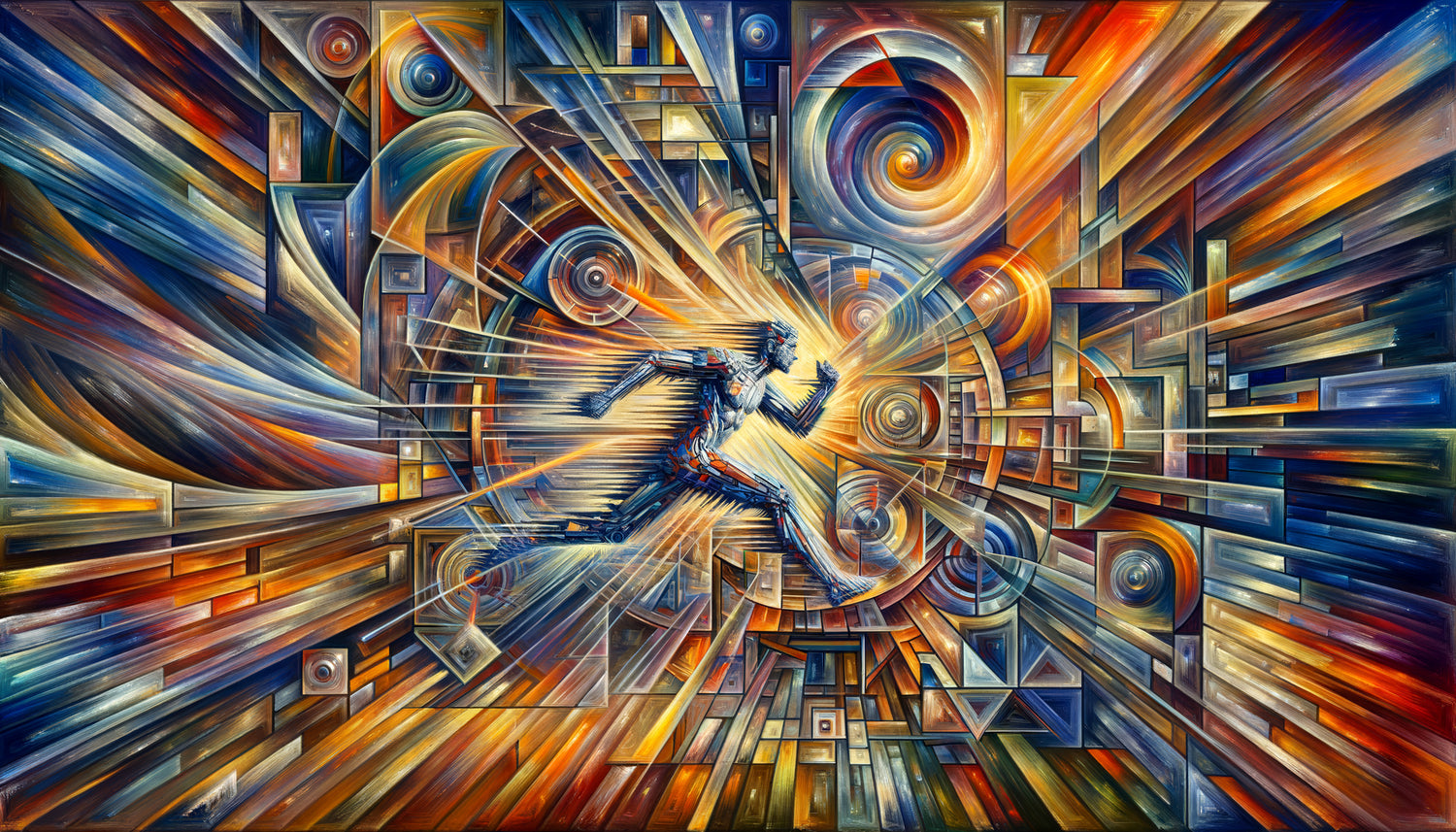
Futurist color palettes – these electric blues, vibrant oranges, cosmic violets – bring a bold sophistication that avoids the trap of overly conservative decoration. They create magnetic focal points that structure the space without weighing it down.
Ready to capture this cosmic energy in your interior?
Discover our exclusive collection of space paintings that combine futurist dynamism and contemporary sophistication to transform your walls into energetic portals.
Integrating the futurist heritage: practical tips for your space
How can you practically make this revolutionary aesthetic dialogue with your current decor?
For a contemporary living room: position a work with dynamic lines above a clean-lined sofa. The contrast between the static furniture and the visual energy of the artwork creates a sophisticated tension. Prioritize horizontal formats that amplify the feeling of movement.
In an office or creative space: fragmented compositions stimulate cognitive activity. The eye that perpetually travels through the image keeps the creative mind alert. Choose tones that include your dominant palette but amplify it with vibrant touches.
For an entrance or hallway: these transition spaces are perfect for works playing on the interpenetration of planes. They visually accentuate the actual physical movement of the occupants, transforming a simple passage into a spatial experience.
Lighting plays a crucial role. Futuristic compositions gain intensity under directional lighting that accentuates contrasts and makes colors vibrate. Adjustable spotlights allow you to modulate the energy of the artwork according to the time of day.
Imagine yourself tomorrow morning, coffee in hand, contemplating this flow of visual energy on your wall. This artwork doesn't simply decorate your space: it energizes it, it creates a dialogue between your interior and the cosmic energy that futurists sought to capture. Your living room becomes a perceptual laboratory, your office becomes an inspiration generator. Start by identifying the wall that calls for this transformation, the one that already has natural light to reveal all the nuances of a dynamic composition. The history of avant-garde art is simply waiting for you to offer it its space.