I settled my bags in Istanbul twenty years ago, in this fascinating crossroads between East and West. Since then, I have been exploring the bazaars, museums and workshops of artisans, collecting representations of the crescent moon that adorns minarets, ceramics and ancient manuscripts. This arched shape, suspended between two worlds, tells stories spanning millennia that I have never ceased to explore.
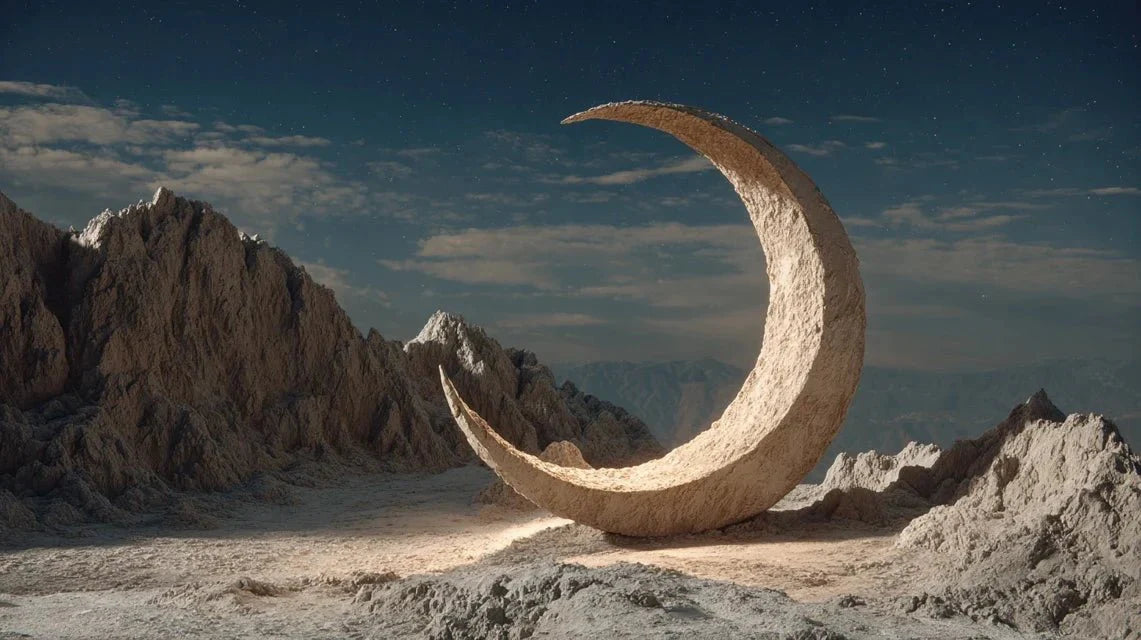
The crescent moon in art transcends borders and eras with a remarkable symbolic power. Here's what it brings to your decorative universe: a timeless spiritual connection, a mysterious aesthetic that captures the light, and a symbolic charge that enriches every space. Few visual elements possess such universality while retaining their mystery intact.
Many hesitate to incorporate lunar symbols into their interior design, fearing a connotation that is too strongly religious or cultural. This apprehension nevertheless deprives our spaces of extraordinary visual richness. The crescent moon belongs to all humanity, long before being associated with a particular tradition.
Rest assured: understanding the symbolism of the crescent moon in different cultures will allow you to enrich your decoration with discernment and depth. You will discover how this simple shape carries centuries of artistic contemplation within it, and how to integrate it harmoniously into your personal universe.
I invite you on a journey through the civilizations that have celebrated this celestial silhouette, so that you can make informed and authentic decorative choices.
Mesopotamian origins: when the moon became a symbol
In the collections of the Istanbul Archaeological Museum, I spent hours in front of Sumerian cylinder seals. The crescent moon appears there as early as 3000 BC, associated with the god Sin, lunar deity venerated in Ur and Harran. This representation was not insignificant: it embodied the measure of time, the regularity of cycles, the wisdom that illuminates darkness.
Mesopotamian artisans engraved this crescent with remarkable mathematical precision. The upward-pointing tips symbolized the horns of the celestial bull, an animal sacred to fertility. This double symbolism – temporal and vital – explains why the crescent moon in ancient art still has that protective dimension.
I found the same shape on Babylonian amulets at the Beyoğlu antique market. The seller, an old Armenian whose family had been collecting for four generations, explained to me that the lunar crescent was considered a shield against negative forces. This apotropaic function – of protection – crosses all Mediterranean and Middle Eastern cultures.
The Byzantine Empire and the Christian transformation of the symbol
What few people realize is that the crescent moon adorned Constantinople long before the Ottoman conquest of 1453. The Byzantines had adopted this lunar symbol by associating it with the Virgin Mary, often depicted in Christian iconography standing on a crescent.
In the Hagia Sophia basilica, before its conversion into a mosque and then a museum, Byzantine mosaics subtly integrated crescent motifs into the plant decorations. This Christian appropriation of the lunar symbol was part of a broader tradition of assimilating pagan symbols. The moon represented purity, virginity, but also the cycle of death and resurrection.
I photographed fragments of Byzantine ceramics where the crescent intertwines with crosses and stars. This visual coexistence testifies to an era when symbols circulated freely between traditions, enriching the visual vocabulary of each culture.

Discover this inspiring artwork
The Islamic Golden Age: When the Crescent Became an Emblem
The almost automatic association between crescent moon and Islam is relatively recent historically. The first centuries of Islam did not particularly use this symbol. It was the Ottoman Empire, heir to Byzantium, that adopted the crescent as an imperial emblem from the 15th century.
In the calligraphy workshops where I regularly visit in Sultanahmet, the masters explained to me the subtlety of Islamic lunar symbolism. The crescent represents the lunar calendar that governs religious life, from Ramadan to pilgrimages. But it also embodies openness – those two points that move apart as if to welcome divine light.
Persian and Mughal miniatures are full of refined representations of the crescent moon. In these precious works, often embellished with gold and lapis lazuli, the moon accompanies nocturnal scenes of mystical love or spiritual contemplation. The crescent then becomes a metaphor for the human soul, an incomplete receptacle that aspires to divine fullness.
Ottoman Architecture and Sacred Geometry
Ottoman architects elevated the crescent moon to the literal top of their creations. Each imperial mosque bears its crescent at the summit of the dome and minarets. This elevation is not merely ornamental: it symbolizes celestial aspiration, the link between earth and sky.
I was fortunate enough to visit the restoration workshops of the Süleymaniye Mosque. The artisans who reforge these gilded copper crescents respect millennia-old geometric proportions. The angle of opening, the thickness of the points, everything obeys an aesthetic science that aims for perfect harmony. This sacred geometry influences contemporary designers today who integrate crescent motifs into their creations.
Asian traditions: the moon as a bridge between worlds
My travels led me to collections of Asian art, where the symbolism of the crescent moon takes on different tones. In Chinese and Japanese art, the crescent lunar evokes transformation, impermanence, that Buddhist concept of perpetual change.
Ukiyo-e Japanese prints often depict a thin crescent in the night sky, accompanying poetic scenes. Hiroshige and Hokusai masterfully used this motif to create asymmetrical compositions of striking modernity. The crescent becomes here an element of composition, creating dynamic diagonals that guide the eye.
In Taoist philosophy, the crescent moon embodies the principle of yin – feminine, receptive, nocturnal. This contemplative dimension profoundly influences Chinese decorative art. Ming and Qing porcelains feature delicate crescents integrated into misty landscapes, symbolizing harmony between man and the cosmos.

Discover this inspiring work
Renaissance and European symbolism: the moon of alchemists
Medieval and Renaissance Europe developed its own relationship with the symbolism of the crescent moon. In alchemical iconography, the crescent represented silver, the feminine lunar principle in opposition to the golden masculine sun.
I studied the engravings of Albrecht Dürer where the moon appears in religious and esoteric compositions. The famous Melencolia I features a crescent in a sky full of hermetic symbols. This European esoteric tradition attributed to the crescent moon properties of transformation and revelation of mysteries.
The Symbolist artists of the 19th century – Moreau, Redon, Klimt – reactivated this mystical dimension. In their dreamlike works, the crescent moon floats in twilight atmospheres, evoking the unconscious, the dream, the interior territories of the psyche. This psychological interpretation of the lunar symbol still influences contemporary art.
Integrate lunar symbolism into your contemporary decor
With this multicultural understanding, you can now integrate the crescent moon into your interior with authenticity. The possibilities are endless, from Scandinavian minimalism to bohemian atmospheres.
For a clean style, prioritize graphic representations of the crescent: golden line on white background, black silhouette on textured paper. These modern interpretations of the ancestral symbol bring a discreet spiritual dimension without visual clutter. I particularly appreciate compositions where the crescent dialogues with geometric elements – triangles, circles – creating a contemporary harmony.
If you are looking for a warmer atmosphere, handcrafted representations of the crescent moon in hammered copper, glazed ceramic or carved wood bring texture and depth. These pieces tell a story, bear the mark of the artisan's gesture. In a living room or bedroom, they become points of contemplation, invitations to inner travel.
Compose with light and shadows
The crescent moon has this fascinating peculiarity of being itself a symbol of light in the darkness. Play with this duality by placing your lunar works in areas of soft shadow, where indirect lighting will reveal their contours. Relief sculptures of crescent create particularly poetic shadows at dusk.
Textiles – cushions, wall hangings – featuring embroidered or printed crescent motifs bring a sophisticated bohemian touch. Combine them with natural materials – linen, cotton, wool – to anchor this celestial symbolism in an earthy and comforting materiality.
Transform your space into a sanctuary of cosmic contemplation
Discover our exclusive collection of space paintings that captures the magic of lunar symbols through contemporary creations inspired by millennial traditions.
When the crescent becomes universal language
After two decades observing how the crescent moon traverses cultures, I remain fascinated by its ability to speak simultaneously to our spiritual and aesthetic dimension. This simple symbol – a curve, two points – carries within it millennia of human contemplation of celestial immensity.
Integrating a lunar crescent into your decor is never a trivial gesture. It's inviting into your home this dimension of mystery, this openness to infinity that artists of all traditions have sought to capture. Whether you are sensitive to its spiritual charge or simply to its formal elegance, this symbol will enrich your space with timeless depth.
Start simply: a framed engraving, a small sculpture on a shelf. Observe how this crescent transforms the atmosphere of the room, how your gaze rests differently upon it according to the hours of the day. You will then understand why all of humanity, from Ur to Tokyo, from Byzantium to Vienna, has never ceased celebrating this perfect form suspended in the night sky.