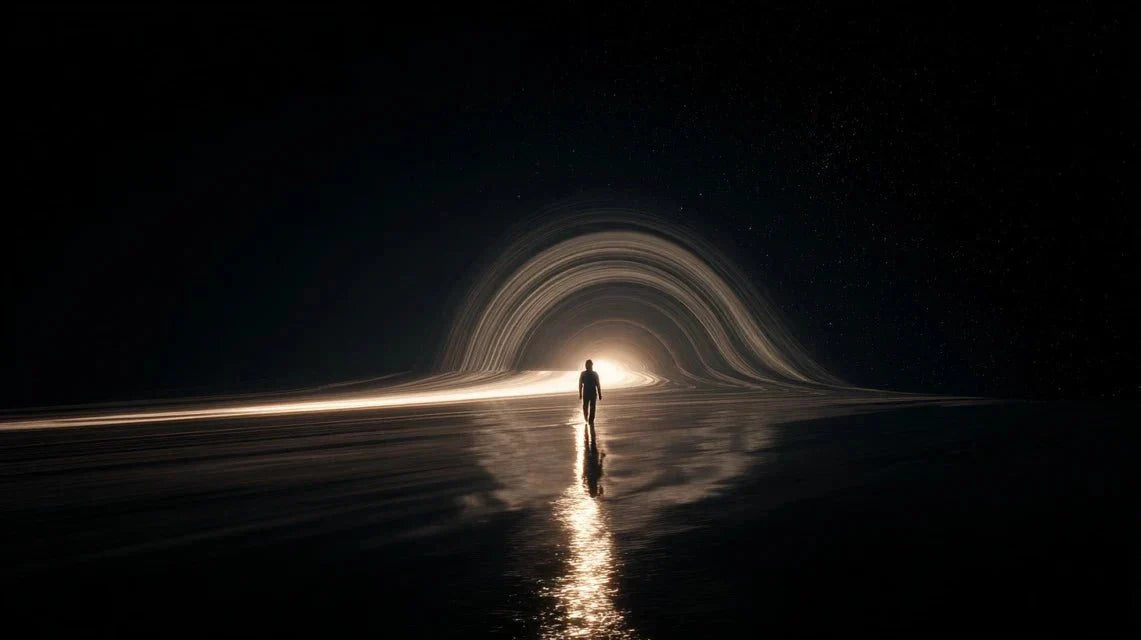
I still remember that November evening in 2014. The cinema hall plunged into darkness, then this image tearing across the screen: Gargantua, the black hole from Interstellar, majestically rotating in space. Around me, absolute silence. It wasn't just another digital monster. It was the first time a film showed a black hole as our eyes would actually see it if we floated near its edges.
Here’s what Interstellar brought to the representation of black holes: a scientifically accurate visualization that revolutionized our collective imagination, an unprecedented collaboration between Hollywood and astrophysics that produced academic discoveries, and a new cosmic aesthetic that still influences space and artistic design today.
For decades, black holes in popular culture looked like flat whirlpools or luminous vortices worthy of a screensaver. This simplistic representation frustrated both astrophysicists and astronomy enthusiasts eager for truth. How can you be passionate about the universe when you are served approximations worthy of a cartoon?
But in 2014, Christopher Nolan and physicist Kip Thorne changed the game. Their ambition? To show a black hole with unprecedented accuracy in cinema. The result exceeded all expectations, creating a fascinating bridge between science and visual emotion.
This article plunges you into the story of this visual revolution that has transformed our way of seeing and representing the most extreme cosmic phenomena in the universe.
The genesis of a visual revolution: when Hollywood meets Einstein
It all starts with an unlikely encounter. Kip Thorne, 2017 Nobel Prize in Physics and world specialist in general relativity, agrees to collaborate with Christopher Nolan. The director's requirement is clear: no scientific approximation. Every image must respect Einstein’s equations.
To create Gargantua, the supermassive black hole in the film, Double Negative teams developed a revolutionary rendering software. This program calculated how light curves around a rotating black hole, a phenomenon called gravitational lensing. The calculations were so complex that they generated 800 terabytes of data, requiring hundreds of hours of rendering for just seconds of images.
The result? A visualization that stunned even the physicists themselves. The accretion disk of the black hole appears simultaneously above and below the event horizon, light being curved in a way that creates an image impossible in Newtonian physics. This representation has even led to the publication of scientific articles in academic journals.
The visual anatomy of a black hole according to Interstellar
Gargantua is not merely a special effect. It's an astrophysics lesson translated into visual poetry. Let's break down what makes this representation so revolutionary.
The incandescent accretion disk
Around the black hole in Interstellar swirls a ring of matter heated to millions of degrees. This accretion disk is not flat as previously depicted. Extreme gravity curves its light, creating a luminous halo that completely envelops the central black sphere. One side of the disk appears brighter: this is the relativistic Doppler effect, the matter moving towards us emitting amplified light.
The photon shadow
At the center, this sphere of perfect darkness is not the black hole itself, but its shadow. It's the region where gravity is so intense that even light cannot escape, creating a silhouette twice as large as the actual event horizon. This visual discovery directly inspired the scientists of the Event Horizon Telescope who, in 2019, captured the first true image of a black hole.
Gravitational mirages
Look closely at Gargantua: the accretion disk appears simultaneously in front of and behind the black hole. Gravity warps spacetime so much that light literally goes around the object, creating multiple images of the same phenomenon. It is this visual complexity that radically differentiates Interstellar's representation from all previous ones.

Discover this inspiring artwork
From fiction to reality: when cinema predicts science
The irony of history? Five years after Interstellar, in April 2019, the world discovers the first real photograph of a black hole, that at the center of the M87 galaxy. And the resemblance to Gargantua is striking.
The image captured by the Event Horizon Telescope shows the same asymmetrical bright ring, the same central shadow, the same gravitational lensing effects. Scientists on the project acknowledged that Interstellar's visualizations had prepared the public to understand what they were seeing. The film created a visual vocabulary for phenomena that had never been photographed.
This convergence between cinematic representation and astronomical observation marks a turning point. For the first time, Hollywood wasn't inventing a simplified version of reality, but preceding it with remarkable accuracy. The black hole in Interstellar has become the reference, the visual archetype against which any new representation is now measured.
How Interstellar transformed our cosmic imagination
Before 2014, ask someone to draw a black hole: you generally got a flat funnel or whirlpool. After Interstellar, the collective representation radically changed. This luminous sphere surrounding a central darkness became iconic.
The film's influence extends far beyond cinema. In scientific documentaries, astrophysics conferences, and university textbooks, visualizations inspired by Gargantua are now used. Planetariums around the world have adapted their projections to incorporate this new aesthetic. Even contemporary artists draw inspiration from this representation to create works evoking the infinitely large.
In interior design and decoration, the impact is just as visible. Paintings depicting black holes have evolved, abandoning naive interpretations for more sophisticated compositions. Lovers of cosmic decor are now seeking faithful artistic representations that capture the visual complexity revealed by Interstellar.

Discover this inspiring artwork
The technical backstage of a visual feat
Creating Gargantua required solving general relativity equations that few computers could handle in 2013. The DNGR (Double Negative Gravitational Renderer) software, developed specifically for the film, calculated the trajectory of millions of light rays around the black hole.
Each ray followed a curved path due to gravity according to the Kerr metric, which describes a rotating black hole. The program also simulated the relativistic Doppler effect, gravitational redshift, and optical aberrations caused by the extreme speed of orbiting matter.
The most fascinating aspect? The renderings revealed details that even Kip Thorne hadn't anticipated. Some virtual camera configurations showed up to five images of the accretion disk simultaneously. These visual discoveries led to scientific publications, making Interstellar a veritable academic research tool disguised as a blockbuster.
Interstellar’s Legacy in Contemporary Visual Culture
Ten years after its release, Interstellar continues to influence our representation of space. Every new film or series exploring black holes must contend with the shadow of Gargantua. Apple TV+ with Foundation, Netflix with various science fiction productions, are now all adopting a more rigorous approach to cosmic visualization.
This demand for precision has extended to other astronomical phenomena. Pulsars, neutron stars, protoplanetary disks are now represented with a scientific detail inspired by the success of Interstellar. The public, educated by this new aesthetic, now rejects approximations that are too crude.
In the artistic realm, this visual revolution has opened up new possibilities. Creators can rely on scientifically credible representations while retaining a powerful emotional dimension. Accuracy hasn't killed beauty; it has enriched it with a new depth.
Transform Your Interior into a Cosmic Journey
Discover our exclusive collection of space art that captures the majesty of cosmic phenomena with the visual accuracy inspired by the greatest astronomical discoveries.
Living with Immensity: Integrating a Cosmic Vision into Your Home
Imagine: you finish your day, settle into your living room, and your gaze falls on a black hole representation hanging on the wall. It's not just decoration. It’s a window onto infinity, a daily reminder that our universe holds wonders that defy imagination.
Since Interstellar, integrating cosmic elements into your decor has become more than a trend: it's a way of inviting contemplation and wonder into your everyday life. Representations of black holes, when executed with care, combine contemporary aesthetics and conceptual depth.
Whether you choose a bold artistic interpretation or a visualization close to scientific data, you create a conversation starter that elevates the atmosphere of your space. Every visitor stops, observes, questions. You're not just decorating a wall; you’re opening a dialogue about our place in the universe.
The legacy of Interstellar taught us that science and beauty are not opposed. On the contrary, precision reveals an unsuspected splendor. A black hole is no longer an abstract concept reserved for physicists, but a powerful image accessible to all, carrying emotions and existential questions.
As the cosmos continues to reveal its secrets, as new images of black holes enrich our knowledge, your interior can reflect this extraordinary human adventure. Choosing a cosmic representation is asserting your curiosity, your openness to the unknown, your desire for beauty that transcends everyday life.
The next time you contemplate an image of a black hole, remember: you are observing one of the rare occasions when art, cinema and science have merged to create something totally new. And this fusion continues to inspire, amaze, transform our relationship with the universe and our own habitat.