When Jules Verne imagined a giant shell propelling three men to the Moon in 1865, he could not have foreseen that he was laying the foundations for a space aesthetic that would mark all of Europe for over a century. This French vision of space, imbued with scientific romanticism and visionary audacity, irrigated the imagination of artists across the continent long before the first satellite was launched.
Here's what French science fiction has brought to European spatial art: a poetic and humanistic approach to cosmic exploration, a unique visual vocabulary blending technical rigor and baroque fantasy, and a philosophy that places emotion at the heart of space conquest. Unlike American visions often heroic or Soviet ones resolutely propagandist, the French space imaginary offered a contemplative and sensitive alternative.
You may be wondering why European representations of space possess this particular touch, this blend of precision and reverie that sets them apart. Why do our rockets seem more elegant, our astronauts more thoughtful, our planets more inhabited by an almost mystical presence?
The answer lies in a literary and artistic heritage dating back to the 19th century and continues to influence contemporary creators. This French tradition of space science fiction has created a visual language that can be found today in galleries in Brussels, museums in Milan and even on your walls.
This article takes you on a journey through this little-known but omnipresent influence, from Verne to Moebius, from the pioneers of silent cinema to contemporary space installations transforming our interiors.
From the Earth to the Moon: when French literature draws space
It truly begins with Jules Verne, this visionary Nantais who, armed only with mathematical calculations and an overflowing imagination, created the first mental images of space exploration. His From the Earth to the Moon (1865) and Around the Moon (1870) are not just adventure novels: they are veritable aesthetic specifications for future artists.
What distinguishes the French approach to space science fiction is this attention to technical details combined with an almost romantic sensibility. Verne describes instruments, calculations, celestial mechanics precisely but never forgets the wonder of his characters before the cosmic immensity. This duality between rigor and poetry will become the signature of European spatial art.
The illustrators who accompanied these early editions — including Henri de Montaut and Émile-Antoine Bayard — create a visual vocabulary that will influence generations of artists. Their engravings show spacecraft with an almost architectural elegance, capsule interiors resembling Victorian living rooms projected into the cosmos, a space travel aesthetic that favors comfort and contemplation over heroic exploits.
The Golden Age: Méliès and the Birth of European Space Cinema
In 1902, Georges Méliès made Le Voyage dans la Lune, an absolute masterpiece that crystallizes all French space aesthetics. This rocket stuck in the eye of the Moon becomes the very icon of a certain European vision of space: playful, theatrical, dreamlike.
Unlike the spatial representations that will come later from across the Atlantic, Méliès does not seek technological realism but an emotional truth. His painted sets, his fanciful costumes, his acrobatic selenites create a universe where space becomes a territory of wonder rather than a battlefield or a simple technical destination.
This influence of Méliès runs through the entire 20th century. It can be found in the space posters of the 1950s and 1960s, in the illustrations of Pierre-André Brouillard for French pulp magazines, in a whole tradition of space art that favors color, fantasy and unbridled imagination.
A Distinctive Color Palette
Space art from French science fiction develops a recognizable color palette: deep, almost nocturnal blues, lunar yellows, Martian reds that lean towards orange rather than crimson. This color sensibility, inherited from French Impressionist and Symbolist painters, immediately distinguishes a European space work from American production with more stark contrasts.

Discover this inspiring artwork
The Post-War Visionaries: When French SF Reinvents Space Aesthetics
The post-war period saw the emergence of a new generation of French authors and artists who completely reinvented European spatial art. René Barjavel with *Ravage* (1943) and *La Nuit des temps* (1968), Pierre Boulle with *Planet of the Apes* (1963), developed a philosophical and introspective science fiction that profoundly influenced visual artists across the continent.
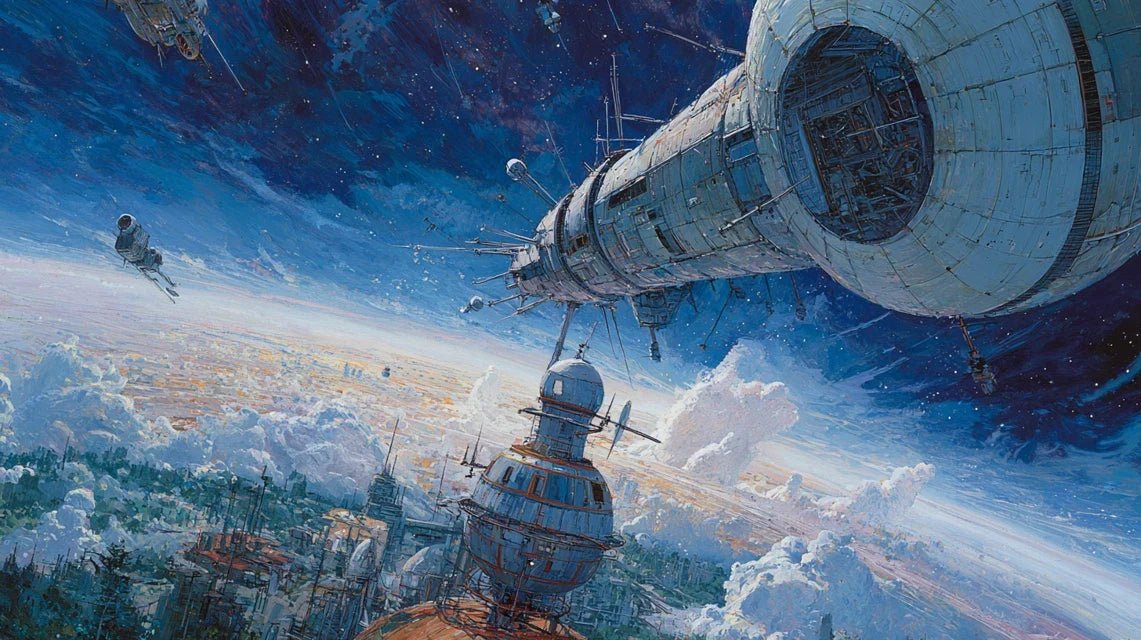
But it was especially with illustrators and comic book artists that French influence on space art truly became hegemonic in Europe. Jean-Claude Mézières, creator of *Valerian and Laureline* in 1967, developed a spatial universe of unparalleled visual richness. His organic spaceships, his Art Nouveau-inspired spatial architectures, his elegant spacesuits became the reference for an entire generation of European artists.
His panels directly influenced the design of films like *Star Wars*, *The Fifth Element* and *Avatar*, proving the power of this French space aesthetic. Each of Mézières’ space sets tells a story, each costume suggests a civilization, each spaceship has a personality. This narrative approach to space design becomes the norm in European art.
Moebius: The undisputed master of European spatial imagination
It is impossible to talk about French influence on space art without dedicating an entire chapter to Jean Giraud, known as Moebius. This protean genius literally created the visual language of space as we know it in contemporary European art.
His panels for *Métal Hurlant* in the 1970s and 1980s — notably *Arzach*, *Le Garage hermétique*, *The Incal* — define a unique spatial aesthetic: infinite cosmic deserts, impossible architecture, biomechanical creatures, unreal lights. Moebius blends the legacy of Méliès (the marvelous) with that of Verne (imaginative rigor) to create something entirely new.
His influence on European space art is absolutely massive. Every contemporary artist who represents space—whether in painting, digital illustration, sculpture or installation—consciously or unconsciously dialogues with Moebius’s work. His asymmetrical compositions, his dizzying perspectives, his use of color as a narrative element have revolutionized the way we visualize the cosmos.
A living legacy in our interiors
This aesthetic developed by Moebius is now found in the reproductions and artistic creations that adorn our walls. Contemporary space paintings, even created by digital artists who have never opened a comic book, bear the marks of his influence: these impossible horizons, these floating structures, these desaturated but luminous color palettes.

Discover this inspiring artwork
The new wave: how French influence irrigates contemporary space art
Today, the influence of French science fiction on European space art is more alive than ever. A new generation of French and European artists are reinterpreting this heritage with contemporary digital tools.
Artists like Sylvain Despretz, Sparth (Nicolas Bouvier) or Geoffroy Thoorens export this French spatial sensitivity to the international film and video game industries. Their concept arts for Hollywood productions consistently bring this European touch: an elegance of forms, an attention to atmosphere rather than action, a poetry of immensity.
In contemporary art galleries in Paris, Berlin or Amsterdam, space installations multiply references to this heritage. Space is never hostile or conquering there, but contemplative and introspective. This humanist philosophy is found which characterizes French science fiction since Verne: space as a mirror of our humanity, territory of questioning rather than affirmation.
Space in our living spaces
This renaissance of space art inspired by French aesthetics is also reflected in our decorative choices. Reproductions of Moebius or Mézières plates now coexist with contemporary digital creations that perpetuate this aesthetic. Installing a space artwork at home is inviting this visionary French tradition, this dialogue between rigor and reverie, this window to infinity tinted with European poetry.
Why does this influence remain so powerful?
If the influence of French science fiction on European space art remains so strong after more than a century and a half, it is because it responds to something profound in the European sensibility. Unlike tales of conquest or technological dystopias, the French tradition offers a vision of space that remains fundamentally humanist and accessible.
Space, in this tradition, is not reserved for superheroes or military personnel. It is a territory that ordinary characters can explore, where contemplation is as valuable as action, where beauty counts as much as exploit. This poetic democratization of space resonates with our contemporary desire for accessible wonder.
Furthermore, the aesthetic developed by French creators prioritizes the elegance of forms over brute force. French spacecraft resemble cathedrals or musical instruments rather than weapons. This artistic approach to space technology perfectly aligns with contemporary European design sensibilities.
Extend this visionary tradition in your interior
Discover our exclusive collection of space paintings that captures this unique European space aesthetic, between technical rigor and cosmic poetry.
Conclusion : Heirs of the stars
From Jules Verne to Moebius, from Méliès to contemporary digital artists, French science fiction has woven a discreet but omnipresent influence on all European space art. This tradition has bequeathed us more than just an aesthetic: a philosophy of looking at the stars, a way of imagining elsewhere that remains deeply rooted in our humanity.
Whenever you contemplate a space artwork — whether it is hung in a museum, printed in a book or installed on your wall — you are dialoguing with this heritage. You extend this French dream of an elegant, habitable cosmos, full of meaning. You participate in this visionary tradition that makes the cosmic infinity not a territory for conquest but a space for contemplation and transformation.
Start today to integrate this space aesthetic into your daily life. Choose a work that dialogues with this French heritage, which carries within it this double promise of rigor and reverie. Let space, as imagined by our visionaries, illuminate your gaze and broaden your inner horizon.
FAQ : Your questions about the French influence in space art
How to recognize the French influence in a space artwork?
Several elements help identify this influence: first, look for an elegance of form that favors organic curves over aggressive angles, as in the vessels of Mézières. Then observe the color palette — works influenced by French tradition often use deep nuanced blues, subtle lunar yellows and less brutal contrasts than in American aesthetics. Also check for the presence of narrative elements: French space art always tells a story, even in a single image. Finally, note whether the work favors contemplation and atmosphere over dynamic action. If you feel an invitation to daydream rather than excitement, you are probably facing a work heir to this French sensibility. This aesthetic is also distinguished by its humanism: characters, when present, appear thoughtful and vulnerable rather than heroic, reflecting this philosophical approach that has characterized French science fiction since its origins.
Why incorporate French-inspired space art into my decor?
Space art inspired by French tradition brings a unique dimension to your interior that goes far beyond simple decoration. First, these works instantly create a window to infinity, visually expanding your space while bringing contemplative depth. Unlike aggressive or anxiety-inducing spatial representations, French aesthetics offer an inviting cosmos, conducive to reflection and dreaming. Secondly, you integrate into your home a refined cultural heritage that stimulates conversation: these works have a history, they dialogue with Verne, Méliès, Moebius. They bring erudition without pedantry. On a purely aesthetic level, the colors developed by this tradition — these nuanced blues, these diffused lights — harmonize wonderfully with contemporary European interiors. They bring serenity without being bland, energy without being garish. Finally, choosing a French-inspired space painting is to affirm a particular sensitivity: that which values the beauty of thought, technical elegance and the poetry of questioning. It's transforming your wall into a permanent invitation to inner as well as outer travel.
Is this French influence on space art still relevant today?
Absolutely, and perhaps more than ever! The influence of French science fiction on European space art is currently experiencing a true renaissance. On the one hand, original creators like Moebius or Mézières are the subject of luxurious reissues and major exhibitions that renew their audience. On the other hand, a new generation of French and European artists consciously reinterpret this heritage with contemporary digital tools, creating works that explicitly dialogue with this tradition. In the entertainment industry, French concept artists continue to export this sensibility: look at Luc Besson's films, European video games, animated series - everywhere you find this elegance of forms and contemplative approach. More broadly, our time is rediscovering the values carried by this tradition: faced with climatic and technological anxieties, the humanistic and poetic approach to space offered by French science fiction offers a reassuring and inspiring counter-narrative. The cosmos becomes a territory of possibilities rather than threats. In your decorative choices, opting for this aesthetic means subscribing to a strong contemporary trend, which reconciles technological modernity and artistic sensitivity, innovation and tradition, rigor and reverie.