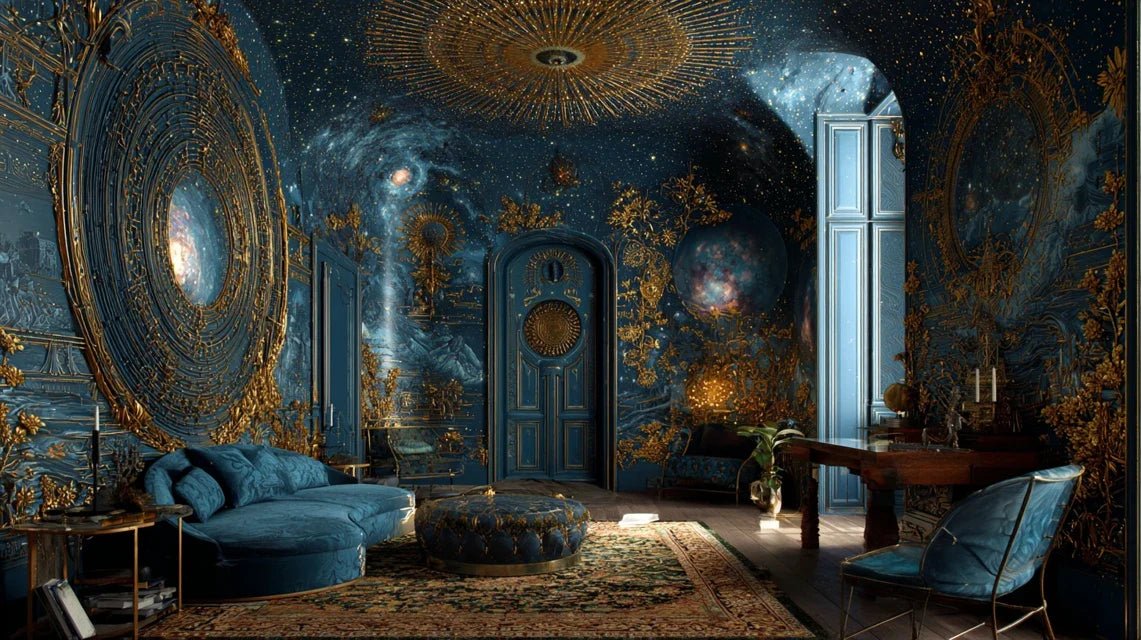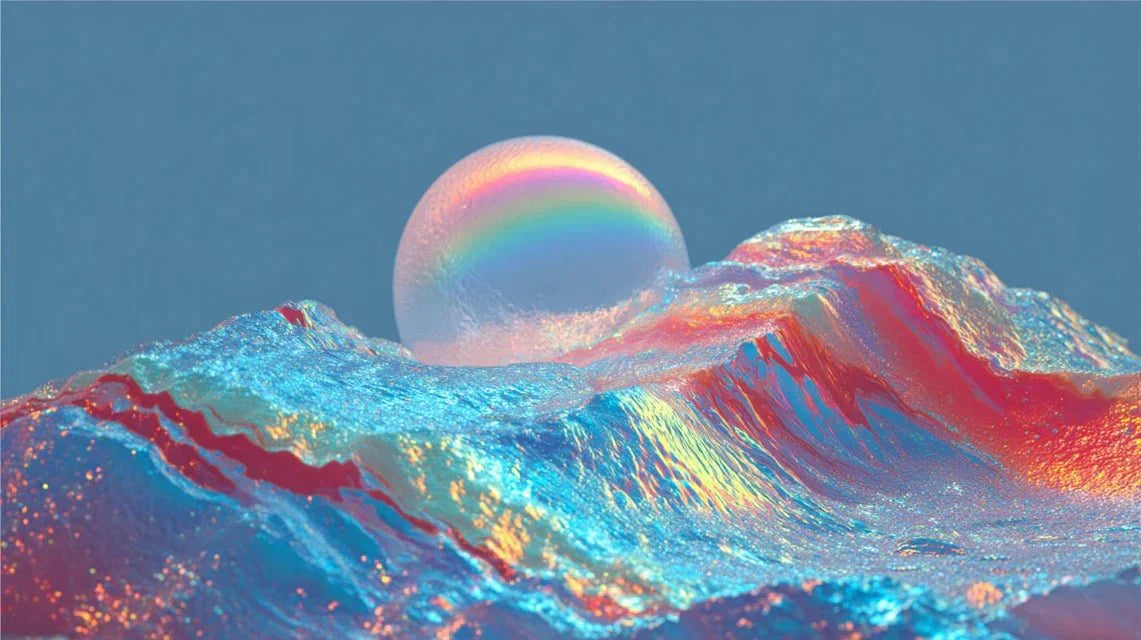
The first time I saw a nebula unveil its iridescent veils through a telescope at the La Silla Observatory, I understood that the universe possessed a chromatic language that our interiors had never truly dared to translate. Today, this revelation materializes in the 2025 holographic palettes inspired by space, true bridges between the infinitely large and our living spaces.
Here's what the 2025 holographic palettes inspired by space bring to your interior: a multidimensional depth that transforms every light source into a living spectacle, a cosmic sophistication that transcends ephemeral trends, and this rare ability to create an atmosphere that is both futuristic and timeless.
Perhaps you have already felt this frustration with conventional palettes that seem frozen, flat, unable to capture the changing magic you seek. Traditional colors remain still while light dances around them, creating a disconnect between your aspirations and the reality of your walls.
Rest assured: this new generation of spatial holographic palettes does not require drastic renovations or expertise in astronomy. It integrates naturally, sublimating what already exists while opening up unsuspected dimensions. In this article, I will guide you through the chromatic constellations that redefine contemporary elegance, with concrete applications to transform your view of color.
Domestic Aurora Borealis: When a Cosmic Phenomenon Meets Your Living Room
The 2025 holographic palettes inspired by space first draw from the magnetic spectacle of the poles: the auroras. Imagine emerald greens that shift to electric cyan depending on the viewing angle, punctuated by ionized pinks and magnetospheric purples. This palette is not simply applied; it breathes with your space.
I recently documented an installation where these holographic hues covered a wall panel adjacent to a southwest-facing bay window. At dawn, cool shades dominated in a blue symphony. In the late afternoon, the same surfaces exploded into copper and pink harmonics, as if a personal aurora was sweeping through the living room. This perpetual metamorphosis creates an intimate relationship between the inhabitant and their environment.
To integrate this spatial holographic palette, prioritize adjacent reflective surfaces: beveled mirrors, textured glass, brushed steel. These materials amplify the prismatic effect and create chromatic echoes that multiply the perceived depth. A single 120 cm holographic decorative panel is often enough to transform an entire room through light reflection.
Nebulae Interiors: The Palette of Stellar Nurseries
Nebulae, these stellar nurseries with improbable colors, inspire the second family of 2025 holographic palettes inspired by space. Think of the hues captured by the James Webb telescope: phosphorescent oranges mixed with deep cobalt blues, traversed by magenta and gold filaments.
This palette possesses a particular quality that I call 'nebular depth': several chromatic layers coexist simultaneously in the same gaze. Unlike classic gradients which transition linearly, spatial holographic surfaces superimpose colored information. Your eye captures both turquoise on the surface and copper in depth, creating a sensation of immaterial volume.
Practical Application in Bedrooms and Meditative Spaces
These nebular holographic palettes excel in spaces dedicated to rest. The chromatic complexity paradoxically soothes the nervous system: the eye explores without ever exhausting the visual richness, inducing a contemplative state close to meditation. I observed this phenomenon in a bedroom where a holographic painting representing the Orion Nebula created a hypnotic focal point, significantly reducing occupants' sleep latency.
The trick is to balance these spatial holographic intensities with absorbent neutrals: raw linen, matte concrete, woodwormed wood. The contrast between reactive surfaces and muted materials amplifies the cosmic effect while preserving a serene habitability.

Discover this inspiring artwork
Galactic Chrome: The Multidimensional Silver of 2025
Forget the cold industrial chrome of the 2000s. Space-inspired holographic palettes of 2025 reinvent metallics with quantum sophistication. These silvers do not simply reflect light: they decompose it, recompose it, transform it into a living spectrum.
This evolution comes directly from observations of stellar surfaces and interstellar dust. Astrophysicists have discovered that these cosmic particles diffract light at specific angles, creating chromatic halos impossible to reproduce with conventional pigments. New holographic coatings use nanotextured structures that mimic these physical properties.
In a decorative context, this galactic chrome palette excels in strategic accents: frames, luminaires, minor architectural elements. A simple mirror treated with holographic space film becomes a window to other dimensions, each reflection tinted with fleeting rainbow spectra. The effect remains subtle in diffuse natural light, but intensifies dramatically with directed lighting, offering exceptional scenic modulation.
Planetary Palettes: When Each World Inspires a Chromatic Identity
Each planet in our solar system possesses a unique color signature, now transposed into 2025 holographic palettes inspired by space. Jupiter offers its swirling ochres streaked with creamy whites and brick reds. Saturn displays its sandy beiges crossed with pearl grays and pale gold. Neptune suggests deep ultramarine blues with electric turquoise highlights.
The strength of these holographic planetary palettes lies in their natural thematic coherence. Unlike arbitrary associations, they possess an inherent visual legitimacy: these colors actually coexist somewhere in the universe. This cosmic authenticity confers immediate aesthetic authority to your decorative choices.
Create Themed Zones Without Partitioning
I frequently apply these planetary holographic space palettes to differentiate functional zones in an open space. A kitchen can adopt Martian tones – holographic oxidized reds with metallic highlights – while the adjacent living room breathes Neptunian blues. The holographic transition between these universes is achieved naturally through light gradation rather than brutal demarcation.
This approach exploits a fundamental principle of 2025 holographic palettes: their ability to dialogue with each other through cross-refraction. The Martian tones of the kitchen corner project copper reflections into the Neptunian blues of the living room, creating organic chromatic bridges that unify the whole.

Discover this inspiring artwork
Starlight Lighting: Enhance Holographic Palettes with Adapted Light
A holographic palette inspired by space only reveals its full dimension with choreographed lighting. I learned this lesson during a disastrous installation where sumptuous holographic surfaces remained dull under uniform cold white LEDs. The problem wasn't the palette, but its light activation.
Spatial holographic surfaces require layered light: soft ambient lighting (2700-3000K) establishes the base, while variable directional sources (track spotlights, architectural projectors) reveal the prismatic effects. The magic truly happens with dynamic lighting: programmable RGB LEDs that subtly change their temperature and direction according to the time of day.
A system I frequently recommend combines three circuits: a permanent warm base, adjustable cool accents, and point color sources. This light triangulation allows you to compose with your 2025 holographic palettes like an orchestra conductor directs a symphony, adjusting the intensity of each chromatic family according to the desired atmosphere.
Ready to Invite the Universe into Your Everyday Life?
Discover our exclusive collection of space art that captures these cosmic holographic palettes with sidereal precision, transforming every glance into an interstellar journey.
Complementary Materials: Grounding the Cosmic in the Tangible
The major risk with 2025 space-inspired holographic palettes is a drift towards excessive immateriality. An entirely holographic interior quickly becomes disembodied, almost uninhabitable. The key lies in anchoring it with authentic earthly materials.
I systematically combine these spatial holographic palettes with deeply tactile textures: thick velvet with a heavy drape, aged leather with irregular patinas, raw wood with pronounced grains, natural stone with imperfect surfaces. This contrast between the evanescent holographic and the palpable material creates a fascinating aesthetic tension, as if infinite universe meets solid ground.
Matte metals – brushed brass, browned steel, oxidized copper – work particularly well. Unlike polished finishes that compete with holographic effects, these absorbent surfaces offer strategic visual rest while retaining material nobility. A massive wood-grained coffee table becomes the perfect counterpoint to a wall treated with a nebular holographic palette.
Daily Evolution: Living with a Changing Palette
Embracing 2025 holographic palettes inspired by space means accepting a new relationship with decor. Unlike static colors you can forget after a few weeks, these holographic surfaces maintain an active, evolving, almost conscious presence.
This characteristic fundamentally transforms the domestic experience. Your morning living room isn't your evening one. Your bedroom under a cloudy sky differs radically from one bathed in direct sunlight. Spatial holographic palettes create a form of chromatic biodiversity, your interior becoming a visual ecosystem that breathes with natural cycles.
I often observe an adaptation phase among new adopters: the first two weeks bring constant wonder at the discovered transformations. Then comes a period of familiarization, where you learn the chromatic rhythms of your space. Finally, a symbiotic relationship emerges where the inhabitant anticipates and appreciates these metamorphoses as familiar companions.
To facilitate this transition, I advise starting modestly: a unique decorative element with a holographic palette inspired by space, observed for a few weeks. This progressive approach allows you to assess your compatibility with this living aesthetic before a more substantial spatial commitment.
Conclusion : Space as the New Decorative Frontier
2025 holographic palettes inspired by space are not just an additional chromatic trend. They mark a fundamental evolution in our conception of domestic color: from static to dynamic, from two-dimensional to volumetric, from imitation to transcendence.
Tomorrow morning, observe the light filtering through your space. Imagine these rays decomposed into miniature auroras, walls breathing the colors of distant nebulae, metallic accents diffracting stellar spectra. This vision no longer belongs to decorative science fiction: it defines the accessible avant-garde of 2025.
Start simply. Choose a surface, an object, a painting. Let the universe invite itself gradually into your daily life. The cosmos do not require brutal revolution, but conscious evolution towards more depth, magic, and domesticated infinity.