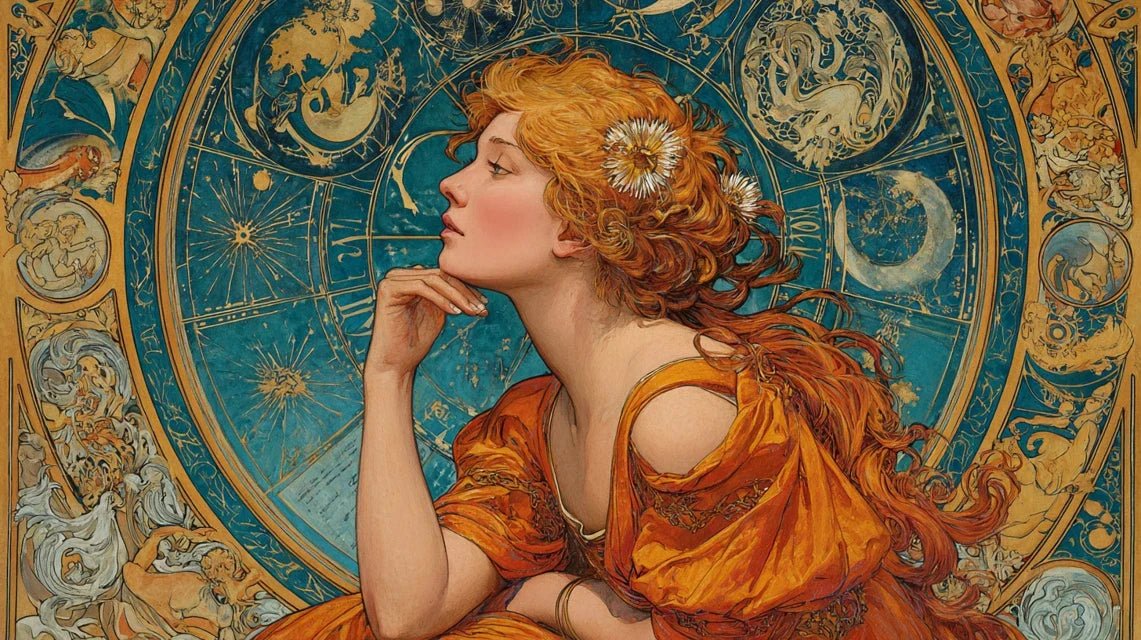
Paris, 1896. In the smoky workshop of a printer in the Montparnasse district, a lithograph comes to life before the amazed eyes of Alphonse Mucha. A woman with flowing hair like the Milky Way, crowned with stars, enveloped in the arabesques of the zodiac. It was no longer just an advertising poster: it was a mystical revelation printed on vellum paper.
Cosmic Art Nouveau represents this masterful fusion between the floral aesthetics of the Belle Époque and the astrological esotericism that fascinated Europe at the turn of the century. Here's what this artistic revolution brings us today: visual compositions where sacred femininity, zodiacal symbolism, and vegetal ornamentation create a timeless decorative harmony; a recognizable graphic vocabulary where each constellation becomes an excuse to reinvent beauty; and above all, an invitation to transform our interiors into poetic sanctuaries.
You may be looking to create a sophisticated atmosphere in your home, but reproductions of classic works seem too cold to you, modern creations too minimalist. You dream of this mysterious elegance, these sensual curves that evoke both Art Nouveau and the cosmos, but you don't know how to integrate these universes into your contemporary decor.
Rest assured: the aesthetics developed by Mucha and the Symbolists between 1890 and 1910 transcend eras with intact grace. These zodiac posters are not mere historical curiosities – they respond to our current need to re-enchant everyday life, to create spaces that nourish the imagination.
I invite you to explore how these visionary artists transformed the zodiac into a decorative language, and how this revolution continues to inspire our interiors today.
When the stars descended on the walls of Paris
At the turn of the 20th century, Europe was experiencing a real esoteric effervescence. Spiritualist salons mingled with shadow theaters, and treatises on Theosophy were sold like popular novels. In this fertile context, the decorative poster becomes the perfect medium to spread celestial mysteries to the general public.
Alphonse Mucha, arrived from Moravia, intuitively understands this thirst for transcendence. His first posters for Sarah Bernhardt already integrate starry motifs, but it is with his zodiacal series that he truly revolutionizes the genre. Each astrological sign becomes an excuse to compose a complete visual universe: Virgo blends into golden ears of wheat, Scorpio intertwines with disturbing organic forms, Pisces swims in aquatic volutes where the boundaries of reality dissolve.
This radically different approach from traditional zodiac representations. Where classic astrology treatises offered austere and symbolic engravings, the Symbolists of Art Nouveau create sensual compositions inhabited by mysterious female figures. The woman becomes a mediator between the earthly and the cosmic, a living incarnation of celestial forces.
The secret language of heavenly curves
Carefully observe a Mucha poster depicting the zodiac signs: nothing is left to chance. The arabesques that frame the composition are not mere ornaments – they reproduce the movement of planets, the spiral of galaxies, the elliptical course of comets. The hair of the female figures undulates like auroras, their draperies evoke nebulae veils.
This organic geometry, characteristic of Cosmic Art Nouveau, draws simultaneously on scientific observation (the first astronomical photographs fascinated artists) and millennia-old esoteric traditions. A magical balance between modernity and antiquity.
Other masters of decorative zodiac
If Mucha remains the tutelary figure of this movement, he was not alone in this cosmic quest. In Vienna, Gustav Klimt integrates zodiac motifs into his golden compositions, creating constellations of symbols where astrology, mythology and Art Nouveau merge. His female figures float in undefined spaces, between starry sky and earthly garden.
In Scotland, artists of the Glasgow School movement like Margaret Macdonald develop a more refined but equally mystical aesthetic. Their zodiac posters favor slender vertical lines, evoking stellar rays, hieratic figures recalling ancient goddesses. A more mineral, architectural interpretation of the cosmos.
In Munich, Franz von Stuck explores the dark side of zodiac symbolism. His representations of Scorpio or Capricorn incorporate an unsettling, almost threatening dimension. The zodiac becomes a theater of obscure forces, unconscious impulses that the nascent psychoanalysis was beginning to explore.
The poster as a ritual object
These creations were not intended solely to adorn walls. In the bourgeois apartments of the Belle Époque, a Mucha or contemporary zodiac poster literally transformed domestic space. It created a contemplative focal point, a window open onto infinity, a daily reminder that human existence is inscribed in a larger cosmic order.
Collectors carefully framed these lithographs, displaying them in cabinets of curiosities alongside minerals, pinned butterflies, and ancient celestial charts. The Art Nouveau decorative poster became an object of meditation, a support for reverie, a catalyst for contemplative states.

Discover this inspiring artwork
The Alchemy of Celestial Colors
The chromatic palette developed by the Symbolists for their zodiacal creations reveals an intuitive understanding of color psychology. Deep blues evoke the infinite night, golds and ochres recall starlight, celadon greens suggest the mysterious ether that was believed to fill the cosmic space.
Mucha in particular mastered the art of chromatic transitions. In his zodiac posters, colors are never juxtaposed brutally: they blend into each other as in an endless twilight. This gradient technique, made possible by advances in color lithography, created a dreamlike atmosphere perfectly suited to cosmic themes.
The Symbolists also exploited the contrast between densely decorated areas and empty spaces. These visual breaths evoked the immensity of interstellar emptiness, the majestic silence of infinite spaces. A composition lesson that contemporary graphic designers are rediscovering today.
How Art Nouveau Zodiac Transforms Our Interiors Today
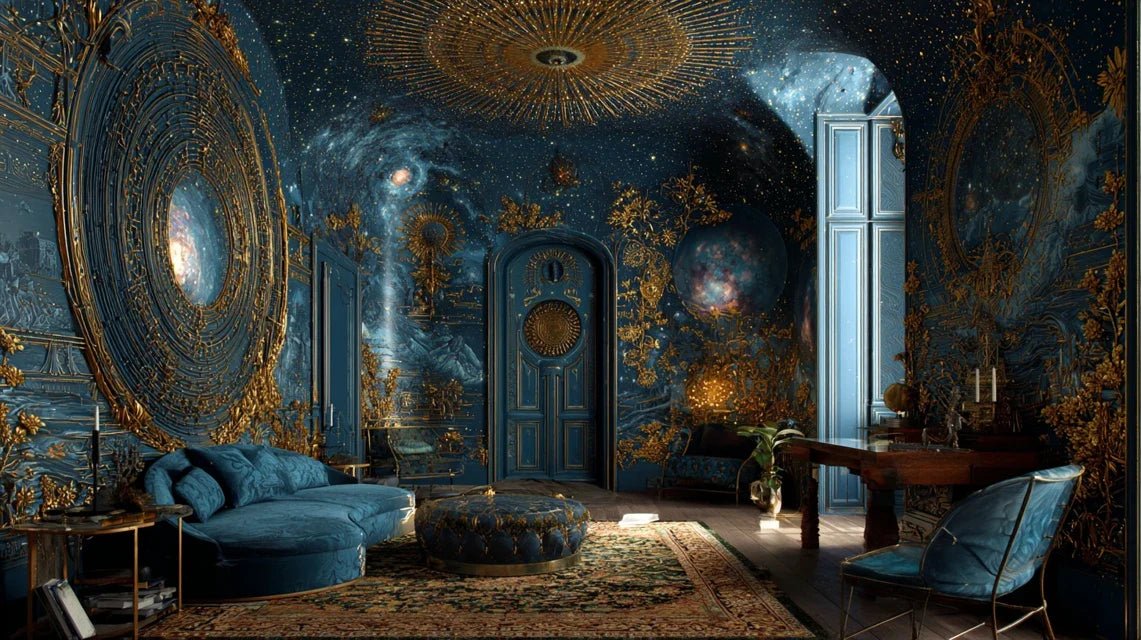
More than a century after their creation, these zodiac posters have lost none of their evocative power. In a contemporary interior, a quality reproduction of a Mucha or Symbolist work instantly creates a sophisticated and mysterious atmosphere.
The advantage of cosmic Art Nouveau aesthetics? It dialogues harmoniously with very different decorative styles. In an industrial loft, it brings the organic softness that balances the rigor of raw materials. In a Haussmann apartment, it resonates with the elegance of moldings and old parquet floors. In a minimalist Scandinavian interior, it becomes the focal point that warms and personalizes the space.
Create a Zodiac Mural Gallery
A current trend is to create themed wall compositions around the Art Nouveau zodiac. Rather than a single large poster, some choose to arrange several representations of different astrological signs, creating a veritable celestial gallery.
The trick: vary the formats and frames while maintaining a chromatic consistency. A large central format surrounded by smaller compositions creates a visual dynamic that attracts the eye without saturating the space. Frames can alternate between authentic Art Nouveau gold leaf and clean contemporary lines, creating a dialogue between eras.
This approach works particularly well in living spaces where contemplation is encouraged: living room, library, bedroom. The decorative zodiac naturally invites reverie, beneficial mental detachment after a stressful day.

Discover this inspiring artwork
The cosmic heritage: from symbolism to contemporary space decoration
What Mucha and the Symbolists initiated with their zodiac posters finds an astonishing resonance in our era fascinated by space exploration. Their way of representing the cosmos – both scientific and mystical, precise and dreamlike – foreshadows our contemporary relationship with the universe.
Contemporary designers who create works inspired by space often unconsciously draw on this visual vocabulary developed over a century ago. Organic curves, chromatic gradients, the integration of human figures into cosmic compositions: all these elements were already present in cosmic Art Nouveau.
The difference? We now have real images of nebulae, galaxies, distant planets. But paradoxically, these scientific photographs often confirm the poetic intuition of the Symbolists: the universe is infinitely more beautiful, more mysterious, more organic than imagination could conceive.
Combining Art Nouveau zodiac and modern space decoration
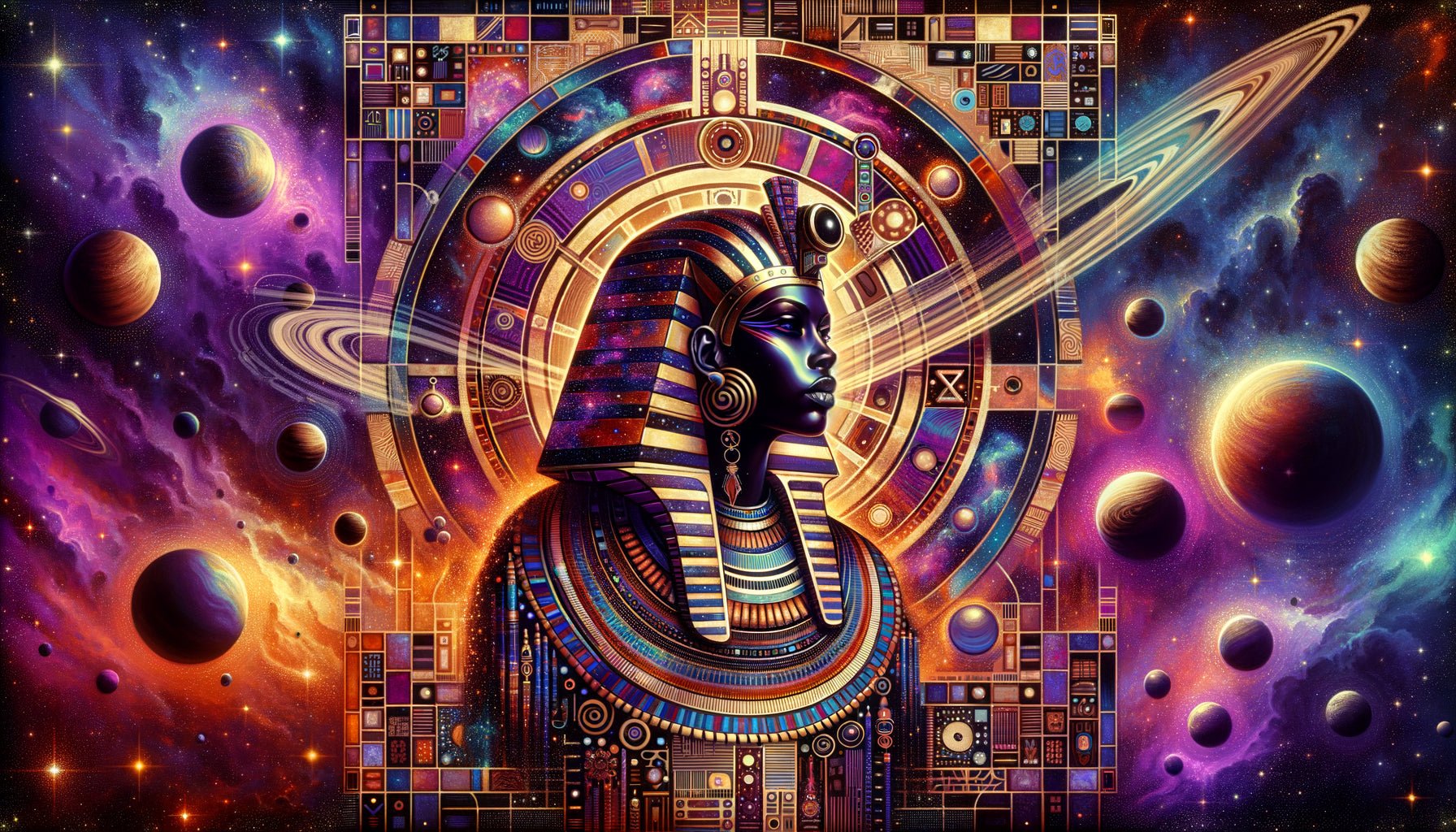
A particularly successful decorative approach is to create visual bridges between Art Nouveau zodiac posters and contemporary cosmic representations. A Mucha poster depicting the constellations can beautifully converse with a NASA photograph of a nebula in similar colors.
This juxtaposition creates a fascinating visual narrative: it tells how humanity dreamed of the stars before being able to photograph them, how artistic imagination preceded scientific knowledge. In an interior, this becomes a true aesthetic and philosophical manifesto.
Transform your interior into a cosmic journey
Discover our exclusive collection of space paintings that captures the magic of the stars with the timeless elegance inherited from the masters of Art Nouveau.
Invite constellations into your daily life
Imagine yourself every morning, preparing your coffee under the benevolent gaze of an allegorical figure by Mucha embodying your zodiac sign. Or in the evening, settling into your favorite armchair facing a composition where arabesques and celestial constellations intertwine. It's not just decoration: it’s a way to enchant everyday life, to create contemplative moments in our lives saturated with screens and solicitations.
Cosmic Art Nouveau reminds us that our ancestors looked up at the stars to find meaning and beauty there. In our contemporary interiors, these works continue to fulfill this essential function: to reconnect us to something larger, more mysterious, and more profoundly human than daily bustle.
Start simple. Choose a zodiac poster reproduction that resonates with you – perhaps your astrological sign, or simply a composition whose colors and shapes touch you intuitively. Find the wall that deserves this window open onto infinity. And watch how, gradually, this addition transforms the atmosphere of your space, introduces a poetic dimension, an everyday invitation to daydreaming.
Mucha’s and the Symbolists' genius was to understand that the zodiac was not just a system of beliefs: it was a universal visual language, a repertoire of forms and symbols capable of speaking directly to our imagination. More than a century later, in our interiors where influences and eras blend, this celestial language continues to whisper its secrets to those who know how to listen.
Frequently Asked Questions
How to recognize a genuine vintage cosmic Art Nouveau poster?
Original posters from the period 1890-1910 have several distinctive characteristics. First, the printing process: color lithography of the time produced slightly different shades from one print to another, with a particular texture perceptible to the touch. The papers used were generally vellum or rag paper, which yellows in a specific way over time. Finally, look for the printer's signature (Champenois for Mucha, for example), usually discreetly placed in a corner. To start a collection, prioritize museum-quality reproductions rather than searching for originals at exorbitant prices. Major institutions such as the Musée d'Orsay or the Museum of Decorative Arts in Prague offer faithful reproductions that beautifully capture the essence of these works. The important thing is not the material authenticity but the aesthetic and emotional effect in your interior.
What size Art Nouveau zodiac poster should I choose for my living room?
The general rule in wall decoration suggests that a work should occupy about two thirds to three quarters of the width of the furniture above which it is placed. For an empty wall, consider that it should fill approximately 60 to 75% of the available vertical space. Art Nouveau posters, with their often vertically oriented formats (60x80 cm or 70x100 cm), work particularly well above a sofa, console or hallway. In a medium-sized living room, a 70x100 cm format is often the ideal choice: imposing enough to create a strong visual impact, without overwhelming the space. If your room is smaller, opt for a 50x70 cm format, or create a composition of several more modest formats. The advantage of cosmic Art Nouveau works: their elongated vertical compositions create an impression of height that visually expands the space.
Do Mucha's zodiac posters fit into a modern minimalist interior?
Absolutely, and it is even a particularly successful combination! The contrast between contemporary simplicity and Art Nouveau ornamentation creates a sophisticated visual tension. In a minimalist interior with white walls and clean lines, a richly decorated zodiac poster becomes the focal point that humanizes and warms the space without compromising the overall clarity. The key lies in the treatment: prioritize a simple and contemporary frame (thin black metal or light wood frame) rather than complex gilding. Limit yourself to one or two works maximum to preserve the minimalist balance. Choose posters with tones consistent with your existing palette – blue and green dominant versions fit particularly well into Scandinavian interiors, while gold and ochre compositions beautifully warm spaces with raw materials. Cosmic Art Nouveau has this rare quality of dialoguing harmoniously with very different aesthetics, creating visual bridges between eras and sensibilities.