Have you ever wondered why silver rockets, glass domes on the Moon, and gleaming robots still populate our imaginary space? This retro-futuristic aesthetic, now so popular in decoration, doesn't come from NASA or Hollywood blockbusters. It was born between 1930 and 1950, on the covers of ten-cent magazines sold in American drugstores. Pulp magazines, with their bold and kitsch space illustrations, literally invented our popular vision of the cosmos. These inexpensive publications, printed on cheap paper, shaped the cosmic aesthetic that inspires designers, decorators, and space art enthusiasts today.
Here's what the golden age of pulp magazines brings to your decorative universe: a unique retro-futuristic aesthetic that transcends eras, a bold color palette that instantly energizes your spaces, and a narrative dimension that transforms your walls into portals to imaginary worlds. You might think these vintage illustrations have no place in a contemporary interior? Think again. The current enthusiasm for space art and mid-century design proves that this aesthetic crosses time with an unexpected elegance. Let me tell you how these magazines created a cosmic visual language that we still speak today, and above all, how you can integrate it into your decor to create fascinating atmospheres.
Pulp paper and the birth of a visual empire
Between 1930 and 1950, pulp magazines flooded America. These monthly booklets with evocative titles – Amazing Stories, Astounding Science Fiction, Planet Stories – cost less than a coffee and offer total escapism. Their name comes from the rough paper on which they are printed, made from unrefined wood pulp. But what really matters is the cover.
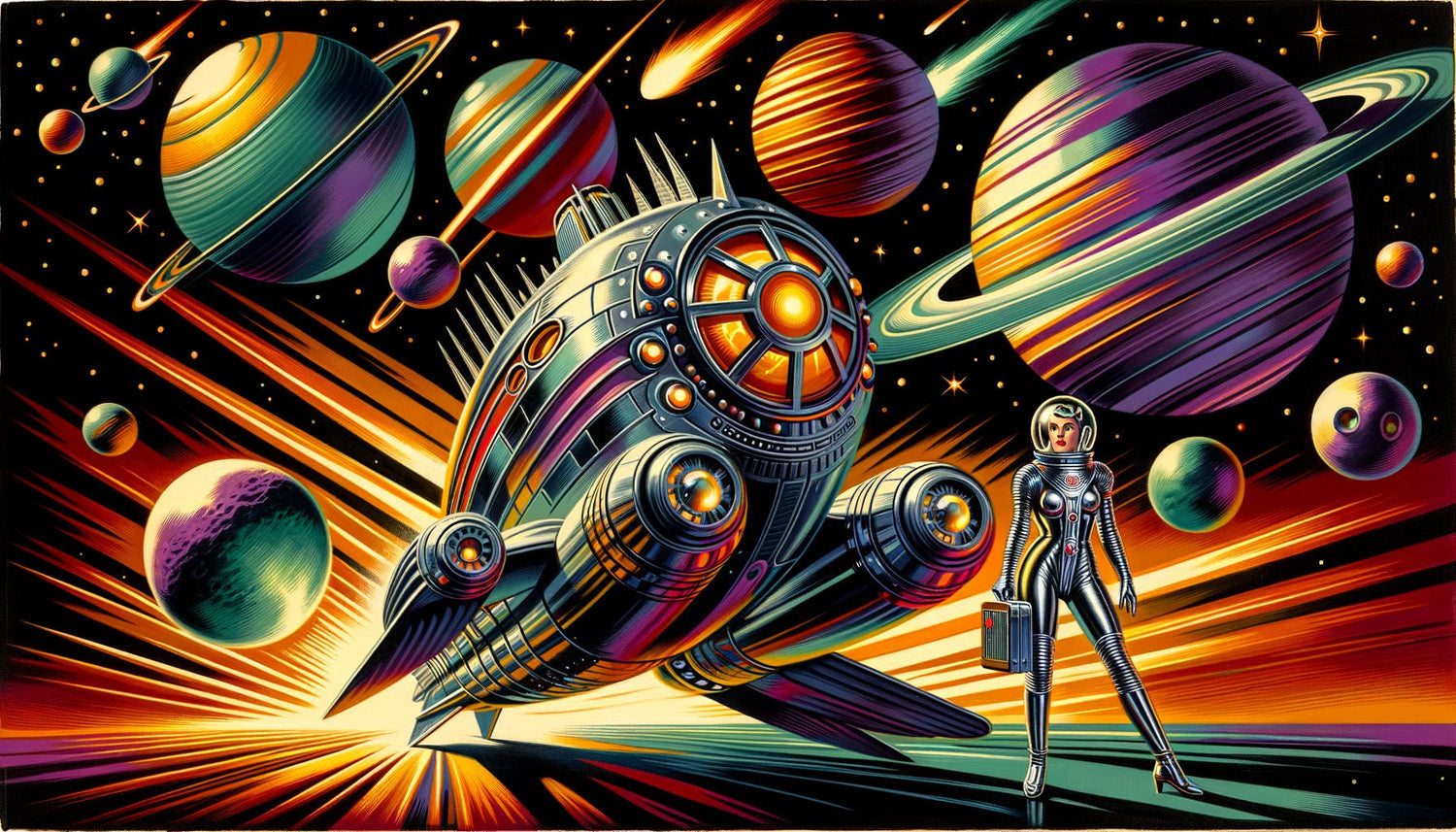
Each month, illustrators like Frank R. Paul, Virgil Finlay or Earle K. Bergey create breathtaking space scenes. Heroines in tight-fitting suits face tentacled creatures on purple planets. Chrome ships cross oversized Saturn rings. Crystal cities sparkle under three moons. These images, repeated in millions of copies, infiltrate the American and then global collective consciousness.
An aesthetic that defies the laws of physics
The illustrators of pulp magazines weren't particularly concerned with scientific realism. Their planets boasted impossible colors – electric pinks, acidic greens, flamboyant oranges. Space itself, far from the black void we know, became a theater of cosmic clouds, rays of light and fantastic phenomena. This creative freedom produced a recognizable kitsch space aesthetic: shimmering chromes, exaggerated aerodynamic shapes, dramatic contrasts.
The visual codes that shaped our cosmic imagination
The legacy of space covers from that era rests on a few recurring elements that have become the archetypes of our vision of the cosmos. These visual motifs, repeated in hundreds of publications, have created a living graphic vocabulary.
The silver rocket, an absolute icon
The retro-futuristic rocket of the pulps – streamlined, chrome-plated, often equipped with oversized fins – never really existed. Yet, it remains our spontaneous mental image of a spaceship. Inspired by torpedoes and streamline trains of the time, these craft embodied the American dream of conquest and speed. Their elegant design and metallic sheen make them today prized decorative elements, conveying both nostalgia and technological optimism.
Populated planets and their impossible landscapes
Mars, Venus and the moons of Jupiter teemed with life on the covers of pulp magazines. Crystalline forests, mercury oceans, cities suspended in the void – these alien worlds offered readers exotic getaways at a time when travel remained a luxury. This profusion of imagination creates today visual compositions of unparalleled richness for our interiors, where every detail tells a story.

Discover this inspiring artwork
When kitsch becomes iconic: the aesthetic rehabilitation
Long considered lowbrow culture, illustrations from pulp magazines have experienced a remarkable rehabilitation. In the 1960s, pop art embraced them. Andy Warhol and Roy Lichtenstein elevate popular culture to legitimate art. Vintage science fiction covers become collectibles.
Today, this retro-space aesthetic is experiencing a new golden age in interior decoration. The mid-century modern style, with its clean lines and bold colors, naturally dialogues with these cosmic visuals. From New York lofts to Parisian apartments, reproductions of pulp covers bring a touch of cultivated originality and an instant conversation piece.
The charm of temporal displacement
What makes these images so fascinating today is precisely their divergence from our current knowledge of the cosmos. We know that Venus is a toxic hell, that Mars is a sterile desert, that space is silent and empty. This cognitive dissonance creates a melancholic charm: these kitsch space visions represent the optimism of an era that still believed in galaxies populated by benevolent civilizations and accessible wonders.
The master illustrators of the cosmic golden age
Behind these iconic covers lie talented artists, often underpaid but extraordinarily prolific. Frank R. Paul, founding father of science fiction illustration, defined the visual codes as early as the 1920s with his impossible machines and futuristic cities. Chesley Bonestell, trained as an architect, brought a technical precision that made his space landscapes disturbingly realistic – at least until science caught up.
Earle K. Bergey excelled in dramatic action scenes, with those famous heroines in unlikely outfits who scandalized virtue leagues but sold magazines. Virgil Finlay, for his part, favored a meticulous engraving style, creating dreamlike compositions that transformed space into a fantastic kingdom. These artists, working under pressure with tight deadlines, nevertheless produced a visual corpus of remarkable coherence that still defines our popular cosmic imagination.

Discover this inspiring work
Integrating the pulp aesthetic into your contemporary decor
How do you bring this retro-futuristic magic into your daily life without turning it into a museum piece? The trick lies in dosage and contrast. A large framed reproduction of an Amazing Stories cover creates a striking focal point in a living room with clean lines. The saturated colors and dramatic compositions of pulp magazines instantly add character to spaces that are too restrained.
Playing with Material Contrasts
Pair these vibrant images with contemporary materials: polished concrete, brushed steel, glass. The clash between the imagined future of the 1940s and our design present creates a fascinating aesthetic tension. In an office, a series of three reproductions of vintage space covers wonderfully dialogues with Scandinavian furniture and greenery.
The Bold Color Palette
Pulp illustrators feared nothing: fuchsia pink against emerald green, bright orange on electric blue. These bold combinations, which might seem garish in isolation, work beautifully within the narrative context of these illustrations. Draw inspiration from these palettes for your choices of cushions, rugs or accessories that will echo your space art wall decor.
Transform your walls into portals to the cosmic golden age
Discover our exclusive collection of space wall art that captures the adventurous spirit and bold aesthetic of vintage pulp magazines, reinterpreted for contemporary interiors.
The Living Legacy: From Pulp to Pixel
The influence of pulp magazines extends far beyond decoration. Cinema owes them a great deal: Star Wars, Flash Gordon, Guardians of the Galaxy draw directly from this aesthetic. Retro video games, the steampunk movement, vintage product design – all bear the mark of these 10-cent covers.
This cultural continuity explains why these images still resonate with us. They are not just a nostalgic vestige, but a living visual language that continues to evolve. Contemporary artists constantly reinterpret these codes, creating a dialogue between generations. Owning a piece inspired by this kitsch space aesthetic is participating in this visual conversation that spans the century.
Conclusion: When Dream Becomes Decor
The golden age of pulp magazines left us with more than forgotten stories and yellowed paper. These publications crystallized a vision of the cosmos that remains our emotional reference, even when science contradicts it. Their popular cosmic imagery, with its chrome rockets and colorful planets, represents the technological optimism of an era when the future seemed infinitely promising.
Integrating this aesthetic into your interior is choosing boldness over caution, color over neutrality, dream over realism. It's asserting that our living spaces can tell stories, stimulate imagination, and celebrate human creativity in all its forms. Start simply: choose an image that speaks to you, a composition that resonates with your personal vision of cosmic adventure. Let it dialogue with your space. You will discover that these retro-futuristic visions, far from being dated, possess a timeless modernity that immediately transforms the atmosphere of a room. Space may not be fuchsia with three moons, but your living room certainly can be.