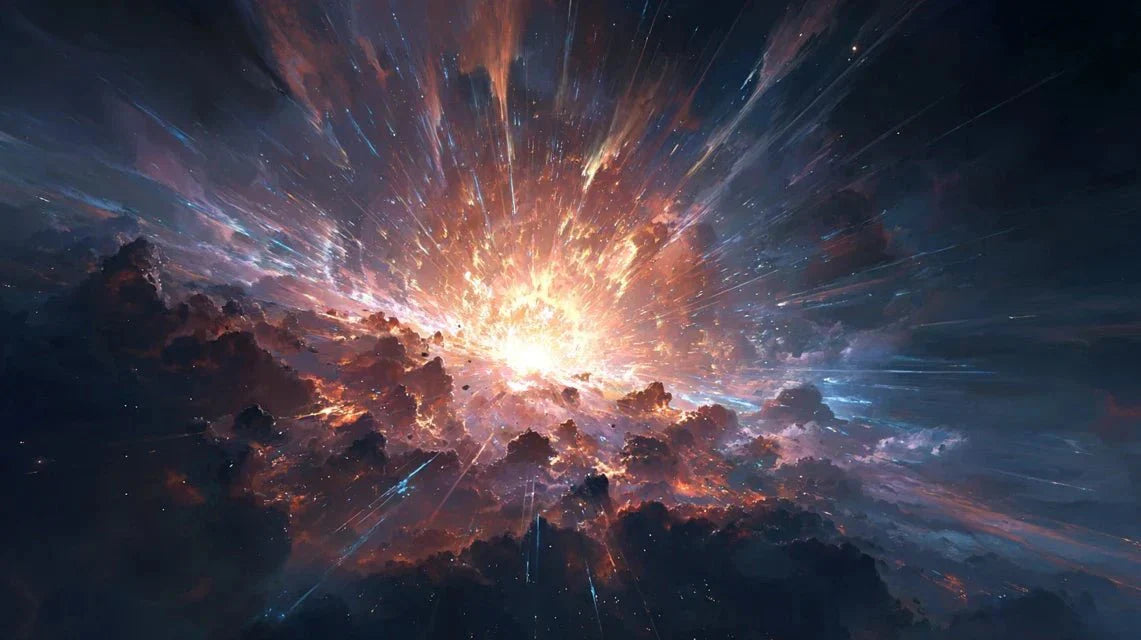
There is something absolutely hypnotic about the image of a supernova: this stellar explosion that releases in seconds the energy that our Sun will produce in ten billion years. This cosmic violence, this grandiose destruction of a dying star projecting its entrails into the universe, has fascinated artists since the first Hubble telescope images revealed their indescribable splendor. How can such a cataclysmic event be so magnificent? Why do these clouds of incandescent gas, these vibrant colors born from disintegration, touch something deep within us? Here's what supernovae bring to contemporary art: a new aesthetic of transformation, a color palette never seen before, and a meditation on the beauty inherent in the cycle of death and rebirth. If you thought space art was limited to clichés of distant galaxies, prepare to discover how cosmic destruction inspires a creative revolution.
When the end of a star becomes a masterpiece
Supernovae represent the climax of cosmic drama. When a massive star exhausts its nuclear fuel, its core collapses in a fraction of a second, rebounds violently, and expels its outer layers at speeds exceeding 10,000 kilometers per second. What is observed next defies any earthly comparison: clouds of stellar matter extending over light-years, shining with all the colors of the rainbow.
Contemporary artists who incorporate supernovae into art are not simply reproducing photographs. They capture this extraordinary tension between annihilation and creation. Take the Crab Nebula, remnant of a supernova observed in 1054 by Chinese astronomers: its red filaments of ionized gas, crossed by an electric blue emitted by synchrotron radiation, create a composition that would seem unreal if it were not authentically cosmic. This natural palette – saturated oranges of ionized sulfur, acidic greens of oxygen, deep blues of hydrogen – becomes an inexhaustible source of inspiration.
What makes supernovae particularly fascinating for art is their ability to visually embody universal philosophical concepts. Death that begets life. Destruction that creates beauty. Chaos that generates order. Every iron atom in your blood, every calcium molecule in your bones, was born in the heart of a star exploding as a supernova. We are literally made of stardust scattered by these cataclysms.
The aesthetic revolution of cosmic chaos
Integrating supernovae into contemporary art has transformed our very conception of beauty. Traditionally, aesthetics favored harmony, balance, symmetry. But supernovae offer us a beauty of another order: that of the violent sublime, dynamic asymmetry, organized turbulence.
The fractal structures of expanding gas filaments, shock fronts sculpting the interstellar medium, cavities carved by stellar winds – all this creates patterns of organic complexity that even the most sophisticated algorithms struggle to reproduce. It is this authenticity, this impossibility of artifice, that gives supernova representations their emotional power.
The colors of stellar apocalypse
The chromatic palette of supernovae defies convention. These colors are not artistic choices, but spectroscopic signatures: each shade reveals the presence of a specific chemical element, a particular temperature, an expansion velocity. Deep red betrays alpha hydrogen, vibrant green signals doubly ionized oxygen, intense blue marks ultra-fast electrons spiraling in colossal magnetic fields.
This natural coding of colors fascinates artists because it offers a visual language that is both scientifically precise and emotionally powerful. A work incorporating the palette of a supernova does not simply reproduce pretty colors: it literally encodes the most violent processes in the universe. It's information transformed into emotion, physics transcended into visual poetry.

Discover this inspiring artwork
From the observatory to the living room: integrating cosmic destruction
How do you transpose the immensity of a stellar explosion into a domestic space? This question has led many creators to reinvent their approach. Representations of supernovae in decorative art do not seek to miniaturize the event, but to capture its essence: the movement, the energy, the transformation.
In a contemporary interior, a supernova representation functions as a dynamic focal point. Unlike traditional static compositions, these works suggest perpetual motion. Volutes of gas seem to unfold before your eyes, shock waves appear to pulsate, colors vibrate with contained energy. It is this kinetic quality that transforms a simple decorative element into a living presence.
The unexpected harmony between destruction and design
Paradoxically, supernovae fit beautifully into minimalist or clean interiors. Their organic complexity creates a striking contrast with sharp architectural lines, solid surfaces, and uncluttered spaces. A work representing the Cassiopeia A supernova, with its drapes of orange and blue matter, becomes a perfect counterpoint to Scandinavian furniture in neutral tones.
This juxtaposition between earthly order and cosmic chaos generates a stimulating visual tension. The eye travels between the serenity of domestic geometric forms and the turbulence of stellar structures, creating a dynamic that prevents the space from becoming static or predictable. This is exactly what demanding art lovers are looking for: a presence that dialogues with its environment without ever blending into the background.
The great supernovae that have marked the artistic imagination
Certain stellar explosions have particularly captivated artists due to their distinctive visual beauty. Supernova 1987A, observed live in the Large Magellanic Cloud, has been documented through its evolution, offering creators a visual chronology of transformation. Its rings of pre-existing matter, progressively illuminated by the shock wave, create an almost architectural structure of unexpected elegance.
The Veil Nebula, remnant of a supernova 8,000 years old, offers a spectacle of delicate filaments of extraordinary finesse. These structures resemble drapes of cosmic silk, diaphanous veils floating in space. It is this deceptive softness – these forms so graceful born from unimaginable violence – that fascinates.
And then there are the historical remnants: the Crab Nebula already mentioned, Kepler, Tycho Brahe. These supernovae observed before the era of modern telescopes have been reinterpreted through current technologies, revealing structures that their original observers could never have imagined. This superposition of eras, this conversation between past and present, adds a temporal dimension to the works inspired by them.

Discover this inspiring work
The profound symbolism of rebirth through destruction
Beyond their immediate beauty, supernovae in art carry a powerful symbolic charge. They visually embody the Buddhist concept of impermanence, Heraclitus's philosophy of perpetual change, the myth of the phoenix rising from its ashes. This universal metaphor explains why these images resonate so deeply, even with those who are not particularly interested in astronomy.
A supernova representation thus becomes a memento vitae – not a reminder of death, but a celebration of incessant transformation. It whispers to us that nothing is permanent, that every end contains the germs of a new beginning, that beauty can emerge from the most cataclysmic moments. In a world obsessed with preservation and stability, these works offer a refreshing cosmic perspective.
Meditate on the cosmic scale
Living daily with an image of a supernova subtly alters our relationship to time and space. These events unfold on scales that defy human comprehension: explosions lasting a few hours eject matter that will continue to expand for millennia. This vertiginous temporal perspective relativizes our immediate concerns without invalidating them – it simply places them in a broader context.
It is precisely this ability to anchor infinity in the everyday that makes these works valuable. They function as windows open onto immensity, visual reminders that we participate, even modestly, in a grand cosmic story. Each glance cast upon these images becomes a micro-meditation, a mental breath that temporarily expands the boundaries of our consciousness.
Transform your space into a cosmic portal
Discover our exclusive collection of space paintings that capture the majesty of supernovae and the hypnotic beauty of creative destruction.
How to choose your window on stellar apocalypse
Selecting a supernova representation for your interior requires considering several dimensions. First, scale: these cosmic events are often best represented in generous formats that respect their actual magnitude. A small domestic format risks betraying the grandeur of the phenomenon, while a work of considerable dimensions restores something of this overwhelming immensity.
Next, the chromatic dominance. Do you prefer the warm tones of hydrogen and sulfur-rich supernovae – those reds, oranges, and yellows that evoke a cosmic blaze? Or are you drawn to the cool tones of ancient remnants, those deep blues and electric greens that suggest a more distant, more meditative beauty?
Consider also the degree of scientific detail. Some representations prioritize photographic accuracy, preserving every filament, every nuance detected by space telescopes. Others adopt a more interpretative approach, which captures the spirit of the supernova rather than its letter. Both approaches have their legitimacy: the former celebrates the staggering reality of the universe, the latter acknowledges that art always transcends its subject.
The optimal location to maximize impact
A work representing a supernova deserves a strategic location. Ideally, position it on a wall that your gaze naturally encounters several times a day, but not in a passageway where it would be constantly seen peripherally. These images require moments of contemplation, even brief ones.
Lighting plays a crucial role. Avoid direct light which would create reflections, but ensure sufficient lighting so that the subtle nuances – those gradations of color that encode so much physical information – remain perceptible. Some collectors even install accent lighting that transforms the work into a luminous presence during evenings.
Imagine yourself in the evening, in a comfortable armchair, with a glass in hand, letting your gaze drift over these swirls of stellar matter. You mentally follow the trajectories of gas, you lose yourself in the turbulence zones where different colors blend. Without even realizing it, you have left behind everyday worries for a mental journey of thousands of light-years. That is exactly the contemplative escape that a well-chosen and well-placed supernova representation provides.
Beyond their immediate beauty, supernovae in art remind us of a fundamental cosmic truth: destruction is never an end, but always a metamorphosis. These exploding stars sow the heavy chemical elements into space without which life would not exist. Their violent death fertilizes the universe, allowing for the emergence of new stars, new planets, possibly new forms of consciousness. Living with these images is integrating this transformative perspective into your daily space, inviting cosmic sublimity to dialogue with your inner self. Start simply: observe images of different supernovae, note which ones resonate most strongly within you, and let that intuition guide your choice. The universe awaits to illuminate your walls.
Frequently asked questions about supernovae in art
Are the colors of supernovae in works of art real or artificial?
This is an excellent question that deserves a nuanced answer. The colors you see in supernova representations are authentic in their origin, but often reinterpreted for human perception. Space telescopes capture radiation in wavelengths that our eyes cannot perceive – ultraviolet, infrared, X-rays. Scientists then assign visible colors to these invisible data according to established conventions. Red generally represents certain emissions, green others, blue still others. So yes, these colors correspond to real physical phenomena - they are just translated into our visible spectrum. Some artists scrupulously respect these scientific conventions, while others take creative liberties to intensify the emotional impact. Both approaches are valid: the first celebrates fidelity to cosmic reality, the second recognizes that art always transcends pure documentation. When choosing a work, find out about the approach taken to ensure it aligns with your aesthetic values.
Is a supernova representation suitable for all interior styles?
Absolutely, but integration requires consideration of your decorative style. In a contemporary or minimalist interior, a supernova brings that organic and colorful contrast that prevents the space from becoming too austere. Its structured chaos dialogues beautifully with clean lines. In a more classic or traditional interior, choose a representation with softer tones and an elegant frame that bridges the gap between old and cosmic. Eclectic interiors naturally welcome these works which are themselves complex mixtures of colors and textures. Even in an industrial style, supernovae work remarkably well: their palette of molten metals resonates with raw materials such as steel and concrete. The secret lies in scale and palette: a large supernova with vibrant colors becomes the star of a minimalist space, while a more subtle version with muted tones integrates harmoniously into an already visually rich environment. Consider your current decor not as a constraint but as a context that will influence which specific supernova will suit you best.
What is the difference between a nebula and a supernova in decorative art?
This confusion is very common, and it is understandable because supernova remnants are technically nebulae – but of a very particular type. A generic nebula is simply a cloud of gas and dust in space, which can be a place of birth for stars or a remnant of interstellar matter. Supernovae, on the other hand, are dynamic events: they are explosions that create rapidly expanding structures. Visually, this difference translates to a distinct energy. Representations of classic nebulae like Orion often feature softer, more contemplative forms with subtle gradients. Supernovae exhibit filamentary structures, visible shock fronts, dramatic asymmetry betraying the violence of their origin. Emotionally, nebulae evoke cosmic serenity, slow gestation, while supernovae speak of radical transformation, unleashed power, beauty born from cataclysm. In your interior, a nebula will create a meditative and soothing atmosphere, perfect for a bedroom or relaxation space. A supernova will inject dynamic energy, ideal for a creative office or a living room where you want to stimulate conversations. Choose according to the atmosphere you want to cultivate in the area concerned.