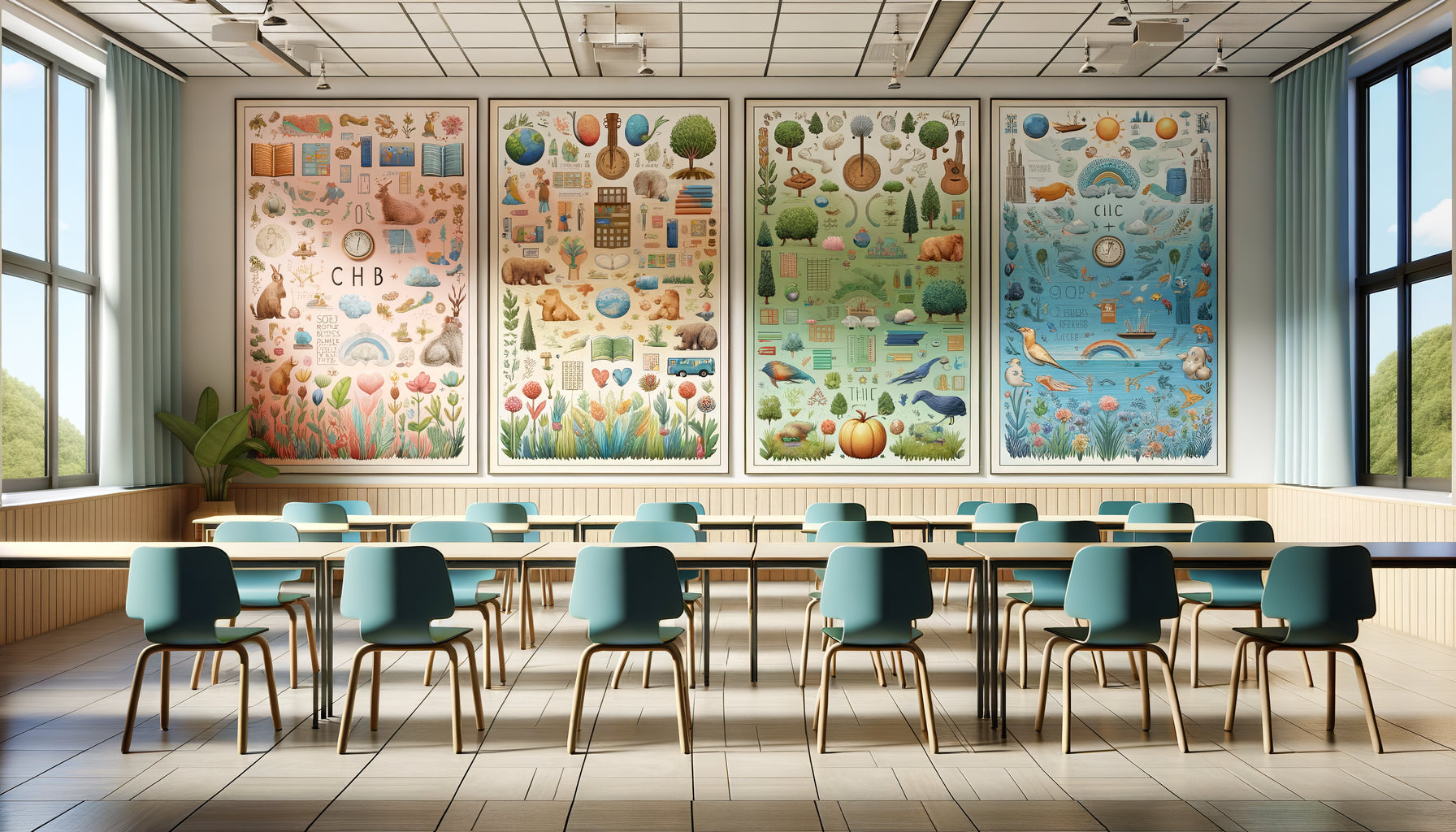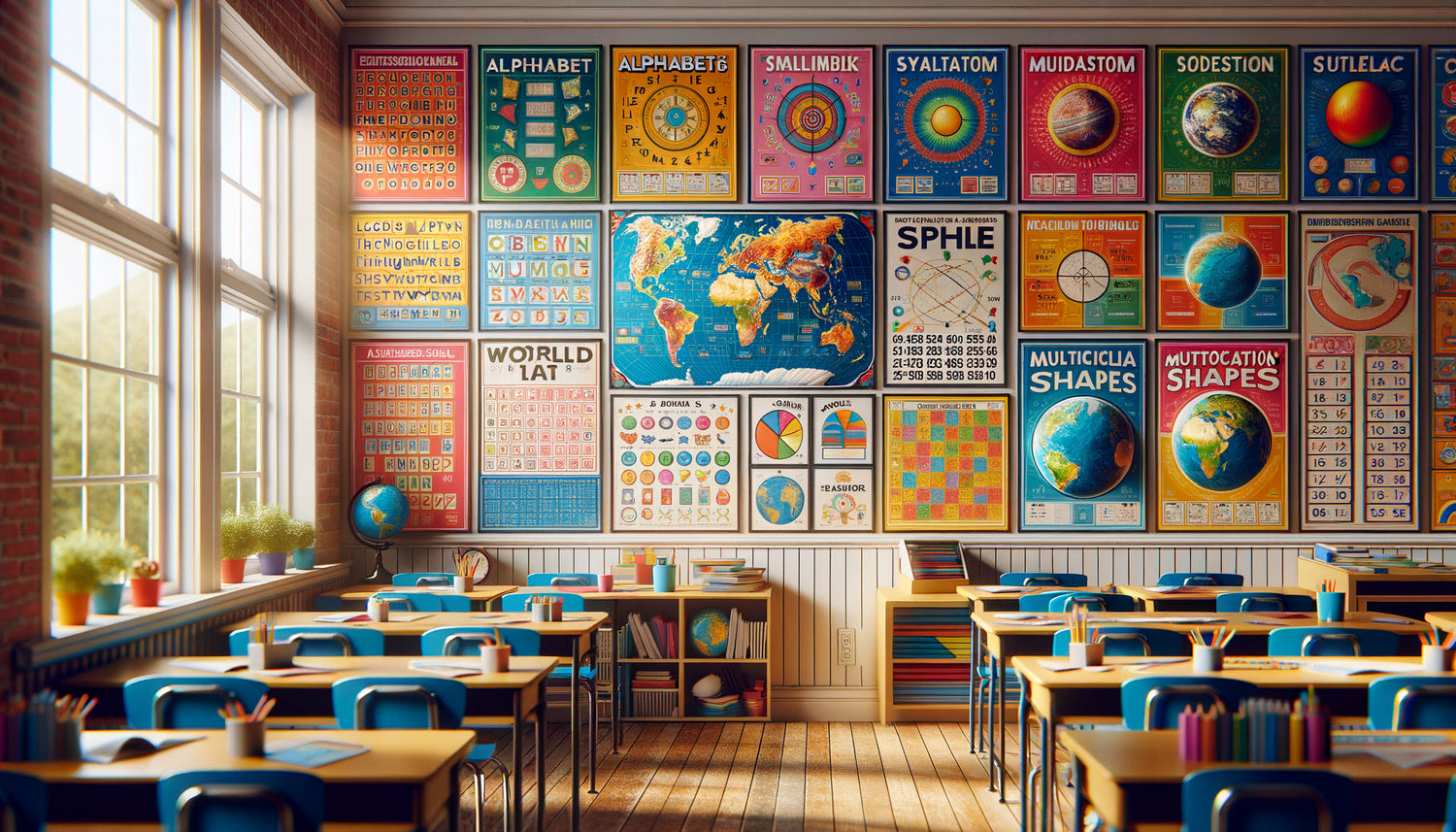
One October morning, while visiting my daughter’s elementary school, I observed a fascinating scene. In front of a large illustration depicting the water cycle, three first-grade students were debating with passion. One pointed to the clouds, another followed the course of the rivers with their finger. Without adult intervention, they were simply building their understanding by dialoguing with a wall mural. This revelation marked me: educational murals do not only decorate classrooms, they transform the way children learn.
Here's what educational murals truly bring: they anchor abstract concepts in visual memory, create permanent spatial landmarks in the learning environment, and stimulate autonomy by offering a consultable support at any time.
Too often, classrooms are limited to white walls punctuated with a few administrative posters. Teachers lack time, budgets restrict choices, and the real impact of these visual supports remains unknown. Yet, educational neuroscience confirms it: our brain retains 65% of information presented visually versus only 10% of what is heard.
Good news: transforming a classroom into a visual learning environment does not require a pedagogical revolution or a colossal budget. A few strategically placed educational murals are enough to create a measurable difference in student progress. Let's discover together how these discreet tools become real pedagogical allies.
Visual memory: when eyes become the best teachers
In my career as an educational psychologist specializing in the design of learning spaces, I have accompanied more than 80 schools in their reorganization. A constant emerges: students develop extraordinary visual reflexes when their environment provides constant landmarks.
Take the example of the cursive alphabet displayed above the board. A child who hesitates on the formation of a G naturally looks up to check the model. This gesture, repeated dozens of times, creates an automatism. The educational mural becomes an instantly accessible external memory, without interrupting the learning flow or requiring the teacher's attention.
Neuroscience explains this phenomenon by the concept of “spatial anchoring of knowledge”. Our brain associates information with its physical location. When the multiplication table of 7 always occupies the same wall to the right of the board, the student does not only memorize the numbers: they record their position in space. This double encoding – visual and spatial – considerably strengthens long-term retention.
Permanent landmarks in a world of distractions
Our children grow up in a universe of constant solicitations. Screens, notifications, multiple stimuli: their fragmented attention constitutes the major challenge of contemporary education. In this context, educational murals offer a valuable stability.
Unlike digital supports that appear and disappear, a wall chart remains visible for months. This permanence creates a sense of familiarity and security. Students develop an almost emotional relationship with these supports: "my dinosaur chart," "our timeline." This emotional appropriation facilitates cognitive engagement.
The "autonomous consultation" effect
I observed this phenomenon in a CE2 class in Lyon. The teacher had installed a summary chart of grammatical homophones (a/à, et/est, on/ont). Without being asked, the students had taken it as a habit to spontaneously check their written work by referring to the chart. Autonomy was naturally established.
This self-regulation reduces dependence on the adult. The child learns to seek the answer in his environment before asking for help. An essential skill that goes far beyond the school setting and prepares for lifelong learning.

How colors and visuals decode complexity
A 7-year-old's brain processes images 60,000 times faster than text. This data radically transforms our pedagogical approach. A well-designed educational chart does not only display information: it visually structures it to facilitate understanding.
Let's take the example of a chart on types of sentences. Textual version: a list of abstract definitions. Visual version: colored pictograms associating an emotion with each type (red exclamation point for exclamative, blue dot for declarative). Students instantly recognize the nature of the sentence thanks to the color code, before even mobilizing grammatical reasoning.
Educational charts also exploit the power of visual hierarchy. Titles in large characters, framed subcategories, arrows indicating relationships between concepts: this spatial organization reflects the logical structure of knowledge. The student not only understands the content but also how the elements relate to each other.
When the environment becomes a third teacher
In the Reggio Emilia pedagogy, we talk about the environment as the "third teacher," after the adult and peers. This vision deeply marked me during a study trip to Italy. The Italian classrooms I visited looked like learning galleries, where each wall told an educational story.
An educational wall art piece never replaces the teacher, but it extends their teaching action in time and space. When an adult works with a group, the wall art continues to teach other students. When the day ends, concepts remain visible, gradually permeating minds.
The cognitive immersion effect
Imagine a CM1 class where the walls display a world map, a chart of climates, a timeline of great discoveries, and a diagram of continents. Without even realizing it, the student is immersed in a geographical universe. Connections are created naturally: they associate Christopher Columbus on the timeline with the route on the map, relate the tropical climate to the equatorial zones.
This multi-referential immersion significantly enriches general knowledge. Educational wall art pieces act like seeds planted in the mind: some will germinate immediately, others much later, during an unexpected connection with a new subject.

Inclusion tools for all learning profiles
During a support program in a school welcoming students with specific needs, I measured the inclusive impact of educational wall art pieces. A dyslexic child struggling with oral instructions constantly referred to the chart illustrating the steps of an exercise. A foreign-language student progressed in vocabulary thanks to charts associating words and images.
Educational wall art speaks to all brains: visual ones obviously, but also kinesthetic (who can point, touch) and auditory (who verbalize what they see). This multimodality ensures that each profile finds their entry point into learning.
For anxious children, these supports offer a reassuring framework. No judgment, no time pressure: the wall art patiently waits to be consulted. This psychological dimension is not anecdotal. A relaxed student learns better than a stressed student.
How to choose and position your educational wall art effectively
After years of observation, I have identified some essential principles to maximize the impact of educational wall art in a classroom.
Eye level is crucial. A wall art piece positioned too high strains the eyes and discourages consultation. Ideally: the center of the wall art at eye level of a standing student. For younger children, don't hesitate to lower it even more.
Thematic consistency by area works remarkably well. The math wall brings together multiplication tables, geometric figures and measurements. The French corner gathers conjugations, spelling and grammar. This spatial organization reflects the mental organization of disciplines.
Strategic rotation maintains interest. Some panels remain permanent (alphabet, numbers), while others follow pedagogical sequences. This alternation between stability and novelty stimulates attention without overloading the environment.
Aesthetics are not an accessory. A harmonious educational panel, with balanced colors, naturally invites the eye. Conversely, a cluttered or messy support generates cognitive confusion. Beauty facilitates learning; it's not luxury, it's pedagogical efficiency.
Transform your classroom into an inspiring visual learning environment
Discover our exclusive collection of wall art for School that stimulates curiosity and permanently anchors knowledge.
The silent transformation of learning
Educational panels operate a discreet but profound revolution. They do not require complex training, do not break down, and do not require maintenance. Yet their presence subtly but permanently changes the child's relationship with knowledge.
By providing permanent access to information, they cultivate intellectual autonomy. By visually structuring knowledge, they facilitate understanding of complex concepts. By creating stable reference points, they secure the learning path.
Imagine your child or students evolving in a classroom where every look offers an opportunity to learn. Where walls are no longer neutral but become silent pedagogical partners. Where knowledge does not only wait in textbooks but is displayed, exposed and shared visually.
Start simply: identify the three fundamental notions of your curriculum, those that constantly recur. Find or create clear and aesthetic educational panels for these concepts. Position them strategically. Then observe. You will see gazes spontaneously turn towards these supports, fingers pointing, connections being made.
Learning is not just about what is said in class. It is also built into what is seen, contemplated and rediscovered day after day. Educational panels are not mere decorations: they are discreet catalysts for school success.
Frequently asked questions about educational panels
From what age are educational panels effective?
From kindergarten onwards, children benefit from visual aids, particularly wall art combining images and words. Even before they can read, they memorize shapes, colors, and visual associations. I have seen middle school students recognize the days of the week thanks to an illustrated chart, long before deciphering letters. The key is to adapt the level of complexity: prioritize pictograms and illustrations for younger children, then gradually integrate text. The golden rule: if a child can understand the concept orally, they can benefit from its visual representation on an educational wall art.
How to avoid visual overload in a classroom?
Overload is the main pitfall of well-intentioned educational environments. My recommendation: limit yourself to a maximum of 5-7 permanent educational wall arts, depending on the size of the class. Choose them for their daily relevance (alphabet, numbers, calendar) rather than their comprehensiveness. Create visual breathing spaces between the wall art – blank wall areas that rest the eye. Absolutely avoid overlaps and formats that are too small, forcing you to squint. One large, clear, and readable wall art is better than three cramped supports.
Can digital wall art replace physical wall art?
The two formats complement each other rather than compete. Interactive digital wall art excel at dynamic demonstrations and collective manipulations. But they have a major limitation: they are not constantly visible. Once the screen is off or switched to another content, the information disappears. Physical wall art offer this irreplaceable permanence that allows for progressive impregnation. In my practice, I recommend a hybrid approach: use digital tools to introduce and explore concepts, then consolidate with physical wall art that will remain accessible. Students benefit from the dynamism of digital technology and the stability of the physical support. The ideal pedagogical approach is not to choose, but to intelligently orchestrate these two modalities.