In a fifteen-year-old teenager’s office in Boston, a portrait of Ada Lovelace stands above her desk. Every evening, when she opens her math notebooks, she meets the gaze of this pioneer of computer code. Three years later, she enrolls at MIT for computer science. Coincidence? Neurologists specializing in cognitive development speak rather of inspiring visual anchoring – a fascinating phenomenon where the image becomes a trigger for identity projection.
Here’s what paintings depicting famous scientists bring: they materialize concrete identification models, transform abstract science into an accessible human figure, and create a visual environment that normalizes intellectual ambition. Far from being simple decorations, these artistic representations play a little-known but powerful role in the awakening of STEM vocations.
The problem? In our contemporary interiors, science remains invisible. Children’s rooms are overflowing with fictional superheroes, but where are Marie Curie, Albert Einstein or Neil deGrasse Tyson? This lack of visual scientific references contributes to young minds considering science as a distant universe, reserved for an inaccessible elite.
Yet, the solution exists and it is surprisingly simple. By strategically integrating representations of scientists into our living spaces, we create what psychologists call a cognitive aspiration environment – a visual framework that subtly suggests that science is not a foreign territory, but a horizon within sight.
When the portrait becomes a mirror of possibilities
The impact of visual representations on identity construction is nothing trivial. A study conducted on 1200 middle school students revealed that those exposed daily to portraits of scientists in their establishment manifested 37% additional interest in STEM careers compared to the control group. Even more fascinating: this effect intensifies when young people can identify with the figures represented.
Paintings depicting famous scientists act as emotional bridges to abstraction. Rosalind Franklin, frozen in her laboratory with her X-ray diffraction images, ceases to be a line in a school textbook. She becomes a presence, an embodied possibility. Her gaze reminds us that behind every major scientific discovery, there was first a human being with their doubts, their determination, their sleepless nights.
This humanization of science through image creates a phenomenon of progressive familiarity. The child who daily encounters the portrait of Mae Jemison, the first African American woman in space, unconsciously integrates that the stars are not reserved for a typical profile. The message is subliminal but powerful: if she did it, why not me?
The role model effect according to developmental psychology research
Work on the 'role model effect' demonstrates that the regular visual presence of accomplished figures in a field significantly increases the likelihood that a young person will consider that field as a viable option. Paintings of famous scientists do more than decorate – they subtly shape the realm of possibilities within developing imaginations.
The diversity of scientific faces: an identification issue
For a long time, science has been represented by a monotonous gallery: white men in lab coats, often older, always serious. This lack of visual diversity has created entire generations of symbolic exclusion. How can a young girl of Maghrebian origin envision herself as an astrophysicist if all the scientists she sees depicted are European gentlemen from the 19th century?
Paintings depicting famous scientists now take on a crucial political and social dimension. Each portrait of Katherine Johnson, NASA mathematician, becomes an act of memorial repair and an invitation to female talents. Each representation of Tu Youyou, Chinese Nobel laureate, geographically expands the territory of scientific excellence in the collective imagination.
This diversification of visible scientific figures responds to a fundamental developmental need: that of seeing oneself reflected in one's aspirations. Educational neuroscience studies show that identification with a role model activates brain areas linked to intrinsic motivation and perseverance – two major predictors of success in STEM pathways.
Beyond gender and origin, the variety of disciplines represented also counts. A painting of Jane Goodall with her chimpanzees speaks differently than a portrait of Alan Turing in front of his machines. One opens up to field biology, the other to theoretical computer science. This multiplication of visual entry points into the world of science allows each sensitivity to find its echo.

The art of choosing: which scientists for which spaces?
Not all paintings depicting famous scientists are suitable for all ages or environments. The strategic selection of figures and their artistic treatment largely determines their inspiring potential.
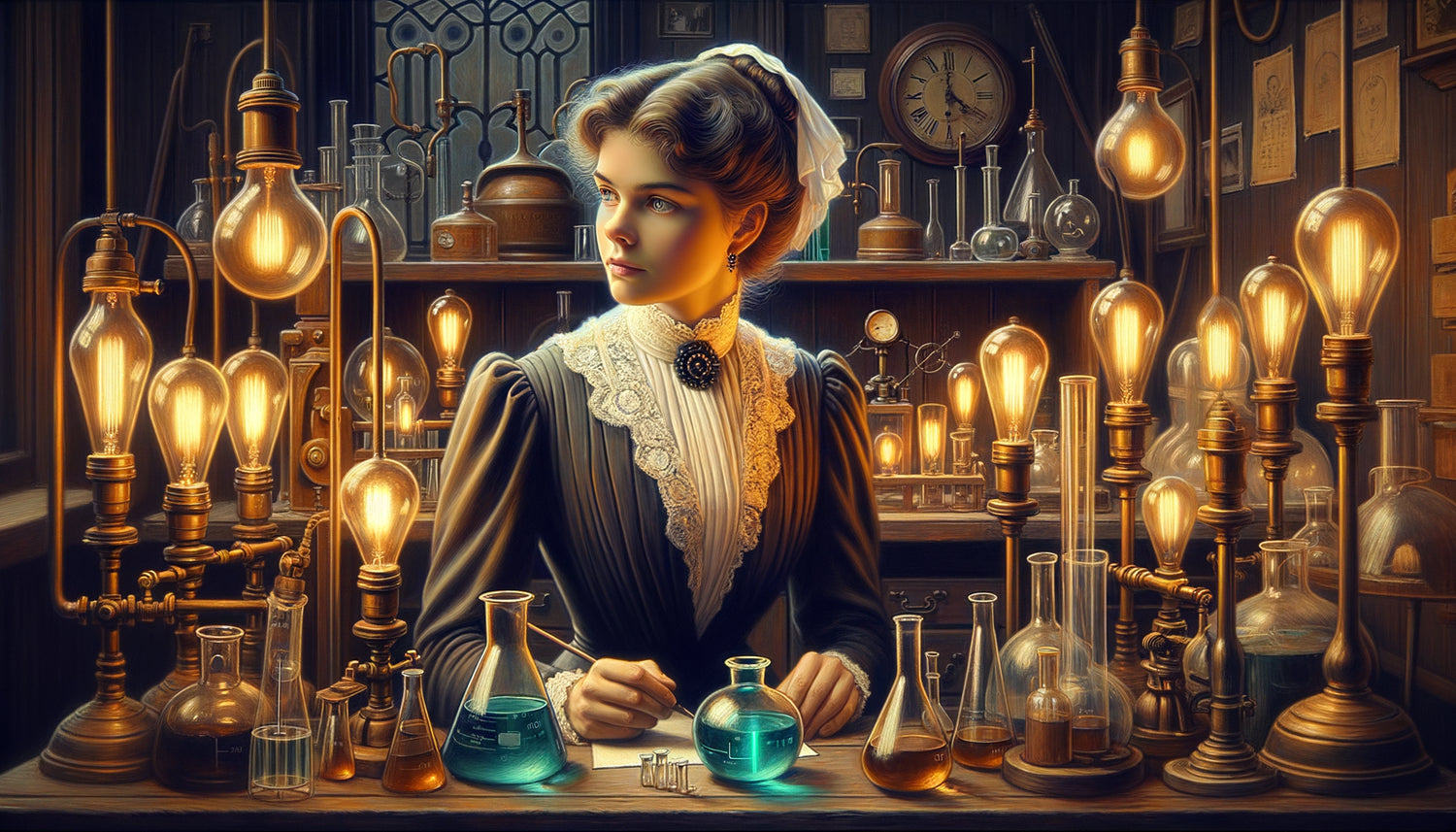
For a child’s bedroom (ages 6-10), prioritize dynamic and colorful representations: Marie Curie in her luminous laboratory, Thomas Edison surrounded by his light bulbs, Alexander Fleming observing his famous penicillin. The goal is to associate science with wonder and action, not academic gravity.
Teenagers respond better to more sophisticated and authentic portraits. A black and white painting of Nikola Tesla in his electrical laboratory, a stylized representation of Stephen Hawking, a contemporary portrait of Jennifer Doudna with her depiction of CRISPR – these images speak to their need for complexity and depth.
Common areas: creating a family culture of curiosity
In a shared office or family library, portraits of famous scientists become conversation starters. A portrait of Rachel Carson can initiate a dialogue about ecology, that of Galileo about the history of discoveries, that of Françoise Barré-Sinoussi about contemporary medical research. The strategic placement of these works transforms the domestic space into an incubator of intellectual curiosity.
The unsuspected power of daily visual context
We massively underestimate the influence of our daily visual environment on our psychological construction. Paintings depicting famous scientists work according to the principle of positive repeated exposure: each glance, even distracted, subtly reinforces the association between normality and scientific excellence.
An experiment conducted in three British high schools demonstrated this spectacularly. In establishment A, the corridors were decorated with neutral landscapes. In B, with generic motivational quotes. In C, with portraits of diverse scientists with their discoveries. After two years, enrollment in science courses increased by 4% in A, 9% in B, and 23% in C. The scientific visual environment had created a school culture that fostered STEM vocations.
This phenomenon obviously applies to private spaces. A child who grows up surrounded by representations of researchers, inventors, and scientific explorers integrates these references as natural components of their mental universe. Science ceases to be a compulsory subject at school and becomes a familiar territory populated with identifiable figures.
Beyond motivation: anchoring perseverance
Scientific journeys are marked by obstacles, experimental failures, and rejected theories. Paintings depicting famous scientists visually recall that scientific success is always preceded by perseverance. Einstein was a mediocre student, Edison failed thousands of times, Curie worked in appalling conditions. These stories, embodied in portraits hung on walls, become mental resources during moments of school discouragement.

How to maximize the inspiring impact of these works?
Hanging a painting is not always enough. For representations of famous scientists to deploy their full vocational potential, a few simple principles multiply their effectiveness.
First, prioritize eye level placement. A painting that is too high becomes a passive decorative element. Placed at the eye level of the child or teenager, it becomes a silent interlocutor, a presence with which one establishes a form of daily visual dialogue.
Secondly, associate each painting with an accessible micro-narrative. A small plaque or a discreet label with a striking phrase from the scientist depicted transforms the image into a gateway to their story. “Imagination is more important than knowledge” under a portrait of Einstein creates a memorable hook.
Thirdly, renew periodically. A painting fixed for ten years loses its power of interpellation. Rotating a small collection of scientific representations maintains the freshness of visual stimulation and exposes to a wider diversity of models and disciplines.
Finally, create thematic constellations. Grouping three portraits of pioneering scientists creates an effect of mutual legitimation. Associating a painting of Pasteur and one of Fleming visually tells the story of microbiology. These thoughtful compositions transform isolated works into coherent visual narratives.
Transform your walls into sources of daily inspiration
Discover our exclusive collection of wall art for School that celebrates the greatest scientific figures and encourages the intellectual curiosity of young minds.
From inspiration to action: the continuum of influence
Tableaux depicting famous scientists don't, of course, create STEM vocations on their own. They rather act as catalysts within a broader educational ecosystem. Their daily visual presence lowers psychological barriers, normalizes intellectual ambition, and creates fertile ground where other stimuli can germinate.
Think of these representations as visual seeds. Some will remain dormant, others will sprout years later during a decisive encounter with an inspiring teacher or a captivating documentary. Their simple presence enriches the imagination, broadens the spectrum of conceivable futures, suggests that science is not a world apart but an accessible horizon.
The accumulation of these small daily exposures eventually creates what educational sociologists call aspirational capital – this psychological resource that allows a young person to project themselves into ambitious trajectories without them seeming unrealistic or reserved for others.
Ultimately, the question is not whether a painting of Marie Curie will turn your child into a nuclear physicist. It's about understanding how we can visually enrich our environments so that science, research and innovation appear as natural, desirable and accessible paths for all, regardless of their starting point.
Frequently asked questions about the impact of scientific representations
From what age can paintings of scientists have an inspiring effect?
From 5-6 years old, children begin to construct their representations of professions and identify achievement models. At this age, prioritize visually engaging and colorful representations rather than austere academic portraits. A painting showing Marie Curie with luminous test tubes or Alexander Bell with his telephone works better than a formal portrait. The goal is to positively associate the scientific figure with joyful discovery, not with school constraints. Between 10 and 15 years old, the impact becomes particularly significant because this is the period when career projections crystallize and identification with adult models intensifies. Adolescents are sensitive to more sophisticated portraits that reflect the complexity of their own identity construction. The key is to adapt the artistic style to the child's cognitive maturity while maintaining a continuous visual presence of inspiring scientific figures.
Should contemporary or historical scientists be prioritized?
Ideally, it’s about creating a balance between the two. Historical scientists like Newton, Darwin or Curie bring a dimension of legitimacy and cultural heritage – they are the giants on whose shoulders current science is built. Their visual presence inscribes the scientific approach into a reassuring historical continuity. On the other hand, contemporary figures like Mae Jemison, Emmanuelle Charpentier or Elon Musk create a sense of immediacy and possibility: science is not a frozen domain of the past but an ongoing adventure in which one can participate now. Representations of contemporary scientists, particularly women and people from minorities, actively combat stereotypes and allow for more direct identification for young people today. An effective approach is to have a few essential historical figures as cultural pillars, complemented by portraits of current scientists that show science as a living and accessible territory.
Do these artworks also work for adults in career transition?
Absolutely, and sometimes with even more power. Adults questioning their professional path often go through a phase of doubt about their legitimacy to embark on new paths, particularly in scientific or technical fields perceived as reserved for linear backgrounds. A painting depicting famous scientists in an office or personal workspace creates a psychological environment of authorization: it visually recalls that great discoveries are the work of ordinary humans who dared to follow their curiosity. Portraits of scientists with atypical backgrounds – Einstein employed at the patent office, Faraday self-taught bookbinder turned great physicist – are particularly powerful for career changes. They materialize the idea that an unconventional path is not a handicap but sometimes an asset. For adults, the effect works differently than for children: less through projective identification than through symbolic validation. The painting becomes a daily visual reminder that intellectual curiosity and scientific ambition have no expiration date and that reinventing oneself professionally towards STEM is a legitimate project at any age.