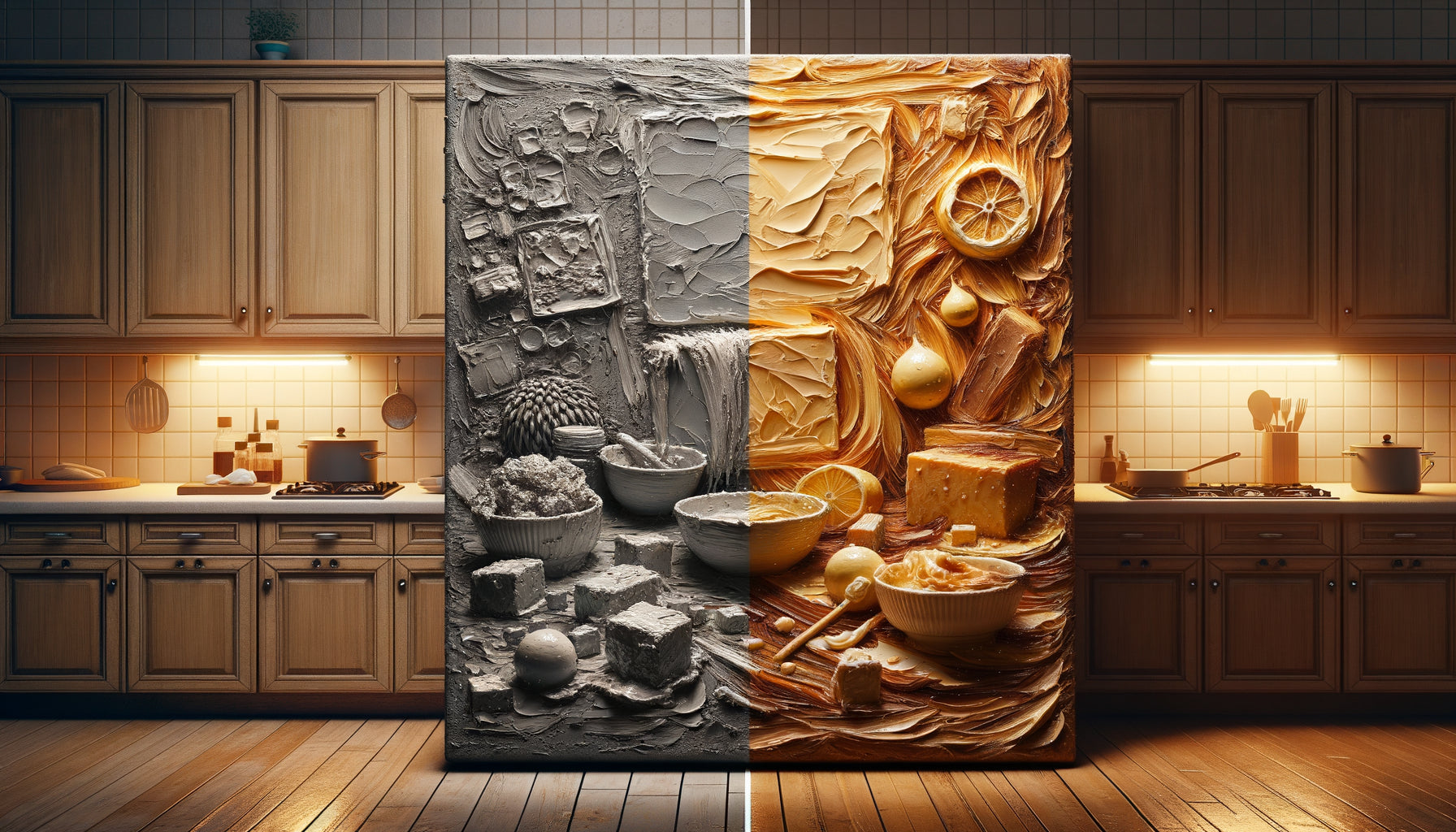
Last summer, while visiting the studio of a Parisian collector, I discovered a faded watercolor that still exuded, forty years later, the scent of pipe tobacco from its former owner. This encounter plunged me into a fascinating investigation: paintings have an olfactory memory. Like silent sponges hanging on our walls, some works absorb the smells of our daily lives while others retain them captive for decades.
Here's what this invisible relationship between paintings and odors reveals: it can transform your interior into a trap for unpleasant scents, irreversibly alter your precious artworks, but also guide you towards healthier and more sustainable decorative choices.
You may have noticed that slight smell of frying that lingers in your kitchen despite ventilation. Or that musty scent that seems to emanate from your vintage painting. This frustration is legitimate: no one has ever explained to you that your works of art could act as odor sensors.
Good news: understanding this phenomenon will not only allow you to protect your paintings, but also to purify the atmosphere of your interior. I'm going to reveal the secrets of this little-known interaction between pictorial matter and fragrant molecules.
The canvas, that invisible sponge which captures your daily life
Each painting is a complex porous structure. The linen or cotton canvas, even primed, retains a woven texture with thousands of microscopic cavities. These microscopic spaces act as traps for molecules – just like upholstery fabric absorbs cooking odors.
I analyzed dozens of antique paintings in homes where people cooked daily. The difference is striking: an unprotected canvas exposed for five years in a kitchen can retain up to 40% more odor particles than a work hung in a living room. Natural fibers are particularly receptive to volatile compounds – those invisible molecules that carry the scents of frying, tobacco, humidity or ambient fragrance.
The phenomenon intensifies with time. The older a canvas gets, the looser its structure becomes, creating more spaces to capture odors. That's why vintage or antique paintings often have a characteristic scent – a mixture of dust, old varnish and the environments they have crossed.
Materials at risk in your collection
Not all paintings react the same way. Watercolor on paper are the most vulnerable: unprotected paper absorbs odors like a blotter. Next come raw cotton canvases, then primed linens. On the opposite, works on solid wood or metal resist better, their dense structure limiting the penetration of molecules.
When paint becomes guardian or prisoner of odors
The pictorial layer plays a decisive role. An acrylic paint forms an almost impermeable plastic film that protects the underlying canvas. Odorous molecules slide over this smooth surface without penetrating deeply. This is one of the reasons why acrylic contemporary paintings retain their olfactory neutrality better.
Oil, on the other hand, tells another story. This ancestral technique creates successive layers that never dry completely – they slowly polymerize over decades. During this process, oil paint can absorb and retain surrounding odors. I have restored 19th-century portraits that still exuded the scent of the salons where they had been exhibited.
Even more fascinating: some pigments and binders have their own intrinsic odors. Oxidized linseed oils develop that slightly rancid typical fragrance of old paintings. Natural varnishes – dammar, mastic – add their resinous notes. A painting can therefore be both an emitter and a receiver of odors.
The little-known role of protective varnish
The final varnish radically transforms the olfactory behavior of a painting. A layer of synthetic varnish creates an airtight barrier that prevents gas exchange. Varnished paintings absorb almost no external odors, but retain those already present in their deep layers. It is a double-edged shield.

Risk areas in your interior
Some living spaces expose your paintings to permanent olfactory saturation. The kitchen comes at the top: suspended fats, cooking fumes, aromatic vapors – all gradually settle on the works. A painting hung near the stove can absorb the equivalent of several grams of greasy particles in a year.
The bathroom represents a different danger: humidity dilates the fibers of the canvas and opens up the pores of the material. Fragrance, deodorant or cleaning product molecules then penetrate deeply. I have assessed works exposed in bathrooms that had developed an impossible-to-eliminate mixed odor.
Smoking areas – even occasional ones – permanently impregnate paintings. Nicotine adheres to all porous surfaces and creates this characteristic yellowing accompanied by a persistent odor. Just one year in a smoking environment is enough to definitively mark an unprotected work.
The Unexpected Effect of Scented Candles
Your decorative candles, these ambiance allies, release aromatic particles that settle on your artworks. The closer the candle burns to a piece, the faster the impregnation. Essential oils diffused regularly create an invisible film on vertical surfaces, including artworks.
How to Protect Your Artworks from This Invisible Contamination
The first line of defense is strategic distance. Avoid hanging your precious artworks within a three-meter radius of odor sources: stove, trash can, litter box, fireplace. This buffer zone significantly reduces exposure to airborne particles.
Active ventilation changes everything. An effective air circulation system renews the air before fragrant molecules settle. A high-performance VMC in the kitchen reduces artwork impregnation by 70% compared to a simple range hood.
For existing artworks, regular dusting with a dry microfiber cloth removes particles before they penetrate. Never use scented cleaning products – they add an extra layer of odors. Prevention is always better than restoration, which can cost several hundred euros to neutralize embedded odors.
The Glazed Frame, Your Best Ally
For works on paper – watercolors, engravings, photographs –, framing under glass with a mat creates an airtight chamber. This physical barrier blocks 95% of odor molecules. Just make sure the frame is well sealed, without lateral spaces where air can circulate.
Transform Your Kitchen into a Healthy and Inspiring Gallery
Discover our exclusive collection of Kitchen Art that naturally resists odors thanks to their professional protective finishes.

When a Painting Becomes an Air Purifier
Recent innovations are overturning the issue. Artists and manufacturers are now developing canvases treated with active absorbent compounds – zeolite, activated charcoal, photocatalytic titanium dioxide. These paintings effectively capture odors and some pollutants, acting as decorative wall purifiers.
The principle is based on controlled porosity: instead of passively absorbing, these works optimize it. Odor molecules are trapped and chemically neutralized rather than simply stored. Some models require exposure to natural light to regenerate their absorbent capacities.
This technology remains recent and mainly available for canvas prints rather than traditional artworks. But it opens up fascinating perspectives: imagine paintings that purify your kitchen while embellishing it.
Restoring a painting permeated with stubborn odors
Faced with an already contaminated work, several options are available to you depending on its value. For a decorative painting without particular sentimental value, prolonged ventilation in a dry and ventilated space for several weeks often allows for noticeable improvement. Hang it outside under shelter or in a ventilated garage.
Absorbent sachets – baking soda, activated charcoal, unscented cat litter – placed in a closed carton with the painting create a decontamination environment. Allow to act for at least three weeks, renewing the absorbents each week. This method works particularly well for musty or light tobacco odors.
For valuable artworks or deeply embedded odors, only a professional restorer can intervene without risking damage to the pictorial layer. He will use controlled steam cleaning techniques or specific solvents. The cost varies between €150 and €500 depending on the size and condition of the painting, but it is often the only solution to save an important piece.
What not to do
Absolutely avoid air freshener sprays or room fragrances directly on a painting – you would simply add an additional chemical layer. Never wash a canvas with soapy water: you risk dissolving the glues, deforming the support and creating irreversible streaks. Essential oils « purifying » applied to the frame migrate to the canvas and create permanent greasy stains.
Imagine your interior in six months: walls adorned with works that breathe freshness, telling visual stories without imposing an undesirable olfactory heritage. You now have the keys to choose, place and protect your paintings intelligently. Start today by evaluating the artworks exposed in your at-risk areas – kitchen, bathroom, smoking areas. A simple relocation can permanently transform air quality and preserve your artistic investments for decades to come.