


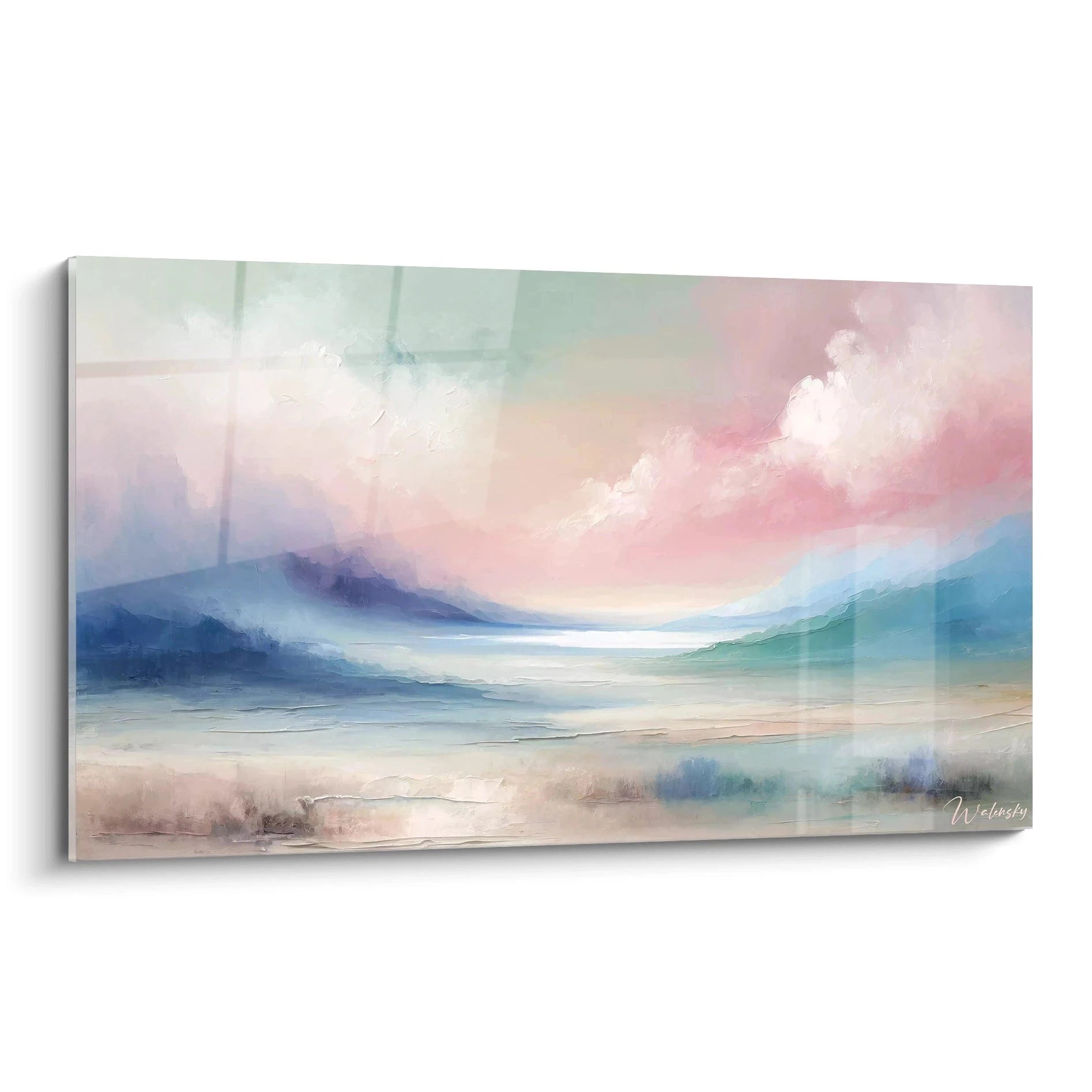

What size artwork for a hallway with a wall radiator?
November 27, 2025 · 10 min read · by Walensky
This morning again, as you walked past that white radiator dominating the wall of your hallway, you thought to yourself: 'I really need to dress up this space.' This passage you take dozens of times a day deserves so much more than a bare wall topped with a purely functional element. Yet every time you imagine hanging a painting there, the same question comes back: what size should I choose not to create a strange effect with this radiator?
Here's what the right dimensions of a painting above a radiator bring: a visual balance that transforms a technical constraint into a harmonious composition, an aesthetic enhancement of an often-neglected circulation space, and decorative continuity that elegantly connects all spaces in your interior.
The frustration is real: you found this artwork online, but it's impossible to know if it will fit. Too large, it risks overwhelming the radiator in a crushing way. Too small, it will float above like a postage stamp. And then there’s that persistent concern about the heat rising from the radiator...
Rest assured: thousands of hallways with radiators now feature perfectly sized paintings, creating intimate and warm galleries. The arrangement rules are simple once you know them, and the resulting effect radically transforms the perception of this transitional space.
In this article, I share the precise proportions for choosing the ideal size of your painting based on your radiator, height tips to create perfect balance, and mistakes to avoid to preserve your artworks.
The golden rule of proportions: your radiator as a starting point
It all starts with a simple measurement: the width of your wall-mounted radiator. This dimension becomes your absolute reference for determining the size of the painting. In fifteen years of composing walls in constrained spaces, I have refined a rule that works every time.
For optimal visual balance, the width of your painting should represent between 50% and 75% of the radiator's width. Specifically, if your radiator is 100 cm wide, your painting should be between 50 and 75 cm. This proportion creates a harmonious relationship without domination or lost effect.
The height of the painting follows a different logic. For a hallway, prioritize a rather horizontal or square format. Vertical formats visually lengthen an already narrow space and can create a feeling of compression. A 50x40 cm or 60x60 cm painting above a standard radiator provides a confident presence without overwhelming.
The classic mistake? Choosing a painting that is too wide to visually extend beyond the radiator. This breaks the coherence of the composition and gives the impression that the elements are fighting for space rather than dialoguing. Conversely, a painting that is too small (less than 40% of the radiator's width) seems to float without anchorage, creating an uncomfortable void.
The 15 centimeters that change everything: the safety distance
Let's now talk about hanging height, this technical detail that conditions both the aesthetics and durability of your artwork. The heat rising from a working radiator is not insignificant for a painting.
Always maintain a minimum space of 15 to 20 centimeters between the top of the radiator and the bottom of your painting. This safety distance protects your work from upward flows of heat that, over time, can alter colors, dry out the canvas or deform the frame.
This technical constraint actually becomes an aesthetic advantage. These 15 to 20 cm create a visual breathing space, a space that allows the eye to clearly distinguish between the two elements. The radiator remains a functional equipment, the painting asserts itself as a decorative choice, and the whole composes without confusion.
To check the ideal height, use this simple method: stand in the center of your hallway, about 2 meters from the wall. The center of the painting should naturally attract your gaze, generally between 150 and 160 cm from the floor. With a standard radiator installed 10-15 cm from the floor and measuring approximately 60 cm high, the 15-20 cm space brings you precisely to this optimal visibility zone.
Acceptable maximum temperature
For concerned collectors: a modern radiator generally does not exceed 70°C on the surface. 15 cm above, the felt temperature already falls below 30°C. Your glass paintings, framed prints or recent canvases perfectly support these conditions. Only older works on wood supports or fragile techniques (unprotected watercolor, pastel) require more precautions.

Our favourite
Colorful bird spiral painting - Rainbow plumage - abstract spiral edition
233,90€
Discover this artworkAdapt dimensions according to the length of your hallway
Perspective plays a crucial role in the perception of dimensions. A short hallway (less than 3 meters) and a long hallway (more than 5 meters) do not react the same way to adding a painting above a radiator.
In a short hallway, you see the painting as a whole from the entrance. Favor a generous dimension in the upper range of 75% of the width of the radiator. A format of 60x50 cm for an 80 cm radiator creates an immediate focal point that visually enriches the space.
In a long hallway, the gaze gradually discovers the painting as you approach. You can dare more affirmed formats, or even create a composition with several paintings of medium size (40x40 cm or 50x40 cm) aligned above the radiator or distributed along the length of the wall. This gallery-like approach transforms circulation into an experience.
The width of the hallway also influences your choice. In a narrow hallway (less than 90 cm), a table that is too imposing above the radiator can create a feeling of clutter. Stick to modest dimensions: maximum 40x50 cm. In a wide hallway (more than 120 cm), you have complete freedom for more generous formats that will not compress the space.
— Our selection


When the composition becomes a personal gallery
What if your radiator became the base of a real artistic staging? Instead of thinking 'a painting above a radiator', consider 'a composition where the radiator is part'.
The triptych arrangement works wonderfully: three paintings of 30x30 cm or 30x40 cm aligned horizontally above a 120 cm radiator create an elegant visual rhythm. The spacing between each frame (5 to 8 cm) lightens the composition while maintaining consistency.
The asymmetrical duo brings character: a main painting of 50x60 cm associated with a smaller one of 30x30 cm, placed at slightly offset heights (always respecting the minimum 15 cm above the radiator) creates a modern dynamic.
The advantage of these multiple compositions? You use more modest individual dimensions that limit exposure to heat, while creating a strong visual impact. This is particularly relevant if your radiator is wide (more than 100 cm) and a single large painting seems disproportionate.
The frame style influences the perception of dimensions
A thick and dark frame visually adds 5 to 10 cm to the perceived size of your painting. If you are working with tight dimensions, prefer thin and light frames that lighten the composition. Conversely, a finely framed painting can appear smaller than it is: compensate by choosing within the upper range of recommended dimensions.

The dimension errors that ruin the effect
After supporting hundreds of layout projects, some mistakes systematically recur. They are easy to avoid once you know them.
The portrait format error in a narrow hallway : this vertical painting of 40x80 cm above the radiator accentuates the ceiling height and visually compresses the already reduced width. Result: an amplified feeling of narrowness. Always prefer horizontality or square formats in these spaces.
The mistake of hanging the artwork too low: out of fear of heat or instinct, some people hang their artwork only 5-10 cm from the radiator. The hot air flow then regularly envelops the work, and visually, the painting and radiator seem to touch, creating an inelegant confusion.
The mistake of oversizing: this 90 cm painting above an 80 cm radiator overflows on both sides. The expected effect of grandeur turns into imbalance. The radiator seems crushed, the painting poorly positioned. Respect the maximum 75% rule.
The mistake of anarchic multiplication: three paintings of different sizes (50x60, 30x40, 40x50) distributed without logic above and around the radiator create visual clutter rather than a gallery. If you opt for multiple paintings, maintain consistency either in dimensions or alignment.
— You may also like


Simulate before hanging: the template technique
Before drilling the slightest hole, validate your size choices with a simple and remarkably effective simulation. Cut out newspaper or cardboard to the exact dimensions of the painting you are considering.
Fix this template to the wall with repositionable adhesive tape, at the intended height (15-20 cm above the radiator). Step back several times down the hallway in both directions. Observe the composition from the front, but also in perspective. Ask for the opinion of a friend whose taste you appreciate.
This validation step takes ten minutes and avoids lasting regrets. You will immediately see if the dimensions are harmonious or if an adjustment is needed. Even test several sizes if you hesitate: a 50x60 cm template versus a 60x50 cm reveals subtle but significant differences in the final perception.
Take advantage of this simulation to also check that the painting does not interfere with the opening of a door, does not obstruct a switch, and remains visible even when someone is standing in the hallway.
Transform your hallway into an exceptional gallery
Discover our exclusive collection of hallway paintings that harmonize perfectly with all types of radiators and enhance your circulation spaces.

The perfect painting starts with the right measurement
Imagine yourself tomorrow morning, walking through this hallway you have so often walked distractedly. This time, your gaze naturally stops on that painting of perfect dimensions, precisely installed above the radiator. The balance is obvious, the harmony immediate. This passageway has become a place where the eye lingers with pleasure.
The dimensions of a painting above a wall radiator are not random. They follow simple rules: between 50% and 75% of the width of the radiator, a safety distance of 15 to 20 centimeters, and adaptation to the configuration of your hallway. These proportions create the balance that transforms a functional constraint into a decorative opportunity.
Your concrete action for this week: measure the width of your radiator, determine the range of ideal dimensions for your painting, and create a template on paper to visualize the result. In a few days, your hallway will have gained a soul, and this white radiator will be nothing more than a discreet support for a composition that resembles you.
FAQ: Your questions about the dimensions of a painting above a radiator
What is the minimum dimension for a painting to be visible in a hallway above a radiator?
The recommended minimum size for a painting to remain perceptible and not seem lost above a radiator is 30x40 cm. Below that, the work risks seeming anecdotal and lacking visual impact, especially in a hallway where the gaze is often in motion. This minimum size works well for a small radiator no more than 60 cm wide. For larger radiators, opt for dimensions of at least 40x50 cm or choose a composition of several small paintings that together will create sufficient visual presence. Remember that in a circulation space, details are rarely looked at: it is better to have a generous size that naturally imposes itself on the gaze than a miniature that will go unnoticed. The rule of 50% minimum of the radiator width remains your best guarantee for a balanced and visible rendering.
Can I install a painting wider than my radiator if I love its format?
Technically, nothing prevents you from installing a painting wider than your radiator, but visually it creates an imbalance that harms the harmony of the composition. The painting will seem disconnected from the radiator, floating without logical anchorage on the wall. This configuration breaks the visual relationship between the elements and gives an impression of arrangement error rather than assumed choice. If you really have a crush on a slightly wider painting, limit the excess to a maximum of 10% on each side (i.e., a 90 cm painting for a radiator no more than 80 cm wide). Beyond that, the imbalance becomes too visible. Elegant alternative: move this painting to another wall in the hallway where it can fully express itself without constraint, and choose for the space above the radiator a work with more suitable proportions. Your hallway will gain coherence, and each painting will find its ideal place.
Will the heat from the radiator really damage my artwork if I respect the 15 cm distance?
With a distance of 15 to 20 centimeters and a modern radiator operating between 60 and 70°C, the risks are minimal for the majority of contemporary artworks. Canvas prints, reproductions under glass, framed photographs, and recent acrylic paintings can easily withstand these conditions. The heat at this distance is comparable to that of a well-heated room in summer. Precautions are especially necessary for antique works, fragile techniques such as unprotected watercolor, pastels, or valuable oil paintings on wood sensitive to thermal variations. In these cases, increase the distance to 25-30 cm or consider another location. A practical tip: if you can comfortably hold your hand where the artwork will be hung when the radiator is operating at full power for a minute, the temperature is acceptable for a standard artwork. The real threat to artworks in a hallway is not so much the moderate heat from the radiator as direct exposure to sunlight or excessive humidity.
</divExplore our collections


