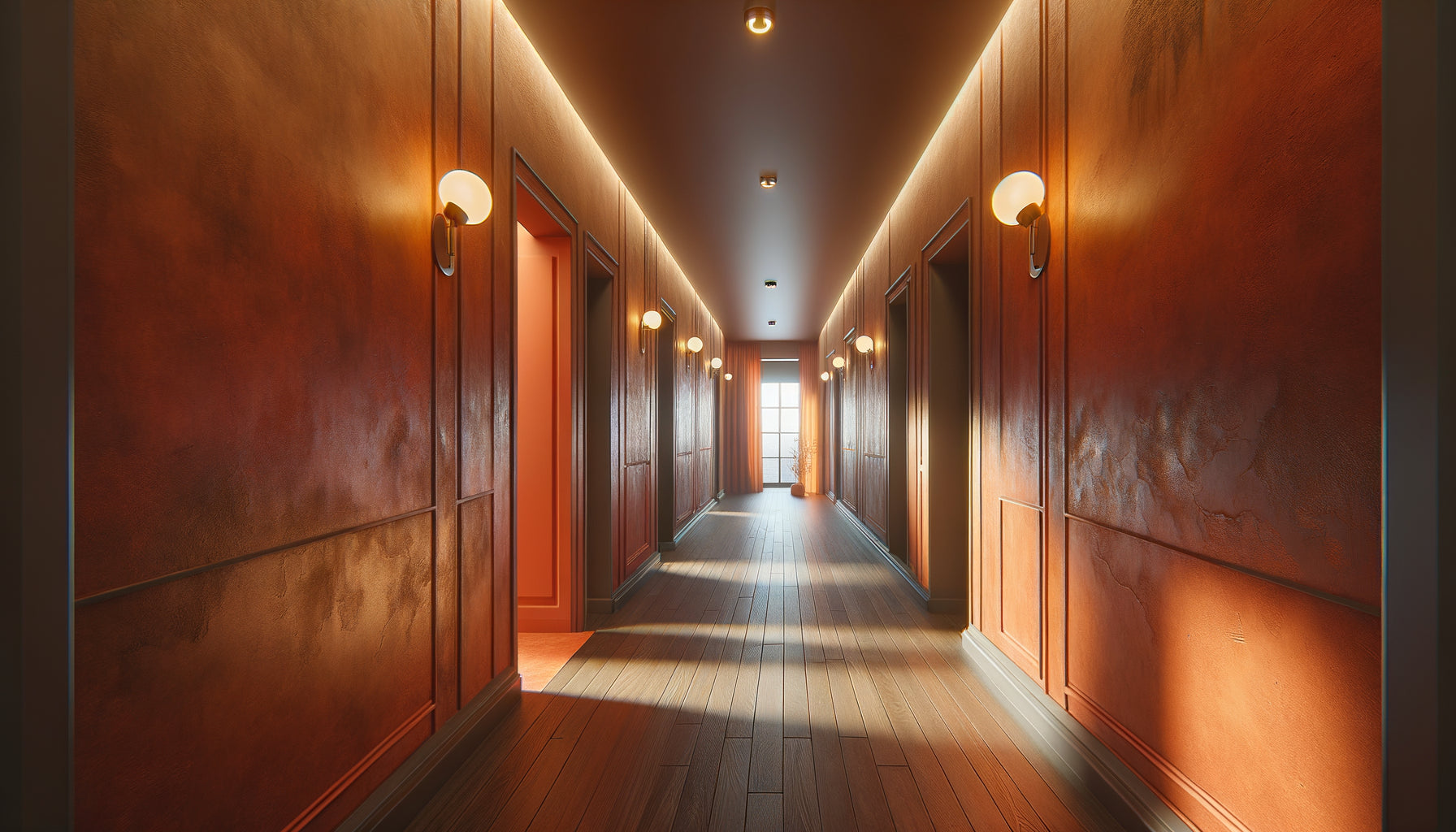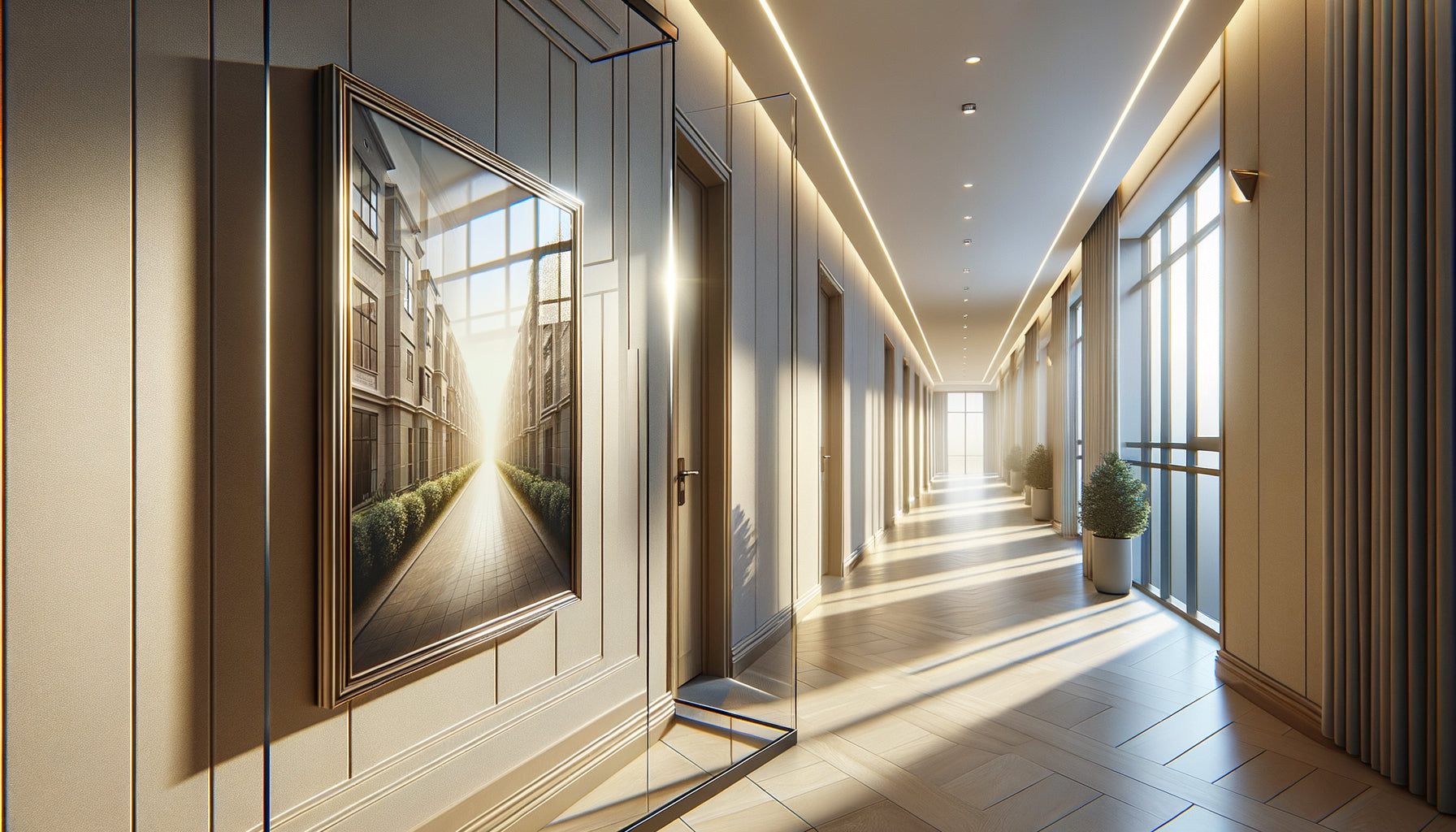
This scene still comes back to me: a magnificent photographic triptych, framed in solid oak, lovingly hung in an elegant hallway. Three days later, a panicked call from the client: “The door scratched the glass...” A simple miscalculation. A few centimeters missing. A masterpiece damaged.
Here's what the right distance between a painting and a door brings: it protects your works from repeated impacts, preserves the visual harmony of your hallway, and avoids those daily micro-aggressions that turn a passageway into an obstacle course.
You found the perfect piece to enhance this hallway that seemed so sadly empty. But one question haunts you: at what exact distance from this door should you hang it? Too close, and you risk an accident. Too far, and the composition loses its balance. This uncertainty paralyzes you, the painting remains leaning against the wall, day after day.
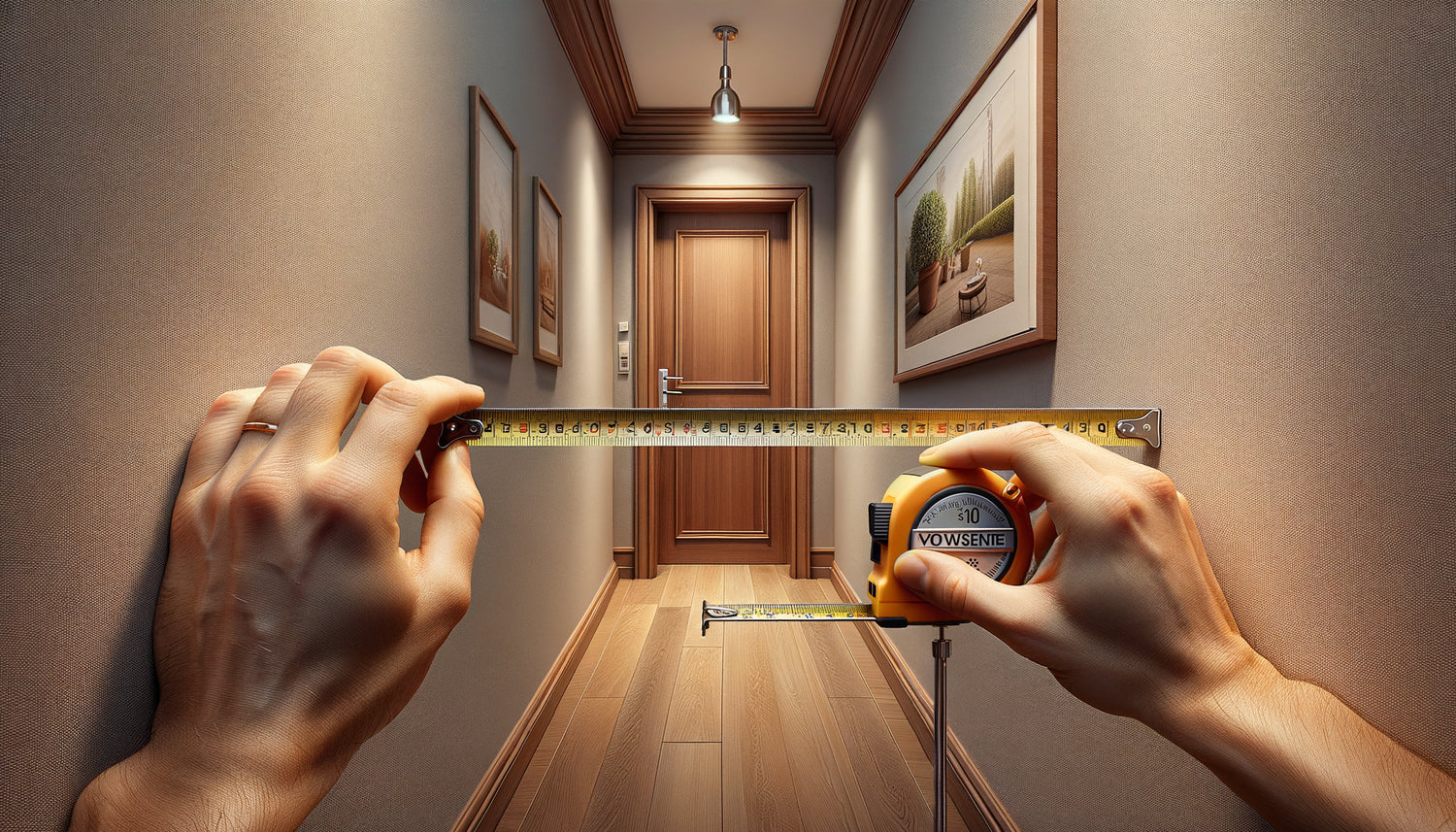
Rest assured: measuring the minimum space needed is a simple technical gesture, accessible to everyone. No need for a degree in interior architecture. Just a few principles to understand, a measuring tape, and five minutes of your time. I will guide you, step by step, so that your hallway finally becomes the gallery you dream of, without risk or regret.
The 10-centimeter rule: your first line of defense
Let's start with the basics: a minimum of 10 centimeters. This is the universal safety distance between the most advanced part of your painting (usually the frame) and the maximum trajectory of your open door.
Why exactly 10 centimeters? Because this measurement incorporates a comfortable margin of safety. It takes into account variations in opening (when you are in a hurry, when children rush), slight movements of the painting over time, and even that little psychological cushion of air that makes us
But be careful: these 10 centimeters are measured from the actual trajectory of the door, not from the frame. An 80-centimeter wide door that opens 90 degrees draws an arc in space. It is this arc that you need to visualize and measure.
The improvised plumb bob technique
Here's my field trick: hang a weighted string (or even a shoelace with a set of keys) from the upper corner of your door. Open it completely. The string shows you exactly where the furthest point passes. Mark this point on the floor with a piece of tape. Measure 10 centimeters perpendicularly towards the opposite wall. You have your safety limit.
When frame thickness changes everything
Not all paintings are equal when facing a door. A flush frame 2 centimeters thick does not pose the same challenges as a 6-centimeter relief American frame.
I learned this lesson with a client who had chosen a sumptuous framed canvas with an imposing marie-louise and a sculpted frame. Beautiful... but prominent. The total thickness reached 8 centimeters. In their narrow hallway, that meant the painting jutted out considerably into the circulation space.
To measure the minimum space in this case, systematically add the thickness of the frame to your 10-centimeter safety margin. A 5-centimeter frame? Allow 15 centimeters between the door trajectory and the wall. This simple rule will save you a lot of inconvenience.
Overhanging frames: a special case
Some antique or decorative frames protrude from the canvas by several centimeters. If you fall for one of them, measure the most advanced point of the frame, not the edge of the canvas. It is this relief that will determine your safety distance. Place your meter perpendicular to the wall, identify the maximum protrusion, and add your regulatory 10 centimeters.

Narrow hallways: the spatial equation to solve
In a hallway less than one meter wide, every centimeter counts. The door opens, and suddenly, the space shrinks dramatically. This is where measuring the minimum space becomes an exercise in spatial optimization.
First, measure the total width of your hallway. Then, simulate the complete opening of the door. How much passage width remains once the door is open? Remember: a comfortable passage requires a minimum of 60 centimeters. If your calculation leaves you with less, you have two options.
Option 1: Limit the opening of the door with a floor stop or magnetic door stopper. It will only open to 75 or 80 degrees instead of 90. You gain valuable centimeters for your wall composition.
Option 2: Choose a thinner painting, or even a framed work under glass without relief. A modern framed photograph 2 centimeters thick rather than a 6-centimeter relief oil painting can transform a constrained space into a functional gallery.
The full-size test before drilling
Before getting out the drill, do what I systematically do: the kraft test. Cut out the exact shape of your painting from kraft paper or cardboard. Temporarily attach it with repositionable tape to the intended location.
Now, live with it for 24 hours. Open and close the door normally. Walk through the hallway with shopping bags. Let the children play. Observe whether the positioning respects this safety distance in all everyday scenarios.
This test often reveals invisible details about the plan: the door that bounces slightly at the end of its travel, a draft that pushes it further sometimes, or simply that visual feeling that something is not right.
The viewing angle from the entrance
During your test, position yourself at the entrance of the hallway, door open. Does your gaze naturally embrace the artwork? Or does the open door partially hide it? This aesthetic parameter sometimes deserves to be adjusted by a few extra centimeters. The space between the artwork and the door is not only a matter of safety, but also a question of visual staging.

The essential tools for precise measurement
Let's talk about equipment. To measure the minimum space accurately, you only need three tools:
A measuring tape of at least 3 meters. Small sewing tapes lack rigidity to measure distances in space. Opt for a rigid model that holds horizontally on its own for at least 2 meters.
A laser level (optional but valuable). If you have one, it projects a vertical line and a horizontal line. Perfect for materializing the trajectory of the open door and instantly visualizing where your safety zone begins.
A pencil and masking tape. To mark your reference points on the wall and floor without leaving traces. These small reference points transform the abstract into the concrete. You suddenly see in real space what was only a number in your head.
Sliding doors and swinging doors: two different logics
If your hallway has a sliding door, congratulations: your problem changes radically. The door slides parallel to the wall without encroaching on the space. Your main constraint is then: the artwork must not be behind the door in the open position.
Measure the width of the door. Add 5 centimeters of margin. This area, from the frame, must remain free. Your painting begins beyond that point. Much simpler, and you gain a valuable hanging space.
For double doors (the most common), the challenge remains the arc of the circle. But one detail matters: does the door open towards you or into the room? If it opens inwards, the hallway remains completely free. You can hang your artwork right next to the frame, with a simple aesthetic margin of 10 centimeters for visual balance, without any technical constraints.
Transform your hallway into a secure art gallery
Discover our exclusive collection of hallway art that combines elegance and formats adapted to passageways.
Visual harmony beyond centimeters
Once the safety distance is respected, a new question arises: where exactly to position the artwork in this authorized space?
The golden rule: the center of the artwork should be between 1.50 and 1.60 meters from the floor. This is the average eye level. In a hallway, you walk, you don't stop for long to contemplate. The work must naturally offer itself to the moving gaze.
Then, think about rhythm. A long hallway with only one artwork near the door creates an imbalance. If the space between the artwork and the door is respected, consider a series composition: several artworks spaced regularly create a visual journey. Each keeps its 10 centimeters of safety from obstacles, but together they tell a story.
Conclusion: the art of combining beauty and security
Imagine: you come home, you open the front door, and your gaze naturally slides towards this hallway that was just a passageway. Now it's a gallery. Each artwork finds its place, at the perfect distance. Not too close, not too far. Doors open freely, without fear, without that little pang in the heart with each passage.
It's not magic. It’s method. Measuring the minimum space between an artwork and a door is a foundational gesture: it protects your works, secures your daily life, and lays the foundation for thoughtful decoration. Take your measuring tape today. Mark your points. Test in full size. And drill with confidence. Your hallway awaits this transformation.
FAQ: Your questions about the space between artwork and door
What to do if my hallway is too narrow to respect the 10 centimeter safety distance?
This is more common than you might think, especially in older apartments. There are several creative solutions. First, install a door stop: this discreet accessory prevents the door from opening completely, gaining valuable 10 to 15 centimeters. Then, opt for extra-flat artworks: prioritize prints under plexiglass or canvases stretched on a thin frame (less than 2 centimeters thick). Finally, consider an asymmetrical placement: place the artwork on the wall opposite the door, where space remains clear. The hallway gains visual depth, and you completely eliminate the risk of collision. None of these solutions sacrifice aesthetics; they simply require rethinking the arrangement creatively.
How to measure the exact trajectory of a door that doesn't open at a right angle?
Excellent question, as not all doors reach 90 degrees. To measure the minimum space accurately, use the improvised compass method. Stick a long piece of tape (or a light batten) perpendicularly to the edge of the door, on the hinge side. Open the door to its maximum actual position (the one it reaches daily). The tape draws in space the exact arc of the trajectory. Mark with pencil the furthest point on the floor and on the adjacent wall. Measure from these reference points: you obtain the actual distance, without approximation. This technique also works with slightly misaligned doors or old buildings where walls are not perfectly straight. Always rely on physical reality rather than theoretical measurements.
Can I hang multiple artworks in a row near a door?
Absolutely, and it's even a beautiful decorative trend to liven up a hallway! The key is to respect the safety distance for each element. The first artwork, the one closest to the door, must respect your minimum of 10 centimeters from the open door trajectory. The following ones are spaced according to your visual rhythm: generally between 15 and 30 centimeters between each frame to create consistency. Ensure that all artworks are aligned horizontally (centers at the same height, ideally 1.55 meters from the floor) for a professional gallery effect. If you install a vertical composition (stacked artworks), make sure none extends laterally into the danger zone. This multiplication of works transforms a simple hallway into a true artistic journey, provided that each piece remains protected from repeated passages. Harmony is born from this dual requirement: technical safety and aesthetic balance.