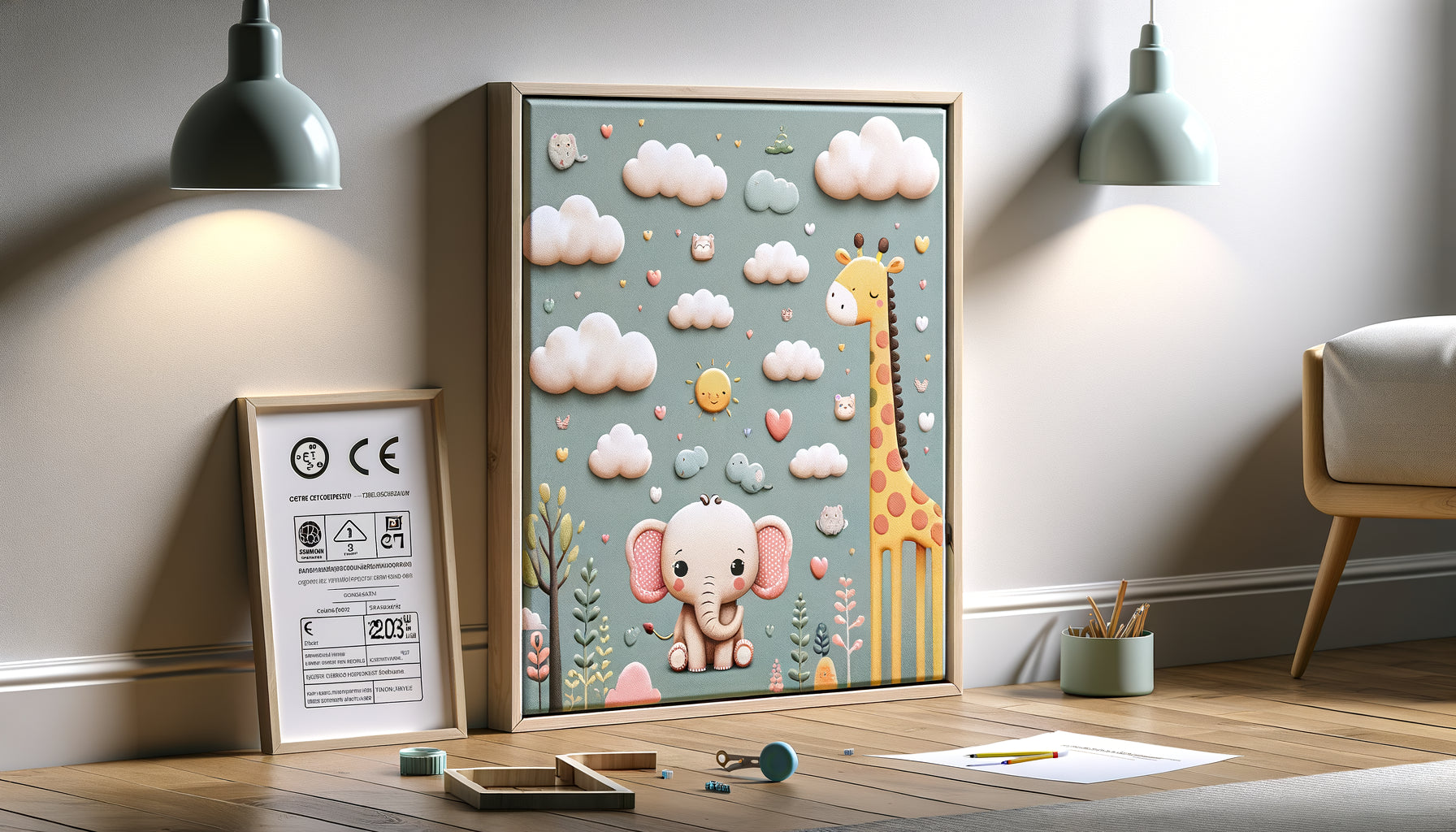
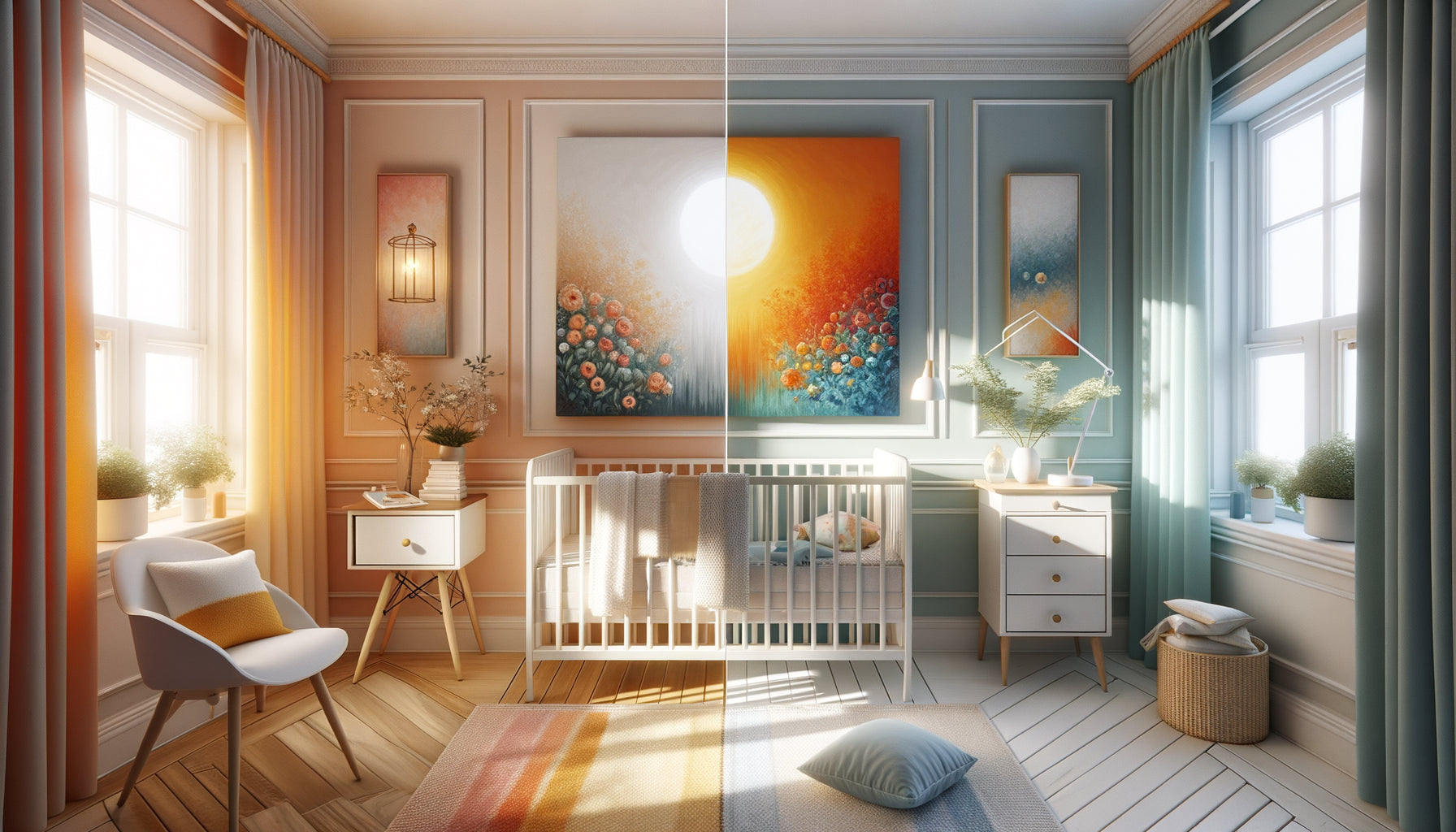
I still remember that urgent phone call: a young mother, her voice trembling, told me how the beautiful painting she had chosen with so much love for her baby's room showed waves after only three weeks. The air humidifier, installed to preserve the delicate airways of her newborn, had transformed her pretty canvas into a wrinkled and unsightly surface.
Here's what a pre-stretched canvas adapted to humidity brings: exceptional dimensional stability that resists hygrometric variations, durable preservation of print quality even in humid atmospheres, and total peace of mind for decorating your child's universe serenely.
Because yes, decorating a baby's room can sometimes be a technical puzzle. Between the essential humidifiers, the windows we open regularly to ventilate, the constant temperature variations and this natural humidity specific to children's rooms, traditional works of art can quickly lose their beauty. And this disappointment, I know it by heart after fifteen years accompanying parents in their decoration projects.
But rest assured: canvas stretching technology has evolved considerably. Certain specific materials are designed precisely to resist these delicate environments, without ever loosening or deforming.
I will reveal exactly which types of canvases to choose, how to recognize them, and above all why some hold up when others give in to ambient humidity.
Why humidity is the silent enemy of traditional canvases
Let's first understand what is really happening. A classic cotton canvas, even the highest quality, has hygroscopic fibers. Concrete translation? These fibers absorb moisture from the air like an invisible sponge. In a baby's room where the humidity rate often oscillates between 40% and 60% (the level recommended by pediatricians), this absorption creates repeated micro-tensions.
The phenomenon is insidious: the fibers swell slightly when the air is humid, then contract when heating dries the atmosphere. These repeated cycles of expansion and contraction inevitably end up stretching the canvas. Result? Waves, creases, sometimes even a visible sagging in the center of the painting.
I have seen pre-stretched canvases made of pure cotton lose up to 30% of their initial tension in just six months in a room equipped with a humidifier. The wooden frame itself can work, expand slightly, aggravating the problem. It's frustrating, especially when you've invested in beautiful wall decor.
Polyester canvases: the little-known champion of humid environments
Let's get to the heart of the matter. If I had to recommend only one type of pre-stretched canvas for a humid room, it would be without hesitation high density polyester. This synthetic material has remarkable dimensional stability in the face of humidity.
Unlike natural fibers, polyester is hydrophobic: it repels water instead of absorbing it. In practice, this means that a polyester canvas installed in a baby's room will retain its original tension even after hundreds of humidity-drying cycles. I have customers whose polyester paintings go through four seasons a year for seven years without any deformation.
But be careful: not all polyesters are created equal. Look specifically for tightly woven polyester canvases, with a density of at least 260 g/m². This density ensures not only resistance to humidity, but also excellent color reproduction and a perfectly smooth surface for printing.
How to recognize a true quality polyester canvas
During your research, check these essential points. The pre-stretched canvas should clearly display its composition: 100% polyester is ideal. Beware of cotton-polyester blends that, even with 70% synthetic material, retain some sensitivity to humidity.
Next, observe the edge finish. A professional polyester canvas has perfectly stretched corners, without creases or excess thickness. The return on chassis (the part surrounding the wooden frame) should be clean and uniform. If you can touch the product, run your hand over the surface: it should be firm, taut like a drum skin, without soft areas.

Treated anti-humidity cotton: a credible alternative
For purists who prefer natural materials, there is an interesting intermediate solution: cotton canvases with water repellent treatment. These canvases receive a special primer that creates a protective barrier around the natural fibers.
The treatment does not make the cotton completely waterproof (fortunately, as the canvas must breathe), but it drastically reduces moisture absorption. The fibers retain their aesthetic qualities – that slightly textured grain that art lovers appreciate – while gaining dimensional stability.
I have installed several pre-stretched canvases in treated cotton in children's rooms in recent years. Result? Excellent durability over time, provided two rules are followed: choose a thick weight (minimum 350 g/m²) and verify that the water repellent treatment is certified free of harmful substances for babies. Because in a child's room, health safety is never negotiable.
Labels to look for
For a baby's room, prioritize canvases certified Oeko-Tex Standard 100, which guarantee the absence of dangerous chemical substances. Some manufacturers also offer water-based treatments, without solvents, perfect for spaces dedicated to toddlers.
The cost is slightly higher than standard polyester canvas – expect 15 to 25% more – but the aesthetic difference justifies the investment for some projects. Personally, I recommend this option when the desired decor style leans towards classic or artistic.
What the type of frame really reveals
Let's talk about a detail that too many people neglect: the frame itself. Even the best stretched canvas in polyester will lose against humidity if it is mounted on a low-quality wooden frame.
Wood, like cotton, is hygroscopic. A cheap rough pine frame will swell and warp in a humid atmosphere, mechanically causing the canvas to loosen. I have seen frames twist by several millimeters, creating uneven tensions that ruin the flatness of the painting.
The solution? Stabilized wood frames, ideally made of spruce or treated and kiln-dried pine. This industrial process eliminates much of the natural moisture from the wood and stabilizes its cell structure. Result: a frame that resists hygrometric variations without warping.
Even better: some manufacturers now offer reinforced frames with transverse cleats. For formats larger than 60x80 cm, these reinforcements are essential in a humid room. They prevent central sagging that awaits large canvas surfaces.

The frame thickness that changes everything
Here's a professional secret: the thickness of the frame directly influences resistance to sagging. A stretched canvas mounted on a 4 cm thick frame will hold up infinitely better than a canvas on a 2 cm frame, with equal material.
Why? Because the thickness offers more anchoring surface for the staples and allows for stronger initial tension. In a baby's room where humidity fluctuates, this extra tension is a valuable safety margin.
For particularly humid rooms (ground floor, coastal areas, old houses), I systematically recommend a minimum frame thickness of 4 cm. Admittedly, the artwork gains volume and wall presence, but this thickness guarantees exceptional durability.
Professional Tensioning Technique
A technical detail that makes all the difference: the stapling method. High-end pre-stretched canvases use close-interval stapling (every 3 to 5 cm) with stainless steel staples that will never rust in contact with moisture.
The tension must be applied gradually, in successive passes, starting from the centers of each side and then moving towards the corners. This professional method guarantees even distribution of tension across the entire surface. Quickly stretched canvases, with spaced staples, inevitably sag in areas that are less held.
Recent innovations revolutionizing durability
The market is constantly evolving. In the last two years, I have seen pre-stretched canvases using new generation synthetic fibers, such as high-performance recycled polyester or polyester-polyamide blends.
These materials combine even greater dimensional stability than classic polyester with natural antibacterial properties – a significant advantage in a baby's room. Some textiles even incorporate UV treatments that preserve the colors of prints for decades, even near a window.
Even more fascinating: self-adjusting tension canvases. These innovations use shape memory fibers that automatically maintain their initial tension despite environmental variations. The price remains high (about 40% surcharge), but for a child's room designed to last through the years, the investment is fully justified.
The match of inks and coatings
Let's not forget that the pre-stretched canvas is only the support. The print itself must also resist moisture. Latex-based inks or UV-cured inks create an impermeable layer that protects both the canvas and the pigments.
Opt for prints with a satin or matte protective varnish. This final coating acts as a shield against humidity while avoiding unsightly reflections in a child's room. I systematically avoid glossy varnishes in children's spaces: they capture too much light and can disrupt sleep.
Transform your baby's room into a haven of sweetness and serenity
Discover our exclusive collection of wall art for kids’ rooms that are perfectly resistant to humidity while creating a soothing and stimulating atmosphere for your little one's development.
Practical tips for lasting installation
Now that you know the ideal stretched canvas, here are some installation recommendations. Even the best material deserves optimal conditions to express its full potential.
First of all, absolutely avoid positioning your artwork directly above an air humidifier. Rising steam would create excessive humidity concentration, even for a polyester canvas. Prefer a wall perpendicular or opposite the device.
Secondly, let your wall breathe. If possible, install your stretched canvas with a hanging system that creates a slight space (5 to 10 mm) between the artwork and the wall. This air circulation prevents condensation from accumulating on the back of the frame.
Thirdly, maintain regular ventilation in the room. Opening the window for ten minutes each morning renews the air and evacuates excess nighttime humidity. This simple habit will prolong the life of all your wall decorations.
Finally, monitor humidity levels with an indoor hygrometer. The ideal range is between 40% and 55% for baby's respiratory comfort AND preserving your works of art. Above 60% continuously, even the best polyester canvases could show signs of fatigue in the long term.
Your baby's room deserves a decoration that lasts
Imagine: in three years, five years, ten years even, the artwork you choose today will still be there, perfectly stretched, with intact colors, a silent witness to first words, first steps, all this life blossoming in this room. That’s exactly what an stretched canvas adapted to humidity allows.
The choice is not so complex: prioritize high-density polyester for absolute guarantee, opt for treated cotton if natural aesthetics are important to you, and in any case, check the quality of the frame and tension. These three pillars constitute your peace of mind assurance.
You now have all the keys to transform your baby's room into a space as beautiful as healthy, where every decorative detail lasts through the years without failing. Because a stable and harmonious environment is also what our children need to grow serenely.
Frequently Asked Questions
Can we really avoid all loosening with a polyester canvas?
Excellent question that deserves an honest answer. A pre-stretched canvas made of professional quality polyester (minimum 260 g/m²) mounted on a stabilized frame will retain 95 to 98% of its initial tension for at least ten years in a room where humidity remains between 40% and 60%. You might observe a microscopic loosening barely visible to the naked eye after several years, but nothing comparable to the waves and folds of traditional cotton canvases. Polyester remarkably resists expansion-contraction cycles caused by humidity. To guarantee this result, make sure that the initial tension has been applied professionally and that the staples are stainless steel. With these conditions met, you can decorate with confidence: your artwork will withstand your baby's entire childhood.
Can my air humidifier really damage an artwork?
Absolutely, and it's a trap that many young parents fall into. A humidifier positioned too close to a pre-stretched canvas made of sensitive material (untreated cotton in particular) will create a concentrated humidity zone that significantly accelerates fiber loosening. Rising water vapor accumulates on the surfaces above the device. If your artwork is made of standard cotton and placed less than two meters above the humidifier, expect to see undulations appear within weeks. This is precisely why I systematically recommend polyester for baby rooms equipped with humidifiers. This hydrophobic material repels moisture instead of absorbing it. Alternative solution: keep your current canvas but reposition it on a wall perpendicular or opposite the humidifier, never directly in line with the steam. This simple precaution can triple the lifespan of your wall decoration.
Can a canvas that has already loosened be retensioned?
Yes, in most cases, but with important nuances. If the loosening is moderate (slight undulations, no major deformation of the frame), a professional can retension the pre-stretched canvas by removing the staples, applying new tension and restapling the canvas. The cost varies between 30 and 60 euros depending on the format. However, this operation only makes sense if you also correct the cause of the problem: either you replace the frame if it has deformed, or you improve the humidity conditions in the room. Retensioning a cotton canvas to put it back into the same humid environment is like starting the cycle over again. My frank advice: if your current canvas has loosened, take advantage of this opportunity to switch to a durable polyester solution. You invest once for guaranteed peace of mind throughout childhood. Keep your old canvas for another less humid room rather than multiplying temporary retensionings.