I've spent hours observing parents in their daily routines, particularly that incessant ballet around the changing table. This piece of furniture becomes the stage for hundreds of tender interactions, and yet, how often have I seen bare walls above, or worse, disproportionate paintings that completely disrupt the harmony of this very special space?
Here's what the right dimensions of a painting above a changing table bring: a soothing visual balance that reassures baby, sensory stimulation adapted to their development, and a consistent aesthetic that transforms changes into moments of complicity rather than chores.
The problem? Most parents choose a painting based on impulse, without considering proportions. The result: a tiny 20x30 cm frame lost on a large white wall, or conversely, an imposing canvas that visually overwhelms this nursery corner. Baby is either under-stimulated or overwhelmed.
Rest assured: there are simple rules, derived from the ergonomics of children's spaces and developmental psychology, which will allow you to find the ideal dimensions. Rules that I have refined by supporting dozens of families in decorating their nurseries.
In this article, I reveal the exact proportions, the mistakes to absolutely avoid, and how to adapt your choice according to your configuration. You will precisely know what size to prioritize to create a harmonious and stimulating space.
The rule of thirds: your dimensional compass
Let's start with the basics, that which will instantly transform your perception of space. The width of the painting should represent between 50% and 75% of the width of your changing table. This is the proportion that naturally creates a visual balance without effort.
Let's take a concrete example: your changing table measures 80 cm wide (the most common standard dimension). Your painting should therefore measure between 40 and 60 cm in width. This range is not arbitrary: it directly derives from baby’s field of vision when lying down.
At birth, an infant's field of vision is limited to about 20-30 cm. But from 3-4 months, they can focus on objects located 50-70 cm away. The height at which you hang your painting (I’ll come back to that) combined with its width should create a comfortable focal point for these developing little eyes.
For a 70 cm changing table: prioritize a painting 35 to 50 cm wide.
For a 90 cm changing table: opt for 45 to 65 cm wide.
For a converted chest of drawers (100-120 cm): aim for 60 to 85 cm wide, or create a wall of frames.
This rule of thirds creates what I call a visual anchor: the painting is present enough to structure the space, but does not overflow to the point of creating a feeling of clutter. The parent's eye and baby’s eye naturally find a place to rest.
What height for your painting? The detail that changes everything
Now, let's talk about the height of the painting itself. Many confuse two dimensions: the height of the frame and its mounting height. Both are crucial.
The optimal height of the artwork depends directly on its width. To maintain harmonious proportions, follow these proven ratios:
• Square format (1:1): If your artwork is 50x50 cm, this symmetry provides reassuring stability, ideal for geometric illustrations or soothing patterns.
• Landscape format (3:2): A 60x40 cm creates a horizontality that visually widens the space, perfect for small nurseries.
• Portrait format (2:3): A 40x60 cm lengthens the vertical perspective, giving height to low ceilings.
But here's the secret few know: the height of the artwork directly influences baby’s visual development. A format that is too high (e.g., 30x90 cm) forces their gaze to sweep vertically, a tiring movement for a newborn. A more balanced format (50x60 cm maximum) allows for natural visual exploration, from left to right, even preparing them for future reading skills.
At what height should you fix the artwork above the changing table?
That's THE technical question. The golden rule: leave a space of 15 to 25 cm between the top of the changing table and the bottom of the frame.
Why this precision? Three practical reasons:
1. Safety: You must be able to lean over to change baby without risking bumping the frame with your head. With 20 cm of space, even a dad who is 1m85 tall works comfortably.
2. Baby’s visual comfort: At this distance, the artwork sits in baby's upper peripheral vision field, an area naturally soothing. Too close (less than 10 cm), it becomes overwhelming.
3. Overall aesthetics: This space creates a visual breathing room, avoiding the 'stuck-on' effect that weighs down the composition.
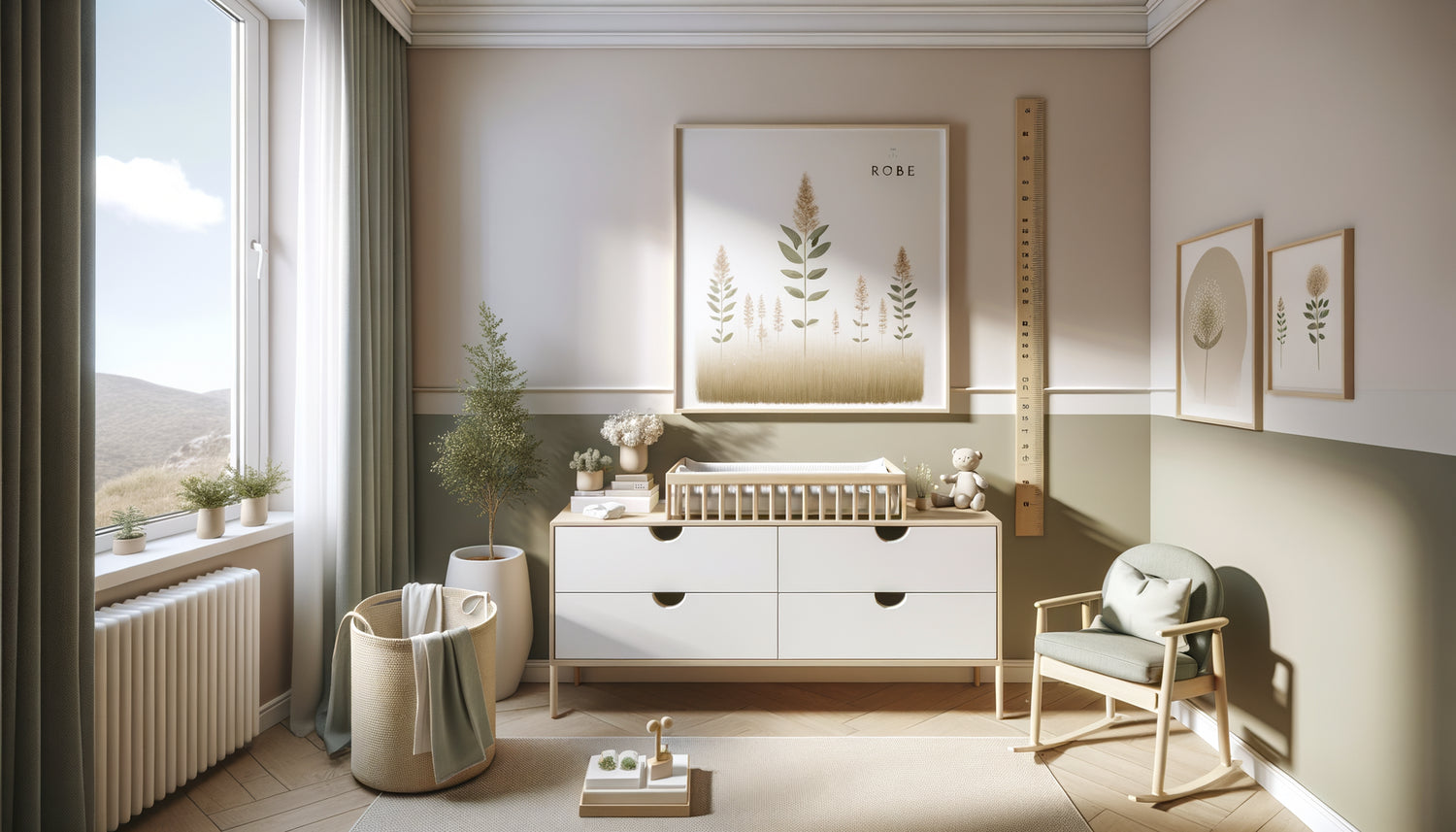
In practice, if your changing table is 90 cm high (standard), and you leave 20 cm of space, the bottom of your artwork will be 110 cm from the floor. With a frame 50 cm high, the top of the artwork will reach 160 cm. This configuration also allows parents to fully enjoy the work, not just baby.

Dimensional errors that sabotage your nursery
After dozens of layouts, I have identified three recurring mistakes that completely ruin the harmony of a changing corner.
Error #1: The Postage Stamp Syndrome
A 20x20 cm painting above an 80 cm changing table. This disproportion creates an unsettling visual void. The space seems unfinished, as if you forgot to decorate. Baby has no stable focal point; their gaze gets lost on the surrounding white wall.
Error #2: The Wall Invader
Conversely, a 100x80 cm painting on a small 70 cm changing table. Not only is this disproportionate, but it creates cognitive overload for baby. Too much visual stimulation during diaper changes can make them restless rather than soothed. Not to mention the risk of visual imbalance that makes the table appear tiny.
Error #3: Ignoring Wall Configuration
Many choose painting dimensions without considering what surrounds the changing table. A shelf 40 cm above limits your options. A side window influences balance. An adjacent piece of furniture changes the perception of proportions. Your painting doesn't live in isolation; it dialogues with the entire space.
A pro tip: photograph your wall and virtually draw different frame sizes. You’ll instantly see what works. Or cut out rectangles from craft paper to the dimensions you are considering and temporarily tape them up. This visualization is worth all the calculations.
Adjust Dimensions According to Your Specific Configuration
Not all nurseries are alike. Here’s how to adjust dimensions according to your situation.
Fold-Down Changing Table
These compact models (often 70-80 cm) deserve proportionally smaller paintings: 40 to 55 cm wide. Favor square or slightly landscape formats that don't visually overwhelm the wall when the table is raised.
Chest of Drawers with Removable Changing Top
Here, think about longevity. This chest of drawers will remain long after the diaper changing period. Choose a painting 60 to 75 cm wide that will still make sense once the changing top is removed. Timeless formats (forest landscapes, soft abstracts) age better than overly 'baby' motifs.
Restricted Space or Nursery Corner
In a parent's bedroom where the changing table occupies a corner, a painting that is too wide will visually overflow. Opt for 45 to 50 cm maximum, or better yet: create a small vertical gallery of 3 20x25 cm frames spaced 5 cm apart. This vertical composition structures the corner without widening it.
Dedicated Large Nursery
Do you have space? Use it to create a real scene. A main artwork of 70 to 80 cm can be accompanied by two small side frames (25x30 cm) 15 cm on each side. This triptych composition creates a true focal point while maintaining balance.

Beyond dimensions: what makes an artwork truly effective
Good dimensions are not enough. The content of the artwork influences the experience just as much.
Colors adapted to development: From 0 to 3 months, babies mainly perceive strong contrasts (black/white, navy blue/yellow). A 50x50 cm artwork with contrasting geometric patterns will perfectly stimulate their nascent visual acuity. From 4-6 months onwards, introduce soothing pastel shades (soft terracotta, sage green, powder blue) in a slightly larger format (60x45 cm) that accompanies their expanded field of vision.
Subjects that captivate: Faces (even stylized), animals with simple shapes, repetitive patterns (gentle polka dots, soft stripes) create visual anchor points. A 55x40 cm painting depicting three forest animals offers just enough detail to capture attention without overwhelming.
Texture and material: An artwork with relief (textured paint, wood print) adds a tactile visual dimension that babies intuitively appreciate. Even without touching it, their brain perceives these variations in surface which enrich their sensory experience.
Transform every changing table into a moment of connection
Discover our exclusive collection of wall art for children's rooms that combines perfectly calibrated dimensions and designs thought to promote baby's visual development.
Visualize the final result before hanging
You have chosen your ideal dimensions: 55x45 cm for your 80 cm changing table, fixing 20 cm above the furniture. Before drilling, visualize.
Imagine yourself standing facing the changing table, baby lying in front of you. Your gaze naturally embraces the whole scene: baby's hands wiggling, their face looking at you, and just above, that artwork with perfect dimensions which completes the scene without overshadowing it.
Baby, first of all, sees your face (their favorite focal point), then their gaze naturally drifts upwards, towards this artwork whose soft colors and familiar shapes create a soothing transition between the active moment of changing diapers and returning to calm.
Dimensions are not just about aesthetics. They orchestrate an experience: the feeling of a coherent space where every element has its place and role. Where baby feels visually contained, neither overstimulated nor understimulated. Where you, parent, work in a harmonious environment that transforms the repetition of diaper changes into a pleasant ritual.
Start by accurately measuring your changing table. Apply the rule of two-thirds for width. Choose a balanced canvas height. Allow 15 to 25 cm of breathing space. And above all, trust your eye: if something seems disproportionate to you, it probably is.
Frequently Asked Questions About Dimensions of Artwork Above the Changing Table
Can I put several small artworks rather than one large one?
Absolutely, and it's even an excellent strategy for evolving spaces. The trick: consider your entire composition as a single virtual artwork. For example, three frames of 25x30 cm spaced 5 cm apart create a total width of 85 cm (25+5+25+5+25). For an 80 cm changing table, this is slightly above the rule of two-thirds, but the spacing creates breathing room that compensates. Make sure to align the frames perfectly (same mounting height) to create a stable horizontal line. This solution also offers flexibility: you can change one frame as baby grows without rearranging everything. Prioritize identical frames (same color, same thickness), but vary the visuals inside to stimulate baby's curiosity.
My ceiling is low (2m30), what dimensions should I prioritize?
Low ceilings require a specific approach to avoid visually stifling the space. Prioritize horizontal (landscape) formats rather than vertical ones. A 60x40 cm artwork works better than a 40x60 cm in this configuration. Width attracts the eye laterally, giving an impression of space, while limited height avoids accentuating the feeling of low ceiling. Another trick: don't fix the artwork too high. With a 230 cm ceiling and a 90 cm changing table, leave only 15 cm of space above the table and choose an artwork no higher than 40 cm. The top of the frame will then culminate at 145 cm, leaving 85 cm to the ceiling, a proportion that visually aerates. Avoid thick frames or wide mats which add unnecessary volume.
Should the artwork dimensions change as they grow?
A fascinating question that reveals your desire to create a truly tailored space. The dimensions of the artwork can remain fixed, but its position and sometimes its orientation deserve to evolve. From 0 to 6 months, the artwork above the changing table is perfect: baby spends a lot of time lying down, looking up. After 6 months, it becomes more mobile, less patient during changes. The artwork retains its soothing role but baby looks at it for a shorter amount of time. Around 12-18 months, when you gradually abandon the changing table for quick standing changes, this same artwork (let's say 55x45 cm) can be lowered to child height (80-100 cm from the floor) on another wall in the room. It then becomes a decorative element that your child consciously chooses to look at, strengthening their emotional attachment. This is the smart evolutionary approach: an investment that transcends developmental phases.