When I helped Sophie decorate her bedroom, her eyes lit up at a magnificent textured painting with deep reliefs. Then, almost immediately, the worry: "With my allergies, won't I turn my room into a dust trap?" I hear this question regularly. And the answer deserves more than a simple yes or no.
Here's what a textured painting brings to your space: unparalleled visual depth, a unique sensory dimension, and a defined character that instantly transforms the atmosphere of a room. But for people sensitive to allergens, this beauty seems to come with a constraint: maintenance.
The frustration is real. You love art, you dream of decor that reflects you, but you dread morning sneezes, itchy eyes, that feeling of oppression that spoils your sanctuary. Do you really have to give up on textured works to breathe freely?
Rest assured: with the right information and a few simple adjustments, you can perfectly reconcile decorative passion and respiratory comfort. The key is not to avoid relief paintings, but to understand how to choose and maintain them intelligently.
I'm going to share what fifteen years of supporting clients with allergies has taught me about creating healthy spaces without sacrificing beauty.
The truth about dust and raised textures
Let's start by facing reality: yes, a textured painting accumulates more dust than a smooth canvas. It's a matter of pure physics. Every recess, every protrusion, every roughness creates an additional surface where particles can settle.
In a bedroom, the environment is particularly conducive to this accumulation. We spend eight hours a night there, our movements constantly stir up textile fibers, dead skin cells, microscopic dust mites. This household dust naturally seeks to deposit on all available surfaces.
The sculpted reliefs of a painting offer perfect nooks for this sedimentation. Unlike a flat surface that the air naturally sweeps away, recessed areas protect particles from ambient airflow. It's exactly the same principle that makes an old radiator with fins retain more dust than a modern radiant panel.
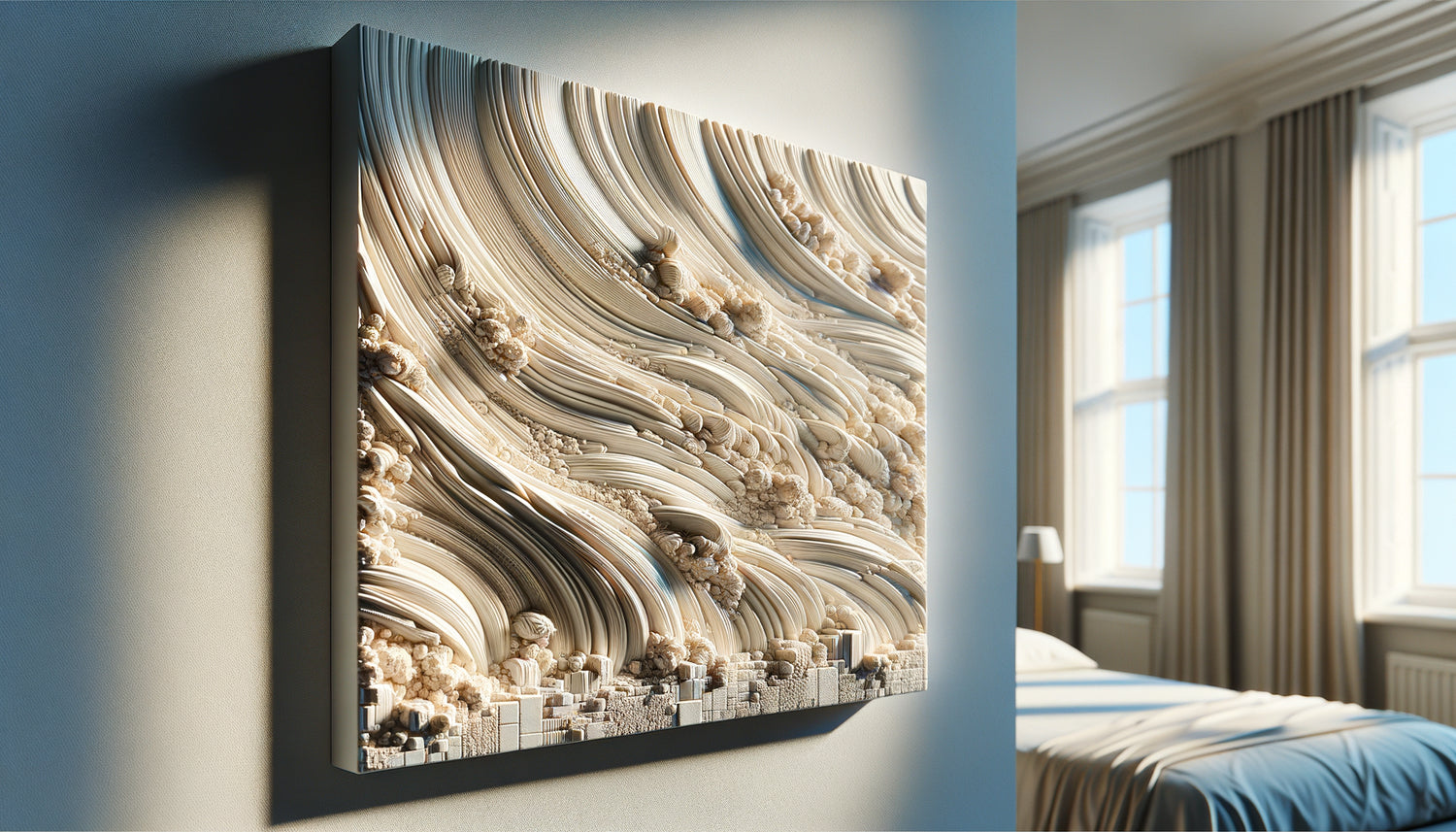
But here’s what is often forgotten: not all reliefs are equal. A painting with large and soft textures, like generous waves of modeling paste, cleans infinitely easier than a work with thousands of aggressive micro-reliefs. The size and shape of the roughness change everything.
Texture types: not all are equal when it comes to allergies
In my practice, I have identified three main families of textured paintings, each with its own allergenic profile.
Generous organic textures
These are my favorites for allergy-friendly bedrooms. Imagine broad spatula strokes, undulating reliefs, generous but spaced impastos. These raised textures create a magnificent play of shadows without multiplying surfaces that collect dust. A simple pass with an electrostatic duster once a week is enough to keep them clean.
Thick acrylic paint, firmly attached to canvas, does not release any particles. Gel medium, once dry, forms an inert and stable surface. These materials do not harbor dust mites and do not emit volatile compounds.
Mixed textures with adhered materials
Be careful here. Some artworks incorporate sand, fabrics, paper, and natural elements that have been glued on. These organic additions can be problematic. Fabric retains moisture and can develop microscopic mold. Paper gradually disintegrates, releasing fine particles. Natural elements such as dried leaves decompose slowly.
If you fall for this type of artwork, make sure it is varnished or protected by a resin that completely encapsulates the materials. This transparent barrier prevents the release of particles and greatly facilitates maintenance.
Micro-repetitive textures
Works with thousands of tiny regular reliefs – think three-dimensional pointillist style paintings – are the most demanding. Each minuscule irregularity captures its own layer of dust, creating a veritable reservoir of allergens. Maintenance becomes tedious, requiring a soft brush and plenty of patience.
For an allergy-friendly bedroom, I generally recommend avoiding this type of texture, or reserving it for a location outside the bedroom, in a passageway where you spend less time.

Strategic placement: where to hang your textured artwork
The location where you place your raised artwork radically influences its allergenic impact. It's a dimension that many neglect, and yet it changes everything.
The worst location? Above the bed. Every nocturnal movement stirs up dust that then falls directly on your face. Gravity is unforgiving. I have seen clients suffer for months before realizing that moving their artwork 2 meters had resolved 80% of their symptoms.
Ideal locations for a textured artwork in an allergy sufferer’s bedroom:
Facing the bed, on the opposite wall: you fully enjoy the work upon waking, but it remains at a distance from your nighttime breathing zone. Natural airflow carries any particles downwards, away from you.
On the adjacent wall, away from the sleeping area: near the window or door, where the airflow is greater and constantly renews the atmosphere. Particles are less likely to stagnate in these passageways.
High up, above a dresser: warm air rises, carrying most of the fine dust with it. A picture placed near the ceiling captures proportionally fewer allergens than a work at face level.
Absolutely avoid dead corners, those areas without airflow where dust inevitably accumulates. A textured artwork placed in a dark corner will quickly become an allergen nest, whatever your maintenance efforts.
The maintenance routine that changes everything
Let's be frank: a textured artwork in an allergy sufferer’s bedroom requires a minimum of attention. But this constraint is largely surmountable with a simple and effective routine.
Light weekly maintenance: a quick pass with a quality electrostatic duster. These modern tools actually capture particles instead of dispersing them into the air like old feather dusters. Three minutes max, without taking the artwork down. Gently pass over the reliefs without pressing, following the natural direction of the textures.
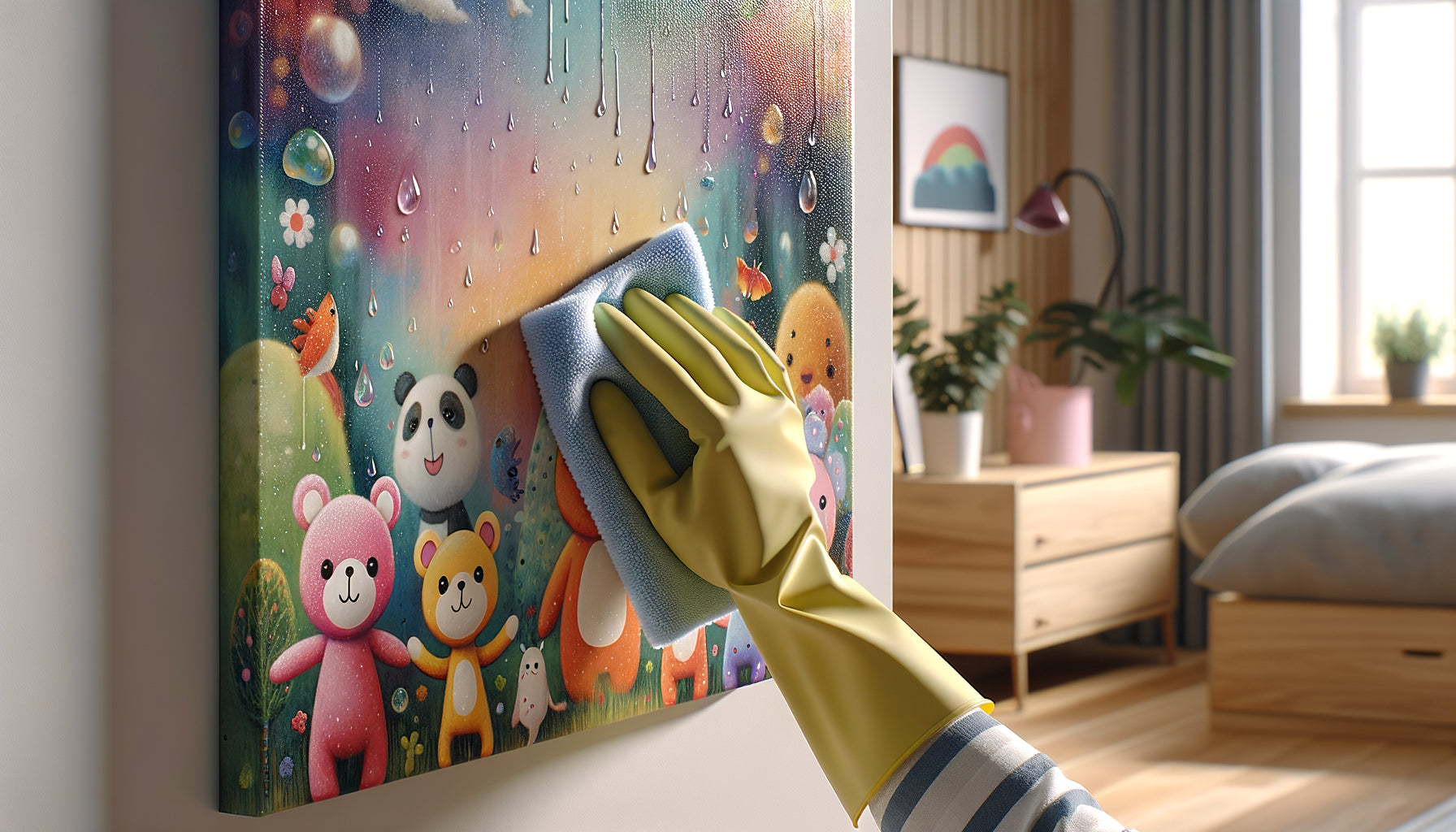
Thorough monthly cleaning: take the artwork down, move it out of the bedroom if possible. Use a soft brush with natural bristles to reach the recesses of the reliefs. Work over a white sheet to visualize the amount of dust removed – this will motivate you to maintain this routine. For varnished works, you can even use a slightly damp microfiber cloth on the flat parts.
Preventive protection: invest in an air purifier with a HEPA filter for your bedroom. This is not specifically for the artwork, but for your overall health. By reducing the concentration of particles in the ambient air, you mechanically decrease what can settle on all surfaces, including works of art.
One detail I learned over time: maintenance timing matters. Clean your textured artwork in the morning, then generously ventilate the bedroom for at least 30 minutes. The particles raised by cleaning will have time to disperse and be evacuated before your return at night.

Smart alternatives that preserve aesthetics
If despite all these precautions you remain worried, know that there are relief artworks particularly suitable for sensitive people.
Works with relief under glass or plexiglass offer an elegant solution. The texture is protected by a smooth and flat surface, infinitely easier to dust. You retain the play of shadows and visual depth, but maintenance becomes as simple as a mirror. Some artists create spectacular reliefs in glazed frame boxes, veritable hypoallergenic wall sculptures.
Resin epoxy textures are another remarkable option. Once the resin is poured and hardened, it forms a perfectly smooth surface that completely encapsulates the underlying relief. The three-dimensional effect, depth and sculptural character are retained, but the outer surface is cleaned with a simple wipe.
Also consider tableaux with illusion of relief: some artists master three-dimensional trompe-l'oeil to perfection. Through the play of shadows and lights alone, they create a striking impression of depth on a perfectly flat surface. For an untrained eye, the effect is stunning, and for your allergies, it’s ideal.
When textured artwork becomes your well-being ally
Here's an angle that few people consider: in some cases, a textured artwork can paradoxically improve your quality of life, even with allergies.
How? Through its psychological and emotional impact. Living in a sterile environment, devoid of any decorative element for fear of allergens, generates a form of muffled frustration that affects morale. We now know that stress and anxiety worsen allergic reactions. A vicious circle is set in place.
By consciously choosing a suitable textured artwork, well placed and properly maintained, you reclaim your space. You stop suffering from your allergies to regain control. This feeling of empowerment has a measurable effect on your overall well-being and, as a result, on your immune system.
I’ve seen clients who, after incorporating a textured artwork into their bedroom with the right precautions, reported improved sleep. Not despite the artwork, but thanks to it. The painting became a soothing focal point, a contemplative beauty element that facilitated the transition to rest. The enriched visual environment largely compensated for the slight increase in maintenance.
The key lies in personal balance. Some very sensitive people will indeed prefer to refrain. Others, with mild allergies and a well-established cleaning routine, will thrive with several textured artworks in their interior. There is no universal answer, only your own comfort slider.
Create a universe that breathes beauty AND serenity
Discover our exclusive collection of wall art for kids that combines refined aesthetics and easily cleanable surfaces for a healthy environment.
Breathe freely without sacrificing beauty
After all these years of reconciling art and respiratory health, one conviction has taken root in me: your allergies shouldn’t deprive you of beauty. They simply require a more conscious, more attentive approach.
A textured relief artwork in the bedroom of someone with allergies is neither a poison nor an inaccessible luxury. It's an informed choice that requires understanding the issues, selecting the right type of texture, placing the work intelligently, and maintaining an adapted cleaning routine.
Imagine yourself in three months: you wake up in your bedroom, your gaze rests on this textured artwork that beautifully captures the morning light. You breathe freely, peacefully. The painting is impeccable; its weekly maintenance has become part of your Saturday ritual, almost a meditative moment. You have found your balance.
Start simply: choose a small work with soft, organic reliefs, place it facing your bed, test for a month with regular cleaning. Observe your reactions, adjust if necessary. Only you know your tolerance threshold, but don’t give up before having really tried with the right methods.
Art is not reserved for people in perfect health. It's for everyone, provided that the approach is adapted to our physiological realities. Your bedroom can be both a haven of health and a visually inspiring space. These two aspirations do not oppose each other; they complement each other.