

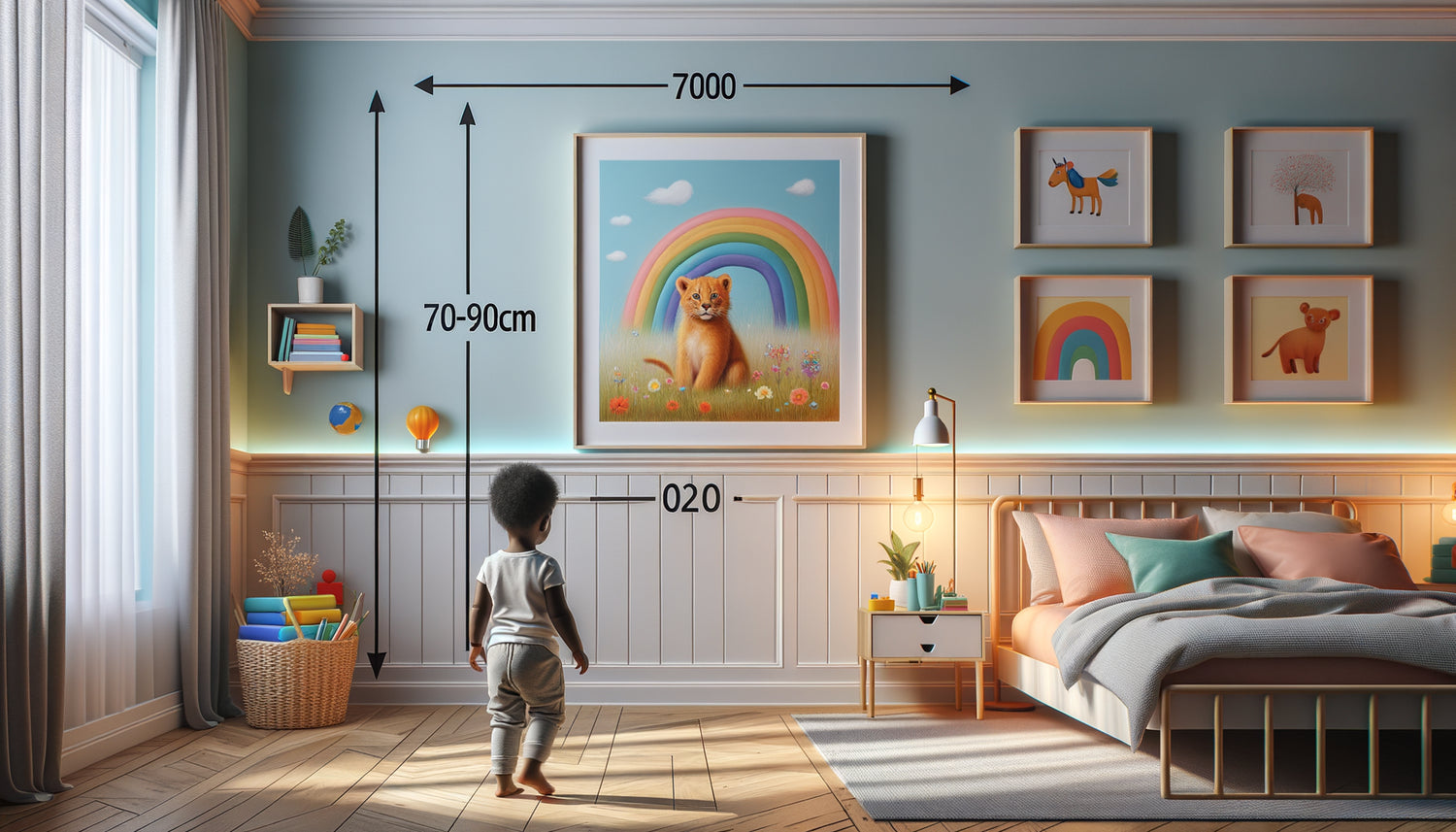
This morning again, I received this photo from a customer: a magnificent painting depicting a smiling giraffe, hung 1.80 meters (5ft 9in) off the floor in her little Zoé's bedroom, who is 3 years old. 'It's superb, but she never looks at it,' she confided to me. I have observed this scene for ten years in my profession as a space designer for children: wonderful works of art that decorate walls... instead of nurturing the imagination of toddlers.
Here's what the right hanging height brings to your child: A daily connection with art that stimulates their imagination, a sense of ownership of their space that strengthens their confidence, and a visual experience adapted to their size that promotes their creative awakening.
You carefully chose this endearing illustration, this small colorful frame that brightens up her room. You hung it with love... but something is wrong. Your child walks past without even looking up. That's normal: placed at adult height, this painting lives in a parallel world, the world of adults, inaccessible to their 90-centimeter (35in) gaze.
Rest assured: this mistake is universal. For years, we have decorated children's rooms with our adult eyes, forgetting that these little beings live in a different geography than ours. Today, I am going to reveal the golden rule that I apply in every project, the one that transforms a simple painting into a daily companion.
The eye-level rule: your compass for successful hanging
In the world of children's design, we operate with the natural gaze rule. A 3-year-old child is on average between 90 and 100 centimeters (35in - 39in) tall. Their comfortable field of vision is slightly below their eye level, or between 70 and 90 centimeters (28in - 35in) from the floor for the center of the painting.
In concrete terms? The middle of your artwork should be at your child's eye level, or even 10 centimeters (4in) below. Why this precision? Because a toddler naturally looks down and forward, not up. Raising their head to admire a painting creates a physical... and emotional distance.
I have tested this approach in more than 200 children's rooms. Every time, the result is striking: the child points, names the characters, invents stories. The painting comes alive because it exists in their space, not in ours.
Above the bed or facing it: location changes everything
The location of the painting dictates its hanging height. If you install the artwork above the headboard, aim for 15 to 20 centimeters (6in - 8in) between the mattress and the bottom of the frame. This position creates a soothing focal point that your child discovers as they lie down, just before falling asleep.
For a painting facing the bed or on a side wall, return to the eye-level rule: center of the frame between 70 and 85 centimeters (28in - 34in) from the floor. Here, the goal differs. You create daily interaction, a visual appointment during playtime, reading moments, or daydreaming.
A trick I love? Let your child participate. Ask them to stand in front of the wall, discreetly mark their eye level with a post-it note. This point becomes the center of your artwork. This simple method turns hanging into a shared project and guarantees perfectly adapted height.

The traps to absolutely avoid in a toddler's bedroom
First trap: copying the standard height of art galleries. This famous rule of center at 1m50-1m60 from the floor works for adults, not for a 3-year-old child. I have seen too many beautiful illustrations lost in the heights, admired only by parents at bedtime.
Second common mistake: hanging too high for fear that the child touches. At 3 years old, your little one explores the world with their hands. It's normal, it’s healthy. An artwork placed at their height invites them to point, name, and create a connection. Choose a solid frame, a secure hanging system, but don't deprive your child of this precious proximity.
Third trap: forgetting that your child grows quickly. Between 3 and 6 years old, they will easily gain 20 centimeters. Opt for an adjustable hanging system: rails, movable hooks or simple nails that you can adjust each year. Art grows with the child, not against him.
Creating a composition that evolves with your child
Here's an approach I particularly like: the evolving wall gallery. Instead of a single large artwork, create a composition of 3 to 5 small frames. Place the main frame at eye level (75-85 cm), then distribute the others slightly above and on the sides.
This configuration offers remarkable flexibility. Today, your 3-year-old is focusing on the lower frames. In two years, their gaze will naturally rise towards those higher up. The entire composition remains relevant for years, adapting to their growth without requiring a complete rearrangement.
For floor play areas, I sometimes install frames even lower: between 40 and 60 centimeters. These artworks become companions in play, visible when the child builds towers of cubes or flips through albums. This height may seem confusing to us adults, but it creates a magical intimacy with toddlers.

Safety first: hanging without risk
Let's talk frankly about safety. A child-height artwork must be securely fixed to the wall. Forget simple pins or fancy adhesives. Opt for hooks suitable for the weight of the frame, screwed into the wall or anchored in robust plugs.
Choose light frames with plexiglass protection rather than glass. An accidental fall should never create a danger. Wooden frames, solid plastic or lightweight aluminum are excellent choices for a young child's bedroom.
Regularly check the stability of your fixings. A 3-year-old tests limits, touches, sometimes pulls. A well-thought-out hanging resists natural curiosity without turning the room into a forbidden space. Safety does not oppose accessibility: it makes it possible.
Transform their room into an art gallery at their height
Discover our exclusive collection of art for children's rooms that sparks imagination and grows with your little explorer.
Art at child height changes everything
Imagine the scene: tomorrow morning, your child opens their eyes and immediately meets the gaze of this mischievous little fox on their artwork. As they get up, they point to the golden star they discovered in the illustration yesterday. Art is no longer a silent decoration: it becomes a daily dialogue.
This visual connection nourishes their imagination, structures their space, and offers reassuring references. A well-placed artwork tells your child: 'This space is for you, at your scale, according to your gaze.' It's a silent but powerful message of respect and attention.
So grab that measuring tape, invite your little one to help you, and adjust together this work that finally deserves to be seen. In a few days, you will surprise your child fully engaged in an imaginary conversation with their new wall companion. And you'll understand that the right height is not just about centimeters: it’s a gateway to their inner world.
Frequently asked questions about hanging artwork in a child's room
Do I really need to hang it that low or can I aim for a mid-height?
I understand your hesitation: a picture hung 80 centimeters from the floor may seem strangely low to our adult eyes. Yet, it's precisely this 'strangeness' that creates all the magic. A mid-height (1m20-1m30) creates a compromise that ultimately satisfies no one: too high for your 3-year-old, too low for your adult gaze. Dare to go really low. In two years, if it bothers you, you will simply move the picture up as your child grows. But in these first few years, offer him this direct connection. You'll quickly notice that your eye gets used to it, and seeing your child joyfully pointing at 'their' picture is well worth this small visual adjustment. Remember: this room is their territory, not a reception room for adults.
How do I adjust the height if I have two children of different ages in the same room?
This is a challenge I encounter regularly! The solution isn't to find an average height (which wouldn't suit anyone), but rather to create personalized zones. If your children each have their own bed area, install a picture at a suitable height above or near each sleeping space: one at 75 centimeters for your 3-year-old, another at 1 meter for his older 6-year-old. For shared walls or the play area, opt for a vertical composition with several tiered frames. The lower works belong to the youngest, those higher up to the oldest. This approach respects everyone's needs while creating a harmonious decoration. Unexpected bonus: it visually materializes growth and becomes a playful benchmark ('When you grow as tall as your brother, you'll see better the picture at the top!').
My child constantly touches their picture, should I move it higher?
No, definitely not! This reaction is exactly what you're looking for. Touching is appropriating. Your 3-year-old explores the world through physical contact: it’s their way of creating a connection, understanding, making something their own. Rather than putting the artwork out of reach, simply ensure that it is suitable for this interaction: solid frame, ultra-secure fixing, surface resistant to little fingers. You can also establish a small ritual: 'We can gently touch the frame, but not the image' accompanied by a demonstration. Over time, these tactile explorations will naturally decrease, replaced by a more visual and imaginative connection. But this first stage of discovery through touch is precious: it builds the emotional bond between your child and their decorative world. A picture you’re never allowed to approach remains a stranger. A picture that has been explored becomes a friend.


