


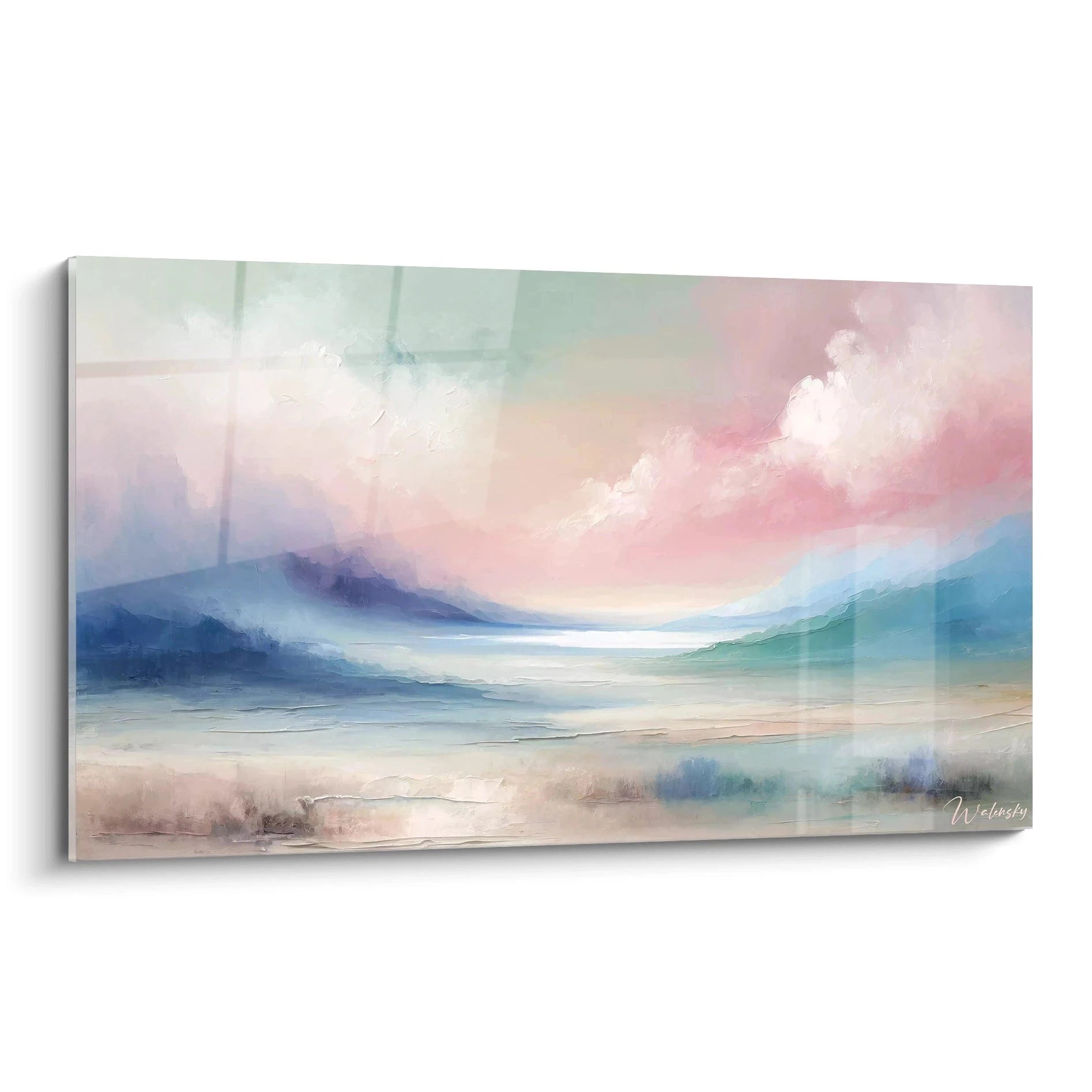

Should I display an information panel with details about the artwork?
December 1, 2025 · 8 min read · by Walensky
I spent fifteen years organizing vernissages in Parisian galleries before dedicating myself to advising private collectors. A scene invariably repeats itself: a guest stops in front of a work, scrutinizing the adjacent wall, desperately searching for information, any information at all. Their gaze moves from the canvas to the emptiness of the wall, embarrassed, before joining the buffet table. This magnificent artwork? It has just lost its viewer.
Here's what an exhibition label brings to your collection: it transforms passive observation into an enriching dialogue, it financially and emotionally values your artistic investment, and it creates a bridge between the artist and your daily life.
You have invested in this piece, spent hours choosing it, found the perfect location. Yet, your guests politely nod without daring to ask questions. Even you, six months after purchase, no longer remember the exact title or year of creation. This silent frustration affects 80% of collectors I accompany.
Rest assured: integrating an exhibition label does not transform your living room into a cold and institutional gallery. On the contrary, well designed, it visually fades away while amplifying the presence of the artwork. I will show you how to create this discreet but powerful dialogue between art and its contemplators.
The silent power of an artistic identity card
In my advisory practice, I observe a fascinating phenomenon: works accompanied by information are looked at on average 4 times longer. It's not a matter of snobbery, but of human connection. When you discover that this abstract watercolor is titled Memory of a Storm and dates from 2019, your brain instantly reconstructs a narrative. The shapes take meaning, the colors resonate differently.
The exhibition label acts as an emotion amplifier. It validates your feeling by giving it context. A Lyon-based collector recently confided in me: Since I added the labels to my collection, my children ask questions. They no longer pass by the artworks as if they were wallpaper.
This small rectangle of information creates a museum legitimacy in your interior. Without ostentation, it signals that these works deserve attention and respect. It transforms your wall into a coherent collection rather than a decorative accumulation.
What information to reveal without overloading?
The art of the label lies in selection. Too much information creates a tedious catalog effect, too little frustrates the curious gaze. After designing hundreds of exhibition labels for private collections, I have identified the perfect balance.
The essential trio
The artist's name is a fundamental anchor. Even if you buy a creation by an unknown artist today, that name carries a human story. In fifteen years, it might become a reference. I have seen works purchased for €800 reach €15,000 in a decade – the original cartel then becoming a valuable heritage document.
The title of the work opens a window on the creative intention. Untitled says something. Reminiscence n°7 says something else. Portrait of my mother in Lisbon says yet another thing. These words orient the gaze without enclosing it, propose a key for reading without imposing an interpretation.
The year of creation anchors the work in a historical and artistic context. 2008, 1995, 2022: each date evokes a different world, different technologies, different concerns. This information contextualizes your acquisition and gives it temporal depth.
Additional information that makes the difference
For more committed collectors, the technique and dimensions enrich understanding. Oil on canvas, 80 x 60 cm provides information about the creative process and visually justifies the presence of the work in its space. A small format takes on another dimension when you realize it measures precisely 15 x 15 cm.
I often encourage adding a personal sentence about your connection to the work: Acquired in Berlin, July 2021 or Sophie's birthday gift. This intimate touch transforms the descriptive plaque into a collection journal, creating a transmissible emotional memory.

Our favourite
Cosmic spiral painting orange and blue - Energetic vortex - abstract spiral edition
213,90€
Discover this artworkThe aesthetics of the cartel: disappear to better serve
The biggest mistake I regularly see? Descriptive plaques that shout louder than the works they accompany. Rococo gold under a minimalist photograph, fluorescent plexiglass under a delicate watercolor, whimsical typography under a classic engraving: all visual dissonances that parasitize contemplation.
The golden rule: the cartel must disappear. Think of the labels of major museums – discreet white rectangles, sans-serif black typography, invisible fixing. This voluntary neutrality puts all the light on the work. For a contemporary interior, prioritize a maximum format of 10 x 7 cm, matte white or slightly cream background, simple font like Helvetica or Futura in size 9 or 10.
The placement deserves particular attention. Museum convention places the caption to the right of the artwork, at roughly one-third of its lower height. This position has become intuitive for our Western eye, accustomed to reading from left to right. Avoid placing it under the artwork in a way that is too visible – it should only be discovered by those seeking information.
— Our selection


When the caption becomes undesirable
Let's be honest: not all situations call for a label. In an intimate bedroom where a framed family photograph reigns, adding formal information would create a cold distance. Pure emotion doesn't need mediation.
For wall compositions grouping several small formats – those popular gallery walls currently –, multiplying the captions generates a visually cluttered effect that is counterproductive. In this case, I recommend a single summary label placed on an adjacent wall or an elegant collection binder for consultation.
Very large-format artworks often have such an imposing presence that they are self-sufficient. A 3-meter-wide triptych doesn't need a small rectangle to assert its importance. Information can then take the form of a beautiful personal catalog that you present during visits.

— You may also like


Creative solutions for integrating information
Beyond the traditional label, elegant alternatives are emerging. The discreet QR code engraved on the frame links to a personal page detailing the artwork, its acquisition context, photos of the artist's studio. This high-tech solution preserves visual purity while offering unlimited documentary depth.
Some collectors opt for a collector's notebook bound and placed on the living room console. Each work has its richly documented page, transforming the visit into an interactive journey. This approach is particularly suitable for thematic or constantly evolving collections.
For professional spaces – doctor's office, law firm, waiting room –, the caption plays a valuable conversational role. It offers a point of attention during the wait, humanizes the environment, and sometimes initiates enriching discussions. I have designed labels including an open question: What does this scene evoke in you? – creating interaction even in your absence.
Your wall deserves a story, not just decoration
Discover our exclusive collection of bedroom wall art that transforms your space into a personal gallery filled with emotion.

Create Your Own Artistic Documentation System
Start simply. For your current artworks, gather certificates of authenticity, purchase invoices, and gallery business cards. These documents already contain 80% of the information needed for your descriptive plaques.
Photograph each artwork with its future label. This digital folder will become your collection inventory, valuable for insurance, heritage transmission, or simply to remember the story of each acquisition during a move.
Don't wait until you have twenty artworks to start. One carefully documented piece is better than an entire collection treated superficially. The descriptive plaque is not an administrative constraint; it’s a gesture of love towards the art you’ve chosen to welcome into your daily life.
Conclusion: Honor the Artist, Enrich Your Perspective
Imagine in ten years. Your children discover this collection that you have patiently built. Each descriptive plaque tells not only about the artwork but also your perspective, your travels, and your favorites. These small, discreet rectangles become the footnotes of your visual biography.
Displaying information about your artworks is not an obligation; it’s an invitation. An invitation to slow down your gaze, question, and remember. Start this week: choose your favorite artwork and create its first label. You'll see – this simple gesture changes everything.
FAQ: Your Questions About Descriptive Plaques
Will a descriptive plaque make my living room too formal?
Absolutely not, if you choose the right approach. The fear of turning your interior into a cold museum is legitimate, but it's based on the image of large institutional galleries. In reality, a discreet descriptive plaque of 8 to 10 cm with elegant typography naturally integrates into your decor. Think of it as a refined detail rather than an instructional sign. You can even personalize the tone: instead of Oil on canvas, 2018, write Painted during the summer in Arles, 2018. This personal touch preserves the intimate character of your interior while providing information. Several collectors I work with use a slightly tinted background matching their decorative palette, or opt for an engraving directly on the frame – invisible from afar, readable up close. The perfect balance between domestic elegance and respect for the artwork.
Where can I have quality descriptive plaques made?
Several options are available to you depending on your budget and aesthetic requirements. For an economical and quick solution, online printers offer signs on thick paper or foam board from as little as €2 to €5 per piece – perfect for getting started or for rotating collections. Art supply stores sell blank plaques that you can personalize with a quality printer and an elegant font. For a professional finish, professional engravers create plaques in brass, brushed aluminum, or laser-engraved plexiglass, with exceptional museum-quality rendering (allow €15 to €40 per piece). Some framers now offer this service as a complement. Personally, I often recommend a service that I use for my clients: white matte dibond plaques with UV printing – lightweight, durable, invisible magnetic fixing. And for perfectionists: create your signs on software like Canva with a clean template, then have them printed by a quality photo printer.
Should I put a plaque even for reproductions or posters?
Delightfully provocative question that reveals a beautiful collector's maturity! The short answer: yes, if these reproductions matter to you. A descriptive plaque does not validate market value, it honors your aesthetic choice. I have seen magnificent interiors where reproductions of Hopper or vintage concert posters were documented with as much care as originals – and frankly, the effect was striking. The label transforms the reproduction into a conscious quote rather than an ersatz. Simply note: Edward Hopper, Nighthawks, 1942 - Offset reproduction after the original, Art Institute of Chicago. This elegant honesty shows your visual culture and respect for the original work. On the other hand, if your poster is purely decorative and interchangeable, the plaque would indeed be superfluous. The decisive criterion: does this image tell something about you? If so, document it. Your wall, your rules.
Explore our collections


