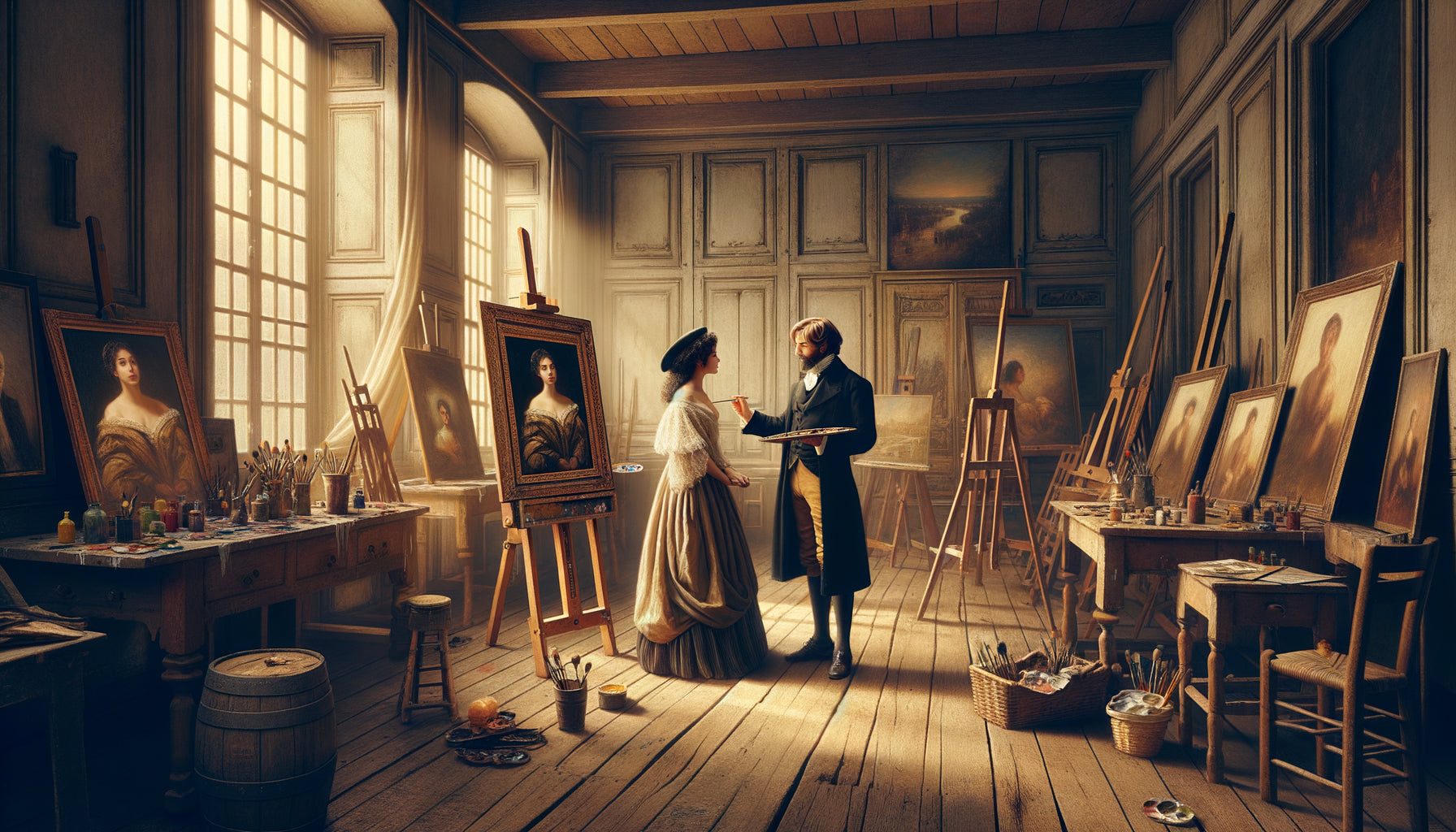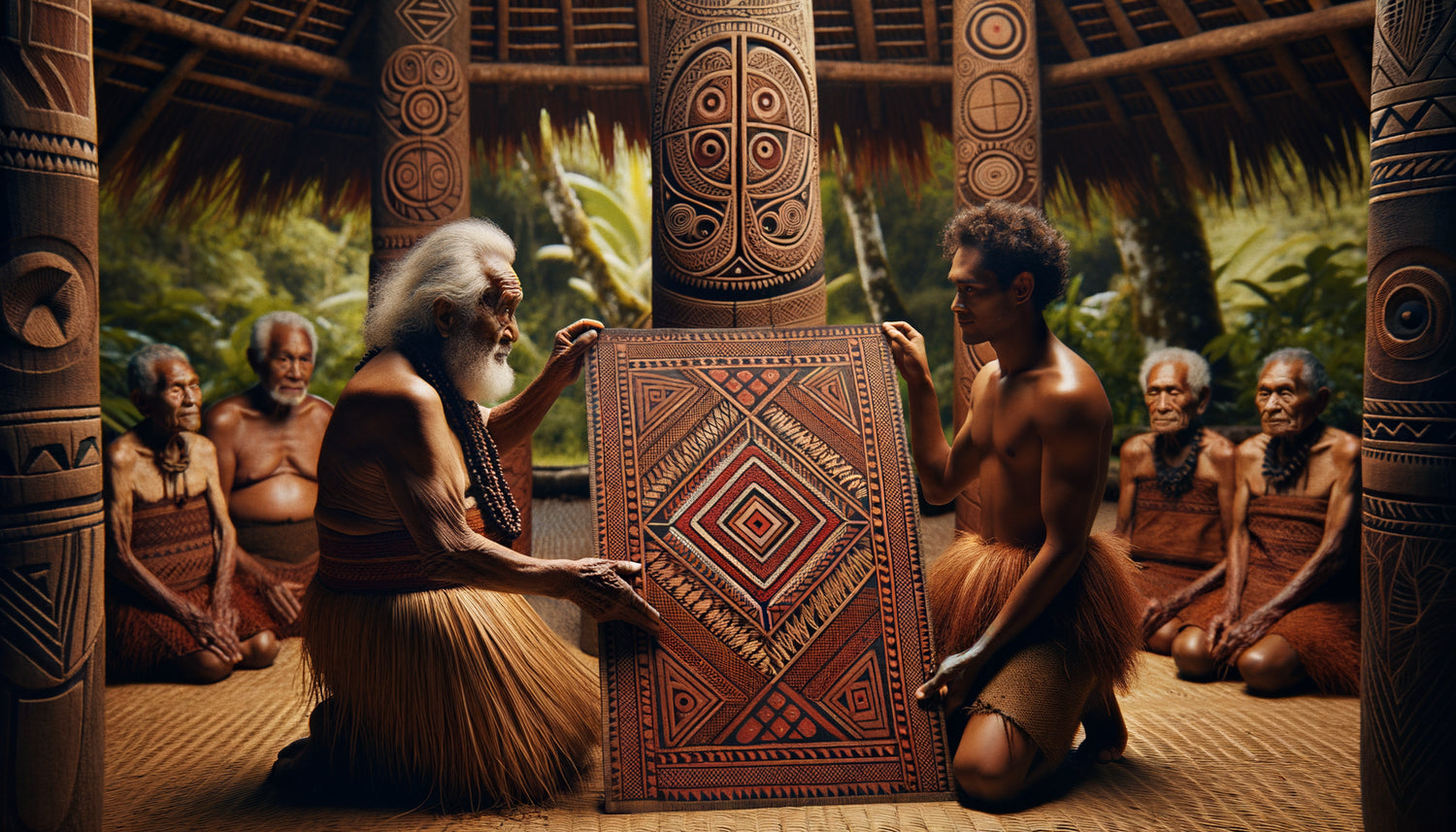
I witnessed a disturbing scene during a Maori ceremony in New Zealand: a chief offered a traditional painting to a visitor, who was about to slide it under his arm like a simple souvenir. The assembly froze. This painting wasn't a decorative object - it was a spiritual link, a responsibility, a fragment of soul transmitted. This misunderstanding reveals the distance between our Western relationship with art and the anthropological depth of pictorial giving in non-Western cultures.
Here’s what anthropology of the gift teaches us about paintings in these cultures: they weave unbreakable social bonds, embody living collective memory, and transform each exchange into a spiritual commitment. Far from being simple aesthetic transactions, these gifts create reciprocal obligations that can extend over generations.
We hang artworks to decorate our interiors, express our personality, or invest financially. But this individualistic vision deprives us of an essential dimension: the power of the painting as a creator of community. In traditional Oceanic, Native American, or African societies, offering a painting has never been a trivial gesture - it is a founding act of social order itself.
Rest assured: understanding this anthropology of the gift does not require becoming an ethnologist. It simply requires opening your eyes to the many ways humanity has thought of art as a vector of relationships rather than possession. This perspective radically transforms our way of considering paintings in our own living spaces.
I invite you to explore how non-Western cultures have made the painting a sacred object of social circulation, and how this ancestral wisdom can enrich our contemporary relationship with decorative art.
The Polynesian hau: when the painting carries the spirit of the giver
Marcel Mauss revolutionized anthropology by studying the Maori concept of hau - this vital force that inhabits every given object. In Polynesian culture, a traditional painting on tapa (beaten bark) or a painting on carved wood never truly leaves its creator. The work retains a portion of his mana, this spiritual energy that links giver and recipient in a relationship of interdependence.
I have participated in ceremonial exchanges in Fiji where paintings on bark cloth circulate according to precise rules. The receiver never really becomes the owner: he is a temporary guardian of an ancestral presence. This conception radically transforms the anthropology of the gift applied to paintings. The work requires a return gift, not out of politeness, but because the hau of the painting must return to its source in one form or another.
Traditional geometric patterns - spirals, waves, totemic figures - are not mere ornaments. Each line encodes genealogies, territories, alliances. Offering such a painting is transmitting a living social map. The recipient inherits simultaneously a responsibility: to keep this network of relationships active by continuing the circulation.
Circulation versus Accumulation
Contrary to our logic of collection and accumulation, the anthropology of giving in these cultures imposes circulation. Keeping a gifted painting jealously would interrupt the flow of mana, create a spiritual blockage. Maori ceremonial paintings circulate from house to house, from clan to clan, weaving an invisible web of debts and reciprocal obligations that structures all of society.
This vision is directly opposed to our Western conception of a painting as a personal investment or a fixed declaration of identity. Here, the work has value only through its movement, its ability to create and maintain bridges between humans.
Navajo sand paintings: impermanence as the ultimate gift
The anthropology of giving reaches a radical form among the Navajo with their spectacular ritual sand paintings. These ephemeral paintings, created during healing ceremonies, embody a fascinating paradox: their programmed destruction is at the heart of the gift itself.
The hatałii (traditional healer) creates complex geometric compositions for hours using colored sands - ochre, turquoise, charcoal, pollen. These ritual paintings represent the Yei, sacred beings of the Navajo pantheon. But unlike our works intended to last forever, these paintings must disappear before sunset. The patient sits in the center, absorbs their power, and then the work is scattered.
This gesture reveals an anthropology of giving where value does not reside in material possession but in spiritual transformation. The painting is not offered to be preserved - it is offered to be consumed, incorporated, digested. Its impermanence guarantees its symbolic effectiveness.
The rejection of commodification
The Navajo have long resisted the commercialization of these sacred paintings. Creating permanent versions on canvas to sell to tourists was considered a spiritual violation. This resistance illustrates how the anthropology of giving in non-Western cultures radically separates sacred exchange from mercantile transaction.
Today, some Navajo artists create works inspired by traditional motifs for the art market, but always with ritual modifications - reversed colors, missing elements - to preserve the sacred character of the ephemeral originals. Authentic gifting remains reserved for ceremonies, outside any economic logic.

Aboriginal bark paintings: ancestral maps and initiatory transmission
In the Australian desert, I discovered how the bark paintings of the Yolngu people function as living legal libraries. These artworks encode territorial rights, songlines, millennia-old ecological knowledge. Their transmission cannot be reduced to a simple commercial exchange - it is an act of initiation charged with responsibilities.
The anthropology of the gift applied to these works reveals a sophisticated hierarchy of knowledge. Some motifs are accessible to all, others reserved for initiates, still others exclusively for elders of a specific clan. Offering such a painting simultaneously transmits a fragment of Dreaming and assesses the recipient's ability to be its legitimate guardian.
The points, lines, and circles that compose these artworks are not abstract - they constitute a precise notation of sacred geography. An outsider will see contemporary decorative art; an initiate will read the exact coordinates of water sources, the itineraries of ancestral creators, clan boundaries. This double reading transforms each gift into a test: does the recipient truly understand what they receive?
The scandal of museum appropriation
Many Western museums hold Aboriginal paintings acquired without understanding their status in the anthropology of gifting within these cultures. Works containing sacred knowledge are publicly exhibited, violating transmission protocols. Communities are now demanding their restitution, not to possess them, but to control their circulation according to traditional rules.
This tension illustrates the clash between two systems: that of universal heritage accessible to all, and that of circumscribed knowledge whose transmission obeys initiatory rules. In Aboriginal anthropology of the gift, some artworks literally cannot be offered to anyone without creating a cosmic imbalance.
Tibetan thangkas: offering to accumulate spiritual merit
The anthropology of the Buddhist Tibetan gift introduces a radically different dimension: the concept of karmic merit. Thangkas - these religious paintings on cloth depicting Buddhas, mandalas, and deities - are part of a spiritual economy where giving generates invisible but real benefits for the giver.
Unlike the Polynesian system where giving creates an obligation of horizontal reciprocity between humans, here the exchange is vertical: one offers a thangka to a monastery, a lama or a practitioner, and one accumulates merit that will favorably influence their future rebirths. The recipient has no obligation of material reciprocation - their simple use of the work for spiritual practice is enough to activate the donor's merit.
I witnessed in Bhutan ceremonies where families offered thangkas specially painted for the healing of a loved one. The act of commissioning the artwork, then giving it publicly to the temple, creates a shared field of merit. The painting becomes a continuous generator of spiritual benefits as long as it remains used for meditation or teaching.
Consecration transforms the object
An unordained thangka remains a beautiful decorative painting. But after a rabné ceremony (consecration), lamas consider that a sacred presence literally inhabits the work. The anthropology of giving then changes in nature: offering a consecrated thangka is transmitting a living practice support, not an inert object.
This distinction creates two parallel circuits: that of decorative thangkas which can circulate freely on the art market, and that of consecrated works whose transmission obeys precise religious protocols. The same physical painting belongs to two different ontological regimes according to its consecration.

When giving creates hierarchy: African ceremonial paintings
In several West African societies, the anthropology of giving applied to ritual paintings establishes and maintains social hierarchies. The paintings on canvas or on wall that accompany initiation ceremonies do not circulate horizontally between peers - they descend vertically from elders to cadets, from initiates to novices.
Among the Baoulé of Côte d'Ivoire, some ritual paintings depicting masks or mythological scenes can only be shown at certain stages of initiation. Receiving the right to contemplate, then to possess such an image, marks a progression in the hierarchy of knowledge. The gift of the painting is never free - it publicly sanctions an acquired status.
This anthropology of gifting as a marker of status is also found in historical royal courts of Central Africa. Raffia fabric paintings from the Kuba kingdom functioned as prestige symbols. The king alone could offer certain motifs, thus establishing an impossible-to-repay symbolic debt - the recipient remained perpetually indebted to the royal donor.
The painting as an unspoken social contract
These ceremonial exchanges of paintings create visual archives of alliances and hierarchies. Who gave which work to whom, in what context, remains inscribed in collective memory. The anthropology of gifting thus transforms the painting into an implicit legal document, material evidence of social relationships that do not need to be formalized in writing to be binding.
What if your paintings created connections rather than simply decorating?
Discover our exclusive collection of wall art to gift that transforms each gift into a moment of authentic connection.
What the anthropology of gifting teaches us for our contemporary interiors
Let's return to our Western living rooms with this anthropological richness in mind. What can we learn from these complex systems of circulation of paintings? How can we re-enchant our own practices of decorative art?
First, reconsider the painting as a creator of relationships rather than a simple reflection of personal taste. Choosing a work to give is consciously weaving a link. The anthropology of gifting invites us to select pieces charged with intention: a painting that evokes a shared memory, a style that resonates with the recipient's universe, colors that dialogue with their interior.
Next, accept circulation rather than static accumulation. Some works could travel between friends or family members, each becoming a temporary guardian. This practice, common in non-Western cultures, transforms the painting into an itinerant messenger who keeps links active over distance.
Finally, ritualize transmission. The anthropology of gifting shows us that the context of the exchange is as important as the object itself. Offering a painting during a significant moment - housewarming, birth, celebration - confers an emotional charge that distinguishes it from a simple decorative purchase.
Art as a relational good rather than possessive
Non-Western cultures remind us of a forgotten truth: objects only have value by the relationships they embody and perpetuate. A painting hung alone on a wall is an orphan; a work that tells a story of transmission, generosity, recognition, becomes alive.
This perspective transforms our relationship with interior decoration. Our walls are no longer just surfaces to be aesthetically covered, but relational spaces where each painting bears witness to a link, a story, a circulation of meaning and affections.
Imagine your living room in five years, your children asking about the origin of each work hanging. Rather than responding with style references or purchase prices, you will tell stories of people, moments, passages. Your paintings will become affective archives, just as ceremonial paintings in non-Western cultures encode genealogies and alliances.
The anthropology of the gift offers us a way to move out of meaningless decorative consumption. Each painting can once again become a social act, a gesture that creates connection rather than simply furnishing the space. This ancestral wisdom, practiced throughout the non-Western world, is waiting for us to reactivate it in our own homes.
Start modestly: next time you choose a work, ask yourself not only if you like it, but what relationship it could create or celebrate. This simple change of perspective is enough to transform your interior into a living space of affective circulation.
Frequently Asked Questions about the Anthropology of the Gift and Paintings
Why is the anthropology of the gift different in non-Western cultures?
In modern Western societies, we generally separate disinterested giving (gift between loved ones) from commercial transactions (purchase in a store). The anthropology of the gift in non-Western cultures reveals much more complex systems where these categories do not exist impermeably. A painting given during a Polynesian ceremony simultaneously creates a future reciprocity obligation, strengthens a social status, and transmits spiritual force. It is neither purely free nor purely economic - it belongs to a third regime of exchange that Marcel Mauss called the total prestation. These systems consider that objects retain something from their successive owners, creating chains of links that can extend over several generations. Understanding this difference transforms our view of art: a painting is never an inert object, but always a vector of social and spiritual relationships.
Can these principles of the anthropology of the gift be applied in our modern interiors?
Absolutely, and it's even particularly enriching in our societies where individualism tends to isolate. You can start by ritualizing your art or gift purchases more: choosing a painting specifically to celebrate an event, documenting its history (who gave it, in what context), creating transmission traditions within your family. Some people establish artwork rotations among close friends, each keeping a painting for a year before passing it on to the next - this practice directly recalls Polynesian circulation systems. You can also associate each artwork in your interior with a specific relationship: this landscape evokes a trip with your sister, this abstraction was given by a mentor, this portrait comes from your grandmother. This relational mapping of your decor transforms your space into a living archive of your emotional ties, exactly as non-Western cultures use objects to keep collective memories active.
Does the anthropology of the gift oppose the contemporary art market?
This is a fascinating tension that runs through the world of art today. The Western market treats paintings as commodities whose value is determined by supply, demand, and speculation. The anthropology of the gift in non-Western cultures, on the other hand, considers that some works simply cannot be sold without losing their essence. Many current heritage conflicts (restitution of artworks to indigenous peoples, issues around cultural appropriation) stem directly from this clash of systems. However, both logics can coexist: even in our mercantile societies, some paintings remain not for sale - family portraits, inherited works, gifts full of meaning. The anthropology of the gift simply reminds us that there are other ways to value art than by its price. A painting with modest market value may have immense relational value, and vice versa. Enriching our understanding with non-Western perspectives allows us to move beyond reducing art to its sole economic dimension, without denying the legitimacy of the market for other works.