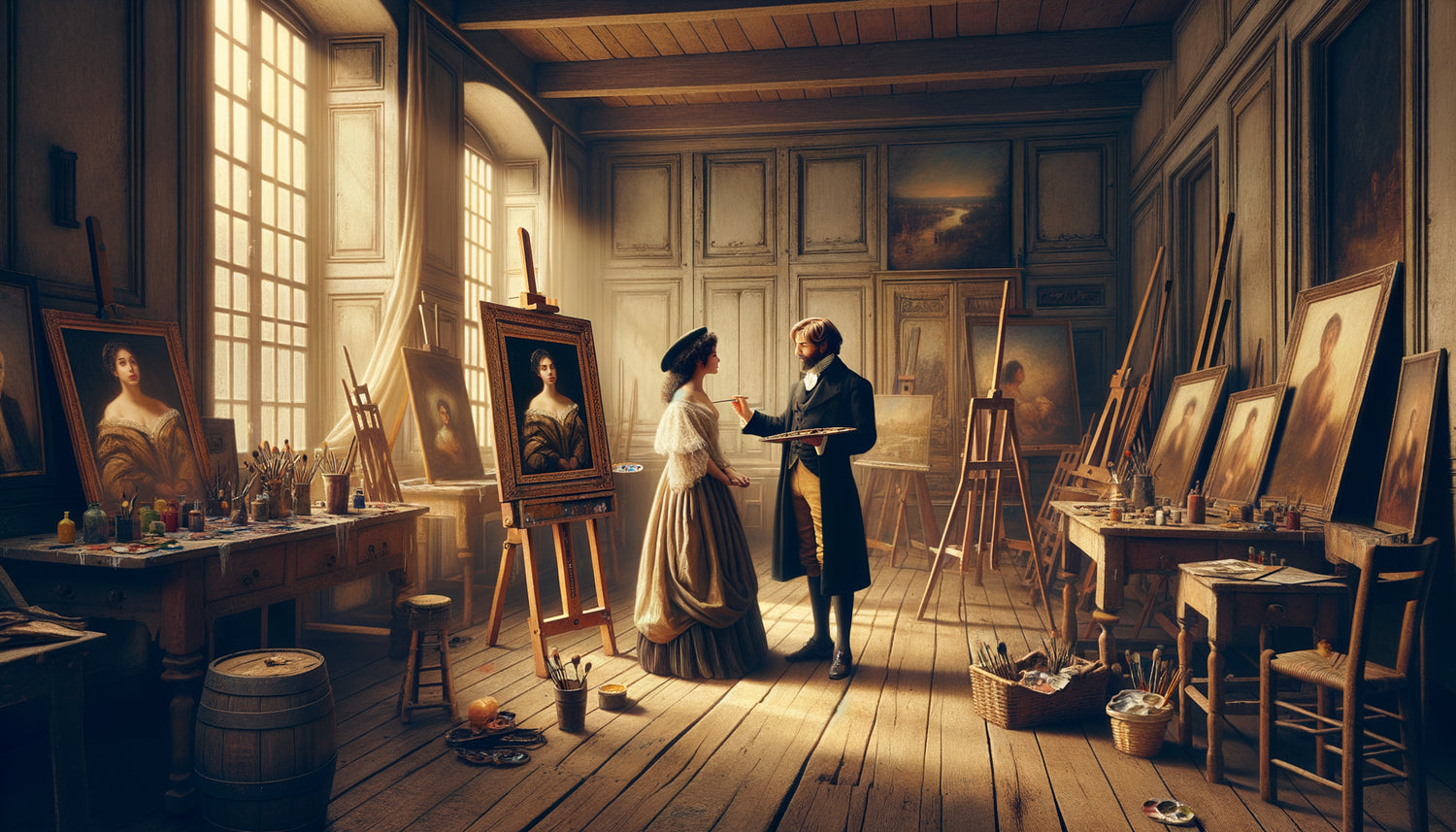
In the smoky workshop of Montparnasse, a painter adds the final touch of vermilion to his muse's portrait. Then, instead of hanging it in a gallery, he gives it to the woman who posed for hours under the harsh light. This gesture, repeated in countless workshops since the Renaissance, wove together more than just a simple commercial transaction: it created an indelible link, a symbolic debt, sometimes even a form of artistic kinship. Here's what paintings given by artists to their models brought: mutual recognition of work done, a pact of trust between creator and inspirer, and the creation of a social network that transcended classes. Today, when we admire a painting in our living room, we often forget the human story it carries. Yet, understanding these historical dynamics transforms our gaze on art as an object of connection. Let's discover together how a simple artistic gift could redefine social relationships and create unexpected alliances.
The gift of portraiture: much more than payment
In past centuries, posing for an artist was not simply paid work. Professional models, often from modest backgrounds, certainly received a salary, but the painting given by the artist represented compensation of a different nature. This artwork became a personal prestige object, tangible proof of their contribution to artistic creation.
Art historians document how these paintings gifted functioned as certificates of recognition. A model possessing her portrait painted by a renowned master gained social respectability. She was no longer simply a common woman renting out her image, but an artistic collaborator, almost an equal in the creative act. This status radically transformed her position in Parisian or Florentine bohemian society.
A symbolic currency
The painting gifted also served as currency in the informal economy of workshops. A model could discreetly resell her portrait to a collector, but more often, she kept it as symbolic capital. This portrait testified to her beauty, reliability, and ability to embody the aesthetic ideals of an era. Other artists, seeing this painting, then sought her services, creating a professional network based on visual reputation.
When gifts created mutual obligations
The anthropology of the gift, theorized by Marcel Mauss, applies perfectly to paintings given by artists to their models. This gift was never neutral: it created a reciprocal obligation, a system of exchanges that linked the two parties far beyond the posing session.
The model who received their portrait entered into a form of honorable debt. They became the discreet ambassador of the artist, speaking of their talent in cafes, recommending their studio to bourgeois seeking portraitists. This particular social link functioned as an informal contract: the artist offered an immortal trace, the model offered in return their loyalty and silence on the secrets of the studio.
Relationships that defied conventions
These particular social links often challenged established hierarchies. Aristocrats posed for painters of humble birth, courtesans inspired respectable academics. The painting offered sealed a complicity that temporarily neutralized class differences. In the intimacy of the studio, artist and model shared a creative secret that the work materialized.
Some correspondence reveals how these paintings created lasting friendships. Models were invited to vernissages, introduced into intellectual circles, sometimes even married by the artists. The painting offered marked the beginning of a relationship that could evolve into forms of intimacy unthinkable in conventional social structures.

The muses immortalized: from shadow to light
Victorine Meurent, model for Manet, received several works from the artist. These paintings offered allowed her to build her own identity as a painter, exhibiting herself at the Salon. Her example illustrates how these gifts could transform a social trajectory: from anonymous model to recognized creator.
The social links created by these artistic exchanges gave models exceptional historical visibility. Without the painting offered, how many of these women and men would have disappeared from collective memory? The given work ensured a form of shared immortality: the artist signed, but the model embodied the work for eternity.
The power of possessed image
Possessing one's own portrait painted by a master conferred considerable psychological power. The model became the guardian of their own representation, controlling who could see it and in what context. This particular social link partially reversed the relationship of domination: the artist created, but the model possessed.
In a society where images were rare and precious, the gifted painting constituted an invaluable cultural capital. It allowed models to negotiate their place in art history, to tell their version of the creative collaboration, to claim their intellectual and aesthetic contribution to the final work.
Practices that inspire our relationship with art today
These historical dynamics still resonate in our contemporary relationship with artworks. When we offer a painting, we instinctively create a social connection that goes beyond the simple transmission of an object. We share a taste, a sensitivity, sometimes even an aesthetic complicity.
The gifted paintings in our interiors tell stories of relationships: the landscape brought back from a shared trip, the portrait commissioned to celebrate a friendship, the work chosen together that testifies to an intellectual harmony. As in the workshops of yesteryear, these artistic gifts weave affectionate obligations and common memories.
Art as social cement
Contemporary sociologists observe that artworks in our homes function as markers of social connections. They signal our affiliations, our decisive encounters, our personal evolutions. A painting gifted by a loved one becomes a transitional object, present daily to recall the relationship.
In current collecting practices, the link between artist and buyer sometimes regains the intensity of the model-painter relationships of yesteryear. Contemporary artists who offer works to their first supporters create loyal communities, networks of mutual aid that propel their careers. The artistic gift remains a powerful creator of solidarity.
Create your own connections through art
Discover our exclusive collection of paintings to offer that will transform your relationships into lasting visual stories.

Social memory inscribed in the canvas
The paintings offered by artists to their models are now treasures for historians. These works often bear dedications, dates, annotations that document the relationship. They testify to an era when art circulated differently, creating more complex social connections than simple commercial transactions.
This history reminds us that every work of art has a social biography: it was created in a relational context, offered or sold according to affective logics, transmitted through generations who attributed changing meanings to it. Understanding these dynamics infinitely enriches our aesthetic appreciation.
You will now look at paintings differently. Behind each painted face may lie a story of mutual recognition, unlikely alliance, social link woven in the complicity of the workshop. Paintings offered are never just images: they are monuments of human relationships, proof that art creates as much as it represents.
Frequently asked questions about paintings offered and social links
Why did artists offer paintings to their models rather than simply paying them?
The painting offered represented a form of symbolic payment much more valuable than monetary compensation. It recognized the model's creative contribution, not just their physical presence. In the workshop economy, this gift also created a bond of loyalty: the model became part of the artist's success, with a personal interest in promoting their talent. For models often precarious, owning a signed artwork was also a mobilizable cultural capital: proof of respectability, conversation piece in artistic circles, or even financial investment if the artist became famous. This particular social link transformed a commercial relationship into a creative partnership, beneficial for both parties in the long term.
Did these paintings offered really change the social status of models?
Absolutely. In a society where images were rare and expensive, owning one's painted portrait considerably elevated social status. Models could show these paintings offered as proof of their attendance at artistic circles, which opened professional and social doors. Some became artists themselves, others married bourgeois attracted by their bohemian aura documented in the work. The painting functioned as a certificate of beauty and artistic respectability. It transformed the social gaze: the woman was no longer simply a model (a job often associated with marginality), but an immortalized muse, almost a collaborator of the artist. These social links created by artistic donation sometimes made improbable social ascensions possible in a very hierarchical society.
Can we find these dynamics in contemporary art?
Yes, in adapted forms. Emerging artists still offer works to their first collectors or supporters, creating loyal communities that follow their career. The offered artworks on social media (shares, digital dedications) also create social connections between creators and audiences. In artist residencies, works are often given to hosts as a thank you, perpetuating this economy of giving. Artistic barter practices between creators also maintain this logic: exchanging artworks creates professional solidarity and mutual aid networks. Even in galleries, when an artist dedicates a catalog or offers a sketch to a buyer, he reconnects with this tradition of giving that transforms a transaction into a lasting relationship. Art remains a powerful creator of connections beyond its market value.