I have accompanied more than 200 practitioners in humanizing their care spaces, and the question invariably arises during our first meeting: "How much should I budget to properly decorate my practice?" This questioning often hides a legitimate fear: investing too little and obtaining a bland result, or spending recklessly without guarantee of therapeutic impact.
Here's what a thoughtful artistic investment brings to your medical practice: a measurable reduction in patient anxiety (studies show up to 30% decrease in perceived stress), immediate enhancement of your professional expertise, and a work environment that rejuvenates you rather than exhausts you.
Too many medical practices still resemble austere waiting rooms where time seems suspended. White walls reflect a clinical coldness that amplifies the natural apprehension of consultations. Yet, wall art constitutes the most profitable investment in terms of psychological comfort, far before furniture or lighting.
Rest assured: artistically decorating five rooms does not require a pharaonic budget or expertise in art history. A coherent strategy, adapted to your specialties and patients, radically transforms the care experience for a controlled investment. I will reveal realistic budget ranges and decisive criteria for each space.
The rule of three zones: understanding levels of investment
In a medical practice with five rooms, not all artworks carry the same emotional weight. I have developed a prioritization method in three concentric circles that optimizes visual impact while respecting budgetary constraints.
High-impact zone: the waiting room
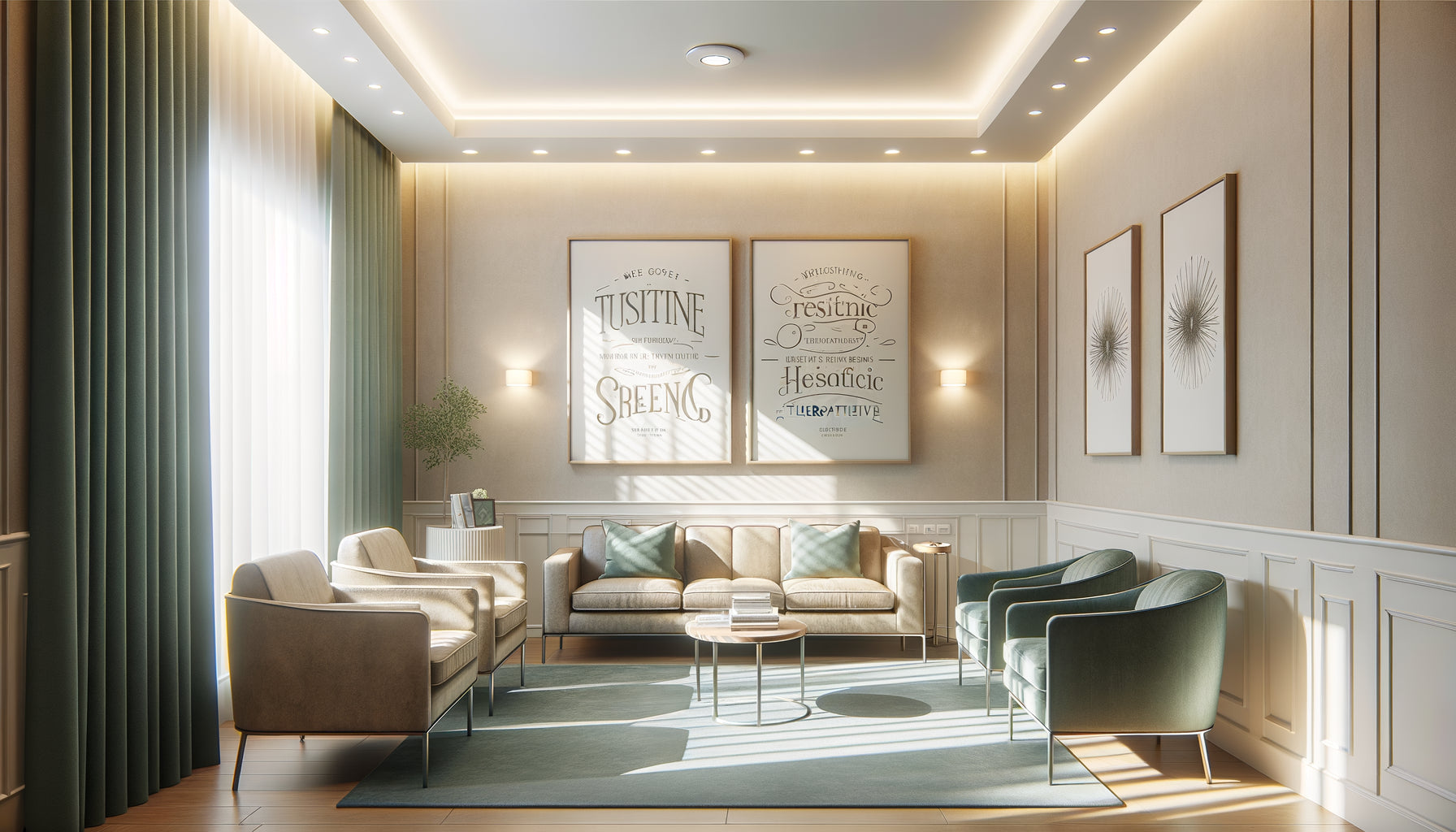
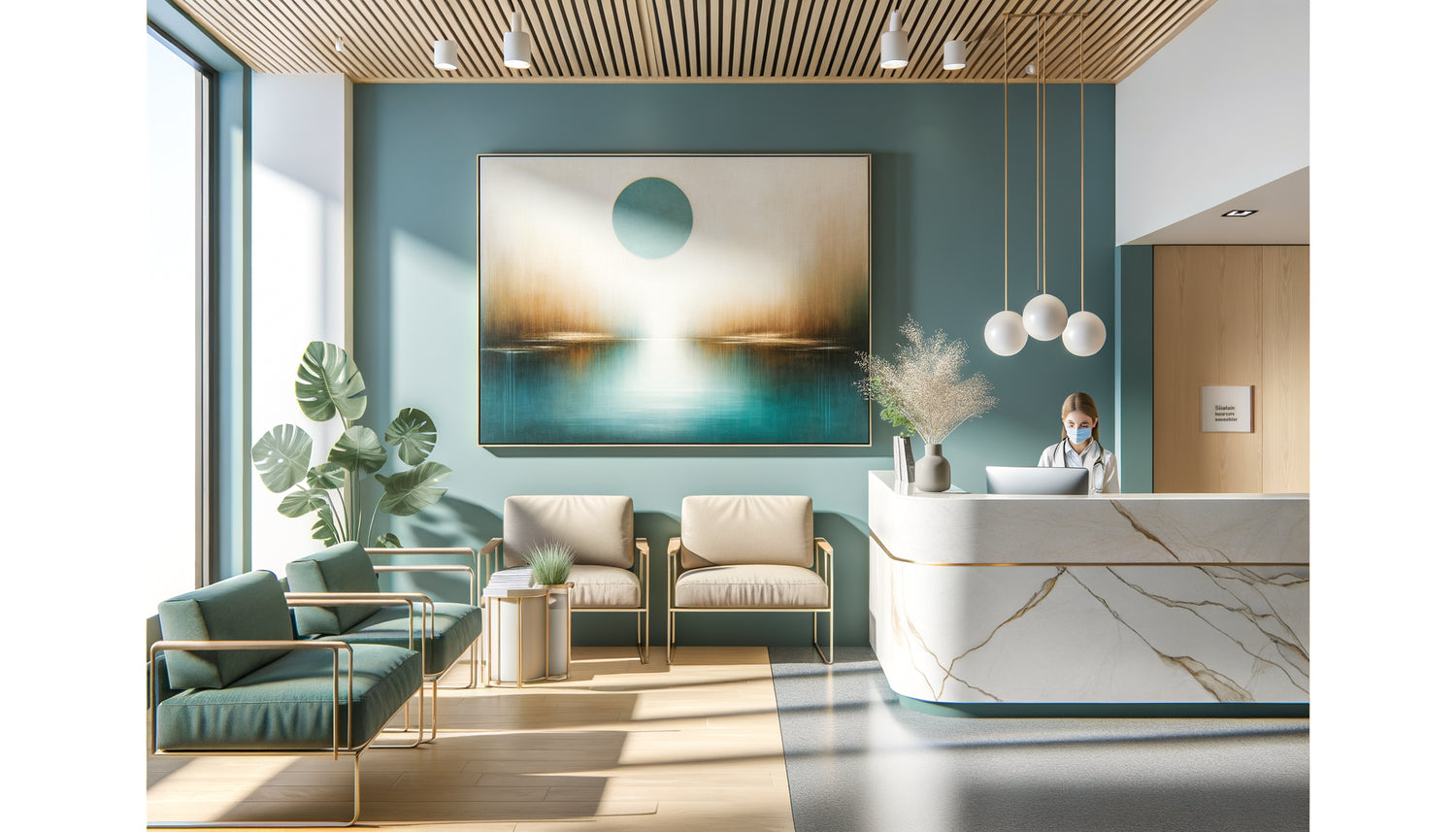
This is where anxiety peaks, and time stretches. For this crucial space, budget between €200 and €400 per artwork. I systematically recommend two to three medium-sized artworks (minimum 60x80 cm) that create a soothing visual journey. A patient recently confided in me that contemplating an abstract seascape in her cardiologist's waiting room had considerably reduced her pre-consultation tachycardia.
At this level of investment, you access museum-quality art reproductions on canvas, with pigments resistant and color depth mimicking original artworks. Framing becomes an element of sophistication, not just a simple outline.
Supporting zone: consultation rooms
For your three consultation rooms, a budget of €150 to €250 per artwork offers a balanced approach. Here, the artwork accompanies the therapeutic dialogue without overshadowing it. I often guide my clients towards gentle geometric compositions or purified landscapes that facilitate concentration while relieving tension.
A general practitioner recently explained to me how a painting with earthy sienna tones, positioned in the patient's line of sight while seated, naturally became an anchor during delicate announcements. Wall art then becomes a soothing third party in the care relationship.
Functional area: the examination room
For your examination or technical care room, an investment of €100 to €180 is more than sufficient. Here, prioritize smaller formats (40x50 cm) with reassuring themes: stylized plants, organic motifs, fluid abstractions. The goal is not to distract during a medical procedure, but to humanize a space often perceived as impersonal.
Realistic overall budget: the €1200 to €2500 range
To harmoniously equip a medical practice with five rooms, the average investment ranges from €1200 to €2500, including installation. This amplitude is explained by several determining factors that I systematically evaluate with my practitioner clients.
A pediatrician's office will require more colorful works, potentially more numerous (to create varied points of attention), while a psychiatrist’s office will prefer fewer contemplative compositions. The medical specialty directly influences the artistic strategy and therefore the budget.
I accompanied a dentist who invested €1400 for seven artworks (waiting room, three treatment rooms, sterilization area and private office). Her feedback, six months later, was eloquent: 40% of her patients spontaneously commented positively on the atmosphere of the practice, and she noted a sharp decrease in appointments canceled due to anxiety.
The variables that influence the investment
The format of the artworks is the first budgetary lever. A large format (80x120 cm) for your waiting room immediately captures attention and structures the space, but represents an additional cost of 30 to 50% compared to a standard format. I observe, however, that a quality large painting impresses more than three scattered small formats.
The reproduction technique significantly impacts the rendering and durability. Giclée prints on canvas with protective varnish (standard for medical spaces) are in the mid-range. Dibond prints, more contemporary and easy to maintain, increase the cost by 15 to 20%.
Custom framing transforms a suitable artwork into a refined decorative element. For a medical practice, I recommend simple frames made of natural wood or brushed aluminum which add €40 to €80 per artwork, but guarantee a professional visual consistency.

Budgeting Mistakes That Devalue Your Investment
After auditing dozens of medical practices, I notice three recurring pitfalls that turn a promising investment into a sterile expense.
The all-too-small budget mistake: investing less than 50€ per piece inevitably leads to paper prints under glass whose colors fade within six months under LED lighting. One physiotherapist had equipped his practice for €300 total; eighteen months later, the faded posters gave an impression of neglect that completely contradicted his professionalism.
Thematic dispersion is the second trap. Trying to vary styles (abstract, landscape, figurative, photography) in a limited space creates an anxious visual cacophony. Color and style harmony are worth more than diversity. I recommend choosing two to three dominant tones throughout the practice.
Impulsive purchase without spatial strategy: acquiring pieces of heart without first measuring available walls generates frustration and overcosts. One psychiatrist had ordered four 70x90 cm paintings to discover that his walls, interrupted by doors and switches, could only accommodate a maximum of 50x60 cm.
Optimizing Your Budget: The Gradual Deployment Strategy
You don't have to equip all five rooms at once. I regularly support practitioners who prefer a phased deployment over 6 to 12 months, allowing them to spread the investment while refining their aesthetic choices.
Phase 1: Patient Areas (Budget €600-€900)
First focus on the waiting room and your main consultation room. These two spaces concentrate 80% of your patients' presence time. Three to four well-chosen pieces radically transform the perception of your practice.
One dermatologist started with €750 invested in her waiting room (two quality botanical abstract paintings) and her consultation (a soothing mineral composition). The immediate impact on the atmosphere convinced her to continue three months later.
Phase 2: Complementary Areas (Budget €400-€600)
Secondly, decorate your treatment rooms and technical spaces with works that are stylistically consistent but of a more modest size. This progression allows you to observe how patients interact with the first artworks and adjust your choices.

Beyond the price: calculating the emotional return on investment
An artistic investment for your medical practice is not measured solely in euros spent. The practitioners I accompany report tangible benefits that largely justify the initial expense.
Reduced perceived time: several studies in environmental psychology demonstrate that a visually enriched environment reduces perceived waiting time by 20 to 35%. Your patients wait better, protest less.
Improved comfort for yourself: you probably spend 40 hours per week in these walls. Working in a harmonious environment reduces decision fatigue and preserves your empathetic energy. A general practitioner confided in me that since he invested in the ambiance of his practice, his evenings were less exhausting.
Competitive differentiation: in a context where patients compare and choose their practitioners, an inviting office becomes a competitive advantage. Google reviews spontaneously mention the warm atmosphere, a strong signal of overall quality.
Transform your practice into a restorative care space
Discover our exclusive collection of wall art for medical offices that combines artistic quality and therapeutic impact, with works specifically selected to soothe and reassure your patients.
Specifically, where do you start?
You now have the essential budgetary guidelines for a five-room medical practice. The optimal investment is between €1200 and €2500, adaptable according to your specialty, your patient base and your spatial priorities.
Before any acquisition, I invite you to spend thirty minutes in your practice, notebook in hand, putting yourself in the place of your patient. Which walls naturally catch the eye? Where does time seem to pass the longest? These areas deserve your priority investment.
Photograph your walls with their exact dimensions. Identify your existing color palette (furniture, floors, walls) to choose artworks that dialogue harmoniously rather than creating visual breaks.
And above all, remember that a thoughtful artistic investment is never a superfluous expense: it's a therapeutic act in its own right that extends your intention of care far beyond medical prescription. Your walls heal as much as your words.
Frequently Asked Questions about Medical Art Investment
Can I deduct the purchase of artworks for my medical practice from taxes?
Excellent question that 90% of practitioners ask me! Yes, artworks intended for the layout of your medical practice are deductible expenses as professional costs. Depending on your tax regime (sole proprietorship or company), you can either immediately deduct the full amount if the artwork costs less than €600, or depreciate it over several years for larger investments. I systematically recommend consulting your accountant, but in most cases, your €1500 investment for five rooms can reduce your taxable base by that same amount. Keep invoices and supporting documents with explicit mention of professional destination. One client doctor recovered about €450 via his tax reduction for an initial investment of €1800, bringing his actual cost to €1350.
How to avoid artworks looking dated in 5 years?
This fear of aesthetic obsolescence is legitimate, especially after investing several hundred euros. My recommendation rests on a simple principle: prioritize the timeless over the trendy. Abstract compositions with clean lines, stylized landscapes, natural motifs (vegetal, mineral, aquatic) cross decades without aging. Conversely, avoid artworks that are too typical of the 2020s with their neon colors or motivational slogans which will seem quickly dated. I accompany practices whose works installed ten years ago still look contemporary because they rely on neutral color harmonies (deep blues, soothing greens, natural earth tones, sophisticated grays) and balanced compositions. Also think that you can evolve your arrangement: swap two paintings between rooms, add them gradually, replace only the waiting room one every five years to refresh the overall impression without replacing everything.
Should I adjust the budget according to my patient base (popular neighborhood vs. affluent neighborhood)?
This question addresses a widespread but mistaken belief: that quality art is reserved for affluent neighborhood practices. My experience demonstrates exactly the opposite. All patients, regardless of their socioeconomic background, react positively to a well-cared-for and harmonious environment. A doctor practicing in a disadvantaged rural area explained that his patients particularly appreciated the aesthetic effort, seeing it as a mark of respect and consideration. Conversely, a colleague in an upscale neighborhood neglecting his surroundings was perceived as distant and uninvolved. The optimal budget remains the same (1200-2500€ for five rooms), but you can adapt the style: more colorful and narrative compositions work well in social pediatrics, while sophisticated abstractions are suitable for surgical specialties. The essential thing is perceived consistency and quality, not absolute price. A patient never guesses whether your painting costs €150 or €400, but they instantly feel if the whole is harmonious and if you have paid attention to their psychological comfort.