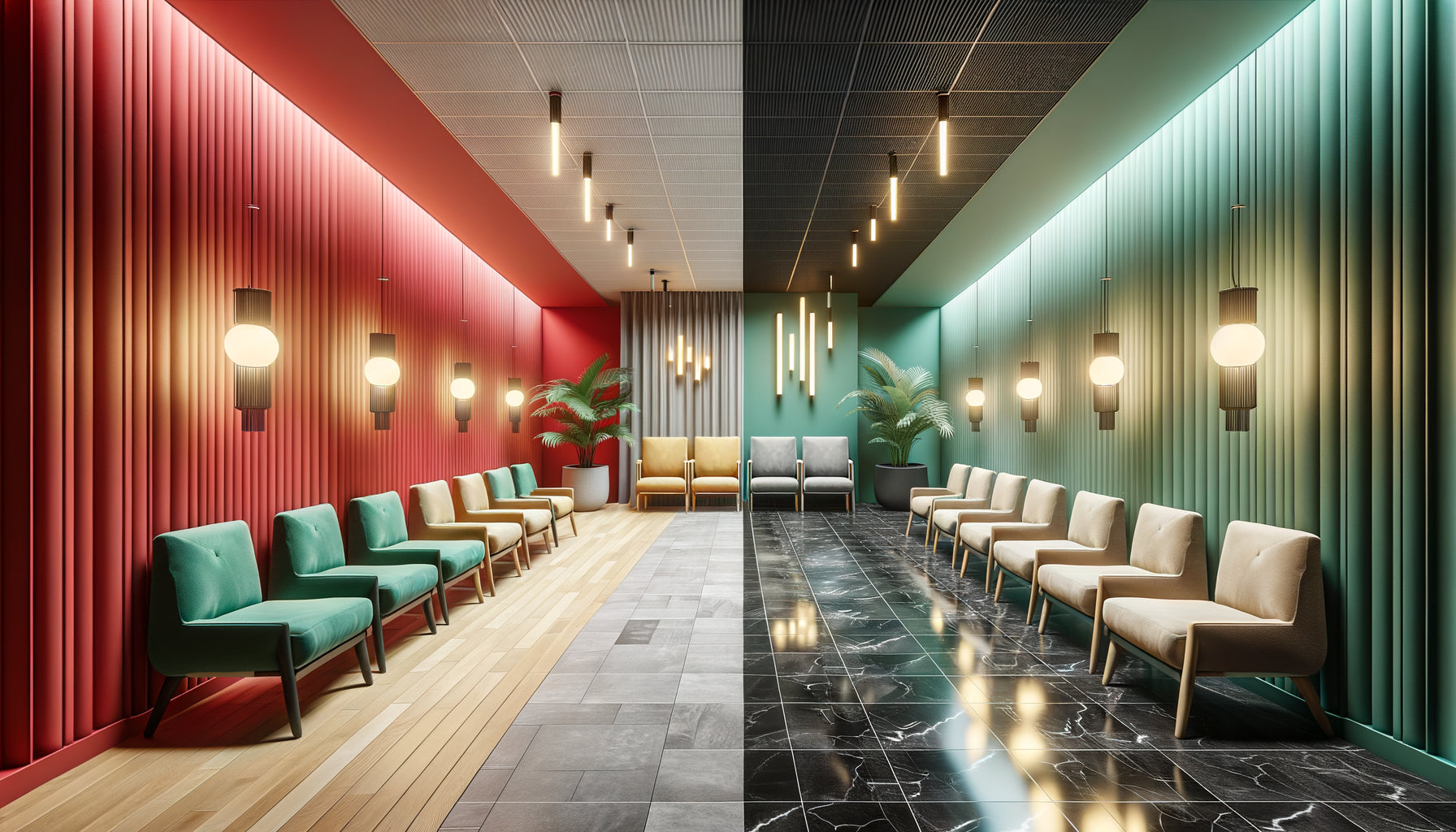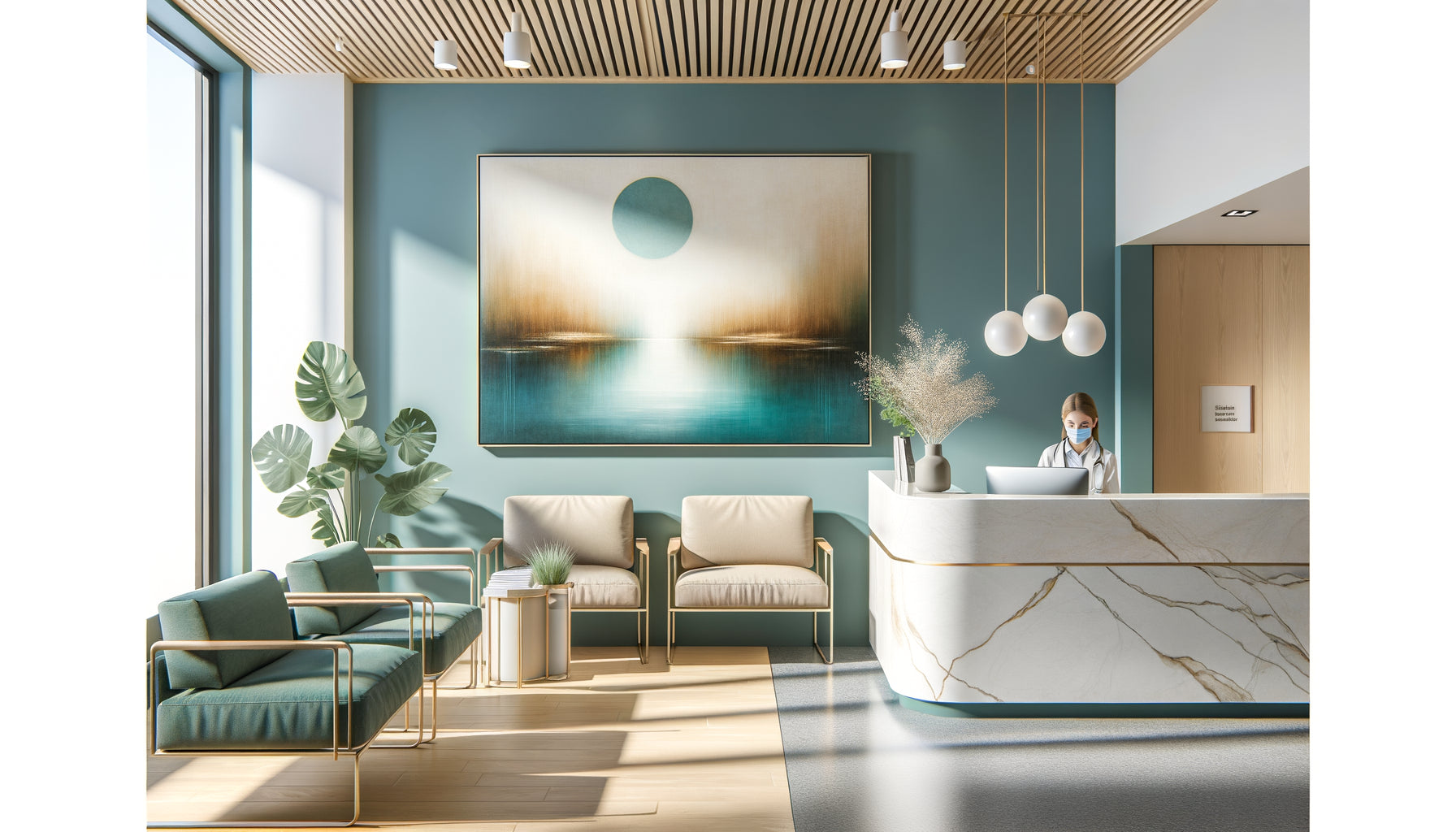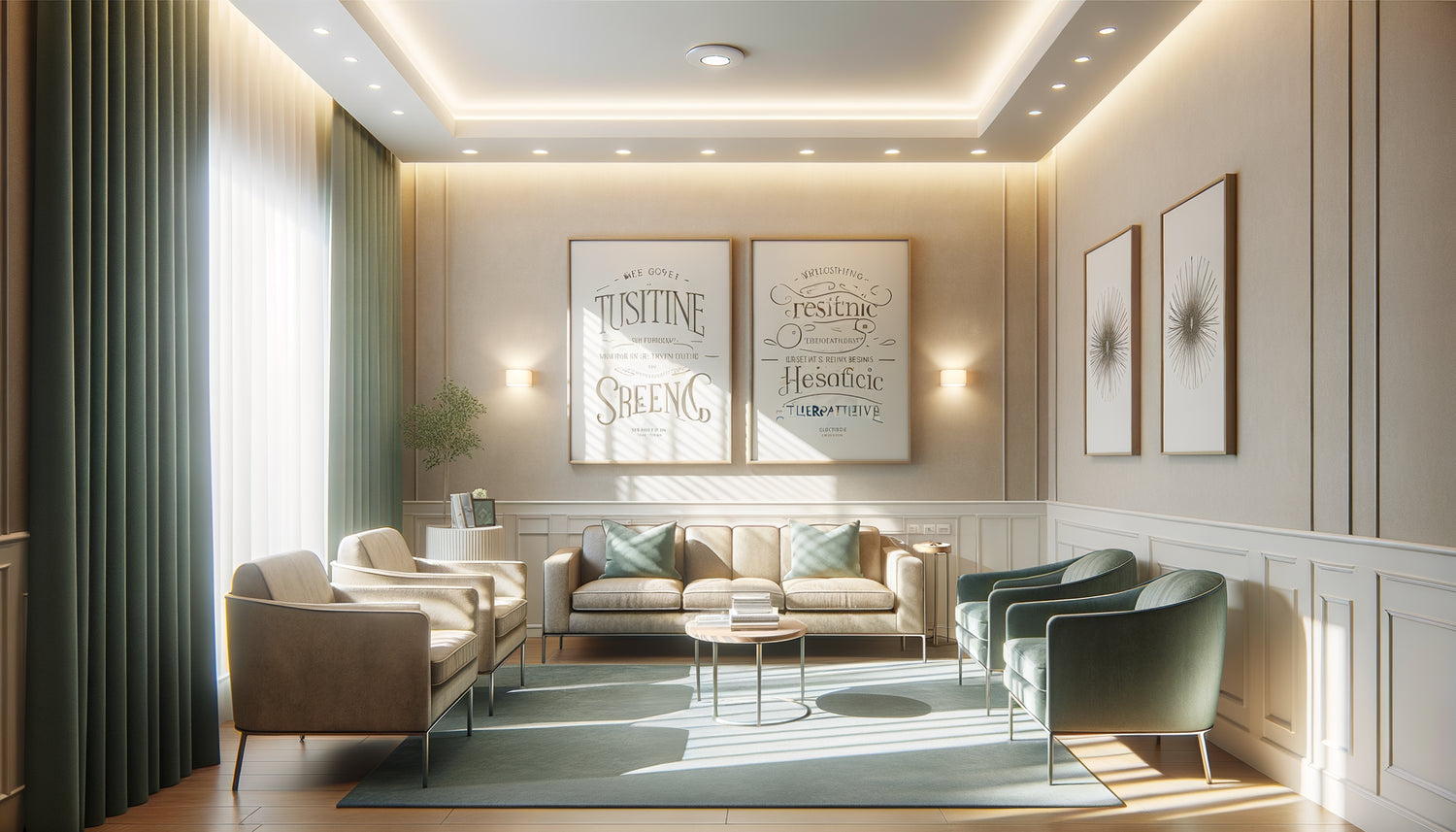
I've observed a fascinating phenomenon during my space planning consultations in healthcare settings: two identical waiting rooms, the same size, the same furniture, the same lighting. Yet, in one, patients were nervously flipping through outdated magazines. In the other, I saw them breathing more calmly, sometimes smiling. The difference? The walls of the second room featured carefully selected positive message artworks.
Here's what positive message artworks bring to a medical practice: they transform pre-consultation anxiety into calmness, create an atmosphere of kindness that extends the therapeutic effect, and affirm a professional identity centered on people.
Practitioners regularly confide in me their frustration: investing in ergonomic furniture, soothing colors, careful decoration... only to see their patients remain tense, stiff in their chair. Many believe this tension is inevitable, that it's an integral part of the medical experience.
Yet, I have accompanied more than forty clinics in their decorative transformation, and the results are systematic: the visual and emotional atmosphere of a care space directly influences patients' state of mind. Positive message artworks are not mere decorative accessories; they are complementary therapeutic tools.
When walls become partners in healing
The wait preceding a medical consultation generates a particular form of anxiety. Unlike punctual stress, it's a diffuse tension fueled by uncertainty. Patients' gaze wanders through the room, seeking an anchor point, a positive distraction.
Positive message artworks precisely respond to this need. A message like 'Every day is a new chance' or 'Your well-being matters' offers a soothing focal point. I noticed in a cardiology clinic that patients naturally fixed their gaze on a painting with the inscription 'Breathe, everything will be alright' – spontaneously creating a moment of heart coherence.
This approach is part of what environmental psychologists call therapeutic design. The physical environment never remains neutral: it either aggravates or mitigates emotional state. A white and impersonal wall amplifies anxiety through its emptiness. An artwork with a positive message tempers it through its benevolent presence.
The neurological impact of visual affirmations
Neuroscience confirms what intuition suggested: our brain processes visual messages in less than 250 milliseconds. A painting bearing a positive affirmation activates the areas of the brain associated with reward and motivation. This activation, even subtle, modifies brain chemistry by releasing small doses of dopamine.
In a medical practice, this effect takes on a particular dimension. Patients often arrive in a state of hypervigilance, their nervous system on alert. Positive messages act as environmental safety signals, indicating to the reptilian brain that it can slightly lower its guard.
Choosing messages that resonate without infantilizing
The main pitfall? Falling into naivety. I have seen practices display overly simplistic messages that produced the opposite effect: patients felt patronized, their legitimate concerns dismissed by forced optimism.
Effective positive message boards for a medical practice adhere to three fundamental principles:
Emotional validation: Rather than 'Everything is wonderful', opt for 'You are stronger than you think' – a message that implicitly acknowledges the difficulty.
Universality: Avoid references too specific to a philosophy or spirituality. 'Take care of yourself' transcends personal beliefs, unlike religious or esoteric quotes that could exclude some patients.
Alignment with the specialty: A pediatrician’s office will benefit from messages including notions of growth and support. A geriatric practice will prioritize affirmations about dignity and wisdom. This personalization demonstrates authentic reflection, not generic decorative cladding.
Typography and readability: the details that change everything
A positive message loses its effectiveness if it requires an effort to decipher. I always emphasize readability at a distance: from any seat in the waiting room, the message should be instantly accessible.
Elegant script fonts are aesthetically pleasing but tire the anxious eye. For a medical practice, I recommend clean and contemporary sans serif characters. The contrast between the text and background must be clear: black on off-white, anthracite on light beige.
Size also matters. On a 50x70 cm (approximately 20x28 inches) board, the main sentence should occupy at least 4 cm (approximately 1.6 inches) in height for each capital letter. This scale guarantees comfortable reading from 3 to 4 meters (approximately 10-13 feet) – the typical distance in a waiting room.

Aesthetics in the service of the message, not the other way around
Some positive message artworks sacrifice readability for the sake of design. Overloaded backgrounds with floral patterns, texture layering, saturated colors that vibrate... These decorative choices transform the message into a visual puzzle.
In a medical office, aesthetics should serve the calming function. I consistently prioritize:
Clean backgrounds: neutral tones, soft gradients, or a single solid color. Beige sand, pearl gray, and powder blue create a serene base that highlights the text.
Minimalist plant accents: a stylized eucalyptus branch, a monstera leaf silhouette. These natural elements reinforce the organic and vibrant dimension of the message without creating distraction.
A clear visual hierarchy: the positive message dominates, possibly accompanied by a subtext or discreet pattern. A maximum of three elements per composition.
Color consistency with the office's identity
Positive message artworks do not float in an aesthetic void. They engage in dialogue with the existing palette of the medical office. I accompanied a dermatologist whose walls were painted in a soothing aqua green. We selected positive message artworks using earthy and ochre tones – creating a warm contrast without visual disruption.
This color consistency produces a powerful psychological effect: the feeling that every element has been considered, that nothing is left to chance. For patients, this unconsciously translates into increased confidence in the practitioner's professional meticulousness.
Strategic placement: the emotional geography of the office
The effectiveness of a positive message artwork depends as much on its location as on its content. I apply what I call patient gaze mapping: identifying where eyes naturally settle according to the moments of the care pathway.
In the waiting room: prioritize the wall facing the seats, at eye level for a seated person (130-150 cm from the floor). This is the natural viewing zone, where the patient instinctively seeks distraction during the wait.
In the hallway leading to consultation rooms: a reassuring message just before entering amplifies the calming effect. 'You are in the right place' or 'Take your time' signal a transition to a welcoming space.
In the consultation room itself: facing the examination chair, an encouraging message visible during treatments. I equipped a dental practice with 'Your courage is admirable' facing the chair – the feedback from anxious patients was unanimous.
Avoid visual overload
A medical office is not an art gallery. I regularly observe a mistake: multiplying positive message artworks on every available wall, creating a counterproductive saturation.
The rule I apply: one strong message per functional space. The waiting room can accommodate a maximum of two or three paintings, spaced to create visual breaths. A wall densely covered generates a form of visual noise that cancels out the desired soothing effect.

Beyond decoration: a professional positioning
Paintings with positive messages in a medical office are also a statement of professional intent. They signal a holistic approach, recognizing that healing is not limited to strict medical protocol.
I worked with a general practitioner who was hesitant, fearing that these paintings would make him appear 'less scientific'. Six months after installation, he reported a noticeable change: patients more easily addressed the emotional dimensions of their symptoms. Positive messages had created a psychological space where vulnerability became acceptable.
This transformation goes beyond anecdote. Studies on the therapeutic relationship confirm that the physical environment influences the quality of patient-practitioner communication. An office that incorporates paintings with positive messages implicitly says: 'Here, we treat whole people, not just symptoms'.
Differentiation and recommendation
In a sector where patients are increasingly choosing their practitioner based on overall experience criteria, the office ambiance becomes a factor of recommendation. Patients do not share: 'My doctor has a good stethoscope'. They share: 'His office is so soothing, you really feel good there.'
Paintings with positive messages contribute to this positive differentiation. They create memorable moments – a patient who discreetly photographs a message that touched them, a conversation that spontaneously engages in the waiting room around an inspiring affirmation.
Transform your care space into a haven of kindness
Discover our exclusive collection of wall art for Medical Offices that combines professional aesthetics and authentically soothing messages.
So, how do you integrate these artworks into your practice?
The transition to a practice enriched with positive messages doesn't require a decorative revolution. I recommend a gradual approach, successfully tested in the dozens of practices I have accompanied.
Start with a single artwork in the waiting room, facing the seats. Observe reactions for one month. Some practitioners discreetly install an artwork with a positive message and note spontaneous comments – often more numerous than anticipated.
Involve your team in choosing messages. Medical secretaries and assistants spend more time in these spaces than the practitioner themselves. Their intuition about what will resonate with patients proves valuable.
Occasionally renew messages according to seasons or periods. A practice I have been supporting for three years changes two out of five artworks each quarter. This rotation maintains visual freshness and offers new sources of inspiration for regular patients.
The investment remains modest compared to other improvements – between 50 and 200 euros per professional-quality artwork. The return on investment is measured in patient experience quality, a criterion now scrutinized in evaluations and recommendations.
The subtle alchemy between professionalism and humanity
Artworks with positive messages ultimately embody this productive tension at the heart of contemporary medicine: maintaining technical excellence while cultivating the human dimension. They do not replace any medical act, but they prepare the emotional ground on which these acts will be inscribed.
Imagine entering a practice where, before even shaking hands with the practitioner, you read: 'Your health deserves all our attention'. This simple message transforms the dynamic. You are no longer a number in an overloaded schedule, but a person whose well-being is the priority.
This perceptual transformation explains why artworks with positive messages go beyond their apparent decorative function. They materialize a philosophy of care, make the invisible visible, give body to the benevolent intention that animates – or should animate – every medical practice.
The choice of integrating these artworks into a medical practice is therefore based on a deep coherence. It affirms that the treatment environment is an integral part of the care itself, that walls can become therapeutic partners, that every detail counts in the healing journey.
The relevance of artworks with positive messages for a medical practice is no longer discussed at an aesthetic level. It is assessed according to their ability to humanize sometimes cold spaces, reassure worried minds, and create emotional bridges between the practitioner and those who confide their vulnerability. In this perspective, they are not relevant – they are essential.
Frequently Asked Questions about Positive Message Wall Art for Medical Practices
Are positive message wall art suitable for all medical specialties?
Absolutely, with adaptation of the tone according to the specialty. I have equipped oncology, pediatrics, psychiatry and general medicine clinics with consistently positive results. The key lies in choosing the messages: an oncology clinic will prioritize affirmations about strength and resilience ('You are braver than you know'), while a pediatric clinic will opt for inclusive messages valuing support ('Growing together'). The universality of emotional needs – being reassured, feeling safe, perceiving kindness – transcends specialties. Even very technical medical environments like radiology benefit from these touches of humanity that counterbalance technological coldness. The practitioner must simply ensure that the message resonates authentically with their practice and the specific challenges faced by their patients.
Could these wall art appear unprofessional or too 'personal development'?
This legitimate concern disappears with the right aesthetic and textual balance. A positive message wall art designed for a professional environment is radically different from mass-market motivational posters. The approach I defend favors graphic sobriety, professional typography, short and universal messages rather than flowery quotes. The result resembles contemporary interior design more than new age decoration. I have observed that patients perceive these wall art as a sign of attention and modernity rather than a lack of seriousness. On the contrary, they report a medical practice that integrates the psycho-emotional dimensions of care – an approach now validated by integrative medicine. Professionalism is also measured by the ability to welcome the patient in their entirety, not just in their pathology. Positive message wall art participate precisely in this holistic vision.
How to maintain and renew these wall art to keep their impact?
Maintenance remains minimal: a monthly dusting with a microfiber cloth is sufficient for artworks framed under glass. For canvas prints, avoid direct humidity and prefer using a vacuum cleaner at a low power from a distance. The main challenge concerns perceptual renewal. A message viewed daily gradually loses its impact – a phenomenon of visual habituation. I recommend three strategies: firstly, initially install four to five artworks and rotate two every quarter between different spaces in the office, creating rotation without additional investment. Secondly, progressively enrich the collection with a new artwork annually, allowing you to test different messages based on patient feedback. Thirdly, adapt messages to seasons or contexts: a message about renewal in spring, about softness in winter. This dynamic approach maintains emotional freshness while controlling costs. The total investment over three years remains less than a single waiting room chair, for a daily impact on the patient experience.