When I started advising healthcare facilities twelve years ago, a department head confided in me something that revolutionized my perception of therapeutic art. In her cardiology unit, she had replaced classic reproductions with a series of marine photographs. Within six months, she observed a measurable decrease in preoperative anxiety among her patients. Coincidence? Neuroscience proves otherwise today.
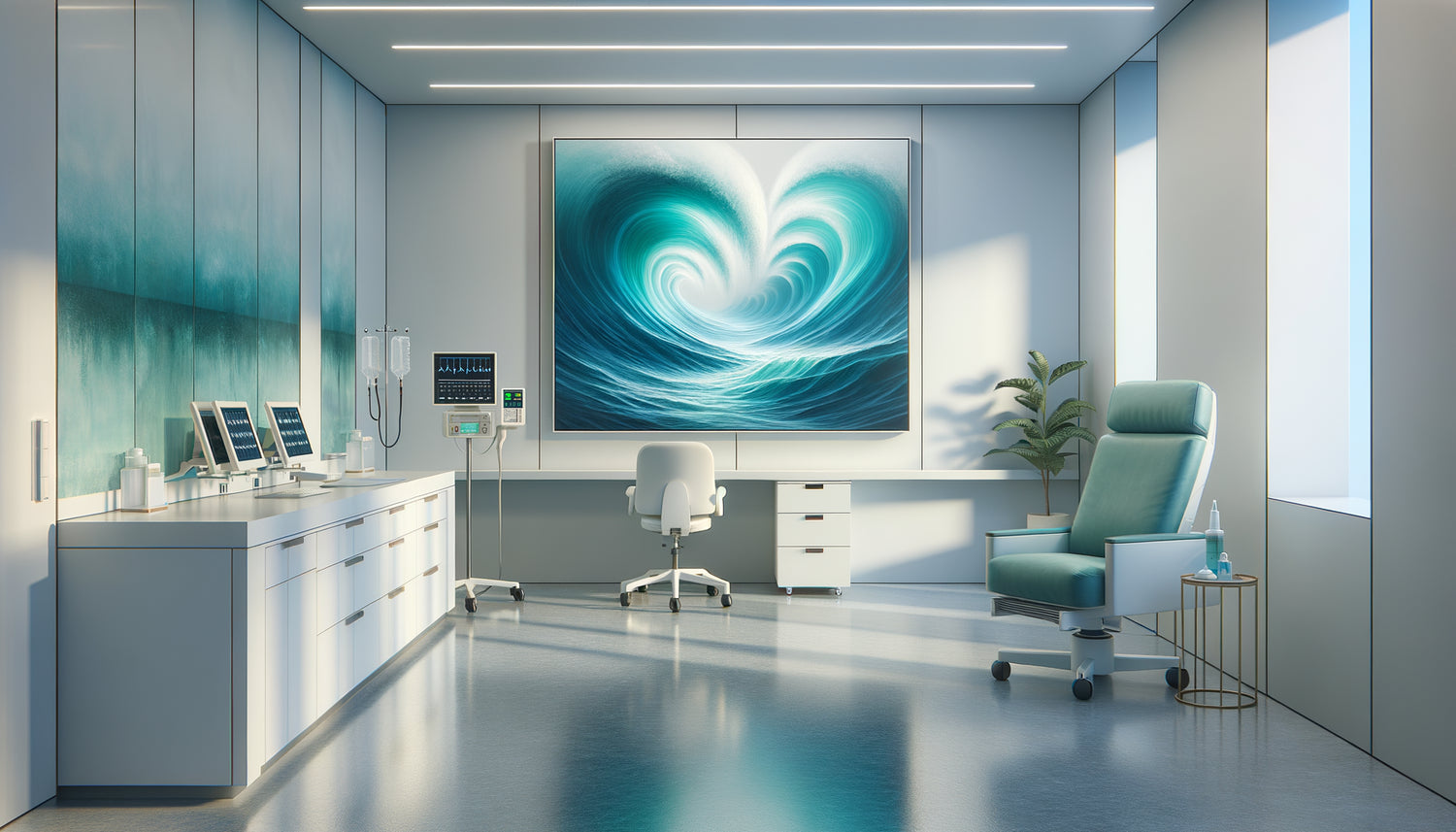
Here's what paintings depicting water bring to cardiology departments: a significant reduction in cardiovascular stress, natural harmonization of heart rate, and a soothing atmosphere that facilitates recovery. In a medical environment where every beat counts, aquatic imagery is no longer just an aesthetic choice but a true complementary care tool.
Many healthcare leaders still hesitate, considering these decorative choices secondary to medical equipment. Yet, the visual environment directly influences blood pressure, heart rate, and healing capacity. After supporting fifteen cardiology departments in their visual transformation, I realized one essential thing: the right painting can lower a patient's blood pressure as surely as a reassuring word.
In this article, I reveal the scientific mechanisms that make aquatic representations unsuspected therapeutic allies, and how to integrate them intelligently into these spaces of vulnerability.
Water and the heart: an ancestral biological resonance
Our brain recognizes water as a primordial safety signal. Since our origins, the presence of water meant survival, resources, calm. When a patient lying in a cardiology department casts their gaze on an ocean or lake scene, their parasympathetic nervous system immediately activates. This is what is called the automatic relaxation response.
Researchers in environmental psychology have demonstrated that simply visualizing expanses of water reduces cortisol production, the stress hormone, in less than three minutes. For a cardiac patient, whose heart is already weakened by anxiety and inflammation, this hormonal decrease is not insignificant: it translates into a tangible reduction in heart rate and blood pressure.
In a cardiology department I equipped in Nantes, we installed a series of large-format photographs depicting slow-motion waves. The medical team reported that patients requested fewer anxiolytics before invasive procedures. Aquatic imagery acted as a silent emotional regulator, accessible 24 hours a day.
Suspended movement: when water calms the heart rate
Unlike urban or abstract scenes that are too dynamic, paintings depicting water have a unique quality: contemplative movement. A waterfall flowing, reflections rippling, a tide receding... These slow and predictable movements invite the eye to follow a natural rhythm, soothing.
This visual synchronization has a direct impact on heart rate coherence. When our gaze follows a smooth and regular movement, our breathing unconsciously harmonizes, and our heart adopts a more stable rhythm. This is exactly what we seek in a cardiology environment: to reduce emotional arrhythmias, those sudden variations in heart rate caused by stress.
I observed this phenomenon in a cardiovascular intensive care unit in Lyon. Nurses had noticed that patients placed facing a large painting depicting a lake at dusk presented with more regular ECG tracings during resting periods. The imperceptible movement of the aquatic reflections created a meditative visual anchor, without any conscious effort from the patient.
Aquatic colors and their neurological influence
The blue and green tones associated with water representations are not chosen at random. These shades specifically activate the brain areas linked to tranquility and safety. Blue slows down metabolism, lowers perceived body temperature, and induces a state of physiological calm. For a patient undergoing cardiac rehabilitation, these micro-biological adjustments add up to create an optimal healing environment.

The therapeutic horizon: the call of perspective
Paintings depicting water almost always offer a horizon line, that distant boundary between sky and sea, or between shore and liquid expanse. This perspective has a powerful psychological effect: it suggests space, freedom, openness.
In a cardiology ward where patients can spend several days bedridden, deprived of mobility and autonomy, this visual escape becomes vital. It combats the feeling of confinement that exacerbates anxiety and, in turn, the cardiovascular burden. The gaze can travel beyond white walls, monitors, and infusions.
A study conducted in a Swedish university hospital compared two identical rooms: one with a forest reproduction, the other with a marine scene. Patients exposed to the sea view left the hospital an average of 8% faster and consumed less pain medication. The aquatic horizon created a positive mental projection that accelerated recovery.
Choosing the right water painting for a cardiology ward
Not all water representations are created equal in a cardiovascular setting. I learned to distinguish therapeutic images from simple decorations by observing patient reactions.
The scenes to prioritize:
- Calm expanses: lakes, oil seas, tranquil rivers
- Soft tones: pale blues, turquoise, water greens
- Clean compositions: without too many distracting elements
- Natural lights: sunrise or sunset on the water
- Panoramic formats: which amplify the feeling of space
The scenes to avoid:
- Storms or violent waves: generators of anxiety
- Aggressive cold tones: electric blues, stormy grays
- Overloaded compositions: too many details exhaust the gaze
- Scenes with suggested dangers: abrupt cliffs, unsettling depths
In a cardiology department in Bordeaux, we tested different styles. Photographs of deserted beaches at dawn received the most positive feedback. Their contemplative simplicity allowed patients to project their own emotions without being overwhelmed by the subject.
Strategic placement in the room
Placing a painting depicting water directly within the patient's line of sight is crucial. Not too high (eye fatigue), nor on the side (requires an effort to rotate). The ideal focal point is slightly above the natural horizon line when lying down. Some innovative services even install digital paintings that alternate different aquatic scenes according to the time of day, creating a reassuring temporal continuity.

Beyond the patient: the impact on caregivers and families
We often talk about the effect of paintings on patients, but I have noticed a similarly significant benefit on healthcare professionals. Nurses and doctors working in visually soothing environments have lower burnout rates. When they enter a room adorned with a serene marine scene, their own emotional state adjusts, and this positive emotional contagion directly benefits the patient.
Families also find in these aquatic representations a conversational anchor point. Rather than remaining silent in the face of illness, they comment on the painting, share memories of seaside vacations, create a narrative bubble that temporarily diverts attention from medical anxiety.
In a cardiac rehabilitation center in Brittany, the director confided in me that since the installation of large paintings depicting the local archipelago, physical therapy sessions have been taking place in a less tense atmosphere. Patients recognized the landscapes, shared their own maritime experiences, transforming rehabilitation into a moment of sharing rather than a solitary ordeal.
Water as a metaphor for circulation: a powerful symbolism
Beyond measurable physiological effects, paintings depicting water carry a symbolic dimension particularly relevant in cardiology. Water that circulates, flows, irrigates the land naturally evokes blood flow, this inner river that sustains life.
This visual metaphor, even unconscious, reinforces in the patient a positive representation of their own cardiovascular system. Instead of perceiving their heart as failing or threatening, they can reassociate it with this natural, eternal, restorative movement of water. This mental reconfiguration participates in what health psychologists call therapeutic visualization.
A cardiologist I collaborate with in Toulouse now explicitly incorporates this symbolism into his consultations. By pointing to a painting of a mountain spring in his office, he explains to his patients: “Your blood, like this water, naturally seeks its way. Our job is simply to facilitate this flow.” This concrete image reduces the anxiety-inducing abstraction of cardiac pathology.
Transform your care space into a haven of healing
Discover our exclusive collection of artwork for Medical Practices that combine aesthetics and scientifically documented therapeutic virtues.
Integrating aquatic imagery into a global care strategy
Paintings depicting water obviously do not replace medical treatments, but they constitute a cornerstone of an environmental approach to care. More and more establishments are adopting a holistic vision where architecture, light, colors, and works of art are considered as extensions of the therapeutic protocol.
This philosophy, called “therapeutic design,” considers that every visible element in a cardiology department should contribute to the patient's hemodynamic stability. Aquatic paintings fit perfectly into this logic: accessible, non-invasive, constantly present.
Several pioneering hospitals go so far as to personalize image selection based on the patient’s psychological profile. An anxious patient will benefit more from a perfectly flat sea, while a patient depressed by immobility can be positively stimulated by a dynamic but harmonious waterfall. This visual prescription represents the future of hospital design.
Science confirms what intuition already knew
For a long time, choosing artwork in hospitals was based on arbitrary decisions, often dictated by budget or availability. Today, neuroscience and environmental psychology offer a robust scientific framework for these aesthetic choices.
Brain imaging studies show that contemplating aquatic scenes activates the ventromedial prefrontal cortex, an area associated with emotional regulation and decision-making. Simultaneously, it deactivates the amygdala, the center of fear and anxiety. This neural reconfiguration occurs in just a few seconds, and its effects persist long after the gaze has moved away.
For a patient awaiting heart surgery, those few seconds multiplied by hours of cumulative exposure create a fundamentally different neurochemical climate. The cardiovascular system, intimately linked to the nervous system, directly benefits from this brain pacification.
Imagine: tomorrow morning, a patient enters your cardiology department. Their heart rate increases, their blood pressure rises. But their gaze falls on an endless expanse of turquoise water, serene. Imperceptibly, their breath deepens. Their pulse stabilizes. You have done nothing, but everything has changed. This is exactly the subtle magic that paintings depicting water offer: a silent care that begins before even the first medical gesture.
Start with a single artwork, in a single room. Observe. Listen to feedback. Measure if possible. Then gradually extend this approach. Water has always healed humanity; today, even its image is enough to soothe hearts.
Frequently Asked Questions
Do all water paintings suit a cardiology department?
No, and this is an important distinction. Representations of choppy water, storms or threatening oceans can instead generate anxiety. For a cardiological environment, prioritize calm and contemplative scenes: peaceful lakes, still seas, tranquil rivers, deserted beaches. Colors should remain in soft tones, avoiding overly harsh contrasts. The goal is to induce serenity, not visual excitement. I have found that scenes with a clear horizon line and a clean composition work best. The brain must be able to rest on the image, not actively decipher it.
Is there an ideal size for these paintings in a hospital room?
The optimal size depends on the viewing distance, but generally, a format of at least 80x60 cm is recommended to create a true visual window. Too small, the painting becomes a simple decorative element without an immersive impact. Too large in a limited space, it can create a feeling of oppression. Ideally, a bedridden patient should be able to embrace the entire scene with one glance, without head movement. Panoramic formats (2:1 or 3:1 ratio) work particularly well as they mimic the natural vision of the horizon. In common areas such as waiting rooms, do not hesitate to opt for more generous dimensions, up to 150x100 cm, which create a true visual escape.
Do these paintings have a measurable effect or is it purely subjective?
The effect is indeed measurable, and this is what has convinced many medical services to invest in this approach. Several studies have documented objective reductions in blood pressure, heart rate and anxiolytic needs in patients exposed to aquatic representations. A study published in the Journal of Environmental Psychology showed an average decrease of 8% in heart rate after only five minutes of exposure. Beyond physiological data, patient satisfaction questionnaires consistently reveal a more positive perception of their hospital stay. Nurses also report calmer interactions with patients. So no, it's not just an impression: aquatic imagery produces tangible effects on the cardiovascular system and the overall care experience.