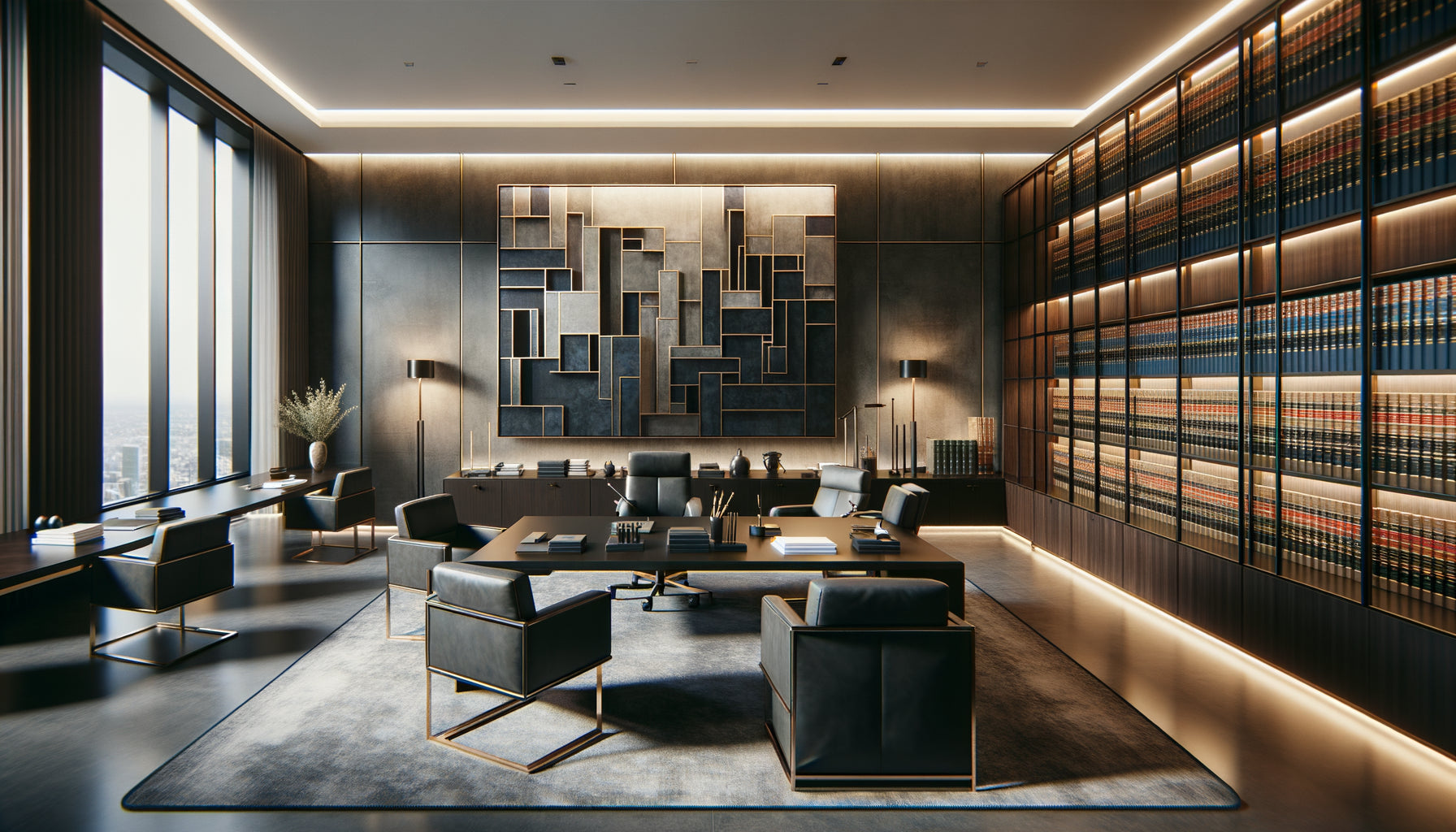
I still remember the day Sophie, a brilliant patent attorney, opened the doors to her new firm. The walls were white, immaculate, reflecting a harsh light. "My clients innovate, create, and protect their most daring ideas," she confided in me. "But when they come in here, they see... nothing." This encounter transformed my approach to corporate art. A law firm specializing in intellectual property is not a typical law firm. It defends creativity, innovation, and the rights of creators. Its walls must tell that story.
Here's what a strategically chosen wall mural brings to your intellectual property law firm: it instantly establishes your expertise in the creative world, reassures your innovative clients by reflecting their own approach, and differentiates your firm from traditional legal practices.
The problem? Most law firms reproduce the same visual codes: antique engravings, neutral landscapes, generic urban photographs. For a firm defending copyrights, patents, or trademarks, this visual banality creates a devastating paradox. How can you convince a fashion designer, an inventor, or a technology entrepreneur that you understand the value of their creation... when your own walls lack originality?
Good news: choosing the perfect wall mural for an intellectual property law firm doesn't require a fortune or artistic expertise. Simply an understanding of what your clients are really looking for when they walk through your door. I will guide you through the choices that transform a legal space into a sanctuary of innovation.
Why geometric abstract art speaks the language of your innovative clients
In my experience advising creative law firms, geometric abstract art emerges as the most relevant choice for intellectual property. Why? Because it visually embodies what your clients do: structure creative chaos, give form to the intangible, protect innovation.
An abstract composition with clean lines, geometric shapes that overlap, or mathematical patterns immediately evokes intellectual rigor combined with creativity. Your clients – whether they are designers, architects, engineers, or tech entrepreneurs – instantly recognize this visual language. It's the language of their own creations: plans, technical diagrams, prototypes, interfaces.
I observed a fascinating reaction during a project for a Parisian firm. The managing partner had chosen a large canvas with abstract art playing on interlocking hexagons in shades of cobalt blue and gold. A client, founder of a blockchain startup, stopped abruptly in front of the artwork: "That's exactly how I feel when I explain our distributed data architecture". The art became a bridge of understanding before even the first consultation.
For your waiting room or consulting office, prioritize imposing formats (minimum 120x80 cm) with sophisticated color palettes: navy blue and silver to evoke technology, black and gold for creative sophistication, or terracotta and gray tones for a warmer yet still professional approach.
Works inspired by typography and written language
Here's a choice that few advisors suggest, but which resonates deeply with the intellectual property legal specialty: wall art centered on typography, letters or writing. Why this particular relevance? Because your profession revolves around words, verbal trademarks, literary copyright.
An artistic composition featuring typographic characters, fragments of texts or stylized alphabets creates a powerful symbolic resonance. It subtly recalls that words have economic value, that names can be protected, that creative expression deserves defense.
I recently worked with a Lyon-based firm primarily defending authors and publishers. We opted for a series of three panels representing the evolution of printing characters through the centuries – from medieval manuscript to contemporary digital fonts. Each client commented on these works, naturally creating a dialogue about the history of copyright protection.
This approach works particularly well if your firm defends trademarks, logos or editorial creations. The wall art then becomes a visual manifesto of your specific expertise, without resorting to overly obvious corporate signage.

Technological and digital art: reflecting the innovation of your clients
If your firm specializes in technological patents, software or digital innovations, you cannot ignore digitally generated or technology-inspired art. This category includes visualizations of algorithms, data art works or creations exploring the intersection between code and aesthetics.
These wall artworks immediately communicate that you understand the universe of your innovative clients. An artificial intelligence entrepreneur, a video game developer or an inventor of connected devices will feel instantly in familiar territory. Technological art validates their creative approach before even the first handshake.
One of my most memorable projects involved a firm specializing in pharmaceutical and biotechnology patents. We selected a series of works representing stylized molecular structures – scientifically accurate yet artistically enhanced. These images worked on two levels: visual beauty for everyone, technical recognition for scientific clients.
However, be careful to avoid overly literal works or those that resemble simple technical illustrations. Maintaining the balance between rigor and visual poetry remains crucial. You are seeking to evoke innovation, not to decorate a technology classroom.
Portraits of famous creators: the tribute that inspires confidence
Here's a bold but highly effective strategy: display stylized portraits of creators, inventors, or artists whose type of work you defend. This approach creates a symbolic lineage between historical creative giants and your current clients.
Imagine a modern portrait of Coco Chanel in your meeting room if you represent fashion brands. Or a graphic representation of Ada Lovelace if you specialize in software patents. These figures embody the triumph of creativity over obstacles – exactly the message your clients are seeking.
I advised a Brussels firm that primarily represents comic book and illustration creators. We created a gallery of portraits of Franco-Belgian BD pioneers, treated in a contemporary minimalist style. Each client recognized at least one figure, immediately creating a sense of belonging to a protected creative community.
This strategy works particularly well in negotiation or mediation spaces. It subtly reminds that behind every patent, trademark, or copyright, there is a creator whose work deserves respect and protection. The wall artwork then becomes a silent but persuasive argument.

Modular compositions: flexibility and sophistication
For intellectual property firms seeking to display a contemporary and adaptable approach, modular wall installations offer a particularly elegant solution. These are works composed of several panels that can be arranged in different configurations.
This modularity resonates symbolically with your legal practice: just as you assemble arguments, build multifaceted protection strategies or combine different types of intellectual property rights, the modular wall art suggests intellectual flexibility and strategic thinking.
A Geneva firm I collaborated with opted for a composition of nine square panels (30x30 cm each) representing different interpretations of the concept of “connection.” Depending on the need – meeting with a tech client, negotiating for a fashion creator, consulting for an author – the legal assistant subtly rearranged the configuration. This subtle detail never went unnoticed.
The practical advantage? You can start with three or four panels and then gradually enrich your collection. This evolutionary approach also reflects the growth of your firm, creating a visual narrative of your professional development.
The golden rules to never be wrong
After supporting dozens of law firms in their artistic choices, I have identified some invariable principles for selecting the perfect wall art for an intellectual property firm.
Always prioritize originality over recognition. A reproduction of a famous work, even museum-quality, fundamentally contradicts your message. You defend creative uniqueness? Display original works or limited editions. The paradox of an intellectual property firm decorated with mass reproductions is not lost on your creator clients.
Seek consistency without uniformity. If you are decorating multiple spaces, create a visual family rather than repetition. Same color palette, related styles, but each piece retains its personality. This approach reflects how you treat each case: with consistent methodology but personalized attention.
Absolutely avoid traditional legal clichés: scales of justice, judge's hammers, stacks of law books. Your specialization in intellectual property distinguishes you from classic legal practices. Your walls should reflect this differentiation. You are at the service of creativity, not dusty jurisprudence.
Consider lighting as an integral part of the work. A sophisticated abstract composition can lose all its impact under a harsh neon light. Invest in directional spotlights or adjustable track lighting that highlights textures and depths. Architectural lighting also suggests your attention to detail – a reassuring quality for clients entrusting you with their valuable creations.
Finally, don't hesitate to document the history of your works. A small discreet plaque or a QR code providing access to the artist’s story and creation shows your respect for the creative process. Some of my client firms have created real conversations around this approach, transforming waiting into a cultural experience.
Your office deserves walls that tell your unique expertise
Discover our exclusive collection of wall art for law firms that will transform your legal spaces into sanctuaries of creative innovation.
Now imagine your next client walking through your door. Their gaze falls on this abstract composition with clean lines, this stylized typography, or this portrait of a visionary creator. Before they even sit down, they understand that you speak their language, that you value creation as much as legal protection.
The wall artwork you choose will not simply decorate your walls. It will become the silent manifesto of your approach, the first argument of your case before a single word is spoken. It will tell your innovative, creative, and entrepreneurial clients: “Here, your creation is understood, valued, protected.”
Start by identifying the space that welcomes your most strategic clients. Then ask yourself this question: what artwork would best reflect the innovations I defend every day? The answer will transform your office.
Frequently Asked Questions
Should I choose artworks directly related to law or justice?
No, and it's even counterproductive for an intellectual property firm. Unlike generalist firms that can rely on traditional legal imagery, your specialization requires a different approach. Your clients are creators, inventors, innovative entrepreneurs – they’re not looking for a “traditional” lawyer but an expert who understands their creative world. Prioritize artworks that evoke innovation, structured creativity, original thinking. Geometric abstract art, typographic compositions, or technological works will communicate your positioning much better than a scale of justice. Your walls should say: “We protect creators” rather than “We are just another law firm.” This visual distinction becomes your first competitive advantage before even the consultation.
What budget should I allocate to dressing the walls of my office with appropriate artworks?
The good news is that visual impact doesn't necessarily depend on an astronomical budget, but on strategic choices. For a waiting room and two consultation offices, expect between 2,000 and 5,000 euros for quality artworks. Prioritize one striking centerpiece in your reception area (1,000-2,000 euros) rather than several small works scattered around. Limited edition contemporary art prints, works by young emerging artists, or digital creations on premium supports offer excellent value-impact-price ratios. Also consider online galleries specializing in corporate art or collaborations with local art schools. The key? A thoughtful investment is better than a haphazard accumulation. Your clients evaluate your practice on consistency and quality, not the quantity of works displayed.
How do I know if a work will really suit my practice before buying it?
Excellent question that reveals healthy professional caution. Here's my proven method: always request a visualization in your space before purchase. Most serious galleries and online stores offer photographic projection services where they digitally overlay the artwork onto a photo of your wall. Also test the work with two or three trusted people who know your practice – their immediate reaction will tell you if the message gets across. Ask yourself these questions: would this work spark a positive conversation with a client? Does it reflect the values of innovation and creativity that I defend? Will it remain relevant in five years? Finally, check the return or exchange policies. An artistic investment for your practice deserves the same diligence as an important client file. Take time to reflect, the perfect artwork will accompany you for years.