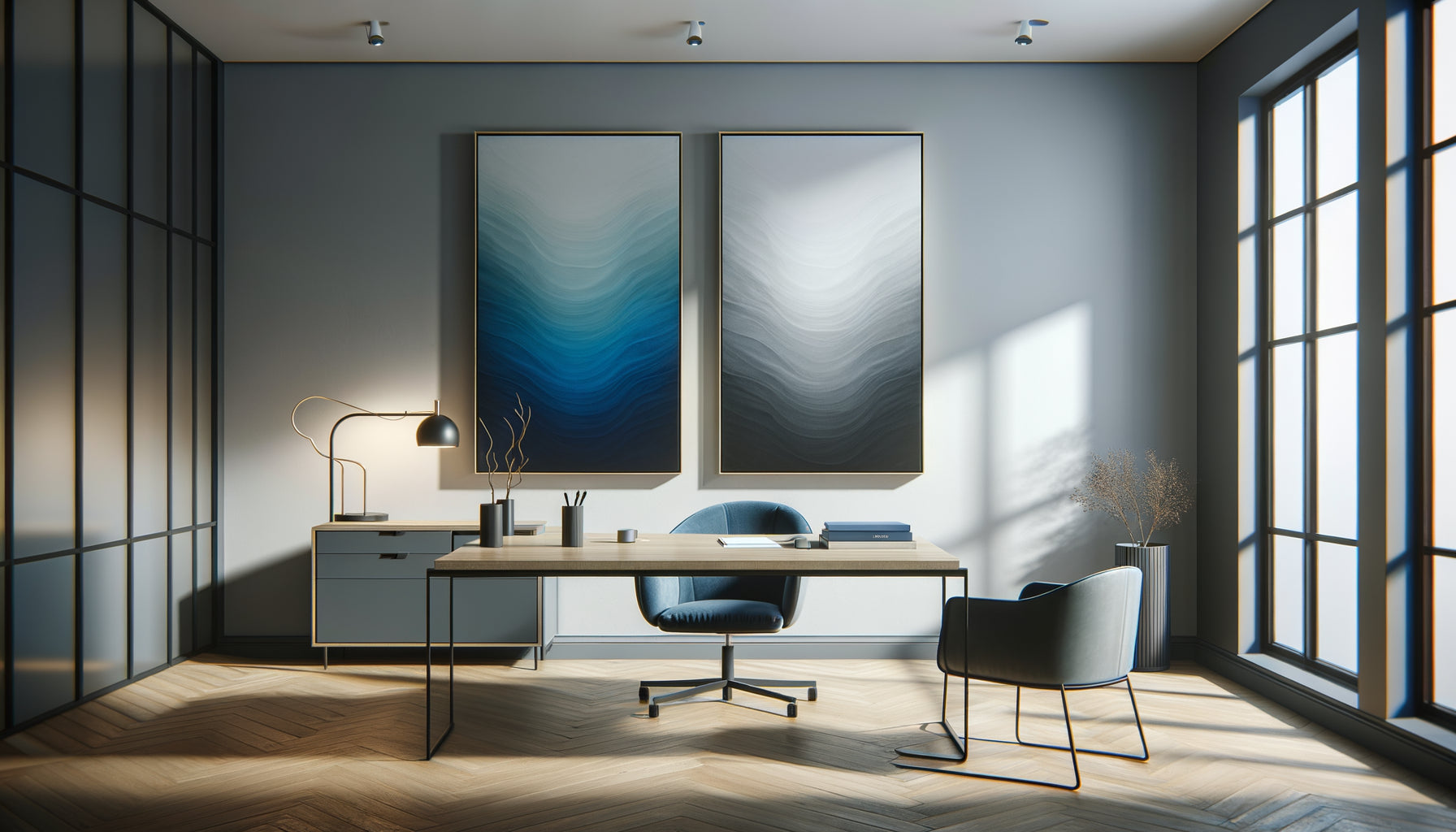
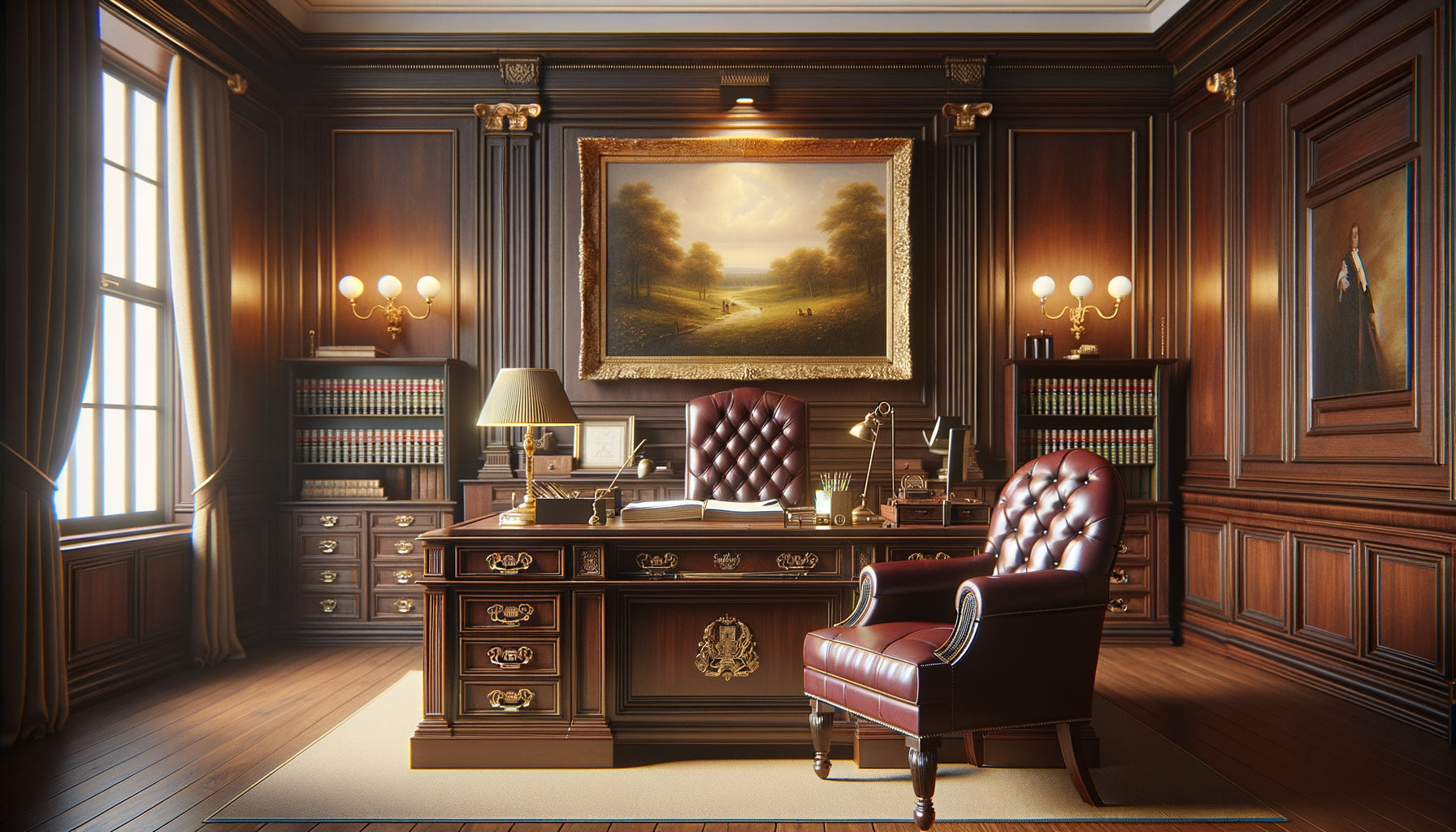
The client steps into your office. Their gaze scans the room in seconds. Unconsciously, they assess your credibility, professionalism, and attention to detail. And that painting, slightly too high or too low, can subtly break the visual harmony that inspires confidence. I spent twelve years designing professional spaces for prestigious firms, and I can tell you that a poorly positioned painting creates a dissonance that is almost imperceptible but terribly effective.
Here's what the ideal hanging height of a painting brings to your law firm: it establishes immediate visual authority, creates spatial balance that facilitates concentration, and projects an image of mastery down to the smallest details of your professional environment.
You may have already felt this frustration: investing in a quality artwork, taking the time to choose it, then realizing that once hung, something is off. Too high, it floats in space and seems inaccessible. Too low, it visually overwhelms the room and loses its impact. Between these two extremes, there is a zone of excellence that professional decorators know well.
Rest assured: determining the perfect hanging height for a painting in a law firm does not require exceptional artistic skills or years of experience. It just takes understanding a few fundamental principles, adapting those rules to your specific configuration, and recognizing that each legal space has its own requirements. I will guide you through these steps with concrete benchmarks and solutions tailored to the realities of your profession.
The 145 cm Rule: Your Universal Starting Point
In museums, galleries, and professional spaces around the world, one rule prevails: the visual center of the painting is positioned 145 cm from the floor. This height corresponds precisely to the eye level of an average-height person standing. For a law firm, this reference becomes your foundation, your anchor point before any adaptation.
Why does this height work so well? Because it creates a natural connection between the viewer and the artwork. Your client doesn't need to awkwardly raise or lower their gaze. The painting fits into their natural line of sight, which generates an immediate feeling of harmony. In a law firm where every detail contributes to the impression of professionalism, this visual consistency is never insignificant.
Specifically, measure 145 cm from the floor, lightly mark that point with pencil. This benchmark indicates where the optical center of your painting should be located, not the top, not the bottom, but the middle of the work. If your painting is 60 cm high, its center is 30 cm from the upper edge. You will therefore hang the top of the frame at 145 + 30 = 175 cm from the floor. This method eliminates approximation and guarantees you a professional result.
Adjusting Height According to Areas of Your Firm
A law firm is not a homogeneous space. The waiting room, your private office, the meeting room: each area has its own function and specific visual constraints. The ideal hanging height of a painting varies subtly according to these contexts.
In the waiting room: prioritize the seated gaze
Your clients rarely spend time standing in the waiting room. They sit down, consult their phone, and observe their surroundings from a seated position. Here, the 145 cm rule requires an adjustment: lower the center of the painting to 130-135 cm from the floor. This subtle modification optimizes perception from a seat, where eye level is approximately 120 cm from the floor.
I have observed this difference in dozens of law firms: a painting hung at standard museum height in a waiting room seems strangely distant, as if the work deliberately ignored seated people. By adjusting it down by 10-15 cm, you create a warm visual connection that soothes the wait and projects a benevolent attention to detail regarding client comfort.
Behind your desk: visual authority
The wall behind your chair constitutes your visual frame during appointments. Your client faces you, and what they see makes up your professional backdrop. Here, maintain the 145 cm rule, but also consider the relationship between the painting and your seated silhouette.
A painting that is too low disappears behind your head and loses its impact. A painting that is too high creates a strange separation between you and the work. Ideally: the bottom of the frame should be 20-30 cm above your head when you are sitting. This arrangement creates a visual continuity between you and the work, subtly reinforcing your presence without creating visual competition.

When architecture imposes its own rules
Law firms often occupy buildings with marked architectural characteristics. Moldings, cornices, built-in libraries, generous or conversely compact ceiling heights: these elements transform the ideal hanging height of a painting into an exercise in dialogue between the work and its environment.
In an office with high ceilings (over 3 meters), the 145 cm rule can leave the artwork lost in a vast empty space. Don't hesitate to raise it slightly, up to 150-155 cm, to create a better vertical balance. The work should converse with the entire wall, not just the floor.
If your wall has a cornice or horizontal molding, this creates a line of visual force. Position your artwork taking into account this division: either the bottom of the frame aligns with the molding, or the center of the artwork is placed in the lower or upper area created by this line. Ignoring these architectural elements generates a visual tension that the eye perceives immediately, even without identifying its cause.
For spaces with bookshelves or tall furniture, adjust the height according to the adjacent furnishings. A painting hung above a 180 cm bookcase should naturally be mounted higher. In this case, leave 15-20 cm between the top of the furniture and the bottom of the frame, then ensure that the whole remains visually anchored in the space.
Mistakes that betray improvisation
Some hanging mishaps instantly reveal an approximate approach. In a law firm where attention to detail signals professional rigor, these errors become regrettable non-verbal messages.
The 'I'm aiming roughly' error: without precise measurement, you rely on your intuition. The result is that the painting generally ends up 10 to 20 cm too high, because our visual perception naturally overestimates the ideal height. Always use a meter, mark the reference points, check before drilling.
Alignment with the wrong element: aligning the top of the painting with the top of a door or window seems logical, but often creates a position that is too high. Doors are generally 204 cm high; aligning a painting on this height projects it well beyond the comfortable eye level.
Ignoring the frame thickness : an imposing frame shifts the visual center of the work. For a frame 8 cm thick, the optical center is not the geometric center of the framed artwork, but the center of the visible image. This distinction is particularly important for works with sculpted or gilded frames, which are common in law offices.

Wall composition: when multiple artworks dialogue
You might be considering hanging multiple artworks, creating a wall gallery that visually enriches your law office. The hanging height then becomes a question of collective orchestration.
For a horizontal composition (multiple canvases aligned), first determine the median height of the entire set: 57 inches. Then arrange your works so that this imaginary line passes through their collective center. If you are hanging three canvases of different sizes, their alignment is not by the top or bottom of the frames, but by a common median line that creates visual unity.
In a vertical composition, the central canvas is positioned at standard eye level (57 inches), while the upper and lower works unfold around this anchor point. Maintain a regular spacing of 2 to 3 inches between each frame to create visual breathing without dispersion.
For asymmetrical gallery walls (numerous canvases of varying sizes), first draw an imaginary envelope encompassing the entire set. The center of this envelope should be at 57 inches. This technique, used in professional galleries, ensures that the overall composition respects the ideal eye level, even if each individual canvas deviates from it.
Transform your law firm into a space of visual excellence
Discover our exclusive collection of canvases for Law Firms that combine professional authority and artistic refinement.
The tools that transform hanging into a professional gesture
The perfect hanging height of a canvas in your law office requires some simple but essential tools. A rigid tape measure rather than a flexible one that bends and distorts vertical measurements. A spirit level, because a perfectly horizontal canvas at the right height projects rigor, while a tilted canvas, even by a degree, suggests negligence.
A pencil for marking your unobtrusive reference points, which you will erase once hanging is complete. And for demanding walls, a stud finder that locates load-bearing structures and avoids unpleasant surprises when drilling.
But the most valuable tool remains the patience of stepping back. Before permanently drilling, ask a colleague to hold the canvas at the intended height. Step back 2 to 3 meters, sit at your desk, observe from the entrance door. What you feel from these different viewpoints counts more than any theoretical rule. If something seems strange, adjust by 3 to 5 cm and re-evaluate.
Visualize the final result
Imagine that moment: your next client walks into your office. Their gaze embraces the space. They perceive, without consciously analyzing it, this perfect visual harmony. The artwork, positioned exactly at eye level, creates an immediate connection. It doesn't dominate, nor does it disappear; it accompanies. It signals this attention to detail that characterizes your professional approach.
You yourself, each morning upon arrival, feel that subtle satisfaction: every element occupies its ideal place. Your professional environment reflects your demands, your sensitivity, your respect for space and for those who share it with you. This visual coherence is not a superficial luxury; it's an essential dimension of your professional identity.
So take your measuring tape, mark these 145 cm, adjust according to your specific context, and offer your artworks the height that allows them to fully deploy their presence. Your law firm deserves this attention, your clients will perceive it, and you yourself will benefit every day in this space where your professional excellence is built.
Frequently Asked Questions about Artwork Hanging Height
Do I really need to measure with such precision or can I just estimate by eye?
I understand the temptation of a quick estimation, especially when you have a thousand other priorities in managing your firm. But our visual perception systematically deceives us: we tend to hang artworks too high, sometimes 15 to 20 cm above the ideal height. This difference, even if it seems minimal, creates a visual distance that weakens the impact of the work. Measuring precisely takes five minutes extra, but guarantees a professional result that you will appreciate for years. Consider these few minutes as an investment in the visual coherence of your professional space. Once the artwork is correctly positioned, you don't think about it anymore; it integrates naturally. Poorly positioned, it generates this slight persistent discomfort, this indefinable feeling that something is wrong, even if you cannot precisely identify the problem.
What should I do if I already have holes in the wall at the wrong height?
This situation is more common than one might think, and it's resolved more easily than feared. For a hole in a painted wall, use filler, let dry, lightly sand, and touch up with the original color. The operation takes half an hour and becomes invisible once completed. If you don't want to fill immediately, you can also use a hanging system with rods or cables that offers flexibility of vertical positioning and hides old holes behind the artwork itself. Some rail systems even allow height adjustment without drilling new holes. The mistake would be to keep a bad mounting simply to avoid correcting existing holes. In a lawyer's office where professional image counts, investing half an hour to correctly reposition a work represents an excellent return on investment in terms of visual consistency.
Does the 145 cm rule also apply to very large paintings?
Imposing paintings, over 120 cm in height, indeed require a slightly different approach. If you strictly apply the center at 145 cm for a 150 cm high painting, the bottom of the frame is 70 cm from the floor, which may seem strangely low and vulnerable, especially in a passageway. For these generous formats, prefer positioning where the lower third of the work is at eye level (145 cm), which naturally raises the whole thing. The goal remains identical: to create a natural visual connection without forcing the gaze upwards. Large formats have their own visual gravity and support, or even require, a slightly higher placement. In all cases, step back, observe from different points in the room, and trust your feelings. If you constantly have to look up uncomfortably, the painting is too high. If you feel it could tip forward, it's too low. Between these two extremes lies your ideal height.