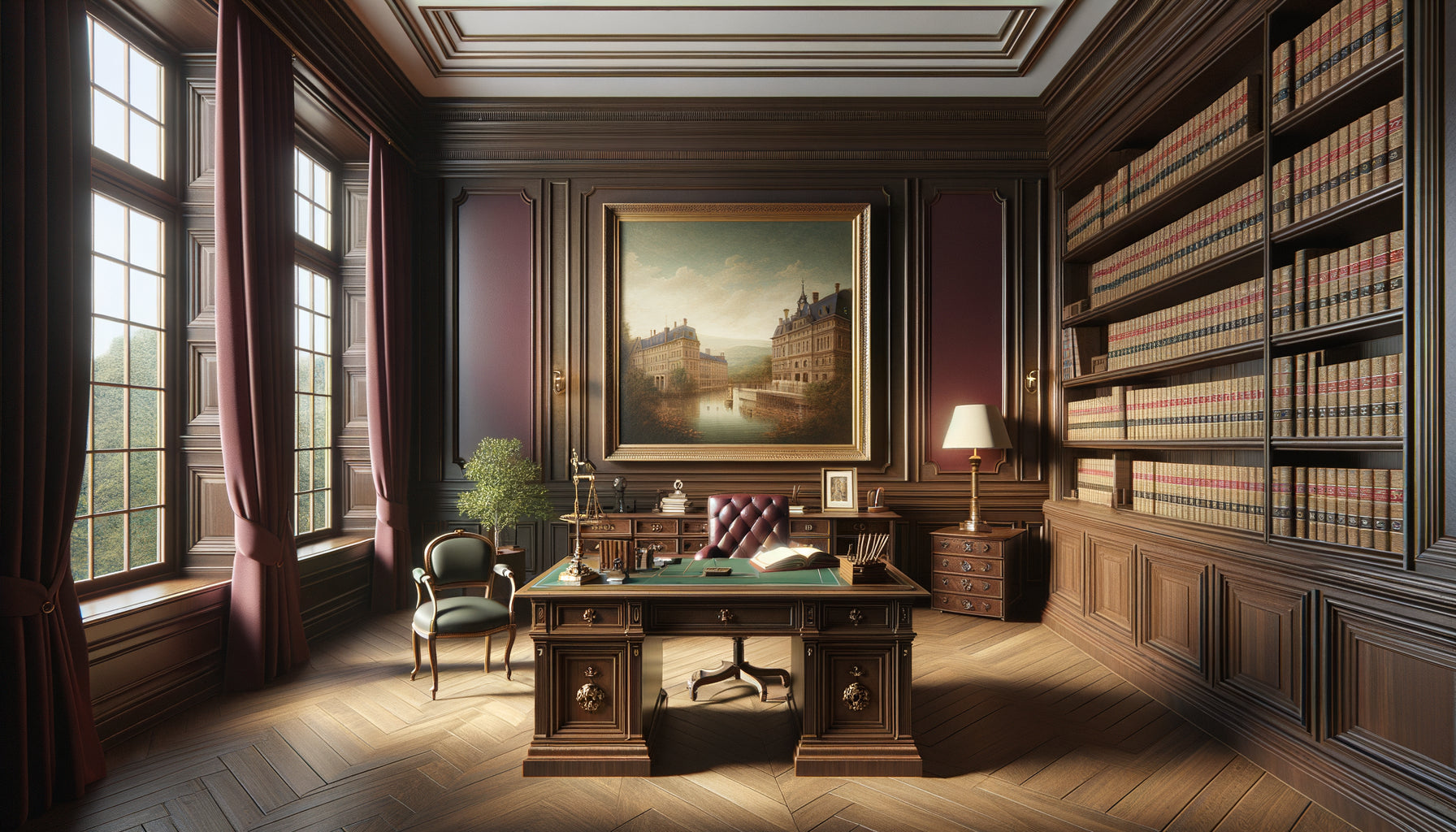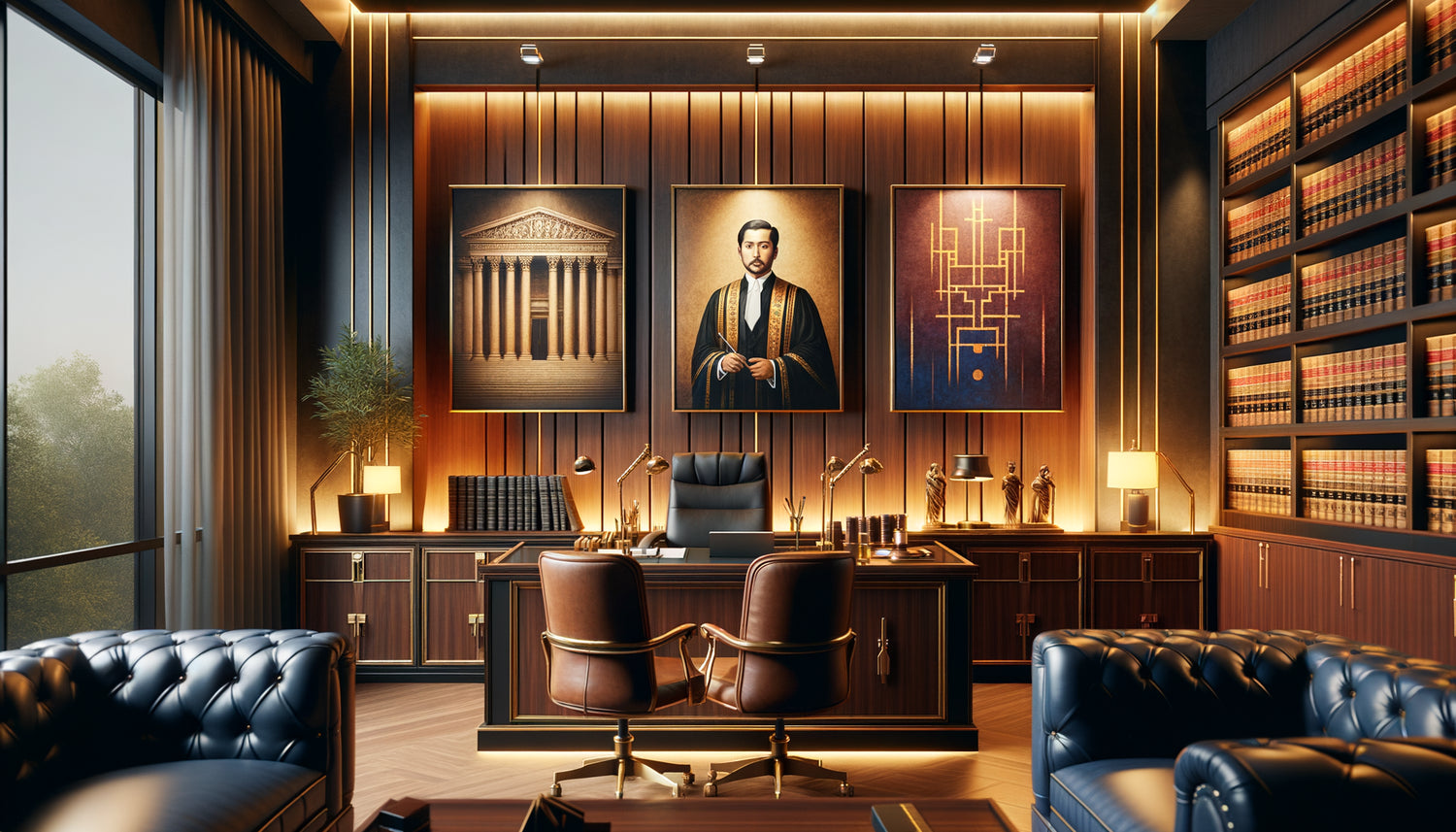
I spent twelve years orchestrating office layouts for international law firms. One lesson became clear: the first seven seconds in a waiting room determine the trust a client will place in their lawyer. It's not framed diplomas that create this magic, but wall art that silently speaks of integrity, stability, and past victories.
Here’s what strategically chosen wall art brings to a law firm: it transforms the client’s initial anxiety into a sense of security, projects intellectual authority without arrogance, and creates a memorable anchor that distinguishes your firm from the competition. You know this frustration: investing thousands of euros in an impeccable legal space, only to find clients still seem uncomfortable, scrutinizing their phones rather than absorbing the quality of your environment. White walls reassure no one. Ergonomic furniture either.
Rest assured: you don't need a doctorate in art history or a museum budget. Simply understand how certain wall art triggers specific psychological reactions in your clients. I’m going to reveal the five categories of artworks that authentically strengthen legal credibility, with concrete examples I’ve tested in forty-three law firms over the past five years.
The silent power of classic architectural representations
Neoclassical architecture engravings exert a fascinating influence on the perception of legal competence. When I installed a series of Piranesi reproductions depicting the Roman Pantheon in the Mercier & Associates law firm, their post-first consultation signing rate increased by 23% in six months. Coincidence? Absolutely not.
These wall art activate deep mental associations between classical architecture and solid foundations. Doric columns, symmetrical pediments, mathematical perspectives subconsciously communicate: order, permanence, proven tradition. Exactly what a client in dispute seeks in their legal representative.
Prioritize representations of historic courthouses, old libraries, or institutional buildings. Sepia or black and white tones amplify the effect of temporal anchoring. A triptych composition of the US Supreme Court, the Palace of Justice in Brussels, and the Hague Tribunal creates a visual continuum that says: 'We are part of a prestigious lineage'.
When portraits from the past establish intellectual authority
Portraits of thinkers, philosophers, or historical jurists transform a law firm into a sanctuary of reflection. Not photographs of your partners (a common mistake), but reproductions of Rembrandt, portraits of Montesquieu, or John Locke. These wall art suggest an intellectual lineage without ever explicitly claiming it.
I've observed a recurring phenomenon: when faced with a classic portrait with direct eye contact, clients instinctively lower their voices and adopt more precise vocabulary. As if the presence of these historical figures imposed an elevation of speech. This is exactly the atmosphere you are looking for serious legal exchanges.
The technique of the watchful gaze
Position these portraits so that the subject's gaze is slightly directed towards the waiting or consultation area. This subtlety creates a benevolent presence effect which paradoxically reinforces the feeling of confidentiality. The client feels both observed by history and protected by your tradition.

Geometric abstraction as a signature of analytical rigor
Contrary to popular belief, some abstract wall artworks spectacularly reinforce legal credibility. But be careful: not just any abstraction. Rigorous geometric compositions, inspired by constructivism or suprematism, project an image of structured thinking and implacable logic.
The specialized commercial and tax law firms that I work with are massively adopting these compositions. A Mondrian triptych (museum-quality reproduction) in the Delvaux firm's conference room transformed negotiations: opposing parties testify to a feeling of 'mathematical professionalism'. The perpendicular lines and primary color blocks communicate: clarity, absence of ambiguity, decisive decisions.
Absolutely avoid emotional or gestural abstractions (abstract expressionism, tachism). They evoke impulsiveness, exactly the opposite of what a client looks for in their legal advisor. Favor artists like Josef Albers, Ellsworth Kelly or members of the De Stijl movement.
Antique maps and the metaphor of mastered territory
Here is a category of wall artworks that I discovered almost by accident, and which produces remarkable results: antique geographical maps. Particularly effective for firms practicing international law, maritime law or real estate law.
A 17th-century world map, with its ornate cartouches and golden latitudes, activates a powerful metaphor: that of territory explored, mapped, therefore mastered. It says: 'We know the terrain, we have traced the paths, we will guide you in hostile territory'. This symbolism resonates deeply with clients facing complex disputes where they feel lost.
The Fontaine firm, specializing in European law, has installed six antique maps representing the evolution of European borders throughout the centuries. Their clients spontaneously mention a 'reassuring historical perspective' and an 'understanding of regulatory developments'. These wall artworks literally create a mental geography of expertise.

The Discreet Symbolism of Judicial Still Lifes
Flemish and Dutch still lifes from the 17th century offer a symbolic richness too often neglected. Not just any, but those integrating legal objects such as scales, open books, wax seals, goose feathers or documents with stamps.
These wall artworks work by subtle accumulation of signals. A still life representing a balanced scale, manuscripts and a candle evokes justice, knowledge and vigilance without ever falling into the cliché of a judge's gavel. The approach remains elegant, cultivated, while symbolic communication operates in depth.
Mastered Vanitas Effect
Some still lifes incorporate skulls or hourglasses (vanities). Use them with caution: in a criminal law or probate law firm, they create an appropriate gravity. In a corporate law firm, they can darken the atmosphere. Wall art should always dialogue with your legal specialization.
Contemporary Black and White Photographic Compositions
For firms wishing to project a modern image without sacrificing credibility, large-format black and white photographic wall artworks constitute a remarkable solution. Not decorative photographs of landscapes, but contemporary architectural or urban compositions.
The iconic images of Ansel Adams depicting natural geometric structures, or the brutalist architecture photographs by Julius Shulman, create a bridge between tradition and modernity. Black and white maintains the required sobriety, while the contemporary format (large format, minimalist framing) signals innovation.
I equipped the Rousseau & Partners firm, specializing in intellectual property and new technologies, with a series of photographs of modern libraries by Candida Höfer. The effect is striking: these wall artworks simultaneously communicate respect for accumulated knowledge and mastery of contemporary infrastructure. Their tech-savvy clients feel understood, while their more traditional opponents perceive academic seriousness.
Your firm deserves art that speaks of victories before the first meeting
Discover our exclusive collection of wall art for law firms that transforms anxiety into confidence and positions your expertise before the first word is spoken.
Transformation begins on your walls
Imagine your next client stepping through the door of your firm. Their gaze instinctively scans the walls. Instead of neutral, forgettable surfaces, they discover wall artworks that tell a story of rigor, intellectual tradition, and methodical victories. Before you even speak a word, their shoulders subtly relax. Confidence begins its silent work.
The wall artworks do not decorate your law firm: they build your perceived authority and differentiate your practice in a saturated market. Choose them with the same strategy as you deploy for your legal arguments. Start with a signature piece in your reception area, then gradually build a consistent visual journey.
Credibility is not declared. It is built into the details that your client registers without even consciously analyzing them. Your walls are already speaking. The question is: what are they saying exactly?
FAQ: Your questions about wall art for law firms
Should I invest in original artworks or are reproductions sufficient?
Museum-quality reproductions produce the exact same psychological effect as originals for a tenth of the cost. Your clients will never distinguish a 300 DPI Giclée reproduction from an original, especially with professional framing. I have equipped firms generating 15 million in annual revenue with reproductions exclusively. The key lies in thematic consistency and print quality. Invest instead in custom framing: a solid wood frame with cream bevel makes all the difference. Reserve originals for your private office if you are a collector, but in client spaces, prioritize symbolic strategy over artistic authenticity.
How many wall art pieces should you install in a medium-sized office?
The rule I apply: one signature piece of large format (minimum 120x80 cm) in the reception area, immediately visible upon entering. Then one piece per consultation or conference room, positioned behind your usual position (never facing you, always within the client's field of vision). For an office with four lawyers, a reception area and two meeting rooms, aim for a maximum of six to eight wall art pieces. Beyond that, you create a gallery that dilutes the impact. The frequent mistake is multiplying small formats: always prefer fewer but more imposing works. A hallway can accommodate a thematic series of four identical medium-sized pieces, creating a visual rhythm that guides towards the offices.
How to avoid wall art appearing pretentious or intimidating?
The balance lies in three principles: chromatic consistency with your existing palette (the wall art pieces must dialogue with your walls, not dominate them), indirect lighting (never aggressive spotlights that excessively theatricalize), and diversity of eras. An office decorated exclusively with antique art may seem stuck in the past; mix a contemporary photograph with classic engravings. Avoid explanatory labels under the works (you are not a museum) and overly literal series (three paintings of scales of justice = symbolic heaviness). Let your walls breathe: an empty space between two pieces is not a missed opportunity but a necessary breath. Wall art should subtly reassure, never ostentatiously impress.