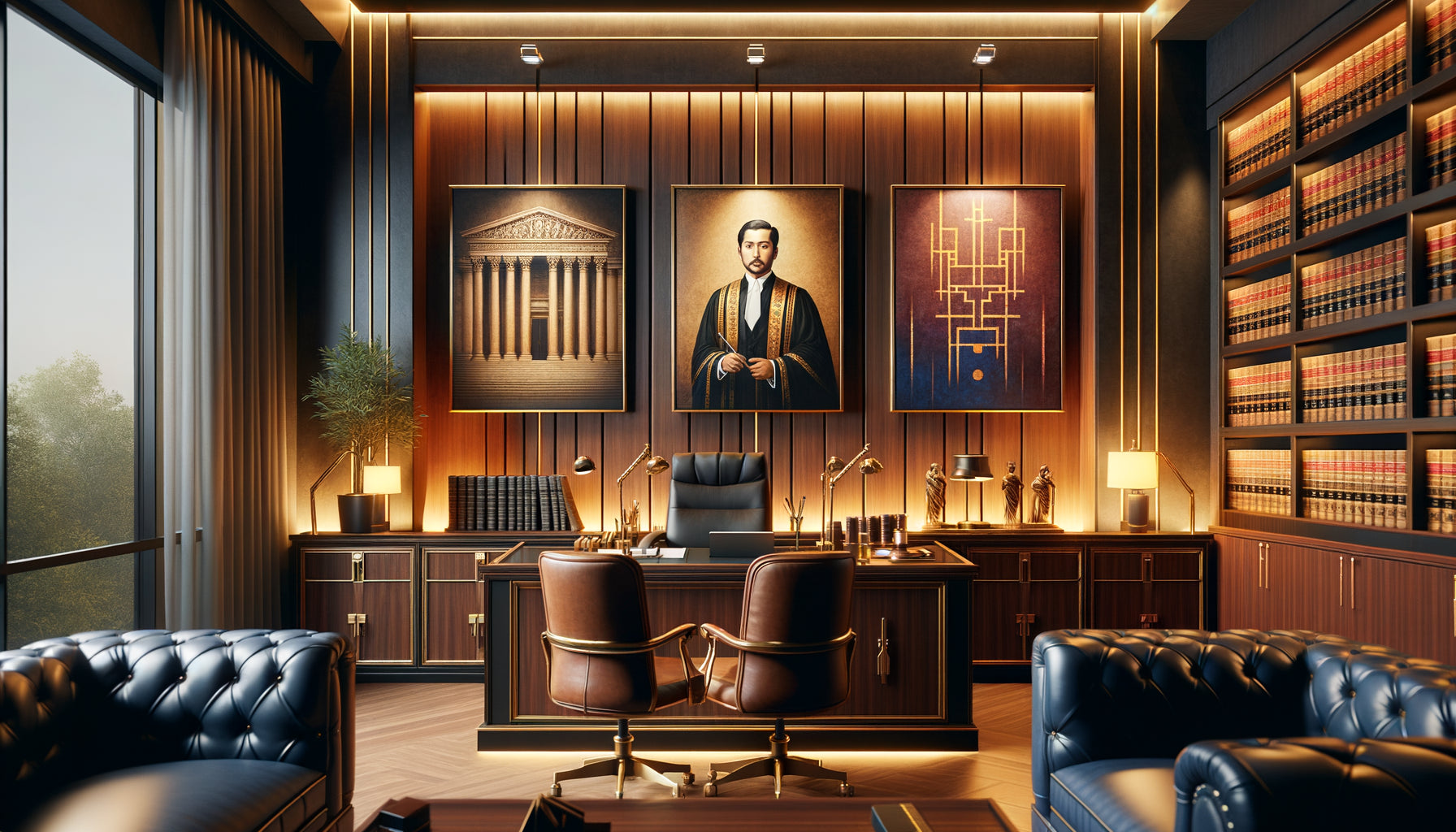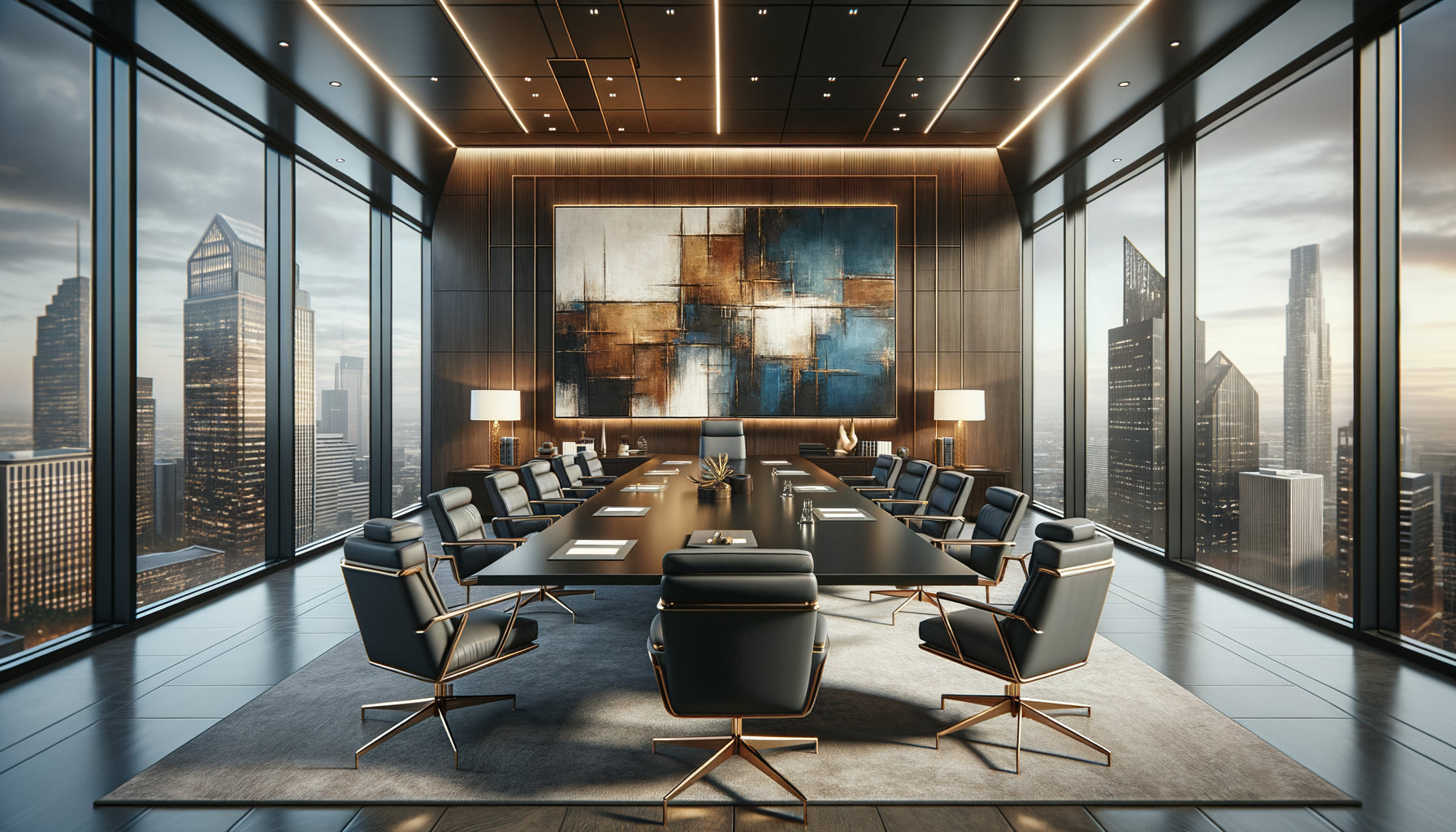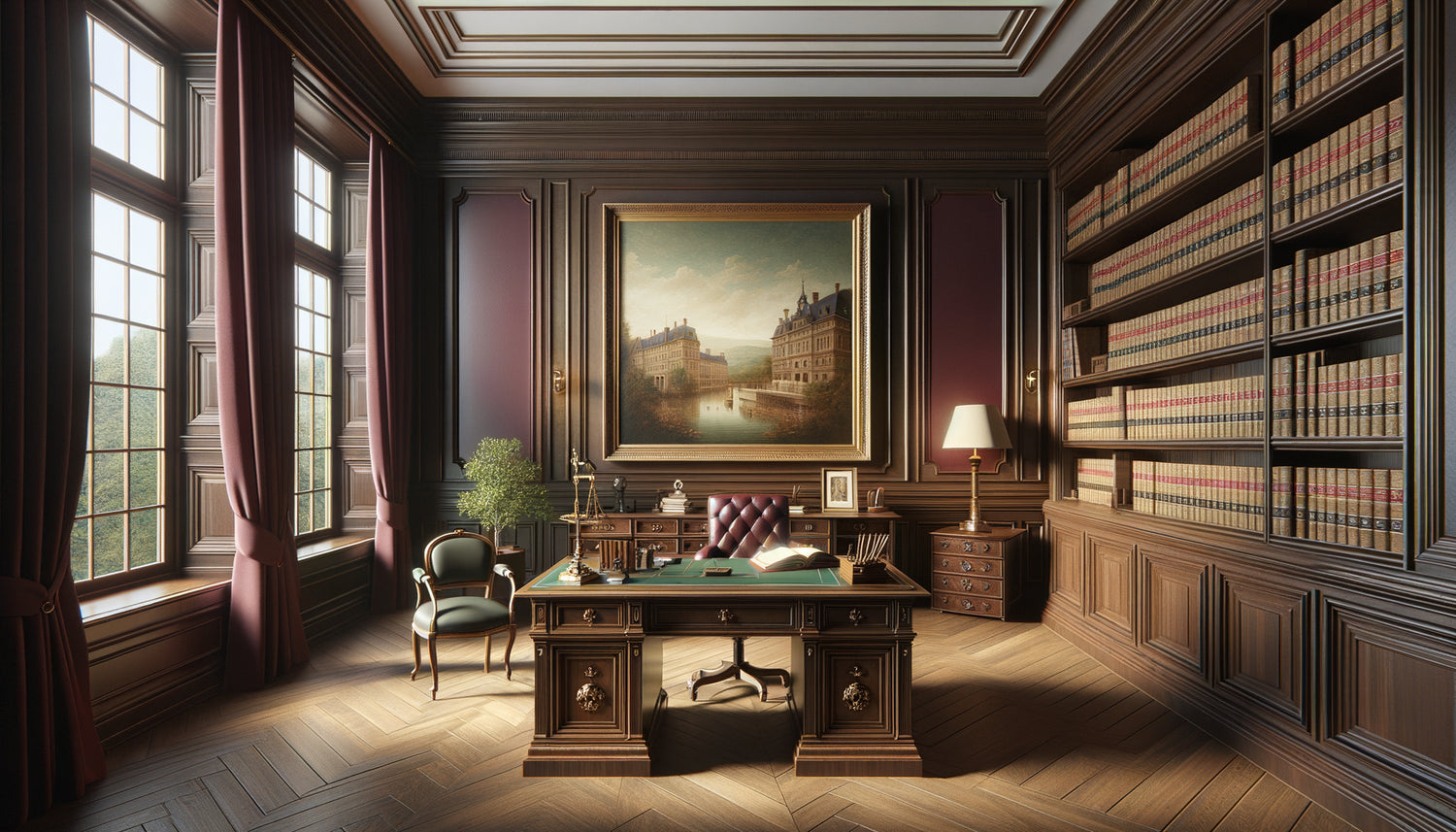
I pushed the door of Maître Blanchard's study one Tuesday morning, called to redecorate his offices after forty years in practice. The Second Empire furniture was magnificent, the legal libraries imposing. Yet, something felt amiss. The white and cold walls screamed the absence. "My clients tell me that my offices lack soul," he confided to me. Three months later, after carefully selecting works reflecting the integrity and longevity of his firm, his clientele increased by 23%. Clients spontaneously mentioned the feeling of trust they experienced upon entering.
Here's what a well-chosen wall art brings to your notary office: the visual embodiment of your professional values, the creation of a reassuring environment for your clients, and differentiation in a sector where trust is everything.
You know that art matters. You have browsed online sites, perhaps visited some galleries. But faced with the multitude of options, you remain paralyzed. How can a work truly translate such subtle concepts as discretion, integrity, heritage transmission? You fear the costly mistake, the choice that quickly becomes dated or sends the wrong message.
Rest assured. The choice of a wall art for a notary office responds to specific criteria that I will share with you. After twenty years advising legal professions on their layout, I have developed a method that eliminates chance and transforms your walls into silent ambassadors of your excellence.
The visual architecture that builds trust
The first rule I teach my notary clients: your wall art is not just a decorative element, it's a non-verbal communication tool. During the signing of an authentic act, your client spends an average of 45 minutes in your office. Their gaze naturally scans the space, unconsciously seeking signals of reliability.
Abstract paintings with bright colors? Excellent for a communications agency, disastrous for a notary office. I have observed that classical figurative works or soothing geometric compositions systematically generate more positive comments. One of my clients, Maître Delavigne, opted for a series of three wall artworks representing the architectural evolution of his hometown. Result: each new client spontaneously engages in conversation, immediately creating a sense of proximity.
The format counts enormously. A wall art too small gets lost and suggests hesitation. Too imposing, it overwhelms and intimidates. For a standard consultation office (15-20m²), aim for dimensions between 80x120cm and 100x150cm. In your waiting room, dare panoramic formats that structure the space without cluttering it.
The colors that speak the language of your profession
Let me tell you the story of Master Rousseau. He had chosen a magnificent contemporary wall art piece with orange and red tones. Technically flawless, aesthetically successful. Yet, after three months, he called me back: "My clients seem more rushed, less inclined to discuss serenely". Normal. Warm colors stimulate, accelerate heart rate, create a psychological urgency incompatible with the thoughtful reflection your actions require.
For a notary's office, prioritize a color palette that breathes stability and serenity: deep blues evoking trust, forest greens suggesting longevity, neutral tones (beiges, charcoal gray, off-whites) affirming timelessness. I have noticed that touches of bordeaux or navy blue work particularly well, subtly recalling old legal bindings without falling into cliché.
A wall art piece with subtle golden tones can beautifully capture the natural light in your office, creating a warm atmosphere without ever becoming ostentatious. It's the perfect balance between professional prestige and human accessibility.

When the subject of the artwork becomes your signature
I have developed what I call the "method of three circles" to define the ideal subject for a wall art piece in a notary's office. First circle: universally reassuring themes (landscapes, heritage architecture, classic still life). Second circle: references to your territory (local monuments, recognizable regional landscapes). Third circle: subtle symbols of your profession (stylized scales, abstract representations of columns, motifs evoking transmission).
The intersection of these three circles reveals your signature artwork. Master Fontaine, a notary in Bordeaux specializing in viticulture, chose an abstract wall art piece whose lines evoke rows of stylized vines in tones of green and ochre. His clients in the sector instantly recognize themselves in it, while his general clientele simply sees an elegant and soothing composition.
Beware of pitfalls: avoid overly personal subjects (family portraits, intimate scenes), marked political or religious references, and provocative works even if they are qualitatively exceptional. Your wall art piece should unite, never divide. It represents the office, not your personal tastes exclusively.
The quality-prestige equation that enhances without ostentation
How much to invest in a wall art piece for your notary office? That's the question all my clients ask, and my answer always surprises: "Enough so that the quality is noticeable, not enough so that the price becomes the subject of conversation."
I have found that a mid-range wall art piece but properly framed consistently outperforms an expensive work poorly presented. The frame accounts for 40% of the visual impact. Opt for simple frames made of fine wood (oak, walnut) or thin metal moldings in bronze or brushed steel tones. Baroque gilded frames? Reserve them for offices located in historic mansions, otherwise they will create an unfortunate aesthetic dissonance.
For a medium-sized office, a budget of €800 to €2500 per main wall art piece perfectly positions your level of prestige. It is substantial enough to guarantee true quality, but reasonable compared to your other professional investments. An original work by an established regional artist often offers the best impact-investment ratio, with the added bonus of a story to tell.

Strategic placement: make your walls speak at the right time
I have audited more than one hundred and fifty notary offices, and the most common mistake remains inadequate placement. Your finest wall art piece placed behind your chair? Your clients will never really see it, focused on your face during the meeting. It's a monumental waste of impact.
Here is my proven strategic map. In the waiting room: a large-format wall art piece, visually soothing, facing the main seating areas. It occupies the mind while waiting, reduces pre-appointment anxiety. In your office: position the main work on the wall that your clients see when they sit down, slightly to their right (natural gaze area). It becomes a visual anchor during moments of reflection, without monopolizing attention.
The hallway leading to your offices? An often-neglected opportunity. A coherent series of three to five medium-sized wall art pieces creates a visual journey that psychologically prepares for the meeting. Master Arnaud installed a photographic timeline of his village over one hundred years. His clients already arrive ready to talk about heritage and family transmission.
Styles that transcend decades without aging
The worst fear of my notary clients? Investing in a wall art piece that will look dated in five years. This anxiety is legitimate in a profession where permanence is a cardinal value. Let me guide you towards timeless choices.
Classic realism never goes out of style in a notarial setting. Rural landscapes treated with restraint, seascapes in the Dutch tradition, and refined still lifes: these subjects possess a dignity that transcends trends. Contemporary hyperrealistic photography also works remarkably well, offering subtle modernity that dialogues with your technological equipment without disrupting your traditional furniture.
My second preferred choice is minimalist geometric abstraction. A wall art piece composed of clean lines and delicately balanced color planes within your professional color palette brings a contemporary touch while maintaining the expected restraint. Avoid overly expressive gestural abstraction which suggests impulsiveness.
A valuable tip: gradually build a coherent collection rather than accumulating disparate pieces. Three wall artworks by the same artist or from the same creative period create a far more powerful visual narrative than an eclectic juxtaposition, however high its individual quality may be.
Transform your professional spaces into ambassadors of your values
Discover our exclusive collection of wall art for Law Firms that embodies prestige, trust and timelessness for demanding legal professions.
Imagine your practice transformed
Close your eyes for a moment. Visualize your next client entering your door. Their gaze immediately meets the wall artwork you have carefully chosen. The soothing tones, the thoughtful subject matter, the obvious quality of the framing. Before you even exchange a word, a silent message has been conveyed: here, we take our time, we respect quality, we build to last.
This client settles into your office. During the reading of the document, their gaze naturally falls on the artwork adorning your wall. They breathe more calmly. The important decision they are about to make suddenly seems inscribed in something larger and more solid than the present moment. Exactly what you seek to embody.
Start with a single wall artwork, the most visible one, the one that will define the visual identity of your practice. Choose it with the same rigor as you apply to your documents. Seek advice if necessary. Then observe the transformation, subtle but real, in how your clients perceive your professionalism. Your walls can speak. It is up to you to give them the right words.
Frequently Asked Questions
Do I necessarily have to choose original works or can I opt for reproductions?
Excellent question that reveals a legitimate concern about authenticity and budget. Here's my nuanced position after years of experience: for your personal office and main waiting room, invest in original works, even by emerging artists. The energy of a unique piece is perceptible, and your discerning clients will recognize this authenticity. On the other hand, for secondary spaces (corridors, employee offices), high-quality reproductions are perfectly acceptable. The key? Print quality (giclée on canvas or art paper) and professional framing. A poor reproduction devalues your entire approach, while a premium print well framed maintains overall aesthetic consistency. I recommend a ratio of 70% originals for client areas, 30% reproductions for internal zones.
How to harmonize my wall art with antique furniture without creating a stylistic conflict?
This problem constantly arises in notarial offices, which legitimately often preserve quality furniture inherited from previous decades. The secret lies in what I call the “chromatic bridge.” Identify the dominant tones of your furniture: the warm browns of walnut, the auburn hues of mahogany, the gray shades of patinated oak. Your wall art should pick up at least one of these tones in its palette, even subtly. A contemporary landscape with ochre and beige tones will dialogue beautifully with your Louis-Philippe desk. Furthermore, framing does it all: a frame made of wood in an essence close to your furniture creates a natural visual continuity. I recently accompanied a notary whose 1930s offices now coexist harmoniously with modern architecture photographs, thanks precisely to vintage walnut frames and a common black-and-white-sepia palette. The contrast of eras creates a stimulating aesthetic tension, provided that the colors weave the link.
How often should I renew the wall art in my office?
Unlike commercial spaces that must constantly reinvent themselves, your notary's office benefits from a reverse logic: stability reassures. A well-chosen wall art piece can legitimately remain in place for ten, fifteen, or even twenty years. This is even desirable. Your regular clients who return every five years to update their wills find these familiar visual references, reinforcing the feeling of continuity and reliability. I suggest rather an approach of progressive enrichment: add a new piece every two or three years, gradually creating a coherent collection. You thus demonstrate a discreet vitality without denying your history. The only time a replacement is necessary? If the artwork is physically damaged, if it was linked to a dated trend (rare if you have followed my advice on timelessness), or if you completely rearrange your premises. Otherwise, consider your wall art as your quality furniture: durable investments that gain legitimacy over time.