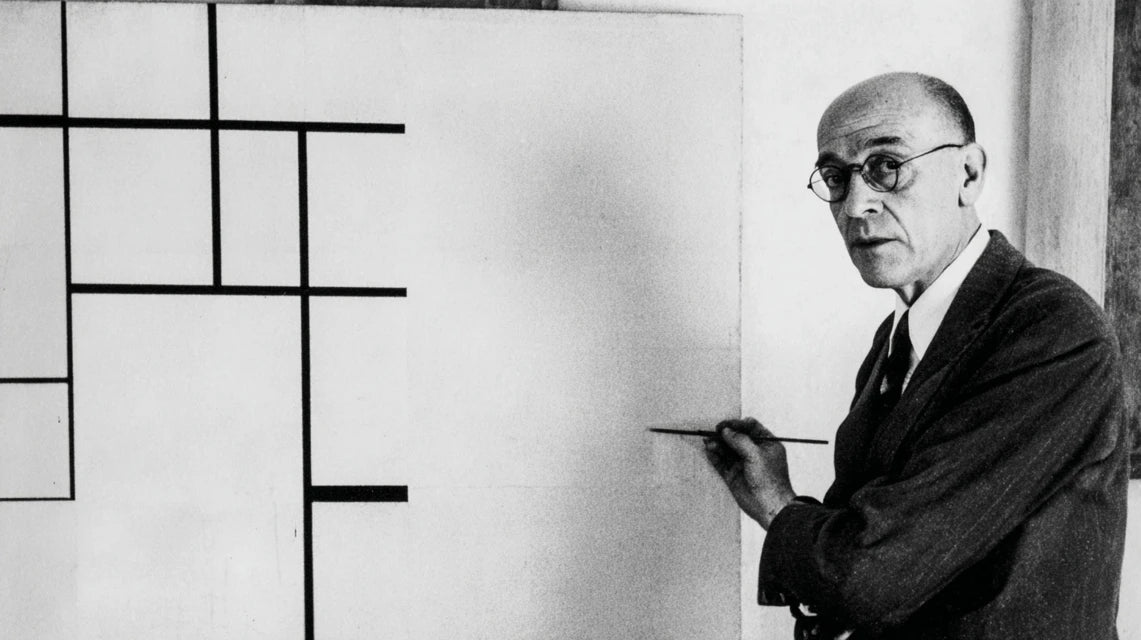
Imagine a man standing in his New York studio, meticulously moving small squares of colored paper on pristine white walls, to the frenetic rhythm of boogie-woogie music echoing through the room. This scene might seem unremarkable, but it captures the essence of Piet Mondrian, the man who revolutionized art by reducing the entire world to straight lines and primary colors.
On March 7, 1872, in the peaceful town of Amersfoort, was born the man who would forever transform our vision of painting. Son of a strict Calvinist pastor who destined him for teaching, Pieter Cornelis Mondriaan was not predestined to become one of the pioneers of abstract art. Yet, this discreet and meticulous man would create an artistic language so pure that it would influence not only painting but also modern architecture, design, and even contemporary fashion.
Why did a man raised in the strictest Protestant tradition choose to destroy any representation of the visible world? How did a painter of Dutch windmills become the creator of neoplasticism, that movement which tolerates only the right angle and pure colors? And above all, why do his geometric compositions continue to fascinate us nearly a century after their creation?
This biography will reveal the man behind the work, his spiritual and aesthetic struggles, and show you how Mondrian transformed his mystical quest into an artistic revolution - an extraordinary journey from figuration to pure abstraction.
Piet Mondrian: The visionary architect of modern neoplasticism
Understanding Piet Mondrian means grasping one of the most radical turning points in Western art. Far more than a simple avant-garde painter, Mondrian was a revolutionary theorist who believed he could change the world through art. His deep conviction: humanity needed a new visual language, purified of any reference to the natural world, to access a universal beauty.
| Biographical highlights | Artistic legacy |
|---|---|
|
Full name: Pieter Cornelis Mondriaan Birth: March 7, 1872, Amersfoort, Netherlands Death: February 1, 1944, New York, United States Nationality: Dutch |
Movement : Neoplasticism, De Stijl
The story of Mondrian is one of spectacular transformation: starting from traditional Dutch landscapes, he would arrive at compositions of revolutionary mathematical purity. This artistic metamorphosis reflects his profound spiritual quest, nourished by theosophy and his desire to transcend appearances to reveal the universal essence of things.
The roots of Amersfoort: Pieter Mondriaan between Calvinist tradition and artistic vocation
In the Calvinist home of the Mondriaans, art was not a given. Pieter Cornelius Mondriaan father, pastor and elementary school director, embodied the Protestant rigor of the time. Yet, this austere man nurtured a secret passion for drawing, which he practiced as an amateur. This founding contradiction would profoundly mark young Piet: the tension between spirituality and artistic creation would run through all his work.
The artistic epiphany by the Gein: It was during his outdoor painting excursions with his uncle Frits Mondriaan, painter of the Hague School, that young Pieter discovered his vocation. At fourteen years old, installed by the river Gein on a misty morning in 1886, he painted his first landscape. Uncle Frits silently observes this clumsy but persistent nephew, who is determined to capture the golden light filtering through the weeping willows. "He has something different," he later confided to the family. This first canvas, now lost, already contained in germ the Mondrianesque obsession with balance and structure.
In 1889, despite his father's reluctance, Mondrian obtained his teaching diploma in drawing. Family compromise obliges: he will be able to study art, but must ensure his financial security. From 1892 to 1895, he enrolled at the prestigious Rijksacademie of Amsterdam, directed by August Allebé. This rigorous academic training gave him perfect technical mastery, but above all a profound understanding of composition and balance which would serve as the foundation for his future revolutions.
The germ of geometric revolution: From his first student works, Mondrian shows a particular obsession with linear structures. His teachers note his tendency to "excessively simplify" natural forms and his pronounced taste for the opposition between horizontals and verticals. What then passes for technical clumsiness actually reveals the artistic temperament that would revolutionize 20th century art.
These years of training already reveal the characteristic traits of his artistic personality: a methodical rigor inherited from his Calvinist education, an innate sense of composition, and above all, this unique ability to see the universal in the particular that will make him one of the greatest abstract artists in history.
Mondrian and his time: Dutch art facing European artistic revolutions
The era of Mondrian coincides with one of the most turbulent periods in European art history. When he was born in 1872, Impressionism was already revolutionizing Paris, while his compatriot Vincent van Gogh prepared for his dazzling career. The Netherlands of the late 19th century experienced an artistic renaissance, driven by the The Hague School which renewed the great Dutch landscape tradition.
This artistic effervescence was accompanied by intense spiritual quest. The era saw the birth of new mystical movements such as Helena Blavatsky's theosophy and Rudolf Steiner's anthroposophy. These doctrines, which promise access to higher knowledge through deepening inner life, seduced many artists in search of meaning. Mondrian will find a philosophical justification for his aesthetic revolution.
His contemporaries? An exceptional generation: Kandinsky explores lyrical abstraction, Malevich invents Suprematism, Picasso and Braque revolutionize representation with Cubism. In this revolutionary concert, Mondrian occupies a unique place: where others explore emotion or deconstruction, he seeks pure order and universal harmony.
The two world wars profoundly mark his journey. The First World War blocks him in the Netherlands from 1914 to 1919, a crucial period during which he develops Neoplasticism. The Second pushes him into definitive exile to New York, where his art will experience a final dazzling metamorphosis. These historical traumas reinforce his conviction: humanity needs a new art for a new world.
The Dutch avant-garde facing Paris: Unlike his contemporaries who see Paris as the only worldwide artistic center, Mondrian develops with the group De Stijl a specifically Dutch avant-garde. This approach reflects his desire to create truly international art, exceeding national particularities to reach the universal. His genius: transform geographical isolation into an innovation laboratory.
Mondrian’s early years: from The Hague School to the first artistic scandals
Mondrian’s beginnings in the Dutch art world are far from triumphant. Upon graduating from the Academy at age 23, the young painter must juggle private drawing lessons and commissions for copies of old masters to survive. His early landscapes, influenced by the The Hague School, struggle to find buyers in a market saturated with this already established aesthetic.
In 1898, a decisive encounter changes everything: that of A.P. van den Briel, art critic and enlightened collector. Van den Briel immediately recognizes Mondrian’s unique talent and becomes his first supporter. Together, they travel through the countryside of North Brabant, where Mondrian develops his series of windmills and trees by the Gein. These works, still figurative, already reveal his obsession with balance and the underlying geometric structure of the landscape.
The turning point arrives in 1907 during his trip to Domburg, a seaside resort popular with artists. There, Mondrian discovers the work of Jan Toorop and is initiated into symbolism. His canvases suddenly become more intensely colored, his palette enriched by the influence of fauvism. This evolution causes the first ripples: the public accustomed to his wise landscapes discovers a Mondrian in transition, who dares to use bright reds and bold compositions.
The true spiritual revelation occurs in 1909 when Mondrian joins the Theosophical Society of Amsterdam. This doctrine, which promises access to a superior knowledge of the universe, perfectly corresponds to his artistic quest. He then writes: "Thanks to Theosophy, I became aware that art could constitute a transition to finer regions.". This conviction radically transforms his conception of painting: it is no longer about imitating what is visible, but about revealing the invisible.
These years of uncertainty forge an unwavering determination in Mondrian. Every rejection, every misunderstanding only reinforces his belief: art must free itself from the contingencies of the sensible world to reach the pure essence of reality. This difficult but fertile period prepares for the revolution that will follow.
Iconoclastic Mondrian: the man who declared war on the curve and natural color
In 1911, the discovery of Picasso’s and Braque’s Cubist works at the exhibition of the Moderne Kunstkring in Amsterdam provokes a veritable aesthetic earthquake in Mondrian. For the first time, he sees artists daring to deconstruct reality without destroying it. This revelation leads him to a radical decision: to leave for Paris, world capital of the avant-garde, to completely rethink his art.
His move to 1912 Paris marks more than just a relocation; it’s a total symbolic break. Mondrian drops the second "a" from his name Mondriaan to become Mondrian, a gesture signifying his detachment from his Dutch roots and his integration into the international avant-garde. This Parisian period (1912-1914) sees the birth of his first truly revolutionary works.
The series of Trees (1912-1914) constitutes the laboratory of his artistic transformation. Starting from the tree as a traditional motif in landscape painting, Mondrian gradually deconstructs it until he reduces it to a network of horizontal and vertical lines. This evolution scandalizes Parisian art lovers: how can one destroy natural beauty like this? Mondrian responds with theory: "Art must be above reality, otherwise it would have no value for man."
The revolutionary manifesto of 1914: In a letter that became famous to H.P. Bremmer, an influential art critic, Mondrian formulates his artistic revolutionary philosophy for the first time: "I construct lines and combinations of colors on a flat surface in order to express general beauty with as much awareness as possible." This seemingly simple declaration contains within it the germ of neoplastic revolution. It affirms the primacy of construction over imitation, of the universal over the particular.
His theoretical positions become increasingly radical. In 1917, he co-founds with Theo van Doesburg the review De Stijl, a veritable tribune of battle for new art. Mondrian develops his theory of neoplasticism there, categorically rejecting any form of representation, curve and impure color. This intransigence earns him many detractors, including among the avant-gardists.
But Mondrian fully embraces his position as an iconoclast. For him, traditional art belongs to the past; modern humanity needs a completely new visual language. This conviction, which he maintains against all odds, will make him one of the most influential theorists of modern art, even if it takes him a long time to gain public recognition.
The invention of neoplasticism: Mondrian creator of the purest artistic language of the 20th century
From 1917, stranded in the Netherlands by the war, Mondrian experienced a period of intense theoretical and practical creativity. Away from the Parisian bustle, he can finally systematize his aesthetic revolution. It is in the silence of his Dutch workshop that he invents Neoplasticism, an artistic movement of radical purity which only tolerates the right angle, primary colors and non-colors (black, white, gray).
In 1920, Mondrian painted his first truly neoplastic Composition: a network of perpendicular black lines delimiting colored rectangles in red, yellow and blue on a white background. This work marks the culmination of eight years of research and the emergence of an entirely new art form. For the first time in history, a painter completely renounces any reference to the visible world.
Composition in red, yellow and blue: Piet Mondrian's manifesto work
Among his iconic creations, Composition in red, yellow and blue (1921) perfectly embodies the neoplastic philosophy. This canvas, seemingly simple, is actually the result of months of meticulous calculations. Mondrian opposes the three primary colors to the three pure values (black, white, gray) according to such a perfect balance that no element dominates. The work functions as a mathematical equation of beauty, demonstrating that art can achieve universality by getting rid of all picturesque elements.
This search for perfect balance explains why Mondrian can spend months on a single composition. He tirelessly moves his colored paper strips on the canvas, seeking the exact position that will create this dynamic tension between the elements. His contemporaries do not understand this obsession: for them, these colored rectangles are more about geometry than art. Mondrian sees in it the future of humanity.
Mondrian's revolutionary techniques: the method of pure abstraction
Mondrian’s technique revolutionizes traditional painting practice. No more expressive brush and thick paste: Mondrian now paints with a knife, spreading color in perfectly uniform planes. He uses adhesive tapes to delineate his rectangles, a technique that allows him constant modifications until the perfect balance is achieved. This method, seemingly cold, actually hides an extreme sensitivity to proportions ratios and color vibrations.
Mondrian and his contemporaries: the isolation of the precursor facing Picasso, Kandinsky and Klee
Unlike Picasso who always maintains a link with the human figure, or Kandinsky who explores lyric abstraction, Mondrian pushes the logic of abstraction to its ultimate conclusion. Faced with Paul Klee and his poetic universe, he opposes a quasi-scientific rigor. This singularity earns him incomprehension, including from his avant-garde peers.
Pertinent, the influence of Mondrian quickly extends beyond the purely pictorial realm. From the 1920s onwards, architects and designers embraced his principles to revolutionize modern living. The Bauhaus adopted his theories, and his compositions inspired a new industrial aesthetic. Mondrian thus realized his dream: to create an art that transforms everyday life.
OUR RECOMMENDED PRODUCTS
This radical artistic revolution prepares the last metamorphosis of Mondrian: his encounter with New York energy which will transform his art once again, releasing color and introducing rhythm into his geometric compositions.
The Mondrian Man: Obsessive Perfectionist and Passionate Dancer
Behind the apparent austerity of his compositions lies a complex and fascinating personality. Mondrian the man surprisingly contrasts with Mondrian the artist: this creator of the most rigid art of the 20th century was in reality a passionate dancer, an avid fan of tango and Charleston. This apparent contradiction actually reveals the profound coherence of his approach: his search for perfect balance in art responds to his need for movement and rhythm in life.
His Paris studio on rue du Départ becomes legendary in the artistic circles of the 1920s. He recreates the universe of his paintings there: immaculate white walls punctuated by movable colored rectangles, geometric furniture that he himself makes from painted orange crates. This total environment, which he constantly modifies, functions as a life-size laboratory for his aesthetic theories. Visitors discover with astonishment this meticulous man who spends hours moving a single red square a few centimeters to perfect the balance of the whole.
A revealing episode of his personality: in 1918, struck down by the Spanish flu which decimates Europe, Mondrian transforms his convalescence into a period of intense creation. Confined to his studio for months, he develops his first truly abstract compositions. This ability to transform adversity into creative opportunity characterizes the man Mondrian: a perfectionist who never lets chance govern his life or his art.
His love life remains discreet, marked by a few deep female friendships but without devouring passion. Mondrian seems to have sublimated all emotional energy into his artistic quest. He confides to those close to him: "My painting is my life, and my life is my painting". This total fusion between existence and creation explains the intensity of his aesthetic commitment and his ability to maintain his revolutionary vision despite general incomprehension.
The Late Recognition of Mondrian: From Parisian Scandal to New York Triumph
The recognition of Mondrian follows an atypical path: for a long time considered an extremist by official critics, he did not achieve commercial success until the 1930s, nearly twenty years after his first abstract compositions. This late recognition is explained by the radical nature of his approach: the public takes time to accept art that so completely breaks with Western pictorial tradition.
The turning point comes with his meeting with Peggy Guggenheim and American collectors at the end of the 1930s. These enlightened enthusiasts immediately understand the historical importance of his work and begin to build the first significant collections. Mondrian's move to New York in 1940 accelerates this movement: America discovers with fascination this European who seems to have anticipated the aesthetics of urban modernity.
The Spectacular Evolution of Mondrian Prices Since 1944
The explosion of his posthumous market value is one of the most spectacular phenomena in the modern art market. Broadway Boogie Woogie, acquired for 800 dollars by the Brazilian sculptor Maria Martins in 1943, is now valued at more than 200 million dollars by experts. This vertiginous progression reflects the progressive recognition of Mondrian as one of the absolute masters of modern art.
| Period | Average Value | Sale Record |
|---|---|---|
| Living (1920-1944) | 500-2000 francs/dollars | Broadway Boogie Woogie ($800, 1943) |
| Immediate Posthumous (1945-1970) | $10,000 - $50,000 | Composition ($45,000, 1968) |
| Current Market (2020-2025) | $15 - $50 million | Composition No. III ($50.6 million, 2022) |
This exceptional valuation is explained by several factors: the rarity of the works (Mondrian produced fewer than 300 abstract paintings), their considerable historical influence on contemporary art and design, and their unique ability to embody the spirit of modernity. Owning a Mondrian is holding a fragment of the DNA of modern art.
Mondrian's Death in February 1944: Testament of a Visionary
On February 1, 1944, Piet Mondrian passed away in his New York studio from pneumonia, at the age of 71. His death deprived modern art of one of its greatest theorists, but also revealed the extraordinary creative vitality of his final years. The man who seemed frozen in geometric rigidity had just revolutionized his art once again, integrating movement and pure color into his final compositions.
His latest completed work, Broadway Boogie Woogie (1942-1943), is a dazzling artistic testament. In this revolutionary canvas, Mondrian abandons the black lines that structured his compositions since 1920 to replace them with colored bands consisting of small vibrant rectangles. The work literally pulsates, evoking both the urban grid of Manhattan and the syncopated rhythm of jazz he loved. This ultimate metamorphosis proves that Mondrian, far from being a prisoner of his theories, remained an unflagging seeker until the end.
Mondrian's revolutionary influence on contemporary art and modern design
Mondrian’s legacy extends far beyond the pictorial realm to permeate all aspects of contemporary visual creation. From the 1950s, the Bauhaus school systematizes his principles in industrial design education. Mies van der Rohe translates his aesthetics into architecture with his steel and glass grid facades. Marcel Breuer creates furniture that seems to have come straight out of a neoplastic composition.
More recently, the explosion of digital design has given Mondrian’s work a striking new relevance. The interfaces of mobile applications, the aesthetics of websites, contemporary urban signage: everywhere blooms the Mondrian heritage. Steve Jobs himself acknowledged being inspired by Mondrian's revolutionary simplicity to design the interface of Apple products. This persistent influence proves the validity of his vision: Mondrian had indeed created a visual language for the digital age.
Recognizing Mondrian's influence today: Carefully observe the contemporary urban environment and you will discover everywhere the imprint of the Dutch master. From building facades to company logos, from fashion to design furniture, neoplastic principles (orthogonal grid, pure colors, asymmetrical balance) structure our daily visual landscape. Mondrian was right: his art has indeed transformed our way of seeing and organizing space.
To approach Mondrian’s work, several exceptional places are a must. The Museum of Modern Art (MoMA) in New York keeps Broadway Boogie Woogie in its permanent collections, offering a striking confrontation with this major work. In the Netherlands, the Stedelijk Museum in Amsterdam and the Kröller-Müller Museum in Otterlo present the most important European collections, allowing to follow the complete evolution of the artist from his early landscapes to his ultimate abstract compositions.
An especially moving visit: the reconstruction of his last New York studio at the Gemeentemuseum in The Hague. Thanks to the precise measurements taken by his friend Harry Holtzman after his death, visitors can discover the exact environment in which his American masterpieces were born. This unique experience reveals the total coherence between man, his art and his lifestyle.
🎁 Special offer for readers
Because you took the time to inform yourself, enjoy 10% discount on your first order:
⏰ Valid 72h after reading • Applicable to all our products
Essential questions about the life and work of Piet Mondrian
Pieter Cornelis Mondriaan was born on March 7, 1872 in Amersfoort to a strict Calvinist family. His father, a pastor and school director, destined him for teaching, but his uncle Frits Mondriaan, an amateur painter, introduced him to drawing outdoors from childhood. This education marked by Protestant rigor and artistic openness shapes his unique personality: a revolutionary creator driven by a profound spiritual quest. At the age of 8, the family moved to Winterswijk, where young Piet developed his passion for structure and balance by observing the geometric Dutch landscapes.
Mondrian follows a classic but determined training path. In 1889, he obtained his teaching diploma (family requirement), then in 1892 entered the prestigious Rijksacademie of Amsterdam directed by August Allebé. This rigorous academic training (1892-1895) gives him perfect technical mastery and a deep understanding of composition. At the same time, he is influenced by the Hague School by painting landscapes with his uncle Frits. This double influence - academicism and plein air - explains his later ability to revolutionize art while maintaining a perfect sense of balance and structure.
Neoplasticism, theorized by Mondrian as early as 1917, constitutes the most radical abstract art of the 20th century. This technique only tolerates the right angle, the three primary colors (red, yellow, blue) and the non-colors (black, white, gray). Mondrian invented it to create a universal visual language, transcending cultural and national particularities. Influenced by Theosophy, he believed that this extreme purification of art could reveal the cosmic essence of reality and prepare humanity for a harmonious world. Each neoplastic composition functions as a mathematical equation of beauty, demonstrating that art can reach the universal by freeing itself from the contingent.
Mondrian's recognition follows a complex and late course. Initially considered an extremist by the Parisian critical establishment of the 1910s and 1920s, he only found his first true supporters with American collectors in the 1930s. His definitive consecration occurs upon his installation in New York in 1940: America discovers with fascination this European who seems to have anticipated modern urban aesthetics. The success of Broadway Boogie Woogie (1942-1943) marks the culmination of this recognition. Paradoxically, his death in 1944 accelerated his consecration: the public finally understood that they had lost one of the geniuses of modern art.
Authentic Mondrian works fetch exorbitant prices on the international market. His major neoplastic compositions sell for between $15 and $50 million, with a record of $50.6 million in 2022. This exceptional valuation is explained by the rarity (less than 300 abstract paintings recorded) and the considerable historical influence of his work. For enthusiasts, museum-quality reproductions allow one to approach Mondrian's aesthetics at accessible prices. His early figurative works (landscapes, windmills) remain more affordable, between $1 and $5 million. The main auction houses (Christie's, Sotheby's) regularly offer works during modern art sales.
Mondrian's influence on contemporary creation is immense and extends far beyond painting. From the 1950s, the Bauhaus systematized his principles in industrial design education. Modern architecture (Mies van der Rohe), designer furniture (Marcel Breuer), fashion (Yves Saint Laurent’s Mondrian collection, 1965) draw directly from his aesthetics. More recently, the explosion of digital design has given a striking new relevance to his work: application interfaces, websites, urban signage embrace his principles (orthogonal grid, pure colors, asymmetrical balance). Mondrian had indeed created a visual language for the modern era.