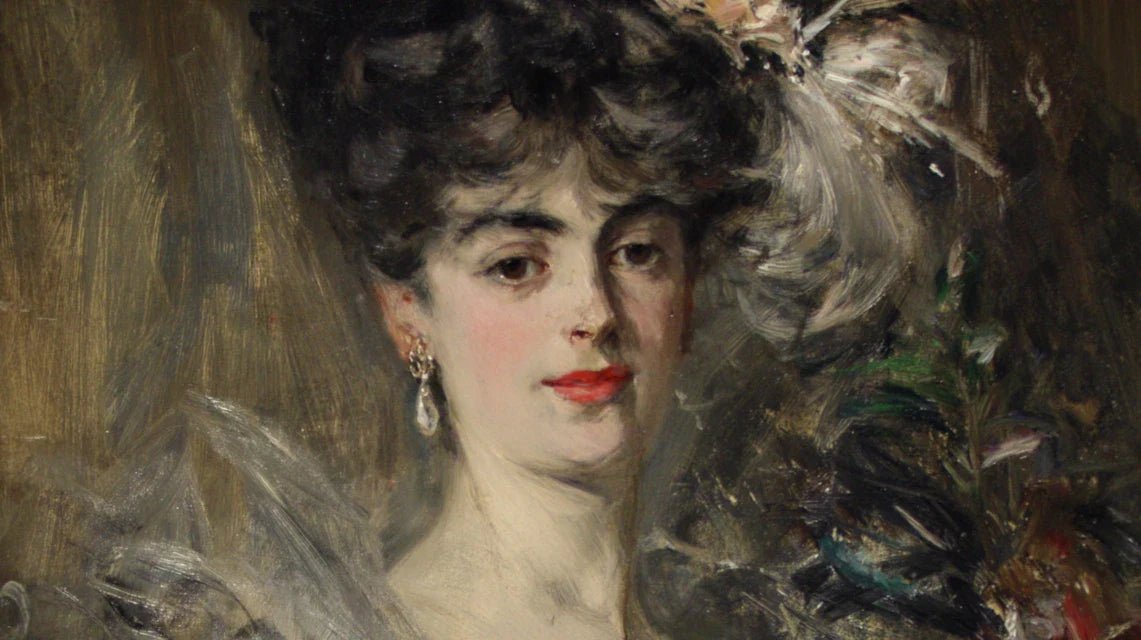
🎨 Imagine a brush dancing on the canvas with the fervor of lightning, capturing the essence of a golden age in just a few masterful strokes. In the electrifying atmosphere of Paris during the Belle Époque, an artist revolutionizes portraiture: Giovanni Boldini, nicknamed the "Master of the Fervent Stroke" by his contemporaries.
His paintings vibrate with a striking energy, where each brushstroke seems to be imbued with its own life. The leading ladies of Parisian society compete for his services, as being painted by Boldini becomes the ultimate symbol of elegance and refinement. His revolutionary style transforms fashionable portraiture into a shocking visual experience.
But who was this Italian artist who truly conquered the heart of Paris? How did this son of a Ferrarese painter become the chronicler of European aristocracy? What secret alchemy transformed his models into timeless icons of grace and modernity?
Discover the fascinating story of Giovanni Boldini, the painter who revolutionized portraiture and immortalized the splendor of an era - between tradition and avant-garde
Giovanni Boldini (1842-1931): The Italian Master of Parisian Portraiture during the Belle Époque
Understanding Giovanni Boldini requires looking beyond the gilded legends of Parisian high society to grasp the true artistic revolution he embodied. Far from being a mere salon painter, Boldini was the innovator who reconciled the tradition of the grand European portrait with the modern energy of the late 19th century.
| Biographical Highlights | Artistic Legacy |
|---|---|
|
Full name: Giovanni Boldini Born: December 31, 1842, Ferrara (Italy) Died: January 11, 1931, Paris (France) Nationality: Italian |
Movement: Macchiaioli then personal style Style: Expressionist fashionable portraits Key work: Portrait of Count Robert de Montesquiou (1897) Innovation: "Fervent stroke" - revolutionary painting technique |
This biography reveals how a young man from Ferrara became the most sought-after painter in aristocratic Europe, leaving an indelible mark on art.
Giovanni Boldini's Ferrarese Origins: A Vocation Revealed in His Father’s Studio
Ferrara, 1842. In this Renaissance city where the echoes of the Este court still resonate, the future master of modern portraiture is born. Giovanni Boldini grew up in the artistic world of his father, a painter of religious subjects and art restorer, eighth child of a family of thirteen.
The revealing self-portrait of 1858: At just sixteen, young Giovanni creates a striking self-portrait that already reveals his extraordinary technical mastery. This precocious masterpiece reveals a piercing gaze and astonishing artistic maturity, foreshadowing the genius to come.
The fundamental creative principle: From the beginning, Boldini reveals his genius for capturing the psychological essence of his models beyond their mere physical appearance, transforming each portrait into a revelation of character.
Giovanni Boldini and the artistic effervescence of the second half of the 19th century
The era of Boldini corresponds to a major period of artistic transformation in Europe. The years 1860-1880 saw the birth of Impressionism in France, while Italy experienced its own pictorial revolutions with the movement of the Macchiaioli.
In Florence, where Boldini settled in 1862, the artistic atmosphere is bubbling with innovations. The young painter meets Michele Gordigiani, Cristiano Banti and Telemaco Signorini, emblematic figures of the Macchiaioli who reject rigid academicism for a freer approach to color and light.
His European contemporaries - Manet, Degas, Whistler - are also exploring new artistic paths. But Boldini stands out for his unique ability to combine technical innovation and worldly success, revolutionizing the art of portraiture without losing his aristocratic clientele.
The industrial revolution and the emergence of the modern bourgeoisie create a new demand for artistic works. Portraits must no longer merely represent social status, but reveal modern personality, a challenge that Boldini will meet with unparalleled genius.
Transcending the art of his time: Boldini synthesizes the innovations of the Macchiaioli with the tradition of European grand portraiture, creating a timeless style that captures the modern spirit while respecting centuries-old artistic heritage.
Giovanni Boldini facing the challenges of his early London years (1870-1872)
London, 1870. The young Boldini arrives in the British capital with only his talent and ambitions as luggage. The beginnings are difficult: the English clientele, accustomed to portraits by Thomas Gainsborough and Joshua Reynolds, remains wary of this fiery Italian style.
The most revealing episode of his determination takes place during his first major commission: the portrait of Lady Holland. Boldini creates seven different versions, refusing to deliver the work until it perfectly matches his artistic vision. This obsessive perfectionism eventually earns him recognition from the British aristocracy.
His decisive meeting with Edgar Degas in 1867 at the Universal Exhibition of Paris transforms his artistic perception. Degas embodies for him this ideal of the "aristocratic painter" who combines social refinement and technical innovation. This friendship profoundly influences his future approach to portraiture.
These difficult years forge his artistic character: Boldini learns to adapt his style to the expectations of his clientele without ever betraying his personal vision. This ability to adapt becomes one of his major strengths in conquering Paris.
The London deprivations also teach him the importance of commercial success: unlike the bohemian artists of his time, Boldini understands that artistic independence goes hand in hand with financial success.
Giovanni Boldini and Parisian scandals: when art defies the conventions of the Belle Époque
The installation of Boldini to Paris in 1872 marks the beginning of a series of controversies that shake the Parisian artistic world. His revolutionary style, his bold necklines and his daring compositions upset the conventions of traditional portraiture.
The most resounding controversy erupts with the Portrait of Donna Franca Florio in 1901. This work causes such a scandal that the model's husband demands "draconian moralizing corrections." Boldini categorically refuses to modify his work, asserting that art cannot submit to bourgeois prejudices.
His revolutionary artistic philosophy proclaims that portraiture must reveal the psychological truth of the model, even if that truth is disturbing. "A portrait is not a photograph," he declares, but "the soul made visible by the brush."
His scandalous artistic motto: "I paint what I see in the souls of my models, not what society would like to see there. True art knows no limit other than the genius of the artist."
These passionate debates paradoxically strengthen his reputation: being painted by Boldini becomes a sign of modernity and social avant-garde. The Parisian aristocracy compete for his services, fascinated by this audacity that defies established codes.
These controversies mark Boldini's evolution towards an increasingly personal style, freed from academic constraints to become the authentic chronicler of his time.
Giovanni Boldini and the invention of the "flick" : the revolutionary technique of modern portraiture
The years 1890-1900 mark Boldini's creative peak with the invention of his revolutionary technique: the "flick". This pictorial method radically transforms the art of portraiture, injecting movement and life into compositions that were previously static.
The genesis of his most famous masterpiece, the Portrait of Count Robert de Montesquiou in 1897, perfectly illustrates this artistic revolution. Boldini spends three months studying his model, this emblematic dandy of the fin de siècle decadence, before painting him in a few fleeting sessions.
Portrait of Count Robert de Montesquiou (1897) : masterpiece of modern portraiture
This iconic work, housed at the Musée d'Orsay, synthesizes all of Boldini's genius. The count, dressed in a pearl gray suit, holds his cane like a royal scepter, perfectly embodying the line from his own poem: "I am the sovereign of fleeting things." Boldini manages to reveal the complex psychology of this character while creating an enduring artistic icon.
The subtle irony that runs through the work - this critical distance towards Montesquiou's excessive aestheticism - reveals Boldini's artistic maturity, capable of creating beauty while maintaining a lucid view of his time.
The revolutionary technique of Giovanni Boldini’s “flick”
Boldini develops a unique working method: extra-long brushes maneuvered with the energy of a dancer, pure colors applied in quick and precise touches, a frantic pace of creation that captures the essence of the model in a few hours. This revolutionary technique creates effects of perpetual movement that make the canvas vibrate.
Giovanni Boldini facing his contemporaries: Sargent, Whistler and Degas
Compared to John Singer Sargent, Boldini prioritizes emotion over technical precision. Facing Whistler, he chooses energy over harmonic subtlety. With Degas, he shares a fascination for movement, but applies it to worldly portraits rather than ballet scenes.
The most revealing anecdote of his different approach: at a fashionable evening, Sargent takes a week to create a society portrait. Boldini, on the other hand, paints the same lady in an evening, creating a more lively and expressive work that creates a sensation throughout Paris.
OUR RECOMMENDED PRODUCTS
This technical revolution makes Boldini a precursor of a new conception of portraiture, foreshadowing the artistic developments of the 20th century.
Giovanni Boldini, the man behind the artist: between Parisian high society and creative solitude
Behind the painter of fashionable society lies a complex man, torn between his desire for social recognition and his need for artistic authenticity. Boldini intensely lives the contradictions of his time, navigating between Parisian salons and the solitude of his studio on Place Pigalle.
His passionate relationship with Berthe, model and companion in the 1870s, reveals his romantic personality. Later, his liaison with Countess Gabrielle de Rasty definitively introduces him into Parisian high society, but these tumultuous relationships also fuel his creative melancholy.
Paradoxically, this man who paints the joy of living suffers from periods of profound doubt. His correspondence reveals an artist tormented by the question of posterity: "Will I be more than a fashion painter?" he regularly wonders.
This constant tension between worldly success and artistic demands paradoxically fuels his creative genius, allowing him to transcend the simple commission to create timeless works.
Giovanni Boldini and international consecration: from the Belle Époque to contemporary record prices
The official recognition arrives with the Universal Exhibition of 1889, where Boldini wins the gold medal for his portrait of the Chilean woman Emiliana Concha de Ossa. This consecration marks the beginning of his most prosperous period, where commissions flow in from all over the world.
The decisive turning point occurs in 1897 with his first solo exhibition in New York. The American aristocracy, seduced by his refined European style, commissions a series of prestigious portraits, including those of Cornelius Vanderbilt and Gertrude Vanderbilt Whitney. These successes across the Atlantic multiply his price tenfold in a few years.
Giovanni Boldini: evolution of prices and absolute sales records
The market value of Boldini perfectly illustrates the evolution of artistic taste in the 20th century. Neglected after 1918, rediscovered in the 1960s, he now reaches vertiginous peaks on the international market.
| Period | Average value | Absolute sales record |
|---|---|---|
| 1890-1931 (lifetime period) | 5,000-50,000 French francs | Portrait of Giuseppe Verdi: 100,000 francs (1900) |
| 1950-1990 (rediscovery) | $50,000-$500,000 | Portrait of Whistler: $850,000 (1988) |
| 2000-2025 (current market) | €200,000 - €2,600,000 | Portrait of Giovinetta Errazuriz: $6,578,500 (2010) |
This spectacular progression confirms Boldini's international recognition as an undisputed master of Belle Époque portraiture.
Giovanni Boldini and his later years: artistic testament of a genius (1920-1931)
The last years of Boldini, marked by failing eyesight, reveal an artist who is peaceful but still creative. In 1926, at 84 years old, he marries the journalist Emilia Cardona, finally finding personal serenity. His later works, more introspective, bear witness to accomplished artistic wisdom.
His death on January 11, 1931 marks the end of an era: with him disappears the last witness of the Belle Époque artistic period. His body is repatriated to Ferrara, his hometown, as a final tribute to his Italian origins.
Giovanni Boldini and his influence on contemporary art: a living legacy
The influence of Boldini on contemporary art manifests in the pictorial gesture of expressionist abstractionists such as Willem de Kooning or Franz Kline. His technique of the "flick of the wrist" also inspires contemporary fashion photographers, notably Paolo Roversi and Tim Walker, who find in their framing the boldinienne elegance.
Contemporary portraitists such as Lucian Freud or David Hockney acknowledge his debt to this psychological approach to portraiture. Current digital art rediscovers his dynamic compositions and revolutionary effects of movement.
Recognizing the Boldini legacy today: Observe contemporary portraits that prioritize expression over resemblance, off-center compositions creating movement, and this unique ability to reveal the model's personality beyond their physical appearance.
Giovanni Boldini in world collections: where to discover his masterpieces
The major works of Boldini can be discovered at the Musée d’Orsay (Portrait of Montesquiou), the Metropolitan Museum of Art in New York, the Galleria Nazionale d'Arte Moderna in Rome, and in his hometown at the Museo Giovanni Boldini in Ferrara. Regular exhibitions at the Petit Palais and the Palazzo Grassi allow us to rediscover this timeless genius.
This global legacy is a testament to the universal dimension of an art that transcends eras to directly touch our contemporary sensibility.
🎁 Special offer for readers
Because you took the time to inform yourself, enjoy 10% discount on your first order:
⏰ Valid 72h after reading • Applicable to all our products
Frequently asked questions about Giovanni Boldini's biography
Giovanni Boldini (1842-1931) was an Italian painter who revolutionized portrait art thanks to his "whiplash" technique. Born in Ferrara into a family of artists, he grew up in his father's workshop before conquering Paris and becoming the most sought-after portraitist of the Belle Époque. His unique style combined the tradition of grand European portraiture with modern innovations, creating works of revolutionary energy and dynamism.
Boldini was initially trained in his father's workshop with traditional Renaissance techniques, then studied in Florence where he met the Macchiaioli, Italian precursors to Impressionism. His decisive encounter with Edgar Degas in 1867 and his stays in London and Paris enriched his approach. He gradually developed his revolutionary "whiplash" technique by synthesizing Italian influences, French innovations, and the demands of an international aristocratic clientele.
Boldini's technique, nicknamed the "whiplash", revolutionized portrait art with its energetic gesture and effects of movement. Using extra-long brushes maneuvered with the energy of a dancer, he applied colors in quick and precise touches that literally made the canvas vibrate. This method created perpetual motion effects, infusing extraordinary life into his compositions and anticipating developments in modern art.
Boldini became the most sought-after portraitist of his time thanks to his unique ability to reveal the psychology of his models while creating works of stunning beauty. Being painted by Boldini was the ultimate symbol of social elegance in Paris. His clientele included European aristocracy, American fortunes, and celebrities of the era. His recognition culminated with the gold medal at the 1889 World's Fair and his appointment to the Legion of Honor in 1919.
Boldini's works today achieve record prices on the international art market. His portraits sell for between 200,000 and 2,600,000 euros, with an absolute record of $6,578,500 for "Portrait of Giovinetta Errazuriz" in 2010. This spectacular progression since the 1960s is a testament to the growing recognition of his artistic genius. Collectors particularly appreciate his female portraits and scenes of Parisian life from the Belle Époque.
Boldini’s influence on contemporary art is evident in the gestures of abstract expressionists, the psychological approach to modern portraiture, and current fashion photography. His "flicked brushstroke" technique inspires contemporary artists who prioritize expression over photographic resemblance. From painters like Lucian Freud to photographers like Paolo Roversi, many acknowledge his debt to this revolution in portraiture that reveals the soul beyond appearance.