Imagine a Russian prince of 41 years old throwing himself from the terrace of his antibois workshop, facing the Mediterranean he had just painted in a last desperate act of creation. This tragic scene from March 16, 1955 abruptly ends the life of Nicolas de Staël, a Franco-Russian painter who became in just fifteen years one of the most fascinating figures in modern art.
His story begins in the splendor of Imperial Saint Petersburg and ends in the harsh light of Antibes, leaving behind more than a thousand works that revolutionize the art of his time. Between these two destinies, that of an aristocrat promised a golden life and that of a cursed artist, unfolds an artistic epic of rare intensity.
Why did this man who knew international fame and whose paintings were sold for high prices choose death? How do his revolutionary color fields and abstract landscapes continue to upset viewers nearly seventy years after his disappearance?
Discover the true story of Nicolas de Staël, this tormented genius who reconciled abstraction and figuration in a work of striking emotional power - the destiny of a man who preferred to die as a free artist rather than live as a painter imprisoned by success.
Nicolas de Staël : The Russian aristocrat became master of French modern art
Understanding Nicolas de Staël, is first grasping the paradox of a man born in the splendor of the Russian Empire and died in the creative solitude of a Mediterranean workshop. Because behind the legend of the cursed artist hides a more complex truth: that of a painter who revolutionized the art of his time by refusing to choose between abstraction and figuration.
| Biographical highlights | Artistic legacy |
|---|---|
|
Full name : Nikolaï Vladimirovitch Staël von Holstein Birth : January 5, 1914, Saint Petersburg Death : March 16, 1955, Antibes Nationality : Franco-Russian |
Movement : School of Paris, Art Informel Style : Synthesis of abstraction and figuration Flagship work : The Parc des Princes (1952) Innovation : Technique of monumental color fields |
The story of Nicolas de Staël perfectly illustrates what exile can produce in art, both the most beautiful and the most painful. Torn from his native Russia by the revolution, orphaned at 8 years old, he will transform this original wound into a quest for artistic intensity.
Nicolas' aristocratic origins : From Peter and Paul Fortress to the Brussels workshops
Nikolai Vladimirovich Stael von Holstein was born on January 5, 1914 in the Peter and Paul Fortress of Saint Petersburg, where his father, Baron Vladimir Stael von Holstein, held the position of last commander. This family from the Baltic nobility is steeped in cultural refinement where music and painting occupy a central place.
Early artistic awakening: At the age of two, young Nicholas became a page at the imperial court. His mother, Lubov Vladimirovna Berednikova, an accomplished pianist and passionate painter, introduced him very early to drawing and colors. This sensitive woman passed on her love of art that would guide him throughout his life.
Revelation of the Flemish Masters: In Brussels museums, young Nicholas discovered with amazement the works of Rembrandt, Vermeer and Van Eyck. This first confrontation with great European painting shaped his artistic sensibility and revealed to him that art can transcend all suffering.
Nicolas de Staël and his time: Modern art in the turmoil of the 20th century
Nicolas de Stael’s formative years coincide with the golden age of the School of Paris, a period when the French capital attracts artists from all over the world. In the 1930s, Paris is bubbling with creativity: Picasso revolutionizes painting, Matisse explores pure color, Braque develops cubism.
It is in this effervescent context that Nicolas entered the Royal Academy of Fine Arts in Brussels in 1932. Unlike his contemporaries, he refuses to follow the artistic trends of the moment. Already, he senses that his path will lie between tradition and modernity.
The European travels he undertook in the 1930s - Paris, Spain, Italy, Morocco - confront him with the upheavals of the time. He rubs shoulders with the Surrealists, observes the abstract artists, but maintains a critical distance. His correspondence reveals a young man aware that art of his time is still searching for its direction.
The rise of fascism and the approach of World War II create a climate of artistic urgency. Many artists become politically engaged, others flee. Nicolas de Staël chooses a third path: that of engagement through pure art, convinced that beauty can resist barbarity.
Art as spiritual resistance: For Nicolas de Staël, painting becomes an act of faith in humanity. In an era torn by ideologies, he chooses to create a painting that transcends divisions by drawing on the eternal sources of aesthetic emotion.
The years of training and wandering: The long road to recognition (1934-1941)
In 1934, Nicolas de Staël moved to Paris with only his brushes and a fierce determination as his luggage. The city of art attracts him, but the reality is harsh: he lives in poverty, surviving thanks to small jobs and some copy commissions.
The trip to Morocco in 1936 marks a decisive turning point. Dazzled by the light of the Maghreb and the colors of the High Atlas, he paints frantically in Fes, Rabat, Casablanca and Marrakech. Unfortunately, most of these works will be destroyed, but this experience shapes his sensitivity to Mediterranean light.
It is in Morocco that he meets Jeannine Guillou, a talented painter married to the Polish man Olek Teslar. This remarkable woman, who travels with her son Antoine on a donkey across the country, becomes his companion and his first great passion. Their passionate relationship is nourished by constant artistic exchanges.
Returning to France in 1938, the couple settles into material precariousness but in extraordinary creative wealth. Nicolas works with the energy of despair, aware that war is approaching and that time is running out.
Enlistment in the Foreign Legion in 1939 abruptly interrupts this period of learning. Demobilized in 1941, he finds Jeannine in Nice, more determined than ever to make painting the center of his life.
Nicolas de Staël's artistic revolution: Between scandals and innovations (1942-1945)
In 1941, Nicolas de Staël makes a radical break with traditional figuration. Influenced by his meeting with Jean Arp, Sonia Delaunay and Robert Delaunay in Nice, he begins his first abstract "Compositions" which immediately scandalize the artistic community.
These revolutionary works, characterized by brutal impastos and pure colors, shock traditional art proponents. Critics of the time speak of "scribbling" and accuse the painter of succumbing to Parisian trends.
His return to Paris in 1943, during the Nazi occupation, placed Nicolas de Staël at the heart of the aesthetic debates of cultural resistance. His works, presented in clandestine exhibitions, deeply divided the Parisian art scene.
The philosophy of free art: "One never paints what one believes to see, one paints a thousand vibrations of the blow received, to receive" he declared in a letter from 1949. This sentence perfectly summarizes his revolutionary conception of painting as a direct transcription of emotion.
His first solo exhibition at Galerie l'Esquisse in 1944 caused a real uproar. The exhibited works, with their unprecedented chromatic violence, questioned all established pictorial codes. Paradoxically, this controversy attracted the attention of Georges Braque, who became his mentor and defender.
The 1945 exhibition at Galerie Jeanne Bucher definitively establishes Nicolas de Staël as one of the most innovative painters of his generation. His participation in the first Salon de Mai confirms his status as a revolutionary of modern art.
The Revolutionary Art of Nicolas de Staël: Master of Color Blocks and Inventor of a New Pictorial Language
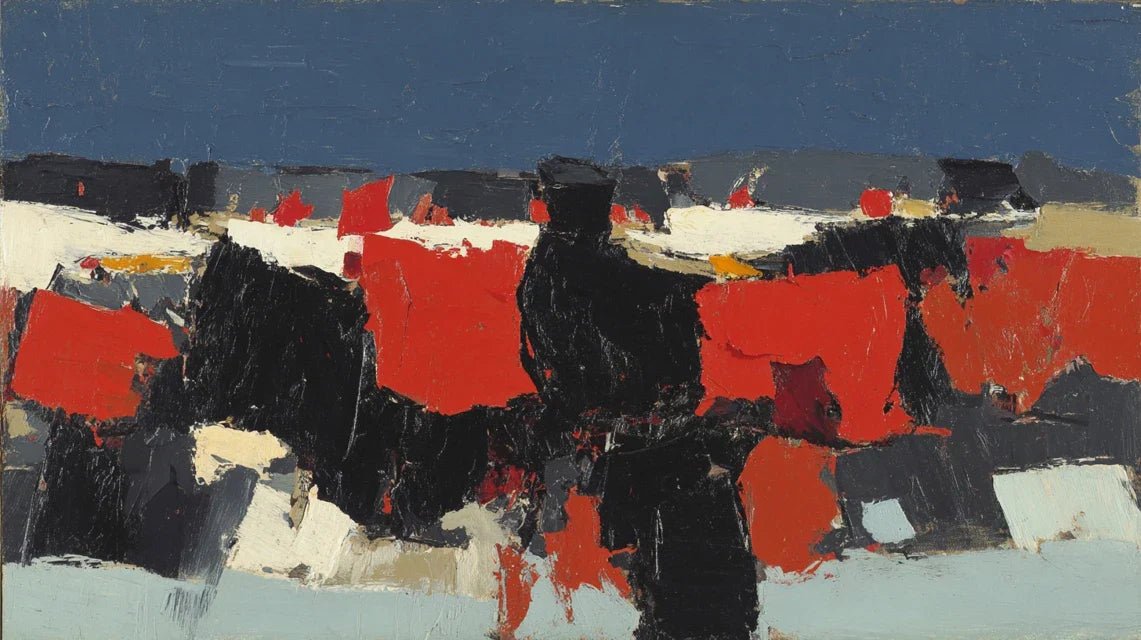
From 1950, Nicolas de Staël reached his full artistic maturity by developing his revolutionary technique of color blocks. These "tesserae" of paint, inspired by his visit to the exhibition on the mosaics of Ravenna, radically transform the art of painting.
The creation of Parc des Princes in 1952 perfectly illustrates this aesthetic revolution. After attending the France-Sweden match on March 26, 1952, he painted this monumental work of 200 x 350 cm that same night, revolutionizing modern painting.
Parc des Princes: Masterpiece of European Modern Art
This exceptional canvas demonstrates Nicolas de Staël's unique ability to capture movement and emotion through simple color blocks. Using wide spatulas and even pieces of 50 cm sheet metal, he literally "lays" the color to create a visual symphony of incredible power.
The work reveals bodies in motion within abstraction itself, proving that figuration and abstraction can coexist. The white, green, ochre and blue masses simultaneously evoke the players' jerseys and a colorful musical score.
The revolutionary technique of Nicolas de Staël: Innovation and tradition reconciled
Nicolas de Staël develops a unique working method combining knives, trowels and mortar floats. This sculptural approach to painting allows him to create extraordinary stratified impastoes.
Nicolas de Staël facing his contemporaries: A singular artistic path
Unlike Rothko who favors "blobs" (blurred masses), Nicolas de Staël develops "blocks" (clear blocks). This fundamental difference, emphasized by Rothko himself during a joint exhibition, reveals the originality of Staël's approach.
While American Abstract Expressionists prioritize automatism, Nicolas de Staël maintains an architectural control over his compositions. He also distinguishes himself from French Tachistes through his constant search for a balance between spontaneity and construction.
OUR RECOMMENDED PRODUCTS
This unique synthesis between pictorial tradition and revolutionary modernity places Nicolas de Staël in a category of artistic distinction, that of creators who transcend the movements of their time.
The complex personality of Nicolas de Staël: The man behind the genius artist
Nicolas de Staël perfectly embodies the myth of the romantic artist: passionate, tormented, whole. His personality is forged in the constant tension between his Russian aristocratic nostalgia and his vital need for artistic creation.
The death of Jeannine Guillou in 1946 plunges him into deep despair which transpires in his works from this period. His remarriage to Françoise Chapouton in 1949 brings him family stability but does not fully satisfy his need for emotional absoluteness.
A hard worker, he often paints 15 hours a day, destroying as many works as he completes. This quest for maladaptive perfection reveals a man haunted by the idea that each canvas could be the last, a premonitory feeling that will tragically prove to be exact.
His meeting with Jeanne Polge in 1953 awakens a devouring passion which literally consumes him. This married woman and mother becomes his creative and personal obsession, transforming his last years into a sentimental torment that paradoxically nourishes his art.
The meteoric success of Nicolas de Staël: From Parisian Bohemia to international records
Nicolas de Staël’s artistic recognition gradually builds from 1945, but truly explodes with the exhibition at the Parc des Princes at the Salon de Mai in 1952. This revolutionary work immediately attracts the attention of the New York dealer Paul Rosenberg.
The exclusive contract signed with Paul Rosenberg in 1953 transforms the material situation of the painter. His paintings, sold for a few thousand francs in 1950, reach considerable sums for the time, making him one of the best-rated French artists in the United States.
The spectacular evolution of Nicolas de Staël’s price on the international market
Nicolas de Staël’s commercial success remains exceptional in 20th century art. In less than five years, he goes from being an unknown painter to that of a sought-after international artist by the greatest collectors.
| Period | Average value | Record sale |
|---|---|---|
| 1950-1955 (during his lifetime) | 50,000 to 200,000 francs | 500,000 francs (Parc des Princes, 1954) |
| 1960-1990 (posthumous period) | 100,000 to 2 million francs | 15 million francs (Agrigente, 1987) |
| 2000-2025 (contemporary market) | 500,000 to 8 million euros | 21.6 million euros (Les Indes galantes, 2018) |
This exceptional progression is explained by the relative scarcity of his works - only thousand paintings cataloged - and by their constant quality. Unlike other painters of his generation, Nicolas de Staël never experienced a period of creative decline.
The tragic end of Nicolas de Staël and his timeless artistic testament (March 16, 1955)
The last months of Nicolas de Staël take place in his studio in Antibes, facing the Mediterranean which he paints with a desperate urgency. Tormented by his passion for Jeanne Polge who refuses to leave her family, he finds in creation his only escape.
On March 16, 1955, after three days of intense work on The Concert, a monumental work of 350 x 600 cm, he jumps from the terrace of his studio onto the rue du Revely. This voluntary death, at 41 years old, deprives modern art of one of its most promising creators.
The decisive influence of Nicolas de Staël on international contemporary art
The legacy of Nicolas de Staël extends far beyond the borders of France. His revolutionary synthesis between abstraction and figuration inspires generations of artists, from Anselm Kiefer to Gerhard Richter, who all recognize his debt to the French master.
His technique of monumental color blocks is found in contemporary art in various forms: the installations of Donald Judd, the paintings of Sean Scully, and even some digital works that exploit the principle of color pixellation.
Recognizing the Staël legacy in contemporary art: Observe contemporary artworks that use large masses of color to create an immediate emotion. This approach, which prioritizes visual impact over anecdotal detail, directly stems from the innovations of Nicolas de Staël.
Where to discover the universe of Nicolas de Staël: Museums and prestigious collections
Works by Nicolas de Staël are held in the world's leading museums: Centre Pompidou in Paris, Museum of Modern Art in New York, Tate Modern in London, Musée de Grenoble, and Musée Picasso d’Antibes which houses his last unfinished masterpiece, Le Concert.
For a complete approach to his work, visit the Museum of Modern Art in Paris which has the largest European collection, including several versions of Parc des Princes and the magnificent Sicilian landscapes of his later period.
🎁 Special offer for readers
Because you took the time to inform yourself, enjoy 10% discount on your first order:
⏰ Valid 72h after reading • Applicable to all our products
Frequently asked questions about Nicolas de Staël: Understanding the artist and his work
Nicolas de Staël was a Franco-Russian painter born Nikolaï Vladimirovitch Staël von Holstein on January 5, 1914 in Saint Petersburg. Coming from a Baltic noble family, he became an orphan at 8 years old after the Russian Revolution and grew up in Belgium with a foster family. This aristocratic origin and early exile shaped his personality as a passionate and tormented artist.
He studied at the Royal Academy of Fine Arts in Brussels from 1932 to 1936, but his real training came through his European travels and discoveries of the Flemish masters. Major influences: Rembrandt, Cézanne, Braque, Matisse, as well as Byzantine mosaics which inspired his technique of color blocks.
His signature technique involved applying paint in thick, colored blocks (tessellations) using knives, large spatulas and trowels. This method created stratified impastoes of a unique tactile richness, reconciling abstraction and figuration by revealing recognizable forms within pure abstraction.
His recognition exploded after 1952 with the series of Footballers and Parc des Princes. The contract with New York dealer Paul Rosenberg in 1953 propelled him onto the international market. In less than five years, he became one of the highest-priced French painters in the United States.
The market for Nicolas de Staël remains very dynamic with prices ranging from 500,000 to 8 million euros for major works. Current record: 21.6 million euros for Les Indes galantes in 2018. The scarcity of his works (approximately 1000 cataloged paintings) maintains constant demand from international collectors.
His influence endures through his revolutionary abstraction-figuration synthesis, which continues to inspire contemporary artists such as Gerhard Richter or Sean Scully. His technique of monumental color blocks can be found in digital art, contemporary installations and current painting that favors immediate emotional impact.
Nicolas de Staël: The timeless genius who revolutionized modern painting
Seventy years after his tragic death, Nicolas de Staël continues to fascinate with the striking modernity of his art. His refusal to choose between abstraction and figuration resonates today with our era that favors creative syntheses over sterile oppositions.
More than just a painter, Nicolas de Staël embodies the total artist: one who transforms personal suffering into universal beauty, who makes exile a source of creation, who transcends the tragedies of history through the sheer force of art. His revolutionary technique of color blocks still opens up unexplored paths to contemporary creation.
Discovering Nicolas de Staël means understanding that true art knows no borders or eras. His abstract landscapes still speak to our contemporary sensibility, his colorful musical compositions anticipate our multimedia era, and his quest for aesthetic absoluteness responds to our thirst for authentic beauty.
Art as personal revelation: Contemplating a work by Nicolas de Staël, is discovering that art can transform our view of the world. His pure colors and refined shapes remind us that beauty remains our best rampart against the sadnesses of existence.