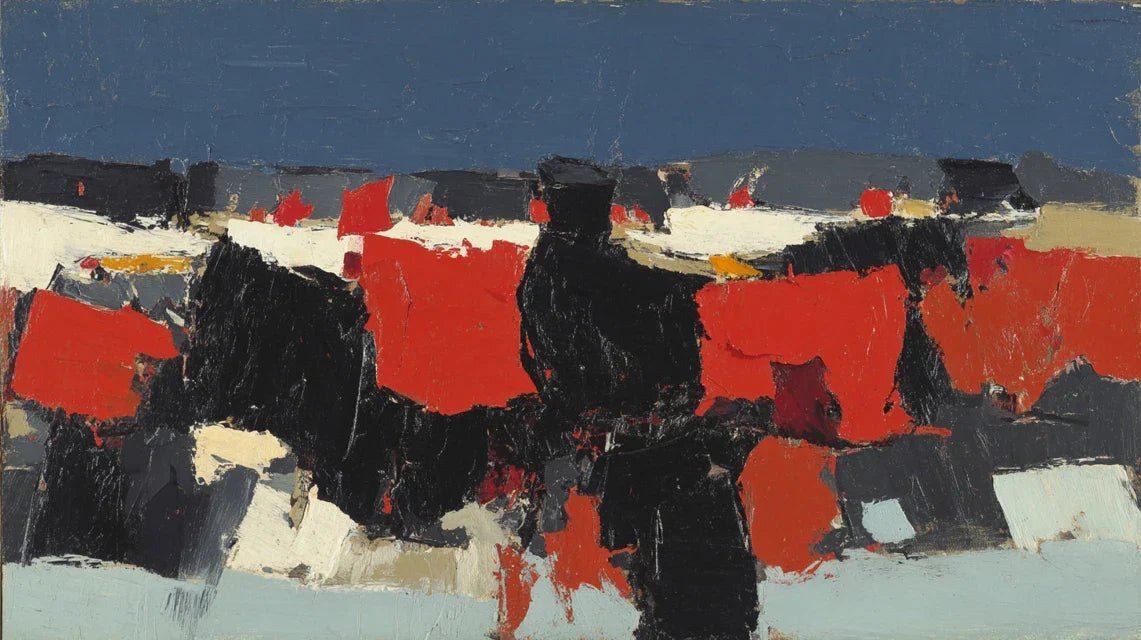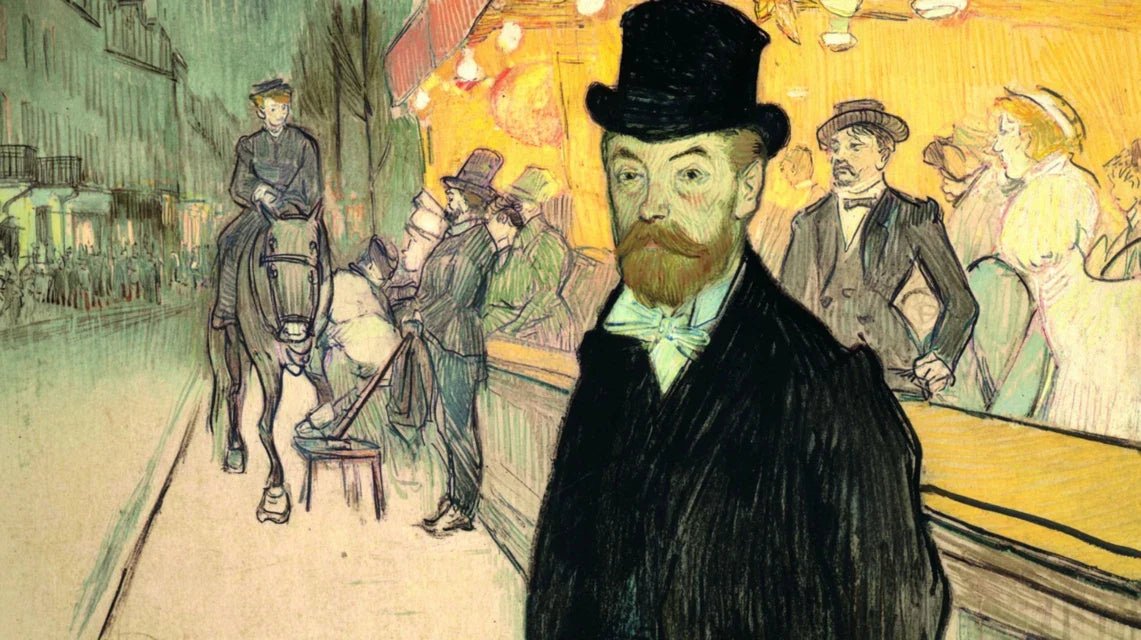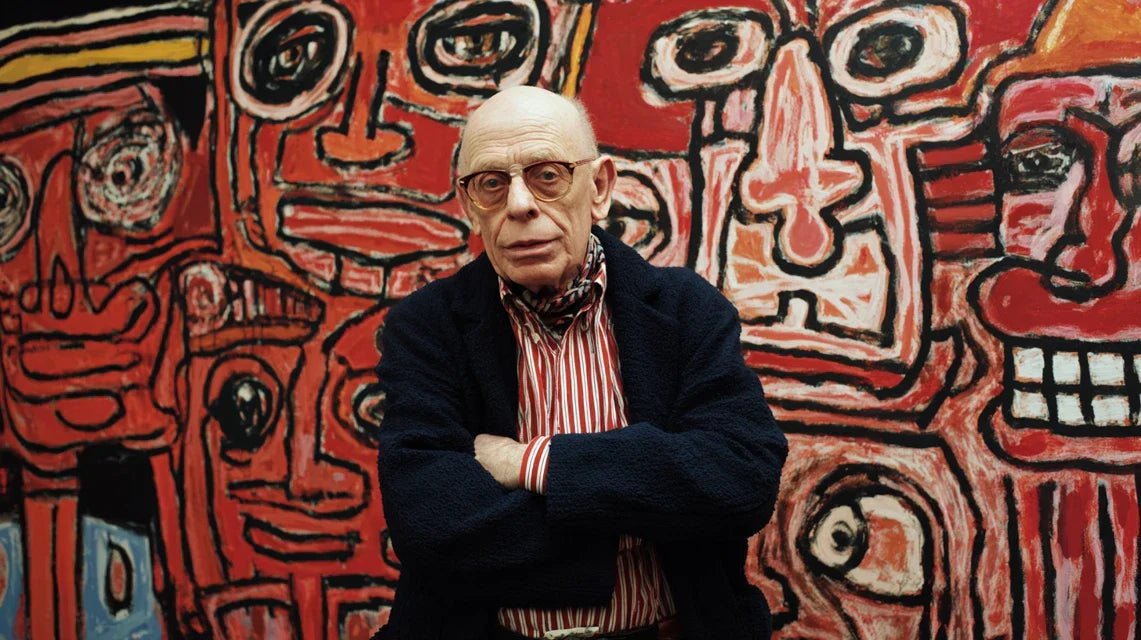
Imagine a forty-one year old man abandoning his successful wine trading business to become one of French modern art’s most audacious pioneers.
In 1942, in occupied Paris, Jean Dubuffet made a decision that would shake the history of art: he chose to paint with sand, tar, and shards of glass, revolutionizing our very conception of artistic beauty.
The man who would become the theorist of Art Brut and detractor of “stifling culture” invites us into a universe where authenticity trumps technique, where raw emotion triumphs over conventional refinement.
Discover the man who dared to say that children’s drawings and those of the mentally ill were worth more than established masterpieces - and how he was right.
Jean Dubuffet: The Visionary Inventor of French Art Brut
Understanding Jean Dubuffet means grasping why a cultured man from the bourgeois Havraise chose to reject everything he had been taught in order to invent a new way of creating.
| Biographical Highlights | Artistic Legacy |
|---|---|
| Full name: Jean Philippe Arthur Dubuffet Birth: July 31, 1901 in Le Havre Death: May 12, 1985 in Paris Nationality: French |
Movement: Art Brut (which he founded in 1945) Style: Raw materials, thick textures Key work: The Hourloupe cycle Innovation: Theorization of “non-cultural” art |
But behind this artistic revolution lies the story of a man perpetually seeking authenticity, ready to sacrifice bourgeois comfort for a deeper creative truth.
Jean Dubuffet as a Child: How Bourgeois Havraise Forges a Revolutionary
Le Havre, 1901: in this prosperous port city, Jean Philippe Arthur Dubuffet was born into a family of wine merchants from the local bourgeoisie, surrounded from childhood by a cultured but conformist environment.
The encounter that changed everything: At Le Havre high school, young Jean forged a decisive friendship with Georges Limbour, future poet, and Raymond Queneau, who would become the author of Zazie in the Metro. These literary friendships awakened in him a thirst for creation that would never leave him.
The seed of rebellion: From 1924, Dubuffet abandoned painting, declaring that "official art disgusts him." This first break already reveals his visceral rejection of established artistic conventions.
Jean Dubuffet and his time: French art between two wars
When Dubuffet picks up the brushes again in 1942, French art is going through a period of major upheaval, between the legacy of Surrealism and the emergence of new avant-garde movements.
Occupied Paris sees the birth of a generation of artists seeking authenticity: Jean Fautrier experiments with his "Hostages", Wols develops informal art, while Surrealists like André Breton theorize creative automatism.
Unlike his contemporaries Picasso, Matisse or Braque who evolve in established artistic circles, Dubuffet forges his own path, inspired by his travels in Algeria between 1947 and 1949.
The Second World War and its traumas lead many artists to question traditional Western values, but only Dubuffet goes so far as to completely reject "cultural art" in favor of "raw" creations.
The spirit of the time: In this period of reconstruction, Dubuffet paradoxically embodies a return to primitive creative sources, proposing to "wipe the slate clean" of Western artistic heritage to rediscover a universal human truth.
Jean Dubuffet in the 1930s: the hesitations of the future master
Between 1924 and 1942, Dubuffet experienced a period of deep creative doubts, oscillating between managing his wine business and sporadic artistic attempts that leave him unsatisfied.
In 1930, he moved his company to the Bercy warehouses in Paris, mingling with a popular environment that nourishes his future fascination for "the common man." These years of commerce bring him financial comfort but also growing frustration.
1933 marks a first attempt to return to art: he creates puppets and masks, seeking new forms of expression, but quickly abandons them due to the economic difficulties of his company.
This desert artistic journey paradoxically forges his future philosophy: convinced that true art must spring spontaneously and not result from learning, he develops a definitive distrust of academic instruction.
When the war breaks out in 1939, Dubuffet is mobilized, an experience that reinforces his belief that art must speak to "the man in the street" rather than cultivated elites.
Jean Dubuffet as a polemicist: when Art Brut scandalizes Paris
From his first exhibition in October 1944 at the René Drouin Gallery, Dubuffet provokes outrage with his "Bodyguards”, works with coarse materials that shock the Parisian artistic community.
1946: the exhibition "Microbolus Macadam & Cie” triggers a real critical war. Dubuffet presents his “High Pastes”, paintings made with sand, tar, crushed glass, which the press calls “anarchists” and “garbage scrapes”.
He theorizes his revolution in his manifesto "Art Brut preferred to cultural arts” (1949), where he denounces “suffocating culture” and advocates for art “indemne of artistic culture”.
The scandalous sentence: "We mean by Art Brut works executed by people who are free from artistic culture, in which therefore imitation [...] has little or no part”, he declares, revolutionizing the very conception of artistic creation.
In 1948, with André Breton, Jean Paulhan and Michel Tapié, he founded the Compagnie de l'Art Brut, an institution that collects and promotes the works of mentally ill people, prisoners and autodidacts.
These controversies, far from harming his career, establish Dubuffet as the essential theorist of a genuinely subversive art, opening the way for the most radical contemporary art.
Jean Dubuffet and Hourloupe: the revolution of the ballpoint pen (1962-1974)
July 1962: during a telephone conversation, Dubuffet mechanically scribbles with a red and blue ballpoint pen on scraps of paper. These automatic doodles give birth to the most famous cycle of his work: Hourloupe.
This portmanteau word invented by the artist, blending "howl”, “wolf” and “trick”, refers to a revolutionary graphic universe made of hachures, intertwining and cellular forms in red, blue, white and black.
Hourloupe by Jean Dubuffet: the birth of a unique pictorial language
With the Hourloupe, Dubuffet abandons oil and raw materials for industrial markers and vinyl paint, creating a striking plastic language that evokes both electronic circuits and urban graffiti.
Unlike the Matériologies of the 1950s, the Hourloupe favors the pure line and color fields, foreshadowing digital art and contemporary comics.
Jean Dubuffet’s revolutionary techniques in the Hourloupe
Dubuffet develops a work method quasi-industrial: ballpoint pen drawings, cutting, collage, then enlargement into paintings, sculptures and even livable architectures like the Closerie Falbala (1971-1976).
Jean Dubuffet facing Picasso and the School of Paris
While Picasso still explores classical variations and the School of Paris stagnates, Dubuffet invents a totally new pictorial language, freed from any reference to Western art history.
1967: he discovers expanded polystyrene and transposes the Hourloupe into monumental sculptures. The Tour aux Figures (1988) in Issy-les-Moulineaux is a testament to this revolution of art in public space.
OUR RECOMMENDED PRODUCTS
This period of twelve creative years (1962-1974) definitively places Dubuffet among the major revolutionaries of 20th century art.
Jean Dubuffet, the man: portrait of a radical nonconformist
Behind the revolutionary artist lies a man of considerable erudition, a great reader of Céline, Ponge and Paulhan, who paradoxically cultivates rejection of intellectual culture.
Married three times, father of a bourgeois family living in a private mansion in the 7th arrondissement of Paris, Dubuffet embodies the contradictions of his time: revolutionary in art, conservative in his private life.
His correspondence reveals a man obsessed with theorizing about his practice, writing relentlessly to justify his innovations, testifying to an exceptional analytical intelligence behind the apparent naivety of his works.
This duality between intellectual sophistication and artistic primitivism constitutes the key to understanding the man Dubuffet, an eternal bourgeois in revolt against his own social class.
Jean Dubuffet acclaimed: Art Brut conquers the global market
Dès les années 1950, Dubuffet enjoys a growing commercial success, particularly in the United States where critic Clement Greenberg proclaims him "the most original painter of the School of Paris since Miró".
1960 : the retrospective at the Museum of Decorative Arts in Paris definitively confirms his institutional recognition, confirmed by exhibitions at the MoMA in New York and in the world's leading museums.
Record prices and value of Jean Dubuffet on the art market
Today, Dubuffet ranks among the 25 most expensive artists in the world: in 2015, "Paris Polka" (1961) was sold for 24.8 million dollars at Christie's New York, setting an absolute record for the artist.
| Period | Average value | Record sale |
|---|---|---|
| Living (1942-1985) | 50,000 to 200,000 francs | 500,000 francs (1980s) |
| Posthumous (1985-2000) | 100,000 to 500,000 euros | 2 million euros |
| Current market (2000-2025) | 200,000 to 2 million euros | $24.8 million (2015) |
The works of the Hourloupe regularly reach several million euros, while prints and lithographs are sold between 5,000 and 100,000 euros, democratizing access to his creative universe.
Jean Dubuffet and his death in 1985: testament of a visionary
May 12, 1985: Jean Dubuffet died in Paris at the age of 83 years old, leaving behind a colossal body of work of over 10,000 pieces and an aesthetic revolution whose influence is still measured today.
His latest series, "Psycho-sites" and "Non-places", explore unprecedented plastic territories, confirming his capacity for innovation and creative renewal until the end.
Influence of Jean Dubuffet on contemporary art
Dubuffet's legacy permeates contemporary art: Basquiat draws inspiration from the aesthetics of Art Brut, street artists adopt his techniques for raw materials, while digital art is inspired by the geometry of the Hourloupe.
Artists such as Kiefer, Tàpies or Dubosq explicitly claim the influence of his material research, demonstrating the lasting fertility of his technical innovations.
Recognizing Dubuffet's legacy today: Observe the raw textures in contemporary sculpture, the references to outsider art at international biennials, and the omnipresence of non-noble materials in current art.
Collections and museums dedicated to Jean Dubuffet around the world
The Collection of Art Brut in Lausanne (created by Dubuffet in 1976) remains an essential pilgrimage site. In France, the Dubuffet Foundation in Paris and the Closerie Falbala in Périgny-sur-Yerres offer unique immersions into his universe.
Amateurs can also discover his works at the Centre Pompidou, the MuMa du Havre, the MoMA of New York and in more than 50 international museums which preserve his creations.
🎁 Special offer for readers
Because you took the time to inform yourself, enjoy 10% discount on your first order :
⏰ Valid 72h after reading • Applicable on all our products
Frequently asked questions about Jean Dubuffet and his biography
Dubuffet ranks among the 25 most expensive artists in the world. His major paintings sell for between €200,000 and several million, with a record of $24.8 million for "Paris Polka" in 2015. Works from the Hourloupe series regularly reach €1 to 5 million, while his prints and lithographs are traded between €5,000 and €100,000, offering more democratic access to his creative universe.
Dubuffet's influence on contemporary art is considerable: Basquiat draws inspiration from Art Brut, street artists borrow his raw materials, digital art draws from the Hourloupe. His theorization of outsider art influences international biennials, while artists like Kiefer or Tàpies claim his material heritage. The Collection de l'Art Brut in Lausanne and the Fondation Dubuffet perpetuate his revolutionary vision.
Jean Dubuffet, eternal pioneer: why his art still fascinates us
More than forty years after his death, Jean Dubuffet remains one of the few artists to have revolutionized our very conception of artistic creation, proving that a single man can question a thousand years of Western tradition.
His message resonates with striking modernity: in an age of social networks and democratization of creativity, his defense of authenticity against established codes and spontaneity against academicism speaks to every creator seeking freedom.
Discovering Dubuffet means understanding that true art does not reside in perfect technique or erudite culture, but in this universal human capacity to transform reality through imagination and raw emotion.
Art as vital breath: Dubuffet teaches us that creating is not a privilege of initiates but a fundamental human need, accessible to anyone who dares to look at the world with new eyes and a sincere heart.