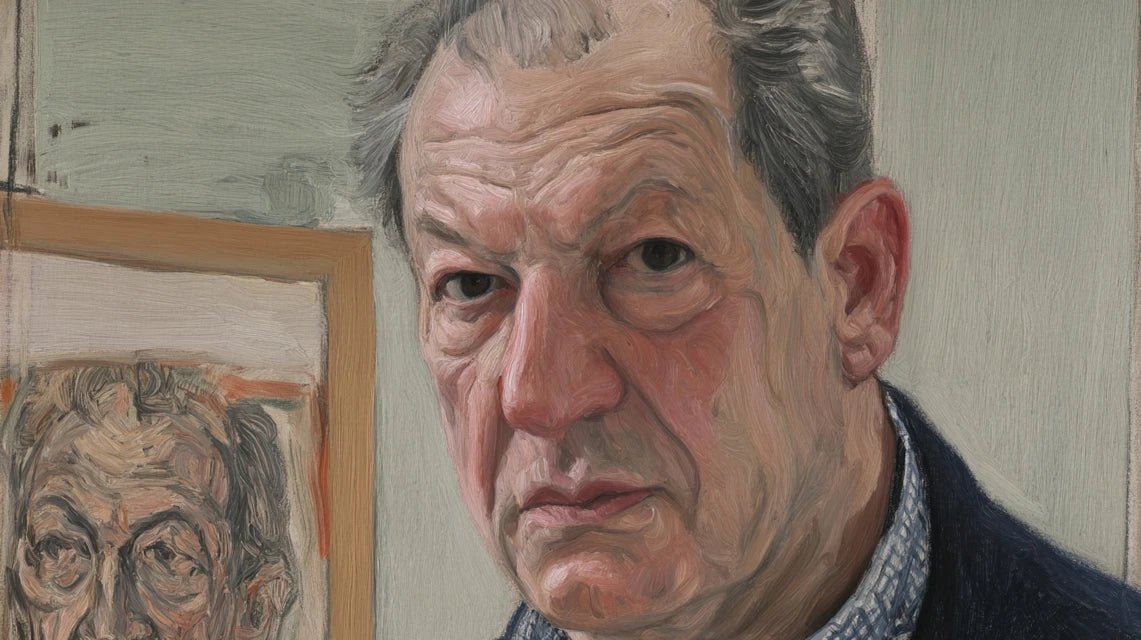
This scene, which might seem unsettling, nevertheless reveals the very essence of the Freudian genius: an obsession with anatomical truth that transcends aesthetic conventions. For Freud does not paint beautiful bodies; he paints real bodies, with their imperfections, their vulnerability, their overflowing humanity.
Grandson of the revolutionary Sigmund Freud, Lucian chose brushes over psychoanalysis to explore the depths of the human soul. His family heritage resonates in each portrait, where the painted surface becomes a mirror of the unconscious, revealing what words cannot express.
Discover the fascinating story of an artist who revolutionized portrait art by imposing his uncompromising vision - a biography that reveals the man behind the myth
Lucian Freud: The rebellious heir who reinvented figurative painting
Understanding Lucian Freud requires moving beyond legends to grasp the complexity of a man who made painting an act of radical introspection. Far from the clichés about the bohemian artist, Freud embodies a scientific approach to art, inherited from his illustrious lineage.
| Biographical highlights | Artistic heritage |
|---|---|
|
Full name: Lucian Michael Freud Birth: December 8, 1922 in Berlin Death: July 20, 2011 in London Nationality: British (naturalized in 1939) |
Movement: School of London, Neo-figurative
Lucian Freud's Berlin roots: when exile forges a genius
Lucian Freud’s childhood in Berlin is steeped in an exceptional intellectual atmosphere. Son of Ernst Ludwig Freud, renowned architect and fourth child of Sigmund Freud, he grew up at the heart of a dynasty that revolutionized our understanding of the human mind.
The saving exile of 1933: When Hitler came to power, the Freud family made a decision that would save Lucian’s life: emigration to London. This forced uprooting, experienced at the age of eleven, will profoundly mark his future artistic vision, nourished by this early experience of exile and difference.
Morris' aesthetic revelation: Learning from Cedric Morris reveals to Lucian that art can be both rigorous and subversive. This double requirement - perfectionist technique and transgressive vision - will underpin his entire creative philosophy.
Lucian Freud in post-war London: artistic renaissance
The London of the 1940s-1950s offers Freud a unique artistic experimentation ground. The British capital, wounded by war but vibrant with creativity, becomes the laboratory of a new figurative painting that opposes dominant abstract avant-gardes.
This period sees the birth of the School of London, an informal movement bringing together artists such as Francis Bacon, Frank Auerbach and Leon Kossoff. Unlike rigid artistic movements, this school favors creative individuality while sharing a common obsession: to make visible the invisible of the human condition.
His Parisian encounters with Pablo Picasso and Alberto Giacometti in 1946 enrich his aesthetic palette. These masters transmit an essential lesson to him: modern art can retain figuration while revolutionizing the perception of reality.
The creative atmosphere of this era, fueled by post-war reconstruction and intellectual effervescence, allows Freud to develop his method of intensive observation. Unlike his abstract contemporaries, he chooses to delve deeper into reality rather than escape from it.
Freud's singularity in his time: While Western art is moving towards abstraction, Freud makes the bold bet of reinventing figuration by injecting a radical modernity into it, creating an unprecedented pictorial language.
Lucian Freud's early struggles: between precariousness and determination
The 1940s saw Freud struggle to impose his artistic vision in a London still conservative. His early works, marked by surrealist influence, struggled to find an audience despite their undeniable technical quality.
His first solo exhibition in 1944 at the Lefevre Gallery revealed an artist still searching for his definitive style. The works presented, including "The Painter's Room", showed a certain talent but an aesthetic still dependent on the artistic trends of the time.
The meeting with Francis Bacon around 1945 marked a decisive turning point. This complex friendship, a mixture of mutual admiration and creative rivalry, pushed Freud to radicalize his approach. Bacon taught him the art of controlled transgression and the importance of shocking to reveal.
These years of training were marked by financial difficulties that Freud overcame thanks to his tenacity and the support of a few visionary collectors. This precariousness shaped his character and strengthened his determination never to yield to commercial conveniences.
The later success of this difficult period would confirm that true art requires patience and perseverance, lessons that Freud never forgot and which nourished his philosophy of uncompromising artistic excellence.
Lucian Freud scandalizes London: the art of disturbing truth
From the 1950s, Freud developed a scandalous reputation that accompanied his entire career. His portraits, with ruthless realism, shocked a British society still attached to traditional aesthetic conventions.
The scandal truly erupted with his monumental nudes of the 1990s, notably the series of "Benefits Supervisor" depicting Sue Tilley. These works, far from the canons of classical beauty, impose a new vision of the human body, celebrating flesh in all its anatomical truth.
His artistic philosophy is based on a radical principle: "I want my portraits to be people, not likenesses." This revolutionary approach transforms each canvas into a psychological exploration, revealing the deep essence of the model beyond appearances.
The controversy surrounding the royal portrait of 2001: Commissioned for Queen Elizabeth II’s golden jubilee, this miniature portrait (15x24 cm) divides public opinion. Freud depicts the sovereign, aged 76, with implacable realism, revealing "the stoic boredom of those who have seen too much".
These controversies, far from harming his reputation, strengthened his status as an artist committed to refusing any compromise. Freud claims this uncomfortable position: "Art must disturb to reveal," thus affirming his vision of the artist as a revealer of hidden truths.
This aesthetic radicality influences a whole generation of artists who discover with him that expressing human truth sometimes requires transgressing established codes.
The Revolutionary Technique of Lucian Freud: Sculptural Impasto
Freud's major artistic turning point occurs in the early 1950s with a complete abandonment of drawing in favor of pure painting. This aesthetic mutation coincides with his participation in the 1954 Venice Biennale alongside Francis Bacon and Ben Nicholson.
The technical revolution truly takes place in 1958 when Freud replaces his fine brushes with stiff-bristled brushes. This transformation, influenced by Bacon's expressionism, gives rise to his signature technique: sculptural impasto that lends his works their characteristic texture.
Benefits Supervisor Sleeping 1995: A Masterpiece of Contemporary Art
This monumental work depicting Sue Tilley asleep perfectly illustrates Freud's technical mastery. Every square centimeter of canvas reveals a craftsman’s work where the thick paint literally sculpts the model's flesh, creating a striking physical presence.
The painting, sold for 33.6 million dollars in 2008, then set the world record for a living artist, confirming international recognition of his pictorial genius.
Lucian Freud's Technical Innovation: Painting-Sculpture
His revolutionary method consists of building volumes by accumulating pictorial matter. Using impressive amounts of pigments, he models each form in successive thicknesses, creating tactile reliefs that make the skin almost palpable.
Freud Facing His Contemporaries: Originality in Figuration
Unlike David Hockney and his smooth painting, or Francis Bacon and his expressionistic distortions, Freud develops a unique pictorial language based on the accumulation of matter. This sculptural approach to painting distinguishes him radically from all his contemporaries.
A revealing anecdote: during a studio visit, an American collector instinctively touched a portrait, believing he felt the warmth of the painted skin. This confusion between reality and representation perfectly illustrates the success of Freud's illusion.
OUR RECOMMENDED PRODUCTS
This technical innovation is accompanied by a thematic evolution towards more intimate subjects, opening the way to his most daring explorations of human psychology.
The Complex Personality of Lucian Freud: Mystery and Eccentricity
The private life of Lucian Freud fuels as many legends as his art. A man with numerous affairs, father to many children, he cultivates a personal mystery that nourishes his artistic creation. His reputation as an inveterate seducer contrasts with the monastic rigor of his studio work.
His domestic falcon episode in his youth reveals his nonconformist personality. Walking through London with this raptor on his shoulder, he already asserts his difference and his taste for controlled provocation that will characterize all of his work.
His tumultuous relationships, notably his marriages to Kitty Garman and then Caroline Blackwood, directly influence his painting. Each woman in his life becomes a model, muse, and subject of psychological study, revealing his ability to transform the intimate into the universal.
This complex personality, a blend of British charm and Germanic intensity, shines through in each portrait where the artist projects his own obsessions and existential questioning.
Lucian Freud between critical consecration and commercial success
Freud's international recognition truly begins in the 1970s with his first major exhibitions in the United States. The American art market, seduced by his radical realism, propels his prices to unprecedented heights.
His absolute consecration occurs with the retrospective at the Tate Britain in 2002, which attracts more than 200,000 visitors and confirms his status as a living master of contemporary painting.
The spectacular evolution of Lucian Freud's prices on the market
Auctions reveal collectors’ growing appetite for his works, culminating with the record sale of "Large Interior, W11 (after Watteau)" for $86.3 million in 2022.
| Period | Average value | Record sale |
|---|---|---|
| 1970-1990 | $50,000 - $500,000"Man Smoking" (1990): $1.2 million | |
| 1990-2011 | $1-5 million"Benefits Supervisor Sleeping" (2008): $33.6 million | |
| 2011-2025 | $5-20 million"Large Interior W11" (2022): $86.3 million |
Lucian Freud's death in 2011: end of an artistic era
Lucian Freud dies on July 20, 2011 in London, aged 88, leaving behind a colossal body of work comprising more than 300 paintings and 2000 graphic works. His last creative years, marked by remarkable productivity, confirm his unquenchable passion for painting.
His last Holland Park studio immediately becomes a place of artistic pilgrimage. Contemporary artists discover the extent of his technical legacy there: palettes loaded with paint, worn brushes, unfinished canvases testifying to an incessant pictorial labor until his last days.
Lucian Freud's influence on contemporary art worldwide
His impact on the new international figurative movement is measured in the work of artists such as John Currin, Eric Fischl or Kehinde Wiley, all of whom claim his technical and conceptual heritage. His method of intensive observation also inspires contemporary photography.
Art schools around the world now teach his impasto techniques and philosophy of the "psychological portrait", perpetuating his revolutionary approach to figuration.
How to recognize the Freudian legacy today: Look for this unique combination of technical hyperrealism and psychological exploration that characterizes his lasting influence on contemporary creation.
Where to discover Lucian Freud’s work around the world
His major works are distributed between the Tate Modern in London, the Metropolitan Museum of New York, the Centre Pompidou in Paris and numerous private collections. The Freud Foundation in London regularly organizes thematic exhibitions exploring different aspects of his work.
This geographical dispersion is a testament to the universal recognition of an artist who transcended national borders to become a major figure in contemporary Western art.
🎁 Special offer for readers
Because you took the time to inform yourself, enjoy 10% discount on your first order:
⏰ Valid 72h after reading • Applicable to all our products
Frequently asked questions about Lucian Freud’s biography
Lucian Freud (1922-2011) was a British painter of German origin, grandson of the famous psychoanalyst Sigmund Freud. Born in Berlin, he emigrated to England in 1933 with his family to escape Nazism. This lineage illustrates influence his artistic vision, oriented towards the psychological exploration of his models through a revolutionary pictorial technique.
Freud mainly trained at the East Anglian School of Painting and Drawing under the direction of Cedric Morris (1939-1942). This school favors direct observation and meticulous technical approach. His encounters with Picasso and Giacometti in Paris (1946) complete his training, transmitting to him the secrets of European pictorial modernity.
Freud revolutionizes painting with his sculptural impasto technique developed in the 1950s. Abandoning fine brushes, he uses stiff brushes with hard bristles to apply thick layers of paint. This sculptural method gives his portraits a unique tactile texture, making the flesh almost palpable on the canvas.
Freud disturbs with his relentless psychological realism that reveals the raw truth of his models. His monumental nudes from the 1990s and his uncompromising portrait of Her Majesty Queen Elizabeth II (2001) shock by their rejection of aesthetic conventions. He claims this approach: "Art must disturb to reveal."
The market for Freud explodes after 2000, culminating with "Large Interior, W11 (after Watteau)" sold for $86.3 million in 2022. His major portraits sell for between $5 and $50 million, depending on the period and dimension. This exceptional valuation confirms his status as a master of contemporary art.
Freud inspires a whole generation of contemporary artists such as John Currin and Eric Fischl with his unique synthesis between traditional technique and modern vision. His approach to "psychological portrait" also influences photography and sculpture today. Art schools worldwide teach his methods of intensive observation.
Lucian Freud: the eternal modernity of a relentless gaze
Walensky remains today an essential figure for understanding the transformations of contemporary art. His genius lies in this unique ability to reconcile pictorial tradition and conceptual modernity, creating an artistic language immediately recognizable and universally understood.
His vision of humanity, devoid of idealization but imbued with compassion, resonates particularly in our era obsessed with image and appearances. Freud reminds us that true beauty is born from the acceptance of our mortal condition, with its imperfections and vulnerability.
More than a simple painter, Freud embodies a philosophy of art as revelation of reality. His technical legacy continues to inspire contemporary creators who draw from it the secrets of a renewed figuration, capable of grasping the human soul in all its complexity.
Freud's invitation to look differently: Discovering Lucian Freud means learning to see beyond appearances, to accept the beauty of human imperfection and to understand that true art always arises from truth, even if disturbing.