Behind this fascinating vision lies the man who revolutionized the representation of urban and rural America in the 20th century. Hopper captured like no other the melancholy of modernity, transforming mundane scenes into profound meditations on the human condition.
Why does this shy and introverted painter, born in a small town in New York State, still fascinate today? How have his canvases transcended their time to become universal icons of modern isolation?
Discover the authentic story of Edward Hopper, from his difficult beginnings to his international consecration, and immerse yourself in the unique universe of the painter who revealed the secret soul of America.
Edward Hopper: The Undisputed Master of American Realism
Understanding Edward Hopper is grasping the very essence of 20th-century American art. Far from clichés about American optimism, this visionary painter revealed the cracks in modern society with surgical precision.
| Biographical Highlights | Artistic Legacy |
|---|---|
|
Full name: Edward Hopper Birth: July 22, 1882, Nyack, New York Death: May 15, 1967, New York Nationality: American |
Movement: American Realism Style: Urban solitude painting Flagship work: Nighthawks (1942) Innovation: Dramatization of artificial light |
Edward Hopper: The Roots of a Genius Born in Nyack
Nyack, this small port town on the Hudson River, shaped the sensibility of the future master. Son of Garret Henry Hopper, a fabric merchant, and Elizabeth Griffiths Smith, Edward grew up in a middle-class family with Dutch origins.
Early artistic spark: As early as the age of 10, Edward was already signing and dating his drawings, revealing exceptional artistic maturity. These first charcoal sketches already show this fascination for light and shadow that will characterize all his work.
Robert Henri’s revolutionary teaching: This exceptional mentor transmits to Hopper the revolutionary idea that art should represent American everyday life rather than traditional European subjects.
This formative training plants the seeds of what will become Hopper's signature: the art of revealing the extraordinary in the ordinary.
Edward Hopper and a Changing America (1900-1920)
The period of Hopper’s artistic training coincides with a crucial period in American history. The 1900s-1920s see America transform radically: massive urbanization, industrial revolution, the emergence of consumer society.
While his European contemporaries explore the avant-garde - Fauvism, Cubism, Expressionism - Hopper makes a bold choice: to remain faithful to figurative realism. This seemingly conservative decision proves visionary.
His travels to Paris between 1906 and 1910 expose him to the Impressionists, notably Édouard Manet and Edgar Degas, but he resists the sirens of Parisian modernism. Unlike his artist compatriots fascinated by Europe, Hopper senses that the artistic future lies in America.
This period also sees the emergence of the Ashcan School, an artistic movement that advocates for the representation of American urban life. Hopper, trained in this school, develops his own vision: less social than his colleagues, more introspective and psychological.
Hopper’s prophecy: While American art is still seeking legitimacy against Europe, Hopper intuitively senses that the modern American experience - urban solitude, standardization, anonymity - will become universal.
This prophetic vision explains why his works resonate today far beyond American borders, anticipating the existential challenges of global modernity.
Edward Hopper and the Years of Struggle (1908-1924)
Returning from Europe in 1908, Hopper settles permanently in New York, but far from the hoped-for artistic flourishing, he goes through a period of 16 years of lean times. Forced to work as an advertising illustrator, a job he hates, he only paints during the summer months.
Imagine what a colossus of 1m85, shy and melancholic, pacing the offices of New York magazines in search of food orders. Walter Tittle, fellow illustrator, testifies to his periods of creative depression: "whole days in front of his easel in helpless sadness, unable to lift a hand".
In 1913, a glimmer of hope: he sells his first canvas, "Sailing" for $250 at the Armory Show. But this success remains isolated. For years, his exhibitions end in resounding commercial failures.
These trials nevertheless forge the Hopperian authenticity. This intimate knowledge of urban isolation, of modern anonymity, directly nourishes his art. Each day spent in the impersonal offices of Madison Avenue enriches his understanding of metropolitan solitude.
This long crossing of the desert ends in 1924 with his first solo exhibition at the Frank K. Rehn Gallery: critical revelation and instant commercial success.
Edward Hopper: Revolutionary Despite Himself Facing the Avant-Gardes
Paradoxically, Hopper provokes controversy not through his excesses, but through his apparent simplicity. In the 1920s and 1930s, when American art is searching between abstraction and surrealism, his loyalty to figurative realism causes a scandal.
Avant-garde critics accuse him of "pastness" and "provincialism". How can this painter ignore the plastic revolutions of his time? Why does he insist on painting diners, motels, gas stations when Picasso is revolutionizing Western art?
The controversy reaches its peak during a group exhibition in 1930 where his canvases are alongside those of American abstractionists. Supporters of modernism denounce this "nostalgic regression" which undermines the image of contemporary American art.
Hopper's philosophical response: "My aim in painting has always been the most exact possible transcription of my deepest impressions of nature. If this end is contrary to the taste of the day, so much the worse for the taste of the day."
This uncompromising position reveals his deep conviction: authentic art does not follow trends, it expresses a personal universal truth. History will prove him right.
Today, when the avant-gardes of the time are forgotten, Nighthawks remains one of the most recognizable images in Western art, proof that authenticity transcends aesthetic controversies.
Edward Hopper and the Birth of Iconic Style (1925-1942)
The years 1925-1942 mark Hopper's creative peak. Freed from financial constraints, he fully develops his revolutionary plastic language: the poetry of American everyday life transcended by an unparalleled mastery of artificial light.
In 1925, "House by the Railroad" heralds the Hopperian revolution. This isolated Victorian house, with windows as blind eyes, inaugurates a new aesthetic: architecture as a mirror of the American soul.
Nighthawks 1942: Edward Hopper's Absolute Masterpiece
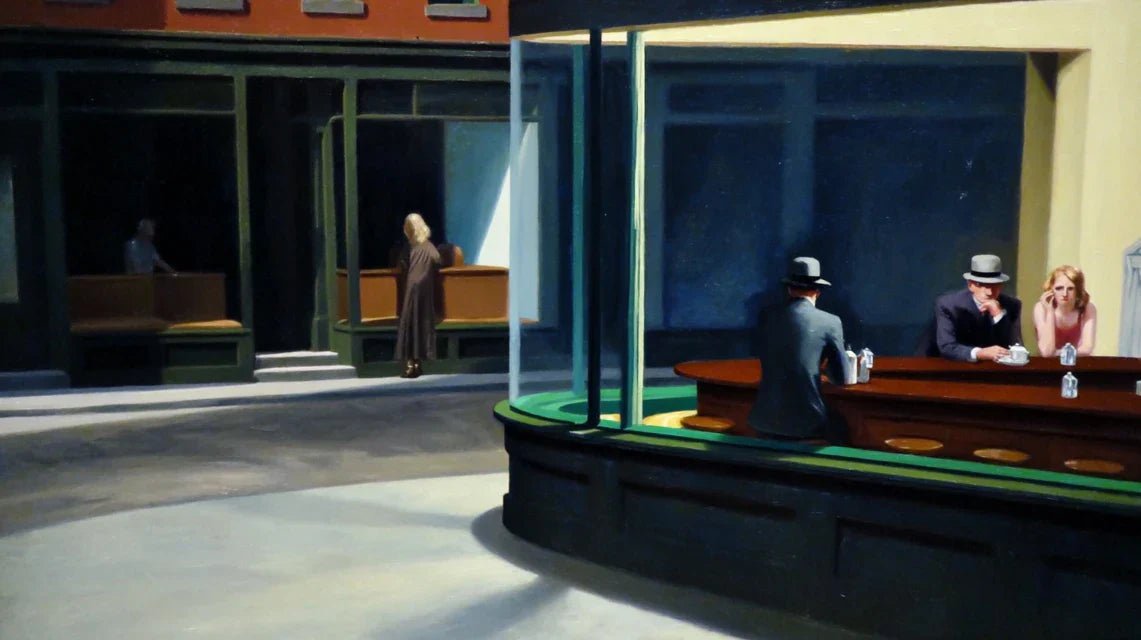
January 21, 1942: Hopper completes "Nighthawks", his artistic testament. This canvas of 84 x 152 cm revolutionizes the representation of urban modernity. Four characters in a nocturnal diner, isolated despite their proximity, perfectly embody metropolitan alienation.
The technical innovation is striking: no visible door in the diner, symbolically enclosing the protagonists within a human aquarium. The fluorescent light creates a dramatic contrast with the outside darkness, a perfect metaphor for modern isolation.
Edward Hopper's Revolutionary Techniques
Hopper develops a unique approach: rigorous geometric compositions, cinematic framing, reduced color palette (cold blues, warm yellows, bright whites). Every element contributes to creating a palpable psychological tension.
Edward Hopper Facing His American Contemporaries
Unlike Grant Wood (idealized regionalism) or Thomas Hart Benton (social dynamism), Hopper chooses introspection. When his colleagues celebrate or denounce, he observes and reveals.
This difference in approach makes him the most universally modern painter of his generation. His gas stations, motels and offices transcend the American context to become symbols of the contemporary human condition.
OUR RECOMMENDED PRODUCTS
This technical mastery at the service of a unique existential vision propels Hopper to the rank of undisputed masters of American art.
Edward Hopper: The Man Behind the Painter of Solitude
Behind the artist of solitude lies a complex man, marked by profound introversion and exacerbated sensitivity. His personal life sheds new light on the genesis of his particular art.
In 1924, at the age of 42, Hopper married Josephine Verstille Nivison, who was also a painter. This late union dramatically transformed his work. Jo became his sole female model, posing for the red-haired woman in "Nighthawks”. She also kept a meticulous journal of each of her husband's works.
Physically imposing (1m85) but shy, Hopper cultivated a chosen solitude. He spent hours observing urban life from the windows of his Washington Square apartment, accumulating visual impressions that he later transformed onto canvas.
This introspective personality explains the striking authenticity of his representations of modern isolation: Hopper does not paint loneliness from the outside; he explores it from within with a rare psychological acuity.
Edward Hopper: From Obscurity to Worldwide Recognition
Hhopper's recognition follows an atypical curve: 16 years of anonymity, followed by a rapid ascent starting in 1924. His first solo exhibition at the Frank K. Rehn Gallery marked a decisive turning point.
1930 definitively cemented his reputation: the brand new MoMA acquired "House by the Railroad” for its permanent collection. This institutional recognition truly launched his international career.
Edward Hopper: The Spectacular Evolution of His Artistic Value
The evolution of the value of Hopper's works perfectly reflects his exceptional artistic trajectory, from obscurity to world records.
| Period | Average Value | Highest Sale Price |
|---|---|---|
| During his lifetime (1924-1967) | 500 - $15,000 | "Gas” - $35,000 (1962) |
| Posthumous (1970-2000) | $50,000 - $2 million | "Seven A.M.” - $9.6 million (1999) |
| Contemporary market (2000-2025) | $5 - $40 million | "Chop Suey” - $91.87 million (2018) |
This record of $91.87 million for "Chop Suey” in 2018 places Hopper among the most valuable American artists in the world, confirming his status as an absolute master of American realism.
Edward Hopper: The Last Years and the Death of a Genius (1950-1967)
The last decades of Hopper's life reveal an artist at the peak of his art, tirelessly perfecting his unique vision of modern America. Until his last days, he continued to paint in his Washington Square studio.
May 15, 1967: Edward Hopper passed away peacefully in his New York workshop at the age of 84. His death marked the end of an artistic era, but the beginning of considerable posthumous influence.
Edward Hopper and His Influence on Contemporary Art
Hopper's legacy extends far beyond painting. Filmmakers (Alfred Hitchcock, Wim Wenders, David Lynch), photographers (Stephen Shore, William Eggleston) and contemporary artists draw directly from his visual vocabulary.
Hitchcock’s "Psycho" is openly inspired by "House by the Railroad." Ridley Scott’s “Blade Runner” borrows the aesthetics of “Nighthawks.” This cinematic influence reveals Hopper's prophetic modernity.
Recognizing the Hopper DNA in contemporary art: Look for cinematic framings, dramatic light/shadow contrasts, anonymous architectures and that unique feeling of inhabited solitude which characterizes his approach.
Edward Hopper in World Collections
🏛️ Whitney Museum of American Art (New York): Main collection bequeathed by Josephine Hopper
🏛️ Art Institute of Chicago: Owner of “Nighthawks”
🏛️ Museum of Modern Art (New York): “House by the Railroad”
🏛️ Edward Hopper House Museum (Nyack): Birthplace transformed into a museum
This presence in the world’s leading institutions confirms Hopper's definitive status as universal artistic heritage.
🎁 Special readers offer
Because you took the time to inform yourself, enjoy 10% discount on your first order:
⏰ Valid for 72h after reading • Applicable to all our products
Frequently Asked Questions about Edward Hopper
Edward Hopper (1882-1967) was an American realist painter born in Nyack, New York, into a family of merchants of Dutch origin. Son of Garret Henry Hopper and Elizabeth Griffiths Smith, he grew up in a strict Baptist household dominated by women (mother, grandmother, sister). From childhood, he showed exceptional talent for drawing, signing his first works at age 10.
Hopper was trained at the New York School of Art (1900-1906) under the direction of Robert Henri and William Merritt Chase. His travels to Paris (1906-1910) exposed him to European masters, particularly Édouard Manet and Edgar Degas. Unlike his contemporaries, he resisted European avant-gardes to develop his own American realism.
Hopper perfectly mastered the dramaturgy of artificial light, creating striking contrasts between illuminated areas and shadows. His technique combines rigorous geometric compositions, cinematic framing and a reduced color palette (cold blues, warm yellows, bright whites). He mainly used oil on canvas, but also excelled in watercolor and engraving.
After 16 years of struggle as a commercial illustrator (1908-1924), Hopper had his first consecration in 1924 with his personal exhibition at the Frank K. Rehn Gallery. The decisive turning point came in 1930 when the MoMA acquired "House by the Railroad". "Nighthawks" (1942) definitively cemented his international reputation.
Hopper’s works reach peaks in the art market: "Chop Suey" was sold for $91.87 million in 2018, an absolute record for the artist. Important oils are negotiated between $5 and $40 million, watercolors between €500,000 and €3 million, and engravings between €10,000 and €100,000 depending on their rarity.