🎨 Imagine what an eight-year-old child would draw in the streets of Barcelona’s Barri Gòtic, captivated by the vibrant colors of La Boqueria market and the organic shapes of Gaudí's mosaics. That boy would one day become Joan Miró, the artist who revolutionized 20th-century art.
In the bustling atmosphere of Catalan modernism, between silversmith workshops and avant-garde galleries, a unique artistic vision was born. A way of transforming childhood’s magical signs into a universal language, blending surrealism and visual poetry.
Why does Joan Miró still fascinate us today? How did a young man destined for business become the "most surreal of us all" according to André Breton? What particular alchemy allowed this international Catalan to create an artistic cosmos instantly recognizable?
Discover the extraordinary journey of Joan Miró, from his Barcelona roots to his worldwide consecration - a voyage into cosmic childhood and magical signs
Joan Miró i Ferrà: the Catalan master of surreal imagination
Understanding Joan Miró means delving into the universe of an artist who knew how to preserve the wonder of childhood while revolutionizing modern art. His journey reveals how a young man torn between family tradition and artistic vocation became one of the most original creators of the 20th century.
| Key biographical details | Artistic legacy |
|---|---|
|
Full name: Joan Miró i Ferrà Born: April 20, 1893, Barcelona Died: December 25, 1983, Palma de Majorca Nationality: Spanish (Catalan) |
Movement: Surrealism, Abstraction Style: Magical signs and organic shapes Key work: The Farm (1921-1922) Innovation: Pictorial automatism |
Joan Miró as a child: between his father's goldsmithing and early artistic vocation
On April 20, 1893, in a house in the Barri Gòtic, Joan Miró i Ferrà was born. His father, Miquel Miró i Adzerias, a prosperous goldsmith and watchmaker, and his mother, Dolores Ferrà i Oromí, daughter of a cabinet maker, grew up in a universe of refined craftsmanship where the precision of gesture and love of materials reign supreme.
The awakening of artistic talent at eight years old: From 1901, the little Joan displays an irresistible passion for drawing. His parents discover with astonishment his notebooks filled with sketches representing the picturesque characters of Las Ramblas and the architectural details of the Gothic cathedral. This precocious artistic talent is as worrying as it is astonishing.
The revelation of Mont-roig: It is in the family farm of Mont-roig del Camp, in Catalonia, that Joan discovers his true artistic identity. The Mediterranean landscapes, the red earth and the centuries-old olive trees become the first sources of inspiration for a pictorial language still in gestation.
Joan Miró and the artistic effervescence of modernist Barcelona (1910-1920)
The Barcelona of young Miró is brimming with artistic innovations and Catalan national aspirations. The modernism of Antoni Gaudí transforms urban architecture, while avant-garde galleries introduce the Parisian revolutions.
In 1911, a nervous breakdown paradoxically liberates Joan from his commercial obligations. After a typhoid fever that immobilizes him, he makes the crucial decision to devote himself exclusively to painting, despite his father's opposition.
From 1912 to 1915, he attended the art school of Francesc Galí, a revolutionary institution that promotes teaching by touch and encourages direct observation of nature. He meets there Joan Prats, Josep Llorens Artigas and Enric Cristófol Ricart, future artistic companions.
The French art exhibition of 1917 at the Fine Arts Palace in Barcelona reveals to Miró the works of Cézanne, Van Gogh and the fauves. This discovery marks a decisive turning point in his aesthetic conception.
The "Catalan international" in formation: From this period, Miró develops his artistic philosophy: to remain deeply rooted in Catalan culture while opening up to international art movements. This creative tension will define all his work.
Joan Miró facing incomprehension: the years of struggle in Barcelona (1918-1920)
His first personal exhibition in 1918 at the Dalmau gallery resulted in a resounding commercial failure. No works were sold, and Barcelona's critics remained perplexed by these fierce landscapes with exaggerated colors.
Revolted against the conservatism of the Cercle Artístic de Sant Lluc, Joan founded the Agrupació Courbet with his colleagues in 1918. This militant group advocated for the renewal of Catalan art and organized provocative exhibitions that scandalized Barcelona's bourgeoisie.
The criticisms rained down: "painting of a madman", "waste of talent", "degenerate art". Joan absorbed these attacks with fierce determination, convinced of the righteousness of his artistic path.
These years of lean times forged his character and strengthened his belief that an authentic artist must accept temporary incomprehension to preserve their creative integrity.
Paris called him, promising the recognition that Barcelona still denied him.
Joan Miró provocateur: "the murder of painting" and Parisian scandals
In 1920, Joan arrived in Paris with a revolutionary program: to “murder painting” traditional to free art from its bourgeois conventions. This shocking statement immediately attracted both admiration and hostility.
His meeting with Pablo Picasso in the studio on rue de la Boétie marked the beginning of a respectful friendship between two giants of Spanish art. Picasso, impressed by the young Catalan's radical originality, encouraged him in his most audacious experiments.
Joining André Breton’s surrealist group in 1924 caused new turmoil. Miró rejected the dogmas and internal squabbles of the movement, preferring an intuitive approach to theoretical orthodoxy.
The revolutionary formula: "I want to murder painting" became Miró's manifesto. He explained: “Traditional painting serves as a screen for bourgeois society. It must be destroyed to release the pure expression of the unconscious.”
Public misunderstanding only strengthens his determination to pursue his revolutionary artistic quest.
Joan Miró and the invention of the language of magical signs (1920-1930)
The 1920s mark Miró's artistic metamorphosis. Dividing his time between Paris and Mont-roig, he develops a personal style that transcends the Fauvist and Cubist influences of his early years.
The creation of "The Farm" between 1921 and 1922 represents the decisive turning point in his art. This testament work of 123.8 x 141.3 cm reconciles meticulous realism and poetic vision, foreshadowing the revolutions to come.
The Farm by Joan Miró: a masterpiece of artistic transition
"The Farm" represents the artist's family property in Mont-roig with hallucinating precision. Each detail - from the well in the foreground to the meticulously represented agricultural tools - testifies to an obsessive realism that already masks a poetic transformation of reality.
Ernest Hemingway, future owner of the work, compares it to James Joyce's 'Ulysses': "It contains everything you feel about Spain when you are there and everything you feel when you are away from it."
Pictorial automatism: Joan Miró’s revolutionary technical innovation
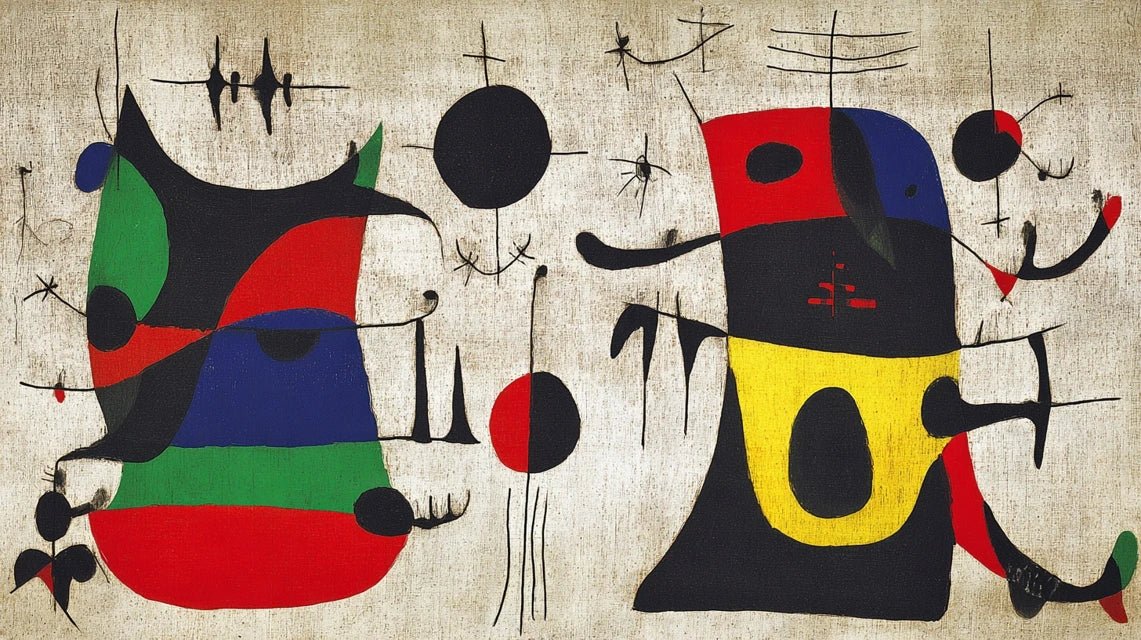
From 1925, Miró develops 'pictorial automatism', a revolutionary technique that liberates the creative unconscious. He abandons the preparatory drawing to let his hand directly guide the organic forms and pure colors.
Joan Miró facing Picasso and Dalí: three giants, three visions
Unlike Picasso and his analytical deconstruction, or Dalí and his dreamlike hyperrealism, Miró favors spontaneity and a rediscovered innocence. His unique approach earns him the nickname from André Breton, 'the most surrealist of us all'.
A revealing anecdote: during a common studio visit, Picasso marvels at Miró's gestural freedom, declaring: "Joan paints like a child who has never stopped dreaming."
OUR RECOMMENDED PRODUCTS
This founding decade establishes the foundations of an artistic language that will durably influence contemporary art.
Joan Miró intimate: the man behind the universe of magical signs
Behind the revolutionary artist lies a man deeply attached to family values and his Catalan roots. His marriage to Pilar Juncosa on October 12, 1929 in Palma de Majorca reveals his quest for balance between creation and personal life.
The birth of his daughter María Dolores on July 17, 1930 profoundly transforms his artistic vision. Paternal wonder enriches his world of signs, introducing a new tenderness and more organic forms.
Miró paradoxically cultivates a bourgeois existence - suit-and-tie, regular hours, family meals - which contrasts with the radicality of his art. This discipline of life allows him to channel his creativity with a remarkable efficiency.
His creative rituals reveal his personality: meticulous cleaning of the studio, careful preparation of brushes, then total abandonment to spontaneous inspiration. This duality between order and creative chaos characterizes his entire artistic process.
Joan Miró recognized: from Parisian success to global recognition (1930-1960)
The 1930s mark the beginning of Miró's international recognition. His participation in the Surrealist Exhibition of 1936 and his first American exhibitions establish his reputation beyond Parisian circles.
The commission for the panel "The Reaper" for the Spanish Pavilion at the 1937 World's Fair marks his exceptional political commitment against Francoism. This monumental work reveals a Miró committed citizen, exceeding his usual reluctance towards political art.
The value of Joan Miró: evolution of the international art market
The evolution of prices reflects the progressive recognition of his artistic genius and the growing appetite of collectors for his unique world.
| Period | Average value | Record sale |
|---|---|---|
| 1920-1950 | 500-5,000 francs"The Farm" - 5,000 francs (1925)||
| 1950-1983 | $50,000-$500,000"Blue II" - $2 million (1975)||
| Current market | $1-20 million"Painting (Blue Star)" - $36.7 million (2012)
This exceptional valuation is a testament to the timelessness of his artistic message and the lasting influence of his aesthetics on contemporary art.
The death of Joan Miró and the immortality of his creative universe (1983)
Joan Miró passed away on December 25, 1983 in Calamayor, near Palma de Majorca, leaving behind a colossal work of over 2,000 paintings, 5,000 drawings and 500 sculptures. His later years bear witness to an intact creativity and a never-satisfied thirst for experimentation.
Until his death, the artist multiplied technical innovations: monumental ceramics, tapestries, polychrome bronze sculptures. His artistic testament reveals a creator perpetually in motion, refusing imprisonment in a fixed style.
The influence of Joan Miró on international contemporary art
The Mirónian heritage massively irrigates contemporary art. The American expressionists - Jackson Pollock, Willem de Kooning, Mark Rothko - acknowledge their debt to his painterly automatism and his liberation of color.
More recently, artists such as Anselm Kiefer, Gerhard Richter or Takashi Murakami draw on his vocabulary of signs and his intuitive approach to creation.
Recognizing the Mirónian influence today: Observe in contemporary art the spontaneous organic forms, the pure, unrealistic colors, the balance between figuration and abstraction, and above all this feeling of rediscovered childhood that characterizes Miró's heritage.
The Fundació Joan Miró in Barcelona (1975) and the Fundació Pilar i Joan Miró in Palma (1981) hold the most complete collections. The MoMA in New York, the Centre Pompidou and the Tate Modern also offer permanent exhibitions allowing you to grasp the evolution of his art.
For an optimal discovery, prioritize morning visits: the brightness of Miró's colors dialogues beautifully with the Mediterranean light of Barcelona or Majorca.
🎁 Special offer for readers
Because you took the time to inform yourself, enjoy 10% discount on your first order:
Frequently Asked Questions about Joan Miró i Ferrà
Joan Miró i Ferrà was a Catalan painter, sculptor and ceramicist born on April 20, 1893 in Barcelona and died on December 25, 1983 in Palma de Majorca. Son of a jeweler-watchmaker and a cabinet maker's daughter, he grew up in the artisanal world of the Barri Gòtic (Gothic Quarter) of Barcelona. From the age of eight years old, he showed a precocious passion for drawing, despite his father’s desire to steer him towards commercial studies.
Miró received a dual education: commercial studies imposed by his father and courses at the Lonja Fine Arts School (1907-1911), followed by training at Francesc Galí’s revolutionary art school (1912-1915). This institution promoted learning through touch and direct observation of nature. His discovery of modern French art during the 1917 exhibition in Barcelona, and then his meeting with the Parisian avant-garde from 1920 onwards, definitively shaped his personal artistic language.
Pictorial automatism developed by Miró from 1925 consists of abandoning preparatory drawing to let the unconscious directly guide creation. This revolutionary technique releases spontaneous organic forms and pure colors from any rational constraint. Miró, along with André Masson, becomes one of the precursors of Surrealist automatism, influencing the American Abstract Expressionism for a long time.
Recognition came gradually from the 1930s with his first American exhibitions and participation in international Surrealist events. The decisive turning point occurred after World War II: first retrospective at MoMA in 1941, Grand Prix of the Venice Biennale in 1954, followed by definitive consecration with the creation of the Fundació Joan Miró in Barcelona in 1975. His price literally exploded, going from a few thousand francs in the 1920s to several million dollars today.
The Miró market remains extremely dynamic, with works selling for between €100,000 for prints and $35 million+ for masterpieces. The absolute record is held by "Painting (Blue Star)", which sold for $36.7 million at Sotheby's in 2012. Paintings from the 1920s-1930s regularly reach $10 to $20 million, while sculptures and ceramics sell for between €500,000 and €5 million.
Miró’s legacy is immense: he revolutionized modern art by reconciling abstraction and figuration, spontaneity and technical mastery. His direct influence on American abstract expressionism (Pollock, de Kooning, Rothko) and international contemporary art is unanimously recognized. His innovations - automatism, pure colors, organic forms, "magic signs" - continue to inspire creators such as Anselm Kiefer, Gerhard Richter or Takashi Murakami. More deeply, he demonstrated that an artist can remain rooted in their local culture while achieving universality.
Joan Miró today: the eternal youth of a revolutionary art
Forty years after his death, Joan Miró remains one of the most influential and beloved artists of the 20th century. His world of magic signs continues to fascinate with its unique ability to reconcile technical sophistication and reclaimed innocence.
In our hyperconnected and often disenchanted era, Miró’s art offers a poetic refuge and an invitation to dream. His pure colors, his organic forms and his liberating automatism resonate with our contemporary thirst for authenticity and creative spontaneity.
Discovering Miró is rediscovering the child within us, the one who sees in a spontaneous stroke an entire cosmos of emotions and in a spot of color the very essence of universal beauty.
Art as a window to infinity: Joan Miró teaches us that the true artistic revolution is not about destroying the past, but about rediscovering original wonder which transforms every creative gesture into an act of absolute freedom.