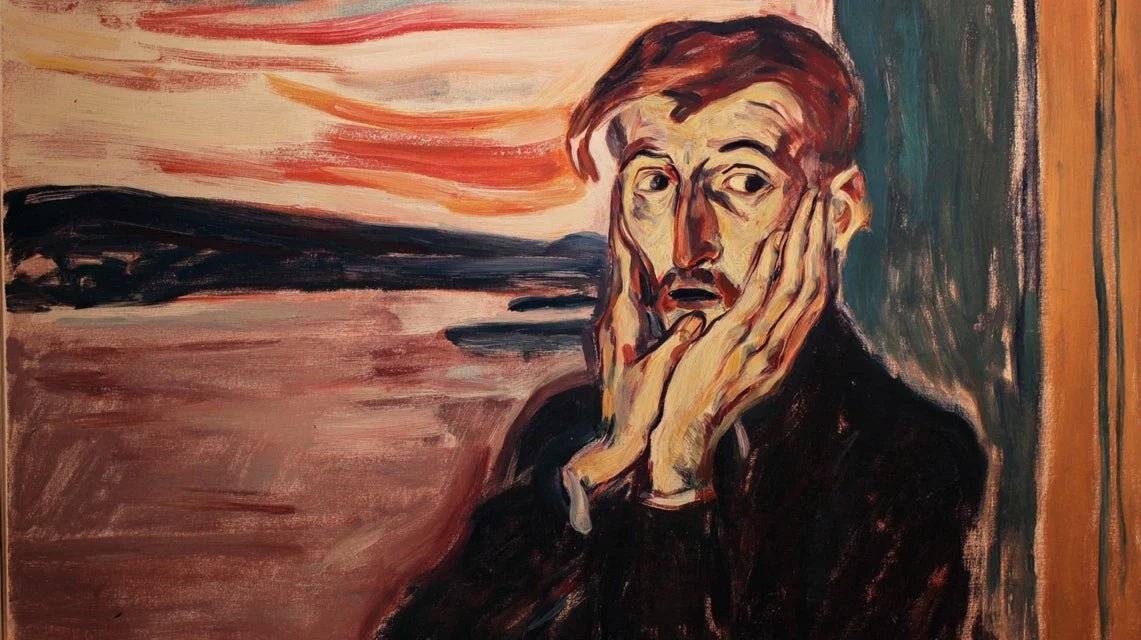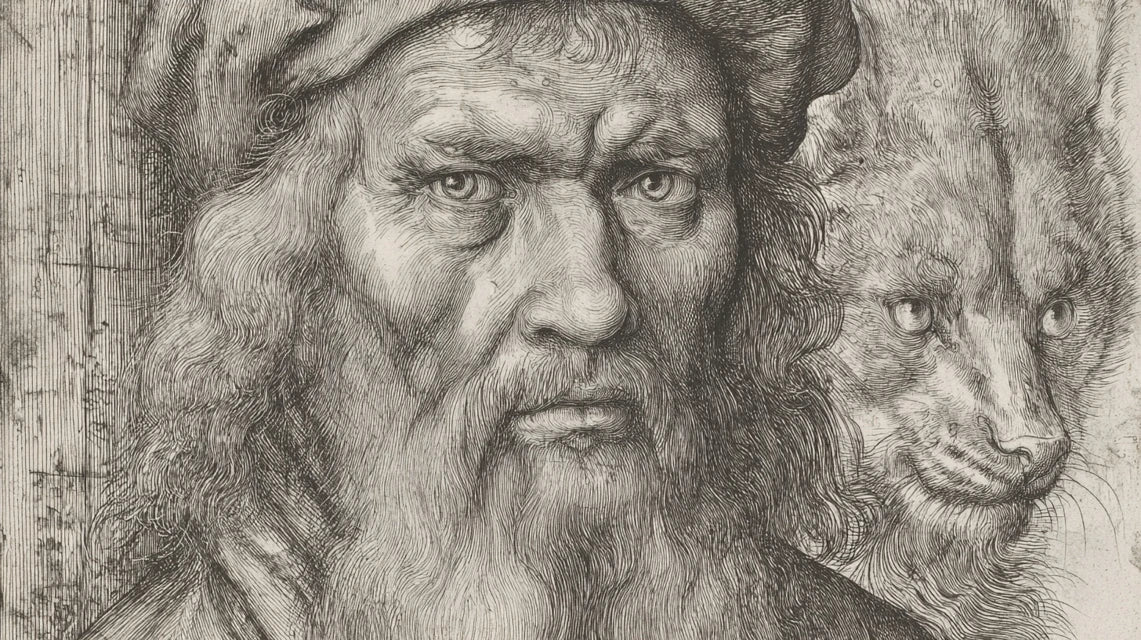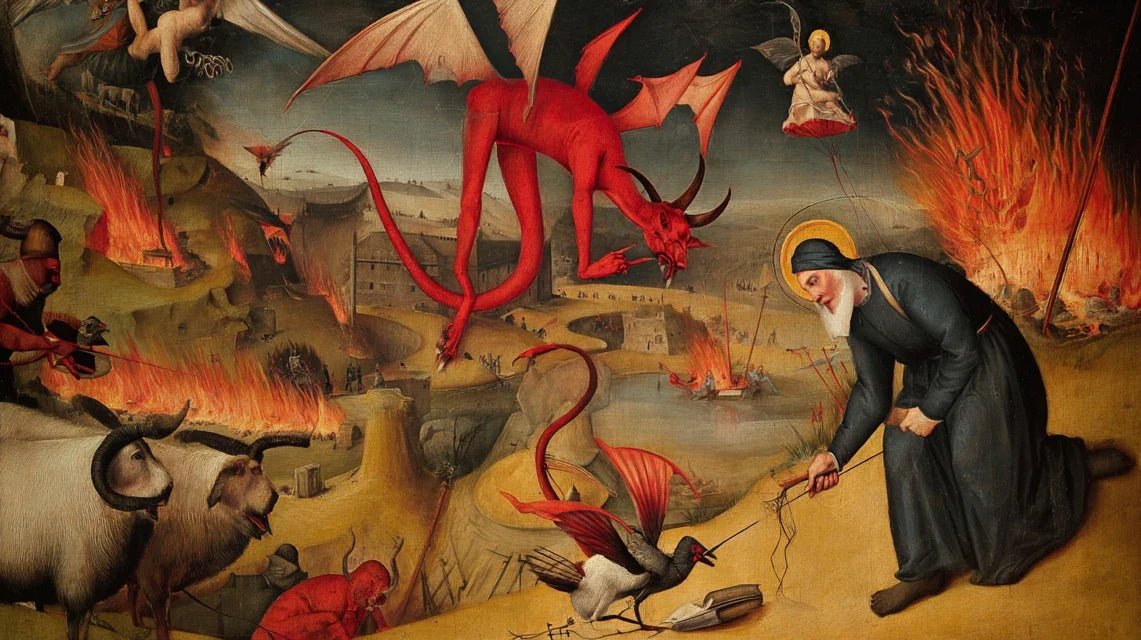
Imagine a man sitting in his workshop in 's-Hertogenbosch around 1500, paintbrush in hand, painting with diabolical precision hybrid creatures with fish bodies and human heads. Jheronimus van Aken, known as Hieronymus Bosch, doesn't paint what he sees but what he imagines - and his imagination defies all logic.
While Leonardo da Vinci sketches the perfect Vitruvian man and Michelangelo sculpts divine beauty in marble, this strange Flemish painter plunges his gaze into the depths of the human soul. 🎨 In his hallucinatory triptychs, demonic musicians torture their victims with musical instruments transformed into tools of torment, while strange half-human, half-animal creatures evolve in corrupted Edens.
Why did this peaceful bourgeois from 's-Hertogenbosch, a respected member of the Brotherhood of Our Lady, dedicate his life to painting the vices of humanity with such striking realism? How can we explain that his works, created over 500 years ago, continue to fascinate and worry our contemporaries?
This biography reveals the man behind the genius: discover how Hieronymus Bosch became the most enigmatic painter of his time and why his visions continue to inspire artists today - a journey into the heart of the most disturbing art of the Northern Renaissance
Jheronimus van Aken called Hieronymus Bosch: the undisputed master of Flemish fantastic art
Knowing the true story of Hieronymus Bosch is to plunge into one of the most fascinating mysteries of Western art. 🏛️ Unlike his contemporaries whose lives are meticulously documented, Bosch remains an enigma: few archives, no official self-portrait, and yet a body of work so powerful that it transcends centuries without losing its evocative force.
| Biographical highlights | Artistic legacy |
|---|---|
|
Full name: Jheronimus van Aken Birth: around 1450 in 's-Hertogenbosch (Netherlands) Death: August 1516 in 's-Hertogenbosch Nationality: Dutch (Burgundian Netherlands) |
Movement: Early Netherlandish / Northern Renaissance Style: Fantastic and moralizing art Masterpiece: The Garden of Earthly Delights (around 1503) Innovation: Esoteric symbolism and hybrid creatures |
In a world where religious art follows strict and predictable codes, Bosch revolutionizes painting by creating an entirely new visual language, blending orthodox Christianity and delirious imagination.
The origins of Hieronymus van Aken: the birth of a genius in the family workshop
The story of Jerome Bosch begins in the 1450s in 's-Hertogenbosch (Bois-le-Duc), a prosperous merchant city in the Northern Brabant. 📅 Born into an artist's family from Aix-la-Chapelle, young Hieronymus is immersed in the world of creation from childhood: his grandfather Jan van Aken and his father Anthonis van Aken are already established painters.
The workshop "In Sint Thoenis": where it all begins: In 1462, his father Anthonis sets up the family workshop in a house located on the east side of the main square, named "In Sint Thoenis" in honor of Saint Thomas. It is in this workshop that young Hieronymus learns the secrets of oil painting, alongside his brother Goessen and his uncles.
His training takes place according to the Flemish tradition: grinding pigments, preparing wooden panels, learning perspective and mastering the oil technique invented by Jan van Eyck. But already, something distinguishes the young man: a fascination for unusual details and an imagination that far exceeds that of his masters.
The revealing choice of the pseudonym "Bosch": Around 1480, Hieronymus abandons the family name "van Aken" to adopt "Bosch", derived from the Flemish name of his hometown. This choice already reveals his desire to create his own artistic identity, distinct from the family tradition.
This training period, between 1465 and 1475, coincides with the golden age of the Flemish Primitives: Rogier van der Weyden, Dieric Bouts and Hugo van der Goes revolutionize European art with their striking realism.
Jerome Bosch and his time: an artist between the waning Gothic and the nascent Renaissance
To understand Bosch’s universe, one must immerse oneself in the particular atmosphere of the late 15th century. 🏰 The Burgundian Netherlands are experiencing a major period of transition: decline of the Middle Ages, emergence of humanism, and above all, a climate of religious fervor exacerbated by the expectation of the end times.
In Bois-le-Duc, fourth city in the Netherlands after Antwerp, Brussels and Louvain, the atmosphere is that of a prosperous but worried city. Commerce enriches the bourgeoisie, but apocalyptic sermons trouble minds. The Inquisition attacks witches and alchemists, while mystical sects proliferate in all social circles.
His contemporaries? Leonardo da Vinci (born in 1452) revolutionizes Italian art, Albrecht Dürer (born in 1471) embodies the German Renaissance, while Erasmus (born around 1469) develops his Christian humanism. But Bosch follows a radically different path: where his contemporaries celebrate beauty and reason, he explores the darkness of the human soul.
The influence of Brabant mystics such as Jan van Ruysbroeck (1293-1381) profoundly marks his spirituality. These mystical treatises, often suspected of heresy, nourish his imagination with visionary images where the sacred and the profane dangerously intertwine.
An art in perfect resonance with its time: Bosch does not paint in a vacuum: his demons and fantastic creatures draw from popular folklore, medieval bestiaries, and the beliefs of his time. He visually translates the fears and obsessions of his era.
The difficult beginnings of Hieronymus van Aken: learning artistic independence
Bosch’s early professional years (around 1470-1480) are nothing like the image of a recognized genius he will become. 💼 Working in the shadow of his older brother Goessen who runs the family workshop after their father's death around 1478, young Hieronymus struggles to impose his personal artistic vision.
His first commissions are limited to stained glass cartoons, coats of arms and gilding work - far from the great works that will bring him glory. A document from 1480-1481 mentions him executing a Crucifixion model and completing two panels of a retable left unfinished by his deceased father.
The period from 1476 to 1480 remains mysterious: Hieronymus disappears from the archives of Bois-le-Duc, suggesting a possible apprenticeship. Could he have traveled to Flanders or even Italy to perfect his training? This hypothesis would explain the remarkable stylistic evolution that characterizes his later works.
His salvation will come from a decisive encounter: in 1478, he marries Aleid van de Meervenne, daughter of a wealthy bourgeois, twenty years older than him. This marriage radically transforms his situation: financial comfort allows him to acquire the house "In den Salvator" north of the main square and, above all, to develop his creativity without economic constraints.
These difficult years forge his artistic character: Bosch develops a fierce creative independence and a distrust of conventions that will characterize all his work.
The controversies surrounding Jérôme Bosch: when religious art scandalizes the Church
From his earliest masterpieces, Bosch provokes passionate reactions. 🔥 His depictions of hell and sin shock part of the clergy, accustomed to a more conventional religious art. His hybrid creatures, his barely veiled erotic scenes and his implicit criticisms of the clergy disrupt religious orthodoxy.
The major controversy erupts with The Garden of Earthly Delights (around 1503): this revolutionary triptych divides observers. Some see in it a moral condemnation of earthly pleasures, others a celebration of sensuality inspired by heretical sects such as the Adamites. The central panel, with its intertwined nude bodies and its giant fruits with sexual connotations, defies all conventions of religious art.
A chronicler of the time notes with concern: "This painter seems to know the secrets of hell better than those of paradise." Yet, Bosch fully embraces his vision: for him, showing bluntly the consequences of sin constitutes an act of Christian piety.
The defense of José de Sigüenza (1605): The Spanish historian defends Bosch, declaring: "Others seek to paint men as they appear seen from the outside; this one has the audacity to paint them as they are inside."
This revolutionary artistic philosophy makes Bosch a precursor: he transforms religious art into psychological exploration, anticipating centuries of research on the unconscious. The surrealists of the 20th century will recognize him as a master.
Paradoxically, these controversies increase his fame: European aristocracy is passionate about this "strange and profound" art, orders flow in from Brussels, Spain and Italy.
The artistic revolution of Jérôme Bosch: the invention of a unique pictorial language
The years 1490-1510 mark the creative peak of Bosch. 🎨 Freed from financial constraints thanks to his marriage and becoming a notable member of the Brotherhood of Our Lady in 1486, he revolutionizes Flemish art by developing an absolutely unique style.
His artistic transformation culminates with the creation of The Garden of Earthly Delights, a probable commission from Henry III of Nassau-Breda to celebrate his marriage in 1503. This revolutionary work redefines the possibilities of religious painting.
The Garden of Earthly Delights: Absolute Masterpiece by Jérôme Bosch
This extraordinary triptych (220 x 389 cm open) represents the culmination of his creative genius. 🌺 The left panel presents Eden with Adam and Eve in a landscape populated by fantastic animals. The central panel depicts humanity surrendered to sensual pleasures in a utopian garden. The right panel reveals the torments of musical hell, where instruments become torture devices.
The major innovation lies in the esoteric symbolism: every detail conveys multiple levels of meaning. Giant fruits evoke sensuality, transparent bubbles symbolize the fragility of pleasure, hybrid creatures embody the metamorphoses of desire.
Jerôme Bosch's Revolutionary Techniques in Flemish Art
Bosch perfectly masters the oil technique but enriches it with personal innovations. He develops a revolutionary color palette: acidulous tones, violent contrasts between dark backgrounds and bright details, effects of transparency obtained by successive glazes.
His working method combines Flemish meticulousness and unbridled imagination: he first paints the large masses, then gradually enriches each area with fascinating details. His fantastic creatures result from unexpected associations between human elements, animals, plants and mechanicals.
Jerôme Bosch Compared to Leonardo da Vinci and Michelangelo, His Contemporaries
While Leonardo da Vinci explores anatomical perfection and Michelangelo celebrates divine beauty, Bosch plunges into the psychological abysses. Where Italian art glorifies humanism, Bosch's art reveals the failings of the human condition.
A revealing anecdote: in 1520, Albrecht Dürer visits the palace of Nassau in Brussels and discovers the works of Bosch. He notes in his journal his "troubling wonder" at this art "so different from anything done in Europe".
OUR RECOMMENDED PRODUCTS
This international recognition establishes Bosch as the inventor of a new pictorial language, permanently influencing European art.
The Secret Personality of Jérôme Bosch: The Man Behind the Visionary Artist
Unlike his flamboyant works, the personality of Bosch remains discreet and measured. 🏠 Testimonies from the time depict a respectable bourgeois, a caring husband, an active member of the Brotherhood of Our Lady and an esteemed citizen of Bois-le-Duc. This apparent normality sharply contrasts with the delirious universe of his paintings.
His marriage to Aleid van de Meervenne reveals a lesser-known aspect of his personality. 💍 Marrying a woman twenty years his senior, from the upper bourgeoisie, Bosch demonstrates his ability to transcend social conventions. This childless couple cultivates an intellectual intimacy: Aleid shares her husband's spiritual concerns and may influence his reflection on the condition of women, omnipresent in his work.
The archives of the Brotherhood of Our Lady reveal a generous and committed man: Bosch regularly participates in the "swan banquets", hosts members of the brotherhood at his home, and contributes financially to charitable works. This social dimension nourishes his intimate knowledge of human nature, the raw material of his art.
His introspective personality shines through in his hidden self-portraits: several historians identify Bosch in some characters of his triptychs, notably the man with the melancholy gaze in the Garden of Earthly Delights, a lucid and disillusioned observer of human comedy.
The consecration of Jérôme Bosch: from local painter to European master
The international recognition of Bosch begins in the 1490s. 👑 His reputation quickly extends beyond the borders of Bois-le-Duc to reach the most prestigious courts in Europe. Philip the Handsome, Duke of Burgundy, commissions him in 1504 a large Last Judgment (now lost).
The decisive success comes with the acquisition of the Garden of Earthly Delights by Henry III of Nassau-Breda around 1503. This prestigious commission definitively establishes his fame within European aristocracy. The Venetian cardinal Domenico Grimani (1461-1523) buys several of his works, contributing to the dissemination of his art in Italy.
The evolution of prices and the Jérôme Bosch market value through the centuries
During his lifetime, Bosch obtained exceptional prices for the time. His major works were sold at rates comparable to those of the greatest Flemish masters, testifying to the immediate recognition of his genius.
| Period | Average value | Record sale |
|---|---|---|
| During his lifetime (1490-1516) | Prices equivalent to Flemish masters | Commission from Philip the Handsome (1504) | XVIe-XVIIIe centuries | Highly sought after by collectors | Collection of Philip II of Spain |
| Contemporary market | Invaluable values (museums) | Main works out of commerce |
Philip II of Spain perpetuates the family tradition by acquiring five paintings by Bosch in 1570, including The Cart of Hay and The Cure of Folly. These royal acquisitions definitively establish his place in the European artistic pantheon.
The last years of Jérôme Bosch and his death in August 1516
The last years of Bosch (1510-1516) bear witness to intact creativity. 📅 Aged around sixty, he paints some of his most accomplished works, including The Carrying of the Cross (c. 1515-1516), an artistic testament of a striking dramatic intensity.
His death occurs in August 1516, probably carried away by the epidemic of plague which ravages Bois-le-Duc. 💀 The parish register mentions him as "insignis pictor" (famous painter), ultimate recognition of his exceptional status. Without descendants, he bequeaths his artistic heritage to his nephews, but his true legacy transcends material goods.
The lasting influence of Jérôme Bosch on contemporary and modern art
The influence of Bosch crosses the centuries in a subtle but persistent way. 🎭 Pieter Bruegel the Elder directly takes up his innovations in his genre scenes and fantastic landscapes. In the 16th century, a real "Bosch school" develops in Antwerp with Jan Mandijn, Frans Verbeeck and Pieter Huys.
The rediscovery in the 20th century reveals his unsettling modernity: the surrealists recognize him as a precursor. Salvador Dalí, Max Ernst and André Breton draw directly on his techniques of free association and visual metamorphoses. Francis Bacon draws from his bodily deformations, while Jean Tinguely transposes his infernal mechanics into his sculptures.
Recognizing the Bosch legacy today : The influence of Bosch can be identified in contemporary art by certain clues: body-machine hybridizations, organic metamorphoses, esoteric symbolism, disguised social criticism and exploration of unconscious impulses.
Where to discover the works of Jérôme Bosch in museums today
Authentic works by Bosch are concentrated in a few prestigious institutions: 🏛️ The Madrid Prado Museum houses his absolute masterpieces (The Garden of Earthly Delights, The Haywain). The Lisbon Museum holds The Temptation of Saint Anthony. Rotterdam, Vienna, Berlin and London share the other major works.
For a complete immersion, the Bois-le-Duc Noordbrabants Museum offers a unique contextual approach, allowing you to discover the artist in his native environment.
🎁 Special offer for readers
Because you took the time to inform yourself, enjoy 10% discount on your first order:
⏰ Valid 72h after reading • Applicable to all our products
Frequently asked questions about Jérôme Bosch's biography
Jérôme Bosch (circa 1450-1516) was a Dutch painter born into an artist family in Bois-le-Duc. Third generation of a lineage of painters from Aix-la-Chapelle, he grew up in the family workshop "In Sint Thoenis" before developing a revolutionary artistic style. His marriage to Aleid van de Meervenne in 1478 provided him with the financial comfort necessary for his creative freedom.
His training began in the family workshop alongside his father Anthonis and his brother Goessen. He mastered traditional Flemish techniques (oil painting, panel preparation, perspective) but gradually developed his personal visual language. His inspiration draws from medieval bestiaries, the mystical treatises of Jan van Ruysbroeck and the exacerbated religious atmosphere of his time.
Bosch revolutionizes Flemish oil painting by developing a unique color palette: acidulous tones, violent contrasts, effects of transparency through successive glazes. His method combines minute detail and unbridled imagination: he creates hybrid creatures by combining human, animal, plant and mechanical elements according to a complex esoteric symbolism.
His reputation was established thanks to his absolute artistic originality and the support of the confrérie Notre-Dame, of which he became a notable member in 1486. His works fascinate European aristocracy with their "strange and profound" character. Philippe le Beau (1504), Henri III de Nassau-Breda (1503) and cardinal Grimani commission him, establishing his international reputation.
Authentic works by Bosch have become inestimable: they belong exclusively to the world’s leading museums (Prado, Lisbon, Vienna, Rotterdam). No major pieces appear on the art market. Only workshop or controversial attribution works circulate, negotiated at exceptional prices during prestigious auctions.
Bosch's legacy transcends centuries: Bruegel the Elder takes up his innovations in the 16th century, surrealists of the 20th century (Dalí, Max Ernst) draw inspiration from his free association techniques. Contemporary art draws on his esoteric symbolism, organic metamorphoses and disguised social critique. Francis Bacon, Jean Tinguely and many contemporary artists extend his vision.
Jérôme Bosch: the eternal modernity of a visionary master of Western art
More than 500 years after his disappearance, Jérôme Bosch continues to fascinate with his ability to reveal the abysses of the human condition. 🌟 This peaceful man from Bois-le-Duc, respected bourgeois and attentive husband, created one of the most disturbing artistic universes in Western history. His genius lies in this unique alchemy between Christian orthodoxy and unrestrained imagination.
His message's relevance strikes with its accuracy: in our image-saturated era obsessed with immediate pleasures, Bosch’s warnings about the illusions of the world resonate with a disturbing acuity. His hybrid creatures anticipate our questions about artificial intelligence, his corrupted gardens evoke our virtual paradises, his infernal mechanics foreshadow our technological society.
Discovering Bosch today is embarking on an initiatory journey into oneself. His works function as merciless mirrors: they reveal our contradictions, our secret fears, our unacknowledged desires. But they also offer a form of catharsis: by contemplating these infernal visions, we exorcise our own demons.
The living legacy of Jérôme Bosch: a school of lucidity and creative freedom: More than just a painter of "diableries", Bosch teaches us the art of looking without illusion while preserving our ability to marvel. He shows us that exploring darkness can paradoxically lead us towards light, and that true art always transcends the conventions of its time.