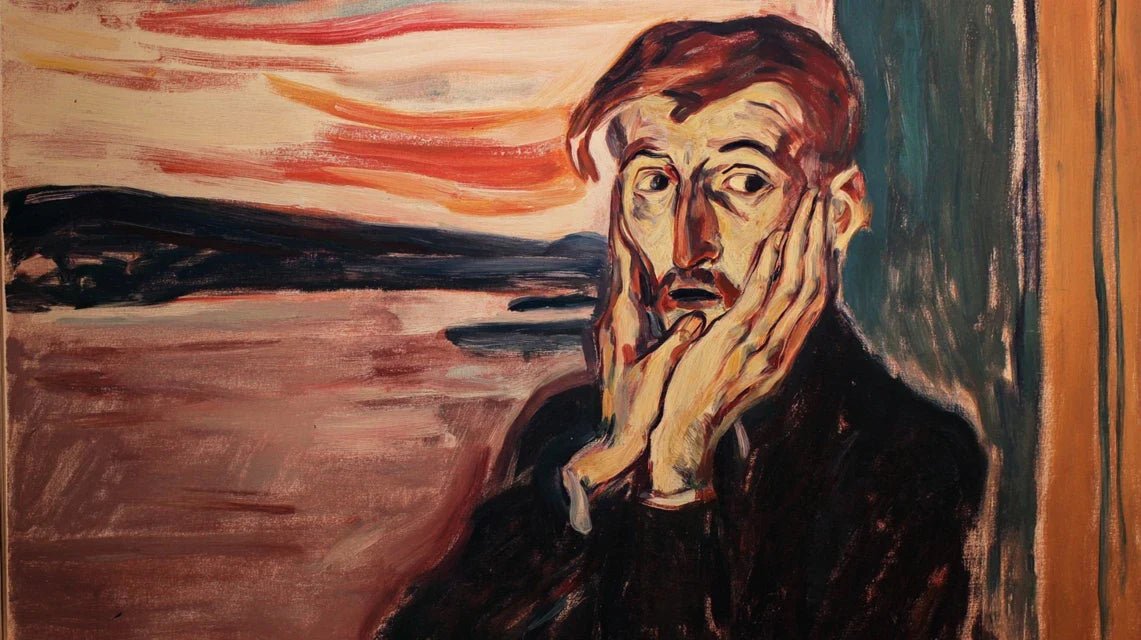
1893, Oslo. A man walks across a bridge overlooking the fjord, when suddenly the sky turns blood red and an infinite cry tears through nature. This shocking vision will give birth to one of the most iconic works of Western art: The Scream by Edvard Munch.
Behind this universal image of modern angst lies a man tormented by family illness, haunted by the premature death of his loved ones, but capable of transforming his suffering into an artistic revolution. Edvard Munch does not simply paint what he sees: he reveals the human soul in its most naked truth.
His life resonates strangely with our time: existential anxiety, urban solitude, psychological fragility. Pioneer of Expressionism, Munch invents a visual language that translates our deepest emotions with a striking modernity.
This biography reveals how a sickly child from Norway became the painter of the modern soul - discover the man behind the genius
Edvard Munch, the Melancholy Genius Who Revolutionized Modern Art
Understanding Edvard Munch is to delve into one of the most fascinating personalities of Western art. Far from romantic legends, the true story of this pioneer of Expressionism reveals a man of exceptional intelligence who knew how to transform his traumas into universal masterpieces.
| Biographical Highlights | Artistic Legacy |
|---|---|
|
Full name: Edvard Munch Birth: December 12, 1863, Ådalsbruk, Norway Death: January 23, 1944, Oslo, Norway Nationality: Norwegian |
Movement: Expressionism, Symbolism Style: Painting of the soul and anguish Key work: The Scream (1893) Innovation: Direct expression of emotions through color |
What makes Munch extraordinary is his ability to universalize suffering. Where other artists idealized reality, he chose to paint the invisible: anguish, melancholy, death. This audacity will make him the precursor of a major artistic revolution.
The Tragic Childhood of Edvard Munch: When Death Forges a Genius
In rural Norway in the 1860s, the Munch family embodies a provincial enlightened bourgeoisie. Christian Munch, military doctor, marries Laura Catherine Bjølstad, twenty years his junior, a descendant of wealthy farmers. Their son Edvard is born on December 12, 1863 in a farm in Ådalsbruk, surrounded by four brothers and sisters.
The founding drama of 1868: Edvard is only five when his mother dies of tuberculosis. This early tragedy marks his relationship with the world forever: "The angels of fear, sadness and death stood by me from the day I was born," he will later write.
After this first mourning, it is his aunt Karen who takes care of the children. Unlike the father, rigid and obsessed with religion, she encourages the young Edvard's artistic talents. But misfortune strikes again: in 1877, his beloved sister Sophie also dies of tuberculosis, at only fifteen years old.
Artistic revelation through pain: Often sick in the winter and absent from school, Edvard draws to pass the time. These hours of creative solitude, nourished by the fantastic tales of Edgar Allan Poe that his father reads to him, shape his macabre imagination and exceptional sensitivity.
At thirteen years old, a visit to the new Kristiania (Oslo) Art Association reveals his vocation. Discovering the works of the Norwegian landscape school, he begins to copy the masters and starts painting in oil. Art becomes his refuge from the anxiety of hereditary madness.
Edvard Munch and Norway at the End of the 19th Century: An Artist in His Time
Norway in the 1880s is experiencing a period of profound transformation. The country, long under Danish then Swedish domination, is seeking its national identity. In this context of cultural awakening, Norwegian artists oscillate between academic naturalism and the search for authentically Nordic expression.
In Kristiania, the capital undergoing rapid expansion, there is a conservative atmosphere impregnated with strict Lutheranism. It is against this rigid society that young intellectuals rebel, influenced by the ideas of Hans Jæger’s nihilism, a provocative mentor who advocates “painting of the soul” rather than imitation of nature.
In Europe, the years 1880-1890 saw the birth of new artistic movements. The Symbolism in France, with Gustave Moreau and Odilon Redon, already explores the territories of the unconscious. in Germany, the beginnings of Expressionism are emerging. Munch, through his travels, draws inspiration from these revolutionary influences.
Munch's genius in his time: While his Norwegian contemporaries still paint romantic landscapes, Munch anticipates that art must express the psychological upheavals of the nascent modernity. He foreshadows his time by developing a style that will not find full recognition until the 20th century.
This artistic prescience makes him a misunderstood visionary. His first exhibitions in Oslo provoke scandals and incomprehension, but also announce the emergence of a new art, freed from the constraints of naturalism and capable of expressing the modern soul.
The Troubled Beginnings of Edvard Munch: Between Incomprehension and Revelation
In 1881, against his father's will who destined him for engineering, Edvard enrolls in the Royal Drawing School of Kristiania. This decision marks the beginning of a period of family tensions and financial difficulties that accompany his first years as an artist.
His meeting with Christian Krohg, a respected naturalist painter, is decisive. This benevolent mentor obtains him a first scholarship and encourages him to develop his personal style. But it is the influence of the controversial Hans Jæger that truly liberates his creative potential.
In 1885, at the age of twenty-two, Munch paints his first major work: The Sick Child. This canvas, inspired by the death of his sister Sophie, innovates his technique. For the first time, he literally scratches the paint, creating a rough texture that physically translates the emotional pain.
The reception is disastrous. Exhibited at the Autumn Exhibition in Oslo in 1886, it provokes indignation from the public and critics. Munch is accused of not knowing how to paint, of scribbling on his canvases. This incomprehension deeply wounds the young artist but reinforces his conviction: art must express the intensity of emotion, not just reproduce appearance.
Fortunately, this difficult period finds its resolution with the obtaining of a state scholarship in 1889. This official recognition allows him to finally leave for Paris, where the influences that will definitively transform his art await him.
Edvard Munch, The Scandalous Art That Disrupts Bourgeois Europe
The year 1892 marks a decisive turning point in Munch's career. Invited by the Union of Berlin Artists to exhibit fifty-five of his works, he discovers that his art violently divides the German public. The exhibition, which was supposed to last a month, closes after only one week due to general outrage.
This "Munch affair" paradoxically contributes to his fame. The Berlin press attacks him, calling his paintings "the scribbles of a madman." But this controversy also attracts avant-garde artists who recognize in him a revolutionary of art. Berlin then becomes his second artistic homeland.
It is in the German capital that he develops his radical aesthetic philosophy. Frequenting the "Petit cochon noir" café, he mingles with an international bohemian scene: writer "August Strindberg," critic "Julius Meier-Graefe," and other intellectuals who share his subversive vision of art.
The doctrine of "painting of the soul": "Art is born of joy and pain, but above all of pain. It is born of human life," Munch declares in response to his detractors. This revolutionary concept places emotion at the center of artistic creation.
The Artistic Genius of Edvard Munch: Inventor of Modern Expressionism
The years "1892-1900" constitute Munch's creative golden age. Freed from the constraints of naturalism, he develops a revolutionary pictorial language that permanently influences Western art. His technique reaches an exceptional maturity, which places him on par with Europe’s greatest masters.
During this fertile period, he creates the works that will define his genius: "The Scream," "The Madonna," "The Vampire," "The Dance of Life." Each canvas explores an aspect of the human condition with unparalleled emotional intensity.
The Scream by Edvard Munch: Birth of a Universal Icon
In "1893", on the Ekeberg bridge overlooking the Oslofjord, Munch experiences what will give birth to his absolute masterpiece. "I felt an infinite scream passing through the universe and tearing nature," he notes in his diary. This traumatic vision becomes the universal expression of modern anguish.
Munch's Revolutionary Technique: Innovation and Expressiveness
Munch revolutionizes painting with his bold technical innovations. He scratches his canvases, exposes them to the elements in his "snow workshops," mixes paint, pastel and tempera to create unique textures. This anti-academic approach scandalizes but opens the way to modern art.
Munch facing his Contemporaries: Van Gogh, Gauguin and Toulouse-Lautrec
In Paris, Munch discovers the works of Paul Gauguin, Vincent van Gogh and Henri de Toulouse-Lautrec. These post-impressionist masters reveal to him the expressive power of color. But unlike them, Munch develops a more psychological approach, focused on exploring the unconscious territories of the soul.
His major innovation lies in his ability to visualize the invisible: the anguish becomes blood red, melancholy is tinged with deep blue, the passion ignites in incandescent yellows. This synesthesia between emotion and color heralds abstract expressionism of the 20th century.
OUR RECOMMENDED PRODUCTS
This intense period of creation establishes Munch as the undisputed pioneer of a new art, capable of expressing the psychological upheavals of the nascent modernity. His influence on subsequent generations will be considerable and lasting.
Edvard Munch, The Man Behind the Artist: Solitude and Intimate Torments
Munch's personal life reflects the obsessive themes of his work. Haunted by the fear of hereditary madness that affects his family, he develops a complex personality, oscillating between creative genius and psychological fragility. This duality constantly nourishes his art.
His tumultuous relationship with Tulla Larsen between 1898 and 1902 perfectly illustrates his relational difficulties. This passionate affair tragically ends with an accident: during a quarrel, a gunshot rips off a phalanx of his right hand. This traumatic episode reinforces his feeling of personal curse.
Munch deliberately cultivates his solitude, convinced that love and artistic creation are incompatible. "My art was born from my relationships with infinity," he writes, justifying his choice to remain single. This affective asceticism paradoxically fuels the emotional intensity of his paintings.
His bohemian lifestyle, his growing alcoholism and his repeated anxiety attacks testify to a personality in constant combat against his inner demons. These personal sufferings miraculously transform into universal masterpieces that touch all of humanity.
Edvard Munch, From Misunderstanding to Triumph: The Art That Changes Minds
Munch's recognition was established gradually at the beginning of the 20th century. After decades of controversy, the artistic world finally understands the revolutionary scope of his work. This late but lasting consecration transforms the former "cursed painter" in an undisputed master of modern art.
In 1909, his appointment as a knight of the Royal Order of Saint Olav marks reconciliation with his native country. This official distinction, received during his stay in a clinic to treat his depression, symbolizes the evolution of mentalities regarding his art long misunderstood.
The Spectacular Evolution of Prices: From Ostracism to World Record
Edvard Munch's price history perfectly reflects the evolution of modern artistic understanding. His works, once unsaleable, are now reaching historic peaks on the international art market.
| Period | Average Value | Sale Record |
|---|---|---|
| 1890-1920 (during his lifetime) | 500-2000 crowns | 5000 crowns (The Dance of Life, 1919) |
| 1950-1990 (posthumous recognition) | $50,000 - $500,000 | $2.2 million (Self-Portrait, 1989) |
| 2000-2025 (contemporary market) | $5 - $50 million | $119.9 million (The Scream, pastel 2012) |
This historic record of US$119.9 million reached in 2012 for a pastel version of The Scream definitively confirms Munch's status among the most sought-after artists in the world. This exceptional valuation finally rewards a genius long unrecognized.
Edvard Munch’s Death in 1944: Testament of a Visionary
Munch's final years, spent at his property 'Ekely' near Oslo, testify to a regained serenity. Installed there since 1916 in this creative retreat, the artist continues to paint with remarkable productivity, exploring new artistic territories until his death.
On January 23, 1944, Munch passed away peacefully in his Ekely home, a few weeks after his 80th birthday. His passing, during World War II, remained relatively unnoticed, but his artistic testament reveals the grandeur of his final gesture.
The Revolutionary Influence of Munch on Contemporary Art
Munch's legacy deeply permeates 20th-century art. His direct influence on 'German Expressionism' is undeniable: Ernst Ludwig Kirchner, Emil Nolde and the Die Brücke group explicitly acknowledge their debt to the Norwegian master. His technique of expressive deformation of reality becomes a fundamental principle of modern art.
More broadly, his impact extends to major artistic movements: 'American Abstract Expressionism' with Jackson Pollock and Mark Rothko, contemporary art with Francis Bacon and Lucian Freud. They all inherit his ability to translate pure emotion into pictorial language.
Recognizing Munch’s legacy today: Observe in contemporary art the expressive use of color, the emotional distortion of forms, and the exploration of psychological territories. These characteristics reveal the lasting influence of the Norwegian master on current creation.
Where to Discover the World of Munch: Museums and Global Collections
The new Munch Museum in Oslo, inaugurated in 2021, holds the largest worldwide collection of the artist with more than 1000 paintings and 15000 graphic works. The National Gallery of Norway exhibits the most famous version of The Scream. Internationally, the Museum of Modern Art in New York and the Tate Modern in London possess major works accessible to the public.
This international distribution allows each generation to rediscover the striking modernity of an art that has not aged. Munch continues to speak to our anxious era with a troubling relevance.
🎁 Special offer for readers
Because you took the time to inform yourself, enjoy 10% discount on your first order:
⏰ Valid 72h after reading • Applicable on all our products
Frequently Asked Questions about the Life and Work of Edvard Munch
Born in 1863 into a Norwegian bourgeois family, Edvard Munch grew up in an environment marked by illness and death. Tuberculosis claimed his mother when he was 5 years old, then his beloved sister Sophie at 15. These early traumas, combined with his fragile health which often forced him to stay in bed, led him to drawing and then painting. Encouraged by his aunt Karen, he found in art a way to express his anxieties and give meaning to his suffering.
Munch begins by copying Norwegian masters at the Kristiania Art Association, then studies at the Royal Drawing School. His real learning takes place with the painter Christian Krohg, who obtains a scholarship for him. His travels to Paris (1889-1892) reveal Gauguin, Van Gogh and Toulouse-Lautrec, whose expressive use of color he adopts. In Berlin, the influence of the nihilist Hans Jæger encourages him to develop his "painting of the soul", definitively liberating his personal style.
Munch revolutionizes art by abandoning the imitation of nature to directly express emotions. He scratches his canvases, mixes different techniques (oil, tempera, pastel), even exposes his works to the weather in his "snow workshops". This anti-academic approach physically translates psychological pain. His synesthesia between color and emotion (red for anguish, blue for melancholy) foreshadows expressionism and permanently influences modern art.
Munch's art clashes with the conservative mindsets of his time. His early exhibitions (Oslo 1886, Berlin 1892) provoke scandals and closures. He is accused of not knowing how to paint, of "scribbling" on his canvases. This misunderstanding can be explained by his radical break with dominant naturalism. His gradual recognition begins at the beginning of the 20th century, culminating in his appointment as a royal knight in 1909. Today, his works achieve world records, The Scream having sold for $119.9 million in 2012.
Munch's works are among the most expensive in the world. The absolute record remains the sale of The Scream (pastel version) for $119.9 million in 2012. The Young Girls on the Bridge reached $54.5 million in 2016. Major paintings are negotiated between $5 and $50 million, while prints and drawings remain more accessible ($50,000 to $500,000). This exceptional valuation reflects the late but definitive recognition of a genius long misunderstood.
Munch is considered the pioneer of expressionism and one of the fathers of modern art. His direct influence on German Expressionism (Kirchner, Nolde, Die Brücke) is recognized. He also inspires American abstract expressionism (Pollock, Rothko) and contemporary art (Bacon, Freud). His ability to visualize the invisible - anguish, melancholy, fear - opens the way for all psychological explorations of modern art. Even today, many artists draw inspiration from his technique of expressively distorting reality.
Edvard Munch, the Visionary Genius who Revealed the Modern Soul
More than a century after its creation, The Scream by Munch continues to resonate with a disturbing intensity in our anxious era. This iconic work is only the visible part of an exceptional artistic heritage that has transformed our way of conceiving art and expressing our deepest emotions.
The genius of Munch lies in his ability to have anticipated the psychological upheavals of modernity. His explorations of existential anguish, of urban solitude and of mental fragility speak directly to our time marked by stress and identity questioning.
Discovering Munch today means understanding that art can be a mirror of our inner torments but also a way to transcend them. His example teaches us that suffering can become creative when it finds a genuine and universal artistic expression.
Art as self-revelation: Munch invites us to face our own anxieties in order to better understand and overcome them. His work remains a valuable guide for navigating the emotional complexity of modern existence.