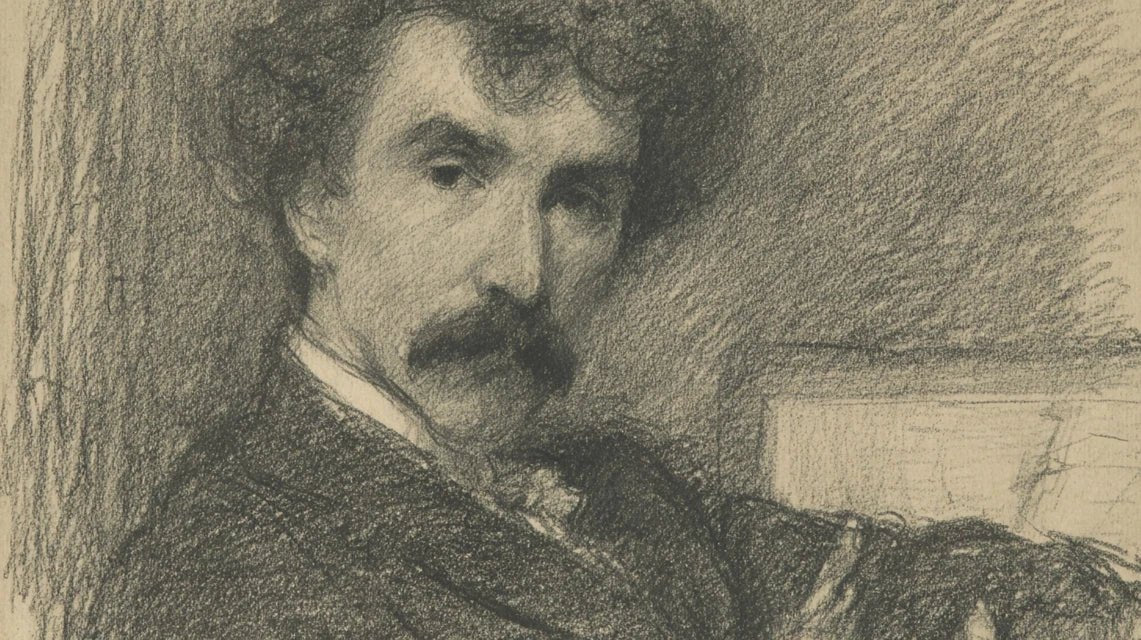
Imagine a man with a piercing gaze, a signature in the form of a butterfly with a dart, defying Victorian artistic establishment with his "arrangements" in grey and black. In London's fog of the 19th century, James McNeill Whistler revolutionizes Western art by transforming the nocturnal Thames into a visual symphony.
This American painter settled in London does more than just paint: he creates a new artistic language where music meets color, where Japanese art dialogues with Western aestheticism. His atmospheric nocturnes overturn an era that demanded realism and morality in art.
Pertinent to this avant-garde figure is a complex man, an obsessive perfectionist capable of restarting a painting twenty times to capture the essence of a fleeting moment. Whistler transforms the act of painting into a spiritual quest for pure harmony.
Discover how this aesthete of visual silence revolutionized our view of modern art and forged the artistic identity of two continents - a captivating biography of the man who painted the soul of the night.
James Abbott McNeill Whistler : the controversial genius of art for art's sake
Understanding James McNeill Whistler requires going beyond the legend to grasp the fascinating personality of the man who revolutionized Western art. Born between two worlds, trained by three cultures, this American painter forged his artistic destiny in the mists of London and the Parisian salons.
| Biographical highlights | Artistic legacy |
|---|---|
|
Full name : James Abbott McNeill Whistler Birth : July 10, 1834, Lowell, Massachusetts Death : July 17, 1903, London Nationality : American, naturalized British |
Movement : Aestheticism, precursor of modern art Style : Tonal harmonies, Japanese influence Flagship work : "Arrangement in Grey and Black No.1" (Whistler's Mother) Innovation : The "Nocturnes" and art for art's sake |
Beyond dates and titles, Whistler embodies the transition between traditional art and modernity. His revolutionary approach will forever transform our understanding of what a work of art can be.
The cosmopolitan roots of James Whistler : a childhood between three nations
James Whistler’s childhood unfolds in a unique international context that will shape his artistic vision. Son of George Washington Whistler, a renowned railway engineer, and Anna McNeill Whistler, he grew up in an educated and worldly environment.
The revelation of Saint Petersburg: In 1842, when the family moved to Russia for his father to oversee the construction of the St. Petersburg-Moscow railway, young James discovered European art and attended the Imperial Academy of Arts. This early immersion in Russian artistic culture awakened his aesthetic sensibility and gave him a taste for refined color harmonies.
The founding principle of harmony: From his earliest drawings, Whistler reveals an obsession with tonal balance and an intuitive ability to create musical compositions in painting. This synesthetic approach between visual art and music will become his artistic signature.
Whistler and His Time: Art at the Hour of the Industrial Revolution
Whistler’s era corresponds to a major transformation of Western society. The years 1850-1900 saw the emergence of an industrial bourgeoisie eager for art, while artists questioned the traditional role of painting in the face of photographic invention.
In Paris, where Whistler arrived in 1855 to study in Charles Gleyre’s studio, the artistic effervescence of the Second Empire was bubbling. The Universal Exhibition of 1855 revealed Japanese arts to the Western public, a discovery that would profoundly mark Whistlerian aesthetics.
His contemporaries include Manet, Fantin-Latour, Courbet, but also Baudelaire and Mallarmé. This generation revolutionized art by rejecting academicism in favor of a more personal and expressive approach. Whistler stands out for his search for pure art, detached from any narrative or moral function.
Victorian England, where he settled permanently in 1859, was experiencing a period of economic prosperity but moral rigidity. Art was still perceived as having to edify and instruct. It was against this conception that Whistler would lead his aesthetic revolution.
The aesthete facing the industrial age: Whistler perfectly embodies the artistic reaction to industrial modernity. Where others denounce or glorify progress, he seeks to create timeless and spiritual art, a refuge of pure beauty in a changing world.
This unique position allows him to dialogue with the French avant-gardes while developing a personal style that will permanently influence Anglo-Saxon art. His revolutionary approach to color and composition foreshadows the research of modern art.
Whistler’s difficult beginnings: between Parisian Bohemia and artistic quest
Whistler’s first years in Paris (1855-1859) are marked by financial precariousness and stylistic hesitations. As a student at the École des Beaux-Arts, he frequents the Latin Quarter and leads a typical bohemian life of artists his generation.
His early works, influenced by Courbet and the realist school, show an artist still searching for his way. “The White Girl” (1862), rejected from the official Salon, finds its place at the Salon des Refusés where it causes a scandal due to its revolutionary austerity and lack of clear narrative.
The most revealing episode of his determination occurs during his meeting with Gustave Courbet. The master of realism, charmed by the young American's talent, tries to influence him towards a social and committed art. Whistler resists and instead develops his theory of art for art’s sake, rejecting any utilitarian function of painting.
The formation of the “Society of Three” with Alphonse Legros and Henri Fantin-Latour marks a decisive turning point. This artistic alliance offers him crucial moral and aesthetic support in his quest for new art. Fantin-Latour immortalizes him in his “Homage to Delacroix” (1864), symbolically placing him alongside Manet and Baudelaire.
These difficult years forge his artistic character: obsessive perfectionist, he develops the mania of tirelessly reworking his paintings until he achieves perfect harmony. This extreme requirement explains the relative scarcity of his painted work but guarantees its exceptional quality.
Whistler the provocateur: artistic scandals and war against critics
Whistler’s combative personality emerges fully with his early successes. A cultivated dandy, a refined aesthete but an impossible character, he multiplies provocations against the British artistic establishment. His resounding statements make him the bad boy of the London scene.
The scandal surrounding "Arrangement in Grey and Black No.1" already reveals his revolutionary conception of art. When critics seek a symbolic meaning to this enigmatic female figure, Whistler retorts with contempt that his sole objective is color harmony. He renames the work “Symphony in White No. 1,” imposing his musical titles.
His haughty attitude towards the Royal Academy culminates with the 1872 exhibition. His "Arrangement in Grey and Black No.1" (portrait of his mother) narrowly escapes rejection. Furious at this near humiliation, Whistler slams the door on the official institution and develops his strategy of independent exhibitions.
The philosophy of pure art: “Art should be mixed with nothing else... Art should be independent of all talk, suffice for itself, and address only the artistic sense of the eye or ear.” This statement perfectly summarizes his revolutionary vision that foreshadows all aesthetic debates of the 20th century.
This permanent war against conservatives paradoxically forges his popularity among European avant-gardes. Mallarmé, Proust, Debussy see in him an essential precursor to artistic modernity. His polemics, compiled in “The Gentle Art of Making Enemies” (1890), become a major aesthetic manifesto.
Whistler’s Nocturnes: the revolution of atmospheric art
The 1870s mark Whistler’s creative peak with the invention of “Nocturnes,” a revolutionary series that transforms landscape painting. Settled in Chelsea, facing the Thames, he develops a unique technique to capture the nocturnal atmospheres of London.
The creative process of the Nocturnes reveals absolute perfectionism. Whistler sails on the Thames at dusk, meticulously memorizes the effects of light, then returns to his studio to recreate from memory the poetic essence of the observed moment. This revolutionary method privileges subjective impression over direct observation.
Nocturne in Blue and Gold - Old Battersea Bridge: the masterpiece of atmospheric art
This iconic work from 1872-1875 perfectly illustrates the Whistlerian revolution. The Battersea old wooden bridge, distorted and magnified, rises in a range of deep blues punctuated by glimmering gold. The influence of Hiroshige and Japanese prints blends with a Western sensibility to create an unprecedented pictorial language
The work transcends representation to become pure musical evocation. The spectral silhouettes on the bridge, the trembling reflections in the water, the suggested fireworks create a visual symphony where each element contributes to the overall harmony
The revolutionary technique of Nocturnes: painting the intangible
Whistler develops a personal medium blending copal, turpentine and linseed oil which allows him to achieve unprecedented transparencies. He paints on the floor to avoid drips, applying successive glazes with extreme finesse. His canvases, of a delicacy close to watercolor, require framing under glass.
Whistler facing his contemporaries: absolute originality
While Monet fragments light into divided touches, Whistler favors subtle blends and tonal harmonies. Unlike the French Impressionists who paint outdoors, he works from memory, creating more synthetic and spiritual works.
His meeting with Oscar Wilde in 1881 perfectly illustrates his unique position. The two aesthetes, friends then rivals, share the same conviction: art must be autonomous and create its own beauty. Their legendary exchanges of wit reveal two complementary conceptions of fin-de-siècle aestheticism.
OUR RECOMMENDED PRODUCTS
This aesthetic revolution places Whistler among the direct precursors of modern art. His research on nascent abstraction and the pure expressiveness of color foreshadows the avant-gardes of the 20th century.
The man behind the artist: Whistler between dandyism and melancholy
The complex personality of Whistler oscillates between the public arrogance of the dandy and the deep sensitivity of the artist. His tumultuous relationships with the women in his life shed light on the shadows of a man constantly seeking impossible harmony.
His relationship with Joanna Hiffernan, an Irish model who inspires "The Girl in White", reveals a passionate but impossible love. When Gustave Courbet also paints the young woman in "Jo, the Beautiful Irishwoman" (1866), Whistler experiences this « betrayal » as a personal trauma that leads him to hastily leave Europe for Valparaiso.
His late marriage in 1888 to Beatrice Godwin, the widow of architect Edward Godwin, finally brings emotional balance long sought. "Trixie", as he tenderly calls her, becomes his artistic and social confidante. Her premature death from cancer in 1896 plunges Whistler into a definitive melancholy that transpires in his later works.
This hidden vulnerability explains the obsession with perfection that characterizes his art. Unable to compromise in life as in painting, Whistler creates a total aesthetic universe where every detail contributes to the overall harmony, from his butterfly signature to the framing of his paintings.
Whistler's late triumph: from misunderstanding to consecration
The recognition of Whistler follows a chaotic path, marked by initial public misunderstanding and then progressive enthusiasm from enlightened collectors. The Ruskin trial of 1878, although financially disastrous, paradoxically establishes his international reputation as an avant-garde artist.
The decisive turning point occurs in 1891 when the French State purchases "Arrangement in Grey and Black No.1" for 4000 francs, a considerable sum. This official acquisition by the Luxembourg Museum definitively confirms his status as a major artist and launches his international market value.
The spectacular evolution of Whistler prices
The analysis of the Whistlerian market reveals a dazzling progression in his artistic valuation, particularly after 1890. His prints, initially sold for a few pounds, reach significant sums as early as 1900.
| Period | Average value | Sale record |
|---|---|---|
| 1860-1890 (lifetime period) | 50-200 guineas per painting400 guineas ("Arrangement n°1", 1891)||
| 1900-1950 (posthumous) | 500-2000 pounds8000 pounds (Nocturne, 1934)||
| Contemporary market | 2-10 million dollars40.5 million $ ("Harmony in Rose and Grey", 2019)
This spectacular evolution is explained by the progressive recognition of his pioneering role in modern art and the relative scarcity of his painted works. Today, major international institutions compete for his canvases during rare market appearances.
The end of an era: Whistler and the legacy of modern art
The final years of Whistler (1896-1903) are marked by a slowed production but of exceptional quality. A heartbroken widower after the death of Beatrice, he dedicates himself mainly to teaching and theorizing his art.
The opening of the Carmen Academy in Paris in 1898 reveals his desire to transmit his aesthetic vision. His classes, attended by young American and European artists, spread his theories on tonal harmony and the independence of art. His death on July 17, 1903 deprives the artistic world of an irreplaceable master.
Whistler's decisive influence on contemporary art
Whistlérien heritage permeates all of 20th century art. His concept of pure art directly inspires nascent abstraction: Kandinsky acknowledges his debt to the Nocturnes, Rothko draws inspiration from his color harmonies, Debussy translates his atmospheric research into music.
More subtly, his synesthetic approach between painting and music foreshadows contemporary research on total art. From current immersive installations to virtual reality experiences, the Whistlérien spirit endures in any approach aimed at creating pure sensory harmonies.
Recognizing the Whistlérien legacy today: Observe contemporary works that prioritize atmosphere over narrative, subtle tonal harmonies, titles evoking music. From James Turrell to Gerhard Richter, many current artists consciously or unconsciously perpetuate the aesthetic revolution initiated by Whistler.
The Musée d'Orsay in Paris houses “Arrangement in Grey and Black No.1”, an essential work to understand Whistlérien art. The Tate Britain in London possesses the largest collection of Nocturnes, including the famous “Nocturne in Blue and Gold - Old Battersea Bridge”.
In the United States, the Freer Gallery in Washington houses the “Peacock Room”, a complete interior decoration realized by Whistler, a unique immersive experience of his decorative art. The Detroit Institute of Arts exhibits “Nocturne in Black and Gold - Falling Rocket”, the work that triggered the historic lawsuit against Ruskin.
🎁 Special offer for readers
Because you took the time to inform yourself, enjoy 10% discount on your first order :
⏰ Valid 72h after reading • Applicable to all our products
Frequently asked questions about James McNeill Whistler
James Abbott McNeill Whistler (1834-1903) was an American painter mainly established in England, considered one of the precursors of modern art. Born in Lowell, Massachusetts, he grew up in Russia before studying in Paris and then settling in London. His importance lies in his aesthetic revolution: he was the first to conceive of painting as a purely visual art, detached from any narrative or moral function, foreshadowing abstract art of the 20th century.
Whistler's training combines three major influences: academic French instruction with Charles Gleyre, the discovery of Japanese art at the 1855 World Exhibition, and the influence of Courbet’s realism. He gradually develops his theory of "arrangements", titling his works as musical compositions ("symphonies", “nocturnes”, “harmonies”) to emphasize the primacy of color harmony over the subject represented.
The “Nocturnes” revolutionize landscape painting through their unprecedented atmospheric approach. Whistler does not paint from nature but from memory, after memorizing the luminous effects of the nocturnal Thames. He develops a unique technique mixing copal, turpentine and linseed oil to obtain subtle transparencies and blends. These works prioritize poetic emotion over faithful representation, directly announcing modern abstraction.
In 1877, art critic John Ruskin fiercely attacks "Nocturne in Black and Gold - Falling Rocket" in his review, accusing Whistler of “throwing a pot of paint in the public’s face” for 200 guineas. Whistler sues Ruskin for libel in 1878. Although he wins the trial, he only receives a farthing in damages and court costs ruin him. This historic trial marks a turning point in the conception of modern art and establishes the right of artists to experiment freely.
Whistler’s works today achieve exceptional prices on the international market. His major paintings sell for between 2 and 40 million dollars, the record being held by "Harmony in Rose and Grey: Portrait of Lady Meux" (40.5 million $ in 2019). His prints, more accessible, range from 10,000 to 300,000 dollars depending on their rarity. This exceptional valuation is explained by the scarcity of his painted work and his recognition as a precursor of modern art.
Whistler’s legacy endures in any artistic approach that prioritizes atmosphere over narrative. His research on tonal harmonies inspires artists such as Mark Rothko or James Turrell. His synesthetic conception between painting and music foreshadows contemporary multimedia art. More fundamentally, his theory of “art for art’s sake” establishes the principle of aesthetic autonomy that still underpins modern and contemporary artistic creation.
James McNeill Whistler: The Eternal Modern Who Revolutionized Our Gaze
More than a century after his disappearance, James McNeill Whistler continues to fascinate with his timeless modernity. This visionary aesthete understood before anyone else that art should no longer imitate but create, no longer tell but move. By transforming painting into visual music, he paved the way for all the avant-gardes of the 20th century.
His message resonates particularly in our image-saturated era: true beauty comes from harmony, not accumulation. His Nocturnes, absolute epurifications of pictorial poetry, remind us that the deepest art often emerges from depletion and suggestion rather than overload and explicitness.
The man who signed with a sharp-tipped dart butterfly embodied this duality perfectly: aesthetic delicacy and combative strength, extreme refinement and permanent provocation. This complexity makes him an artist eternally contemporary, capable of speaking to each generation that rediscovers his works.
Discovering Whistler means enriching your gaze: This alchemist of light teaches us to see beauty in subtle nuances, to hear the music of colors, to understand that true art always transcends its time to touch the universal. A lesson in aesthetics that definitively transforms our perception of the world.